Joieful Connections believes that children of all abilities should have the opportunity to attend college or other forms of higher education.
Unfortunately, college is often not accessible to students with disabilities. With disabled students making up 14% of public school students, with a total of around 7 million, it’s critical that this group has more support, so they’re able to pursue their dreams of higher education.
This scholarship seeks to support students with a diagnosis of developmental or intellectual disabilities so they can pursue higher education.
Any high school senior who has a diagnosis of developmental or intellectual disability may apply for this scholarship, but students in Oregon will be preferred.
To apply, provide a well-thought-out response to the three questions outlined in the essay prompt.
Selection Criteria:
Ambition, Need, Boldest Bold.org Profile
Essay Topic Requirements
Tell us about any experiences, challenges, or accomplishments that have helped you prepare for this journey toward higher education.
Please tell us specifically what subject or area you plan to study in school and explain why this field is important to you.
How do you hope to make an impact in your community or in the field you plan to study?
400–600 words
$25,000
5 winners, $5,000 each
Awarded
Application Deadline
Feb 15, 2026
Winners Announced
Mar 15, 2026
Education Level
High School
Share
Explore All Kinds of Scholarships for All Kinds of Students
I don’t wake up to a phone alarm like most people do, I wake up to my bed shaking and a screeching alarm that wakes the whole house. Every morning at 5:30 A.M., I start my day in silence, not by choice, but because at age two, I was diagnosed with bilateral sensorineural hearing loss. Over time, this progressed into complete deafness in my right ear and severe hearing loss in my left.
What many see as a disability, I’ve come to see as one of my greatest strengths. My hearing loss has shaped my identity and challenged me to build resilience, adaptability, self-awareness, and self-advocacy. Whether it’s pushing through the noise, literal and metaphorical, in sports, facing challenges in class, or advocating for myself in daily life, I’ve learned not just to hear differently, but to live differently.
Even though I’m Deaf/Hard of Hearing, my parents kept me in mainstream schools so I could learn to navigate real-world problems in a “normal” environment. As my hearing declined, the world around me became harder to decode. I learned to wear hearing aids and when I turned ten, I had surgery for a cochlear implant in my right ear. Even though I had amplified devices I understood sound, but not words. Conversations blurred into chaos. So, I adapted by learning visually, reading facial expressions, becoming fluent in lip reading, and developing a sense of observation. I did everything I could to blend in, and though teachers praised my speech and vocabulary and classmates saw me as “normal,” I often felt like an outsider to the hearing world, and I was.
I worked harder than my peers and learned to perform at my best. In the classroom, I stayed ahead. On the soccer field, I was fast and hyper-aware. I used my eyes to navigate and problem-solve, studying movements, reading lips, scanning environments. I learned how to thrive in the hospitality industry, where most customers never even realized I was Deaf unless I told them. I walked with confidence and held my head high, not just to be seen, but because I had learned to see the world in a unique way.
As I transition to college, Not just with pride in who I am, but with full confidence in how I navigate the world with a disability. I am a student-athlete with a 4.63 weighted GPA. I earned Student of the Year as a freshman and Student of the Month as a junior. I’m the varsity football team’s kicker and a two-time Varsity Hurdler of the Year since my sophomore season.
If you ask my teachers, counselors, or peers how they’d describe me, their answers would challenge most people’s assumptions about what it means to be Deaf. I’m not a stereotype, I’m a Christian, a Black student-athlete, a leader, and someone who just happens to be Deaf. I didn’t just “get by” with a disability, I learned to run with it, and to run with excellence.
I, Stephen Azaí Jameison, am taking the next chapter of my life as a college student attending Texas Tech University for Pre-Speech, Language and Hearing Science. My desire is to become an Audiologist and help advocate for those who can’t advocate for themselves. I am going to show the world that Deaf people can do amazing things and a hearing disability doesn’t mean we can’t achieve as much or higher than the world around us. I chose this route not despite being Deaf, but in full ownership of it. Because my difference doesn’t define my limits, it defines my strength.
Defying Expectations
By Roy D. Jones (Word Count: 491)
I was shackled with expectations of failure and mediocrity from a young age.
I was expelled from preschool when I was just four years old for hiding under tables (an early sign of a later autism diagnosis). My parents mourned. What sort of life could they expect for me if I couldn’t be successful at pre-school?
They didn’t, however, give up on me.
My parents moved forward in the best way that they knew by deciding to educate me at home. I hated my disability for a long time. I felt that it defined me by my limitations… as inferior, or less than. But, as I grew, homeschool gave me the freedom to pursue my unique interests and passions without regard to what might be considered “normal.” I have deeply explored areas of computer science, robotics, math, and electronic engineering and I began to take classes at the community college at the age of 15.
I also began to see my “disability” not as something wrong with me, but rather as something unique that informs my perspective. My journey now includes: serving as chair of the Pendleton Library Teen Advisory Board, serving on a curriculum steering committee for the Oregon Department of Education, winning 1st place in the calculus level of the regional high school mathematics competition, working as an engineering intern at the Pendleton Unmanned Aerial Vehicles Range, becoming team captain of my high school robotics team, and lastly, maintaining a 4.52 GPA (on track to become valedictorian of my high school graduating class).
I will always need to put in extra effort to compensate for my struggles in verbal and nonverbal communications. However, I also have learned to lean into my strengths. I have chosen to pursue a career as an Agricultural Robotics Engineer and to help farmers to use robotics to increase efficiencies to continue to feed the growing population. I have seen firsthand the work that our farmers give day in and day out to provide food for our country. I will give our farmers the tools that they need today to meet the demands of tomorrow.
By majoring in Computer Science and with a minor in Agricultural Entrepreneurship, I will build a strong foundation for this career path. I have chosen Eastern Oregon University because of its intimate classroom settings, professor availability, and endless opportunities for traveling off-campus to gain real world practical experience and dive into cutting edge research. The combination of these factors will help me to succeed as a unique individual with autism spectrum disorder.
Those administrators that expelled 4-year-old me from preschool so long ago could only see a problem child. They did not take the time to get to know or understand me. Their solution was exclusion. Through education and hard work, I have freed myself from expectations that I never chose. Now, I get to show them what I can do!
My name is Javier, and I live with cerebral palsy, a condition that has deeply influenced my personal, academic, and social life. Throughout the years, this experience has presented me with constant challenges, but it has also allowed me to develop a strong awareness of the importance of communication, inclusion, and accessibility. Living with a disability has taught me that the most difficult barriers are not always physical, but those that prevent people from expressing themselves, being understood, and participating fully in society.
From a young age, I have experienced how communication difficulties can lead to isolation and limit opportunities. At different stages of my life, these barriers have affected my access to education, employment, and community participation. I have witnessed how many people with disabilities are excluded not because of a lack of talent, effort, or ability, but because environments are not designed to meet their needs. These experiences motivated me to advocate for equal opportunities and the removal of communication barriers.
My interest in studying American Sign Language, commonly known as ASL, comes from my firm belief that communication is a fundamental human right. The ability to express ideas, emotions, and needs, and to be heard with respect and dignity, is essential for personal and collective development. Learning ASL represents much more to me than acquiring a new language; it is a powerful tool to connect communities, foster empathy, and build bridges between hearing individuals and the Deaf community.
I also believe that knowledge of ASL can benefit people with different disabilities who face communication challenges similar to my own. My long-term goal is to use this skill to empower others, support inclusion, and actively contribute to the creation of more accessible spaces. I aspire to work in educational, community, or social environments where inclusive communication is a priority and where everyone has the opportunity to participate equally.
Receiving this scholarship would be a transformative opportunity in my life. Access to quality ASL education can be financially out of reach, and this support would allow me to continue my studies without economic limitations becoming an obstacle. This opportunity would not only support my academic and professional growth, but it would also allow me to give back to my community by promoting greater understanding, empathy, and respect for diversity.
I consider myself a committed, resilient person who is deeply motivated to create a positive social impact. The difficulties I have faced have not weakened my determination; instead, they have strengthened my desire to be an agent of change. I strongly believe that investing in my education is an investment in accessibility, community empowerment, and social justice.
I envision a society where diversity is not seen as a limitation, but as a strength that enriches everyone. With the right support and the opportunity to continue learning, I am prepared to actively contribute to building a more inclusive, humane, and supportive environment. This scholarship would not only represent an important step in my personal development, but also an opportunity to create lasting social impact based on communication, inclusion, and mutual respect.
I am convinced that when one person receives support to grow, the entire community benefits. My commitment is to use every skill and piece of knowledge I gain with responsibility, ethics, and a strong sense of service. I want to be a bridge between people, cultures, and different lived experiences, demonstrating that accessible communication transforms lives, strengthens communities, and opens pathways toward a more equitable society. This is the inclusive future I strive to help build. Through education, compassion, and action, I will continue advocating for inclusion everywhere with purpose.
I died for the first time before I was even born. Delivered with my mother’s umbilical cord wrapped around my neck, I suffocated in the birth canal. Doctors resuscitated me after nearly four minutes with no heart rate or brain activity.
When I was revived, a part of my nervous system may have stayed on the other side. Psychologists and psychiatrists have attributed this to neural firing patterns that didn’t restart.
Numbers are like hieroglyphics to me, constantly shifting and inverting. Sights, sounds, touch, and space are processed so differently that I sometimes wonder if I’m still human. Diagnosed with a slew of disorders; including ADHD, Math Learning Disorder, I spent much of my life in therapy—behavioral, occupational and vision—trying to rewire my mind’s buggy hardware.
In first grade, I was the “weird” kid sitting on the “wiggle seat” in class. I hated those early years, filled with confusion, embarrassment, and a deep desire to fit in; overcoming challenges caused by my underdeveloped or damaged nervous system. Nothing seemed to work—until I found the ocean.
One day, catching waves with my dad, something clicked. With salt stinging my eyes, wind whipping my hair, and water stretching to the horizon, I stopped fighting the sensory chaos and surrendered. The ocean became my refuge. I’d surf before and after school, sometimes staying long after sunset, listening to waves lap the sand.
That peace inspired me to help others lost in their neural struggles. A few searches led me to Surf and Turf, a nonprofit using surfing as occupational therapy for special needs children. Each session is a chance to help kids connect with the ocean and draw strength from it. I guide them to ride waves and immerse themselves in the ocean’s sensations—the texture of sand, the salty air, the vast horizon. It’s transformative, empowering them to feel capable and confident.
At school, I pursued my passion for surfing by joining the surf team and becoming captain by senior year. Balancing the sport with academics challenged my overstimulated brain, but with coping strategies and determination, I thrived. Capturing footage of my teammates surfing also sparked my love of videography, which I plan to hone while studying cinematography in college.
Teaching young surfers has shown me that disabilities don’t define anyone. Whenever I capture footage for them, I frame shots to retain their agency. Seeing their confident faces as they watch themselves riding waves speaks volumes about cinema’s power to tear down stigmas.
Similarly, handing out meals to the homeless or working in domestic violence shelters in Mexico has taught me how deeply suffering is woven into the human experience. These encounters have inspired me to use my camera to examine systemic issues critically while giving people space to tell their stories in their own voices.
Taken together, these experiences have taught me the importance of empathy in my films. Every person I shoot represents a history of victories, struggles, and lived experiences. Whether capturing a beaming child standing on a surfboard for the first time or my weary grandma, it’s my responsibility to frame their stories with respect. By telling these narratives in all their complexity, I foster connection, understanding, and authenticity.
These differences once felt like obstacles, but they’ve shaped my success. I’ve competed as a surfer in the world’s surf mecca, made a positive impact in my community, created award-winning films, and launched a sought-after production company—achievements I never imagined as the “weird” kid.
Different doesn’t mean bad. It’s okay to be different. My life proves challenges can be overcome, and unconventional beginnings can lead to extraordinary success.
My name is Jorell Kalel Bond. Just so you know my parents are the Superman fans I'm more of a Batman fan. I would impact my community like Batman. I have no superpowers but I will bring inspiration and hope. Most people counted me out when I got diagnosed with Autism at the age of 2. My mom and dad have been married for 24 years and are my biggest supporters on this journey. I have One brother and 2 sisters and a nephew who are always helping me grow. I have former teacher like Ms Sharon who was with me for my entire elementary school learning and a huge support throughout my high school years.
I come from the roughest part of Chicago. Englewood. Where experiencing violence, hearing gunshots is part of the norm. My mom always says its not your zipcode that defines who I am but my love for life,compassion & understanding for others values,integrity and self love. It's difficult having Autism. Most people don't relate or understand me. I have been raised to be aware that the world will make little to no adjustments at all due to my condition. So I have to learn how to adapt and adjust while not losing my true authentic self.
Most people already believed that my parents would be taking care of me for the rest of their life. Yes I do require support in certain life skills but who doesn't. The only difference is I'm not afraid of knowing when to ask for help. I have a 4.0 GPA. I take create and make orders for the Coffee Club at my school. This has helped me develop skills in managing finances, currency, developing social interactions and cues.
I have impacted my community already. My peers,family and teachers say I'm inspirational. That I always find the joy in everything I do. That I keep my peers focused on projects. My family on routines like making sure we have dinner at the table every week day. My teachers how I accept all challenges with a can do attitude.
Most children and young adults like me have difficulties finding careers or even a job after high school. Going to college and being able to live away from home without any assistance?? That's even more difficult. But that has never stopped me.
The impact I will have on my community is hope, inspiration and determination. It's already happening. The people who just hang out all day on my block or who have been here for years. Admire and give me praise regarding my can do attitude and my determination to discover the world and make something of myself. Despite all the odds against me.
I got accepted to NLU college Pace program in Chicago. After I complete college I want to work in retail or security. I love interacting and meeting new people. Bringing awareness, being kind, inspirational and having hope. That's what I will carry on my utility belt for life.
Thank you for taking the time to read my essay. Have a great day.
I’ve never been the loudest in the room, but on my journey to higher education, I have learned how to make my voice count. Growing up with Autism, I faced challenges with communication, social interaction, and adapting to new environments. In second grade, I was reading at a kindergarten level and often felt left behind. But with the support of my family, teachers, therapists, and providers, I gradually developed the tools I needed to succeed. I learned to ask for help, manage sensory overload, and advocate for myself. By my junior year of high school, I felt like I was finally doing what I was capable of. I never gave up, and balanced varsity sports, including wrestling, football, and track, with rigorous coursework, which led me to received recognition as a 2024 Academic All Star. My experiences over years taught me one challenge at a time how to manage my time, prioritize, enjoy hobbies, overcome barriers, and learn how to thrive.
I don’t recall exactly when I first decided I wanted to become a lawyer, but I vividly remember my dream taking off in 8th grade when I had the opportunity to shadow a prosecutor at the Charleston County Solicitor’s Office. Walking into that courthouse, hearing the echoes in the halls, and watching the courtroom in action, I saw how law could be used to protect people’s rights and promote fairness. That moment showed me that the legal system isn’t just about rules—it’s about using structure to create change. I plan to study Law, Rights, and Justice in college to build a strong foundation in legal systems, public policy, and ethics. While I’m still exploring which type of law I’ll pursue, I know I’m drawn to helping others who feel unseen or underserved. Navigating education as a student with Autism and growing up at the intersection of multiple cultures has given me a deep appreciation for justice, equity, and inclusion. Studying law will allow me to turn that understanding into action.
I hope to make a difference by becoming a lawyer who challenges assumptions and advocates for more inclusive systems. My goal is to support and advocate for families, and communities navigating environments that were not designed with them in mind. Whether it’s in education, disability rights, or another area, I want to help others access opportunities, understand their rights, and feel empowered to speak up. I also hope to be a mentor and a role model for others who feel different or underestimated, showing them that their identities are strengths, not obstacles. In my community and future career, I want to use my experiences, education, and empathy to build a more equitable world where all voices are valued, and everyone has a fair chance to thrive.
In a world where everyone competes to be the best of the best, the top 1%, I have always strived to be average, to be part of the other 99%. But with a prominent hunchback and braces strapped to my legs, my ambition is quite ironic. Cerebral palsy has made my life anything but average. From navigating insecurities about my disability to overcoming learning difficulties, my personal and educational journeys have been marked with adversity.
Standing out requires minimal effort on my part. Growing up, I was constantly asked “Why do you walk that way?” to which my autopilot response was always “I was born this way” before forming an escape plan to avoid further questions. Teachers would learn my name through monthly doctor’s notes excusing my absences as I had to make the four-hour car trips to Shriners Children’s Hospital for new braces and muscle relaxants. Cerebral palsy made me far from the average classmate, but I was still fortunate to have a mild form of it. Yet, in a society that often measures disability by its visibility, I have fought with the insecurity of not being “disabled” enough for my struggles to be validated. While I am not in a wheelchair or fully mentally handicapped, abilities that others have taken for granted require extra effort on my part.
Similarly, my educational journey has been motivated by the desire to be average despite my challenges with cerebral palsy. As an advanced student, I have always excelled in my studies, continuously surpassing expectations from my parents and teachers. However, I have always had to work harder compared to my classmates to grasp the same material. The dissonance between my intellectual capabilities and my cognitive impairments often left me frustrated, but ignited a determination to bridge the gap between potential and reality. This has led me to outside opportunities to narrow the gap of support and resources for medically disabled people. I have worked with ESE children at my local church as a pre-k assistant and provided support to the patients and dedicated medical staff at Delray Medical Center.
Cerebral palsy has been most vital in fostering my passions in genetics and medicine. I have had the opportunity to witness not only the intelligence and compassion of the medical profession, but also the strength and gratitude of patients and their families. This has led me on a life-long mission to advocate against the negative misinformation of the medical industry and restore the humanization of the people working behind it. As a high school senior at the College Academy at Broward College, I have undertaken rigorous courses that will allow me to graduate with my Associates of Arts with my high school diploma.
Most recently, I have been admitted into the University of South Florida’s Biomedical Sciences program as a Presidential Scholar. After earning my bachelor's, I will decide my commitment to either genetics or pharmacy. But regardless of my choice, I intend to participate in research into advancements in biotechnology for under-represented medical disabilities. I am excited to begin this new part of my life and it would not have been possible without the resilience that my disability has instilled in me, along with the constant support from my family, doctors, and teachers. They have given me the mental strength to overcome my physical weakness and receiving the Joieful Connections Scholarship would allow me to show my appreciation towards those people and to carry on their legacies of love and acceptance to the future generations of people like me.
Thank you for your consideration.
I would like to start by introducing myself. My name is Caden Curry. I am originally from NY but have resided in South Carolina for 15 years. I began my schooling in this state and will complete it here as well. As a person, I am hardworking, focused, driven, and destined to achieve my goals in life. The only path forward to do so is attending college. For me, it was important to take that a step further and attend a 4-year university. Last fall, I submitted my application for admittance to Coastal Carolina University. This was the only school I applied to and had the faith in myself to get in. In November, I was elated when a piece of mail came from the university. As I was shaking, I opened the envelope and was overwhelmed that I had just received early acceptance into the university. Moreover, as I read the letter I saw that I was also recognized as being welcomed with a Teal Scholar title due to academic achievements. My mother was so shocked because she was nervous about me being dead set on one select school. I was driven by my goal to achieve what I have always wanted, I was able to attend a university, something no one in my family has ever done. I did this by hard work and overcoming so many obstacles in my way. This is where I recognized a huge problem, finances. My mother struggles with Multiple Sclerosis and is on Social Security. There is no way that she could afford the tuition, she was adamant that I do not get caught up in student loans. There was never a minute I was discouraged, instead I pushed further. I promised myself that under no circumstance would I give up my dream no matter what the barricade was. Throughout the year I have ground pavement and looked up every scholarship under the sun and my fingers got to work. Although I do not know being accepted for any of them, I have faith that it is my purpose on Earth to help people, and no matter what my faith would make a way because if you ask the universe for it, and you deserve it, it will serve it. Due to my struggle with mental health & physical health, I know adversity. It is my wish to help people with the same issues I have. The world dealt me a not-so-great hand medically. One of my medical conditions is that there is no other male living with it in the world. That will never stop my purpose to help ease the mental toll medical issues take on people like me. Yes, doctors may have the medical knowledge, if you are lucky enough, but don't understand how diagnoses affect people every day. Whether they struggle with complex issues like mine or are suffering from ADD, we all deserve the help. It is my passion to give a voice to the often voiceless. The need to destigmatize mental health issues, even some medical issues, has been vast in this country alone for so many years. Each generation tries or attempts to make this change but I think they are missing that certain something inside that makes you not give up, it's called being patient. With every fiber of my being, I know I will make a difference in this world through psychology no matter my approach to practicing it. So many people look at the financial aspect of college and give up, not me.
I am an athlete. I am an athlete who experiences cerebral palsy who has taken the disappointment of being cut from high school athletic teams due to my disability and turned the negative experience into what has been a life changing experience by focusing on my own personal development, both physically and mentally through weight training. I want to share this passion with others who are interested in changing the lives of people with disabilities.
I am passionate about business and sports management, and I want to combine both business and sports management with disability advocacy work to support businesses in becoming more inclusive for people who experience disabilities.
Ultimately, I would like to pursue my doctorate in business administration and work in the sports management industry. I want to work to create more inclusive environments for people who experience disabilities in sports industries to include amateur athletics, professional athletics, athletic clothing and footwear, and sports related industries. Part of my goal includes ensuring parents of young children with disabilities are educated on both civil rights and creating and fulfilling their child's dreams and their dreams for their child despite their disability. I want to be an advocate while pursuing my passions in an industry that I enjoy.
Despite my own physical disability, I was raised in fully inclusive settings, played sports with my non-disabled peers, and attended all of my classes in a general education classroom without ever being segregated because I experience a disability. I want to combine this important aspect with my love of sports and business. I am hoping to partner with companies such as Nike, Addidas, dress shoe companies, mainstream clothing companies, athletic training equipment companies, and even traditional corporate offices to ensure their facilities, products, and presentations are all inclusive for people who experience a range of disabilities.
I want to be considered an expert in the fields of disability studies and sports/business management. I would like to be a person who is consulted with in these fields by people who are in charge of making policies that impact the lives of people who experience disabilities. I want to ensure all people with disabilities have fulfilling lives without being held back by inaccessibility in areas that they shouldn't have to worry about being accessible, their everyday lives and activities. I want everybody to feel like their body belongs and they belong regardless of their differences.
When I was five years old I was diagnosed with a Non-Verbal Learning Disability (NVLD) and ADHD. This has impacted my ability to learn and function in the world in many ways. An NVLD is defined as a learning disability that causes difficulty with motor, visual-spatial, and social skills. Children with NVLD's are often well-spoken and can write well, but struggle with subtle social cues and comprehension of abstract concepts. This diagnosis has impacted me in many ways.
I had years of Occupational Therapy where we focused on fine motor skills, motor planning, hand-eye coordination, directionality, hand dominance and visual-spatial coordination. In school it impacted my ability to interpret symbolic language, such as interpreting maps, spatial relationships, geometry, math symbols, tracking words across the page while reading, graphing, and lining up numbers. In 4th grade I entered a school for students with learning disabilities where I learned study skills, reading decoding, Executive Function skills, writing, math and advocacy skills. I am now a Senior, in a mainstream public high school.
One of the key coping tools which have helped me has been music. Since I was a child, music has been a consistent force in my life and music has always been a safe haven that has given voice to my emotions and pulled me into the light of optimism and hope. Music has the power to resonate with anyone deeply, and where they are in their life. A talented artist can combine lyrics and melody in a way that creatively expresses emotions and connects with people on a deeply personal level. Music is not just my passion, it's my purpose.
It is my goal to pursue my lifelong passion for music in a career as a music industry professional. I am thrilled to have been accepted to Berklee College of Music's Industry Leadership and Innovation program in Boston, MA! This is a program that uses the model of ‘design thinking’ a hands-on approach to creating innovative solutions to solving problems. My degree will prepare me to take a strategic leadership role within the music industry readying me to identify new opportunities, develop innovative solutions to solve problems, and better meet the needs of both musicians and music-goers.
In my future role in the Music Industry, I hope to make an impact by providing a voice for new and emerging artists. Although it is easy for new artists to release their music, it has never been more difficult for fans to discover new music, and for newer and diverse artists to break through the noise. I hope to play a role in addressing these challenges, by developing approaches that expand accessibility for listeners of new and diverse music, level the competitive playing field, and create equitable revenue streams. If a young artist is looking to make their way, I hope that I will be able to give them a platform so that their voice can be heard too.
My last hurdle is trying to pay for this special opportunity. Receiving the Joieful Connections scholarship could literally mean the difference between my being able to attend college, or not. My parents drained much of their savings when they paid for the Learning Differences school, which was further exacerbated when my father's business closed during COVID. Thank you for this special opportunity and for your consideration.
How it works
Bold.org is Built to Make Scholarships Feel Possible
Step 01
Start with your story
Bold.org helps students show donors who they are beyond a transcript.
Step 02
Where scholarships are awarded
Every scholarship is funded by donors and managed directly on Bold.org.
Step 03
Fund your future
Scholarship dollars are disbursed through Bold.org to help students pay for school.
FAQ
When is the scholarship application deadline?
The application deadline is Feb 15, 2026. Winners will be announced on Mar 15, 2026.
How will scholarship application information be used?
Your privacy is a top priority on the Bold.org platform, and you can find our privacy policy in full here. You may opt out of communications from Bold.org at any time, and unless we’ve first notified you and gotten your consent, you’ll never receive communication from any third parties related to personal information you give us.
What is the scholarship award?
Award amounts per winner are designated by the donor. Check the award amount for a detailed breakdown.
When will the scholarship winner be chosen? How will they be notified?
The winner will be publicly announced on Mar 15, 2026. Prior to the announcement date, we may contact finalists with additional questions about their application. We will work with donors to review all applications according to the scholarship criteria. Winners will be chosen based on the merit of their application.
How will the scholarship award be paid?
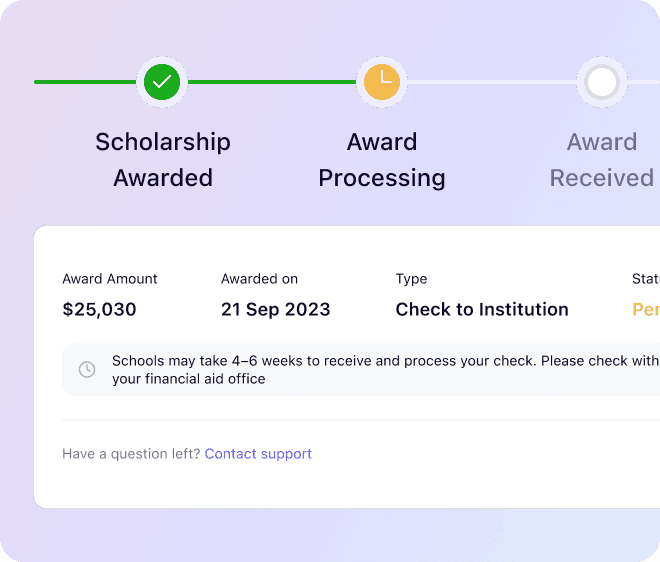
Award checks will be sent to the financial aid office of the winner's academic institution or future academic institution in their name to be applied to their tuition, and in the name of their institution (depending on the school's requirements). If the award is for a qualified educational non-tuition expense, we will work with the winner directly to distribute the award and make sure it goes towards qualified expenses.
How will my scholarship application be verified?
Before we award the scholarship, the winner will be required to confirm their academic enrollment status. Depending on the circumstances, verification of Student ID and/or their most recent transcript will be required.
How should I get in touch with questions?
If you have any questions about this scholarship or the Bold.org platform, just email contact@bold.org and we’ll get back to you as quickly as we can.
Does the scholarship have terms and conditions?
Yes. The terms and conditions for this scholarship can be found here.
97% of students don't win scholarships. We’re here to change that.