First or second-generation immigrant or other underrepresented minority
Education Level:
Field of Study:
Background:
Bachelor's or master's degree
STEAM
First or second-generation immigrant or other underrepresented minority
Access to higher education often serves as a barrier to success in the United States, with students underrepresented in academia struggling to catch up.
Having just one person pursue higher education can serve to elevate an entire family, but that possibility is being put further and further out of reach financially as college costs soar. Families that are new to America and those that have otherwise been generationally denied higher education face particular struggles when attempting to enter the collegiate space, furthering cycles of poverty and strife.
This scholarship aims to make college more accessible to students with no family background in higher education so they can have the same opportunities as their peers.
Any student pursuing a bachelor’s or master’s degree in a STEAM field may apply for this scholarship if they’re a first or second-generation immigrant or an otherwise underrepresented minority in higher education whose parents and grandparents haven’t attained the level of education being pursued.
To apply, tell us about your hopes and fears about pursuing college and how your background has affected your education and your goals.
Selection Criteria:
Ambition, Drive, Passion
Essay Topic Requirements
Write about your hopes or concerns about entering higher education as an outsider to the system. Specifically, how has your experience as a first or second-generation immigrant impacted your educational journey thus far, and how has it impacted your future goals?
Southern Connecticut State UniversityNew Haven, CT
With every school year comes the daunting process of applying for financial aid, which is even more challenging for first-generation college students. Having now completed my bachelor’s degree and preparing to pursue a master’s degree, I consider myself to be more adept at filling out financial aid forms and understanding government funding. However, my journey into higher education did not begin this way.
As a high school senior, I vividly remember the excitement of my classmates announcing their college choices, while I quietly worried about how I could ever afford mine. I came from a low-income family. My parents, both immigrants who never attended college, worked tirelessly in industries that did not require higher education. Despite separating when I was an infant, they both tried their best to provide stability. My parents could not provide monetarily or offer me financial guidance for college.
I still recall one evening, sitting in front of the FAFSA application with tears in my eyes. I had completed every section except one: my parents’ financial information. Asking my mother to provide this was an uphill battle. She feared that by entering her income, she would somehow be signing a loan in her name. For her, this was something she could not risk with poor credit and bills piling up. Her concerns were real: she wanted me to succeed, but she could not imagine taking on debt to make it possible.
My father was present, but his answer was no simpler. He insisted that using my mother’s information would give me better aid, while acknowledging that he could not fund more than a fraction of tuition himself. I felt trapped in a lose-lose situation, torn between their financial limitations and my dream of higher education.
At 17, I was already financially independent in many ways, but FAFSA rules did not recognize me as such. I tried explaining to my mother that entering her income did not bind her to loans, and that I could not apply as “independent” unless I was 24, legally emancipated, or met certain extreme circumstances. To her, this made little sense. To me, it was heartbreaking—my future felt like it hinged on bureaucratic definitions.
In the end, I managed to complete the process, but the struggle left a lasting mark. My parents feared loans would chain me to decades of debt. They encouraged scholarships instead, and while I applied to dozens, I received only one small award: $1,500 toward a $21,000 annual tuition bill. Still, with a patchwork of aid and determination, I made it through.
Now at 26, I am financially literate in ways my 17-year-old self never could have imagined. I understand my loan obligations and can navigate the aid process on my own. Yet, the burden remains heavy. I have been accepted to James Cook University in Australia to pursue a Master’s in Marine Biology beginning in January 2026. The program costs $31,000 per year for two years. While my parents now earn more stable incomes, they are still unable to contribute substantially, and I remain reliant on federal funding and scholarships to pursue my goals.
My experience as a first-generation student taught me resilience in the face of financial barriers. It also shaped my future goals: I want to succeed not only for myself, but to prove that higher education is possible even when the path is unfamiliar and intimidating. With this degree, I hope to continue my work in marine conservation and contribute to global solutions for reef restoration—work that will make my parents’ sacrifices worth every struggle.
I am five years old. Animated shows embrace my retina, filling with fantastic images and stories that are destined to shape my life. The intricate worldbuilding, complex characters, and valuable life lessons will make these programs some of the most cherished memories of my life. It showed me the power of animation and encouraged me to pursue it in the future.
I had no idea that the struggles that being black in animation would lead to, and how profound that would shape my journey.
At fifteen years, I started to study animation less as a hobby but more as an intense passion. I become familiar with techniques from famous animation books, become more interested in the process of animation filmmaking by studying documentaries and behind-the-scenes footage, and I begin to develop my storytelling through writing my own scripts. Initially, I believed these would guide me to an average yet successful career in animation yet as I began to learn more about its history, my path started to change.
Gradually, as I began to dive deeper into the history of animation, I noticed the prejudices and stereotypes that developed in the medium. Since its inception, animation has promoted derogatory and dehumanizing images of African Americans that represent the nadir of racial politics in America. I also noticed how limited the demographics of animation were for my race, with only 4% of animators being black, affecting my belief in my success. As an African American artist, I had to confront how my medium was used to degrade my race and culture, and it made me consider if it was right for me.
While these barriers should have slowed my progression, they instead invigorated me to pursue a more unconventional path in animation. I began to study films that had accurate cultural representation against mainstream works. My influences began to become more diverse as I became entranced by animators from Japan, Mexico, Africa, and other countries that showed the diversity of the medium. This led me to my decision to pursue a degree that combined learning animation production with learning the business side of the medium. The degree offered the opportunity to connect with like-minded studios and animators that promoted diversity both on-screen and off-screen, becoming aware of how to emulate their success in promoting inclusivity in animation.
At twenty-five years old, I started a business in racially diverse and animation powerhouse city of Austin, hiring minority animators from my internships and college as my first employees. Our goal is to create films that promote cultural acceptance, unity, and respect for others through our work. I hope they use their films to portray cultures, characters, and storytelling exclusive to their identities to create more powerful films. Instead of feeling like outsiders to the field, we are becoming at the forefront of the medium, winning acclaim for our culturally resonant films.
Even as an eighteen-year-old, I am working to develop a career in animation that promotes diversity and freedom of expression. Using networking, curiosity, and self-study, I am learning the skills that will be responsible for my future success in animation. Currently, I am joining organizations that focus on diversity such as Raider House Practicum to learn how to create diverse character representation. I have also become passionate about community service organizations like Habitat for Humanity that inspire me to pursue collaborative mindset, which is key to success in animation. Through it all, I am motivated to fulfill my childhood dreams and inspire the next generation to pursue animation by seeing their experiences replicated through this medium.
Columbia University in the City of New YorkNew York, NY
Winter is coming, and as I prepare for the season, I think of my grandmother’s patchwork blanket. My mom found it years ago while organizing the wardrobe—which was quite needed. Each colorful piece tells a story about my family in Barra do Chapeu, a small rural town in Brazil.
I see my life as a patchwork quilt stitched together from experiences that continue to shape my path as a first-generation student.
One piece of my quilt takes me back to my grandmother’s farm. After playing outside with my cousins, I would sit with my mom, carefully looking for ticks. It wasn’t until I became a young adult that I processed my mother’s fears. Years later, when Brazilian Spotted Fever (BSF) threatened the city where I studied, I couldn’t ignore the problem. Soon after, my school hosted a presentation from the Biological Institute of Sao Paulo (BISP) to explain the science and dangers of ticks. Could we make a trap to attract ticks? How could we neutralize them? The idea seemed impossible. But, I was curious.
I realized I didn’t have all the knowledge to address the issue either, but I wanted to learn. Working with biologists and friends, I led the Papa Tick project, creating a solution that can protect hundreds of people. I combined my experiences with electric fly swatters, prototyping, and solar panels to create a single system. That experience showed me how combining community expertise with initiative could yield meaningful results.
Another patch reminds me of my aunt Felina. She was building a house and needed help surveying the land. I arrived with a drone I bought with the money I had saved from being a tutor, and its sharp buzz startled the chickens. “It sounds like a bee,” my uncle joked, laughing as he watched it soar. “Almost, uncle—it’s a drone,” I replied, proud of how to use technology to solve real problems. With my knowledge of photogrammetry, I measured the land and captured aerial images for her.
That same problem-solving mindset guided me during one project last semester when I did landscape photography—but now in a different country. Moving to the US and studying in college alone was exciting and daunting. I didn’t want to feel reduced to a single “rural” patch from my quilt, yet I wanted to experience new moments. I sought what was familiar, tried to connect with like-minded people, and found a challenge where I could apply my passion for technology to have an impact. That’s when I spearheaded a solar system for a learning center in a secluded area with no electricity. My memories of life in Barra do Chapéu helped me see the bigger picture—thinking about maintenance, accessibility, cost, and the daily realities of people who needed the solution.
Today, I see a parallel as I explore the field of robotics. I’m stepping into uncharted territory, much like I did during the tick project. Back then, I leaned on biologists; now, I’m finding a new community of mentors and peers who share my interests. Last year, I took the initiative to found the Robotics Club— a place where I could teach about drones, robots, and new technologies. Through the club, I met people who have combined arts and music with robotics. With them, my biggest hope is to assist in developing technology and robots that can genuinely cooperate with humans in daily activities. Though I’m sometimes exploring these new places alone, I know I can always count on my family for support, just as they’ve supported every stitch of my journey.
University of California-Los AngelesLos Angeles, CA
How it works
Bold.org is Built to Make Scholarships Feel Possible
Step 01
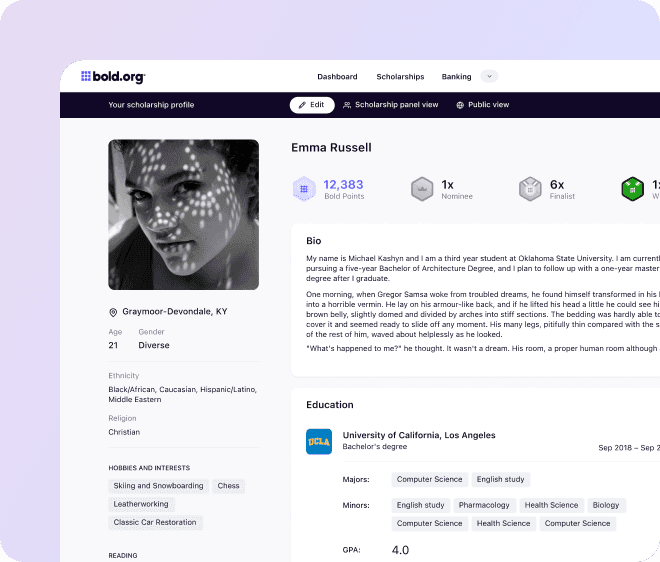
Start with your story
Bold.org helps students show donors who they are beyond a transcript.
Step 02
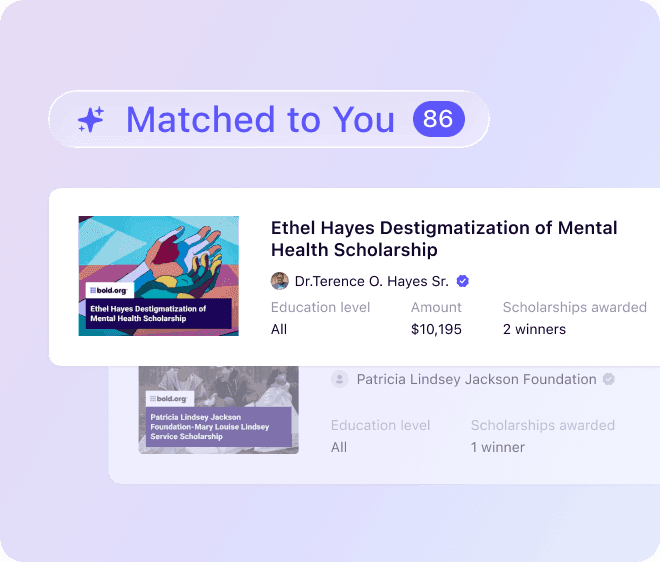
Where scholarships are awarded
Every scholarship is funded by donors and managed directly on Bold.org.
Step 03
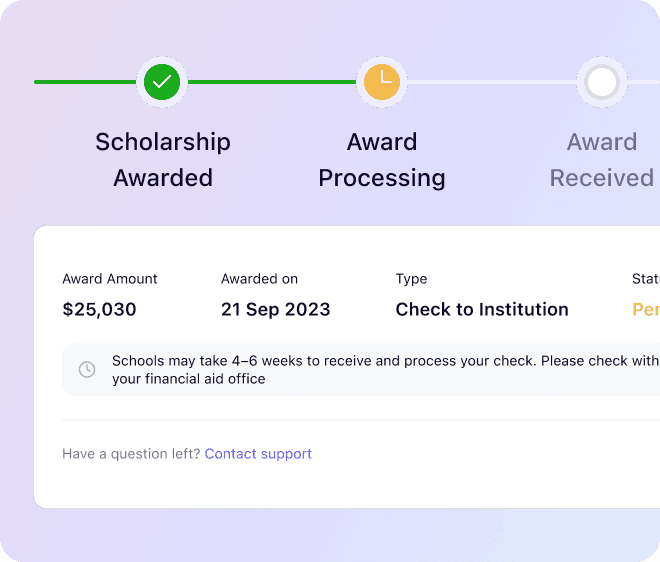
Fund your future
Scholarship dollars are disbursed through Bold.org to help students pay for school.
FAQ
When is the scholarship application deadline?
The application deadline is Nov 30, 2026. Winners will be announced on Jan 1, 2027.
How will scholarship application information be used?
Your privacy is a top priority on the Bold.org platform, and you can find our privacy policy in full here. You may opt out of communications from Bold.org at any time, and unless we’ve first notified you and gotten your consent, you’ll never receive communication from any third parties related to personal information you give us.
What is the scholarship award?
Award amounts per winner are designated by the donor. Check the award amount for a detailed breakdown.
When will the scholarship winner be chosen? How will they be notified?
The winner will be publicly announced on Jan 1, 2027. Prior to the announcement date, we may contact finalists with additional questions about their application. We will work with donors to review all applications according to the scholarship criteria. Winners will be chosen based on the merit of their application.
How will the scholarship award be paid?
Award checks will be sent to the financial aid office of the winner's academic institution in their name to be applied to their tuition, and in the name of their institution (depending on the school's requirements). If the award is for a qualified educational non-tuition expense, we will work with the winner directly to distribute the award and make sure it goes towards qualified expenses.
How will my scholarship application be verified?
Before we award the scholarship, the winner will be required to confirm their academic enrollment status. Depending on the circumstances, verification of Student ID and/or their most recent transcript will be required.
How should I get in touch with questions?
If you have any questions about this scholarship or the Bold.org platform, just email contact@bold.org and we’ll get back to you as quickly as we can.
Does the scholarship have terms and conditions?
Yes. The terms and conditions for this scholarship can be found here.