Harry Anderson was born in 1906 and attended a one-room schoolhouse in Greenwich, NY, with his brother and three sisters.
Upon graduation in 1924, Harry was accepted at Rensselaer Polytechnic Institute (RPI) in Troy New York and graduated in 1928 with a degree in civil engineering. He co founded Anderson's Dairy in Speigletown, New York with his brother Edward and later worked as an engineer for the State of New York.
Harry lived an interesting life with his wife, Lily, traveling to Europe, Egypt, Morocco, and all over the United States at a time when airline travel was rare. He built his own loom and wove his own cloth. Harry, or Andy as his family called him, was also a beekeeper and a master gardener and worked for the Rensselaer County Cooperative Extension to help spread agricultural knowledge.
This scholarship aims to honor the incredible life of Harry B. Anderson by supporting students who are pursuing careers in STEM.
Any female student who is in her second year or above of an undergraduate STEMdegree program and has at least a 3.5 GPA may apply for this scholarship opportunity. Applicants who have a completed Financial Snapshot as part of their profile are preferred. Applicants to previous iterations of the Harry B. Anderson Scholarship are encouraged to re-apply.
To apply, tell us about yourself and why you’re passionate about pursuing STEM and what your planned field of study will be and what you plan to do with it.
Selection Criteria:
Ambition, Drive, Passion
Essay Topic Requirements
Please tell us about yourself and why you’re passionate about pursuing STEM and what you planned field of study will be and what you to do with it.
400–600 words
$20,000
4 winners, $5,000 each
Awarded
Application Deadline
May 27, 2026
Winners Announced
Jun 27, 2026
Education Level
Undergraduate
Share
Explore All Kinds of Scholarships for All Kinds of Students
I am a chemical engineering student at Clemson University with a passion for using science to improve lives. I have always been drawn to STEM because it combines curiosity, problem-solving, creativity, and service. To me, STEM is not only about learning equations, reactions, or technical concepts; it is about using that knowledge to solve real problems and create something meaningful for other people.
My interest in STEM has grown through both my coursework and hands-on experiences. As a chemical engineering major with interests in chemistry, biomolecular science, and pharmaceutical development, I have learned to appreciate the connection between scientific discovery and real-world application. Chemical engineering challenges me to think critically about efficiency, safety, design, and accessibility. It has taught me to look at problems from multiple angles and to ask not only whether something works, but how it can be improved and made useful for others.
I am especially passionate about pursuing a career in pharmaceutical research and drug development. My long-term goal is to help develop effective and accessible treatments, particularly for communities that are underserved in healthcare. I am interested in the way chemistry, biology, and engineering come together to create therapies that can reduce suffering and improve quality of life. After completing my undergraduate degree, I hope to continue my education and eventually contribute to research that helps move better medicines from the lab to the people who need them.
My drive also comes from my experiences serving and supporting others. As a tutor for General Chemistry and Calculus, I have seen how powerful it can be to help students gain confidence in difficult subjects. Tutoring has reminded me that STEM can be intimidating, but it can also be empowering when students are given patience, encouragement, and clear guidance. In the lab, I have gained a greater appreciation for the persistence, precision, and problem-solving required in scientific work. These experiences have strengthened my desire to become someone who not only succeeds in STEM, but also helps make STEM more approachable and impactful.
What inspires me about Harry B. Anderson's life is the way he combined engineering, curiosity, creativity, and service. He was not only an engineer, but also a beekeeper, gardener, traveler, craftsman, and educator. His life reflected a deep commitment to learning and contributing to others. I hope to carry that same spirit into my own career by remaining curious, working hard, and using my education to serve people beyond myself.
As a woman pursuing a STEM degree, I know that ambition and perseverance are essential. My path has required discipline, resilience, and faith in the purpose behind my goals. I am passionate about STEM because it gives me the tools to address problems that matter. Through chemical engineering and future work in pharmaceutical research, I hope to help create treatments that are not only scientifically effective but also accessible, ethical, and meaningful for the people who need them most.
My name is Janelle Kennedy, and I am currently a psychology major at University of California, Berkeley with plans to attend graduate school and become a psychiatrist. I have always been interested in understanding how the brain works, how emotions influence behavior, and most importantly, how mental health affects every aspect of a person’s life. Over time, that curiosity grew into a passion for psychology and a desire to pursue a STEM career where I can make a meaningful difference in the lives of others.
What draws me most to STEM is the combination of science and real-world impact. I enjoy learning how scientific research and innovation can play apart in improving people’s lives, especially in the field of mental health. Psychology allows me to explore both the biological and social aspects of human behavior. In the future, psychiatry will allow me to directly help individuals through treatment, support, and advocacy. Mental health is often overlooked or misunderstood, particularly in underserved communities, and I want to be part of changing that by becoming a compassionate professional who helps people feel heard and supported.
My academic journey has prepared me well for pursuing a STEM field. In high school, I challenged myself through rigorous Honors and Advanced Placement courses, including AP Chemistry and AP Calculus, while maintaining a 4.3 GPA and graduating near the top of my class. Those classes pushed me to strengthen my problem-solving, analytical thinking, and time management skills. STEM subjects are not always easy for me, but I enjoy the challenge because they encourage growth, discipline, and perseverance. I believe that being successful in STEM requires determination and a willingness to continue learning, both of which I strive to demonstrate every day.
Outside of academics, leadership and service have played a major role in shaping who I am. I founded and served as president of my school’s Black Student Union, where I worked to create a supportive and inclusive environment for students. Through organizing events, mentoring peers, and encouraging discussions about culture and representation, I developed strong communication and leadership skills that I know will help me in my future career. My experiences showed me how important it is for people to feel represented, understood, and valued. This is something I hope to bring into my work in mental health care.
In the future, I plan to use my education to become a psychiatrist and work with younger people and families. I want to provide care that is not only scientifically informed, but also compassionate and accessible. I am especially passionate about reducing the stigma surrounding mental health and increasing access to care in communities where resources are limited. Beyond working directly with patients, I hope to contribute to research efforts that improve mental health education and treatment.
Pursuing STEM is important to me because it gives me the opportunity to combine science with service. Through psychology and psychiatry, I hope to make a lasting impact by helping people improve their mental well-being and empowering them to live healthier, more fulfilling lives.
For much of my life, I felt disconnected from both education and myself. I attended community college after high school, but lacking direction or confidence in my abilities, I dropped out—twice. After losing my father to an aggressive form of lung cancer in my twenties, I reached my lowest point. I believed I had already fallen too far behind to build a meaningful future and that I had wasted my life. Slowly, I began to rebuild myself with the reminder of how deeply my father believed in me. Eventually, I made the decision to believe in myself as well, no matter how difficult that initially felt. Returning to school after a seven-year gap was one of the hardest decisions I have ever made, but it ultimately saved my life.
When I re-enrolled at Modesto Junior College, I discovered not only a passion for STEM, but also a sense of purpose and belonging that I had not yet experienced. Physics especially captivated me because it challenged me to think critically, solve problems creatively, all while expanding my understanding of the world around me. What began as curiosity became something much deeper. STEM gave me confidence in myself and showed me that growth is possible at any stage of life.
As I became more involved in my classes, I realized that one of the most meaningful parts of STEM was not only conquering difficult concepts but helping others believe that they too were capable of mastering them. I began working as a STEM Peer Tutor and later became a Supplemental Instruction Leader for an introductory physics course, guiding students through challenging material and helping them build lasting confidence. This summer, I am proud to continue serving in both roles. Through these experiences, I learned how important patience, communication, and encouragement are within education, especially in subjects that many students find intimidating.
Wanting to create a stronger sense of community around science, I founded and became president of the MJC Science Club. What started as a small idea grew into an active organization focused on outreach, collaboration, and making STEM feel accessible and welcoming. I organized community science nights, educational events, workshops, and field trips that encouraged students and local families to engage with science in interactive ways. In 2025, our organization received my college’s Club of the Year award, an achievement that reflected our collective effort to build an inclusive and supportive STEM community.
Alongside these experiences, I was recognized for my academic work in physics and received the overall Physics Award at my college this May. While these accomplishments mean a great deal to me, the most important part of my journey has been discovering how education and mentorship can transform the lives of others, just as it transformed my own. I understand now that many capable students struggle not because they lack intelligence, but because they lack support, confidence, or representation.
I plan to continue my education in physics with the long-term goal of becoming a physics professor. I want to combine scientific research with teaching and mentorship, creating classrooms where students from all backgrounds feel capable of succeeding in STEM. I am especially passionate about supporting students who may feel uncertain about their place in higher education because I understand firsthand how life-changing support and community can be.
To me, STEM is about far more than technical knowledge. It is a way to empower others, strengthen communities, and create opportunities for future generations. Through teaching, outreach, and service, I hope to continue using STEM not only to understand the world, but to make it better however I can.
From the moment my grandfather asked me, “¿Voy a estar bien?” while we awaited his cancer prognosis, I knew that I wanted to dedicate my life to medicine. I was there as his translator, but in that moment, I felt helpless. I watched him struggle—not just against his illness, but against a lack of specialists, language barriers, and financial obstacles that stood in the way of care. That moment resonated with me, and it’s what drives me now to pursue a career in STEM where I can become part of the solution.
My passion for STEM comes from a desire to understand how things work beneath the surface, especially within the human body. I’ve always been fascinated by how biology, chemistry, and technology come together to fight disease and improve lives. As I grew older, this curiosity evolved into a purpose. Whether shadowing nurses in the emergency department, researching ways to improve student well-being through mental health initiatives, or helping young children in our hospital’s kindness program, I’ve seen firsthand how science can be applied with empathy to change outcomes. STEM, to me, is not just about problem-solving—it’s about using knowledge to heal, advocate, and transform the systems that fail too many. It’s about taking the pain my family once felt and turning it into progress for others.
This commitment to medicine led to my acceptance into the University of Arizona’s prestigious Accelerated Pathway to Medical Education (APME) program. Out of a national pool of applicants, only ten students are selected each year. The APME program offers a unique seven-year track that allows high school students direct and reserved admission into the University of Arizona Medical School. As an APME student, I will major in Physiology and Medical Sciences through the W.A. Franke Honors College while receiving personalized mentorship, early clinical experiences, and access to initiatives that address Arizona’s healthcare disparities. The program is designed for students like me, who are committed to practicing medicine in service to their communities.
Growing up in a rural, medically underserved border community has shaped my perspective and purpose. Beyond the classroom, I plan to join student organizations focused on medicine, science, music, and my Hispanic culture—each of which plays a meaningful role in my identity. I also hope to engage in research and community outreach programs that focus on closing the healthcare gaps that affect families like mine. My goal is not just to study science, but to apply it in ways that directly uplift the people and places that have shaped me.
Ultimately, I plan to become a pediatric oncologist. I’ve seen the impact of cancer up close and know how devastating it can be for families. My volunteer work in the emergency department and my involvement as Treasurer of Onvida Health’s Kindness Project have shown me the kind of physician I want to be: one who listens, empowers, and brings light to even the darkest moments. My long-term goal is to return to my hometown and open a practice that provides comprehensive, compassionate care to the community that raised me. I also hope to contribute to cancer research, advancing treatment and prevention strategies so fewer families have to endure what mine did.
For me, STEM isn’t just about science—it’s about service. My drive to pursue medicine is fueled by a desire to honor my family’s sacrifices and to make a lasting impact in the lives of others. Through the innovative field of STEM, I hope to be the kind of doctor who not only heals but also inspires change.
Hello, I am Dana Abbring. I am an introspective, intelligent, ambitious individual who works through God, my school, and community to make positive contributions to the world, doing everything with the intent to improve the lives of others (or improve my ability to improve the lives of others). I envision a future in which the lowly are lifted up and don't have to suffer, where we don't squander the Earth nor the limited time we have on it, and where we acknowledge all are loved. I can be quite stubborn in my pursuit of achievement and have never felt discouraged from trying something new, challenging my intellect, nor helping the world. Thus, I am determined to be a woman in STEM.
With my mind for math, curiosity for science, and fascination with modern inventions and technological advancements, STEM piqued my interest and got me excited to be an engineer starting in elementary school. I have been inspired by Thomas Edison, Marie Curie, and Shark Tank entrepreneurs to be an inventor, and explored such instincts by participating in Camp Invention (a program sponsored by the National Inventors Hall of Fame to encourage innovative thinkers) during two summers and being a counselor for a third.
Like Harry B Anderson, I love to travel with my family and have gone all over the United States. This past summer, I went to Europe for the first time; that opened my eyes to “normal” occurrences in America that, when viewed through an international lens, frame our United States as wasteful. Fast food chains serve plastic utensils, grocers bag 20 goods in 10 separate bags, and highways are littered. These are sad truths of my home country, and I want to change that through science, technology, engineering, and math.
I plan to study materials engineering, which creates and studies materials, then utilizes and manipulates what currently exists in the world to make something new and meet a specific purpose. I believe this is the career that will allow me to pursue my passion to not waste the Earth, but instead invent something new (or apply something in a new way) to make a positive impact.
I’m inspired by Harry B Anderson to use natural materials to create something homemade and sustainable. I love making do-it-yourself products that have a purpose and personal touch. In addition, I enjoy sharing what I know, and like Harry B Anderson I hope to spread my newfound chemical and material knowledge with the world so that others may make decisions that consider our limited resources and use them more efficiently and effectively.
Inspired by great scientists, inventors, and people like Harry B Anderson, I aspire to become a materials engineer and use my career in the STEM field as a force for positive change in society. Thank you for the opportunity to alleviate monetary worries from the work required to pursue my dream.
Ever since I was a little girl I have been fascinated by the way the world works around me. Throughout school, I always found myself drawn towards my science and math classes in particular. I'm one of those people who would rather sit and solve 100 math problems than write one research essay.
Growing up I had a lot of supportive people in my life who helped foster my passions. My mother in particular always believed in me. She always encouraged me to take difficult STEM based classes and would buy me books or rent me movies on the topics I found to be particularly interesting in my classes.
The older I grew the more my passion for STEM grew. By my first year of middle school I was positive that I would end up with a STEM based career. Throughout high school I took my time to explore a lot of careers in fields that interested me. Junior year of high school I read up on biomedical engineering and I just felt something click. The field seemed truly perfect to me, I would be able to do a job that I was passionate about while also developing things to help others.
My planned field of study is biomedical engineering. My dream job in this field would be to work with a company that makes artificial organs. A younger cousin of mine has been told that he will need a heart transplant when he is older. Discovering that led me down a rabbit hole of research surrounding organ donations and transplant lists and how people can spend their whole lives waiting for an organ that they will never receive. I would like to change that. My goal is to help make artificial organs more easily available to the public. I would like to develop artificial organs that are more affordable but still work well, because nobody deserves to spend their entire life hoping for something that they will never receive.
Overall, pursuing a degree in STEM is something that I have always known I would end up doing. I have always found myself fascinated by different STEM based ideas. A STEM based career field would allow for the perfect mix of all of my passions, such as seeing how things work and helping others. Growing up I have always searched for a career that I would enjoy, and I think I have truly found that with biomedical engineering.
How it works
Bold.org is Built to Make Scholarships Feel Possible
Step 01
Start with your story
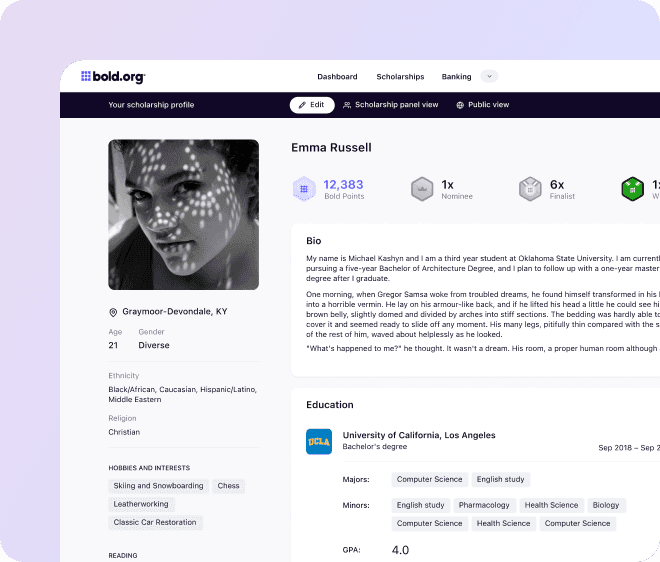
Bold.org helps students show donors who they are beyond a transcript.
Step 02
Where scholarships are awarded
Every scholarship is funded by donors and managed directly on Bold.org.
Step 03
Fund your future
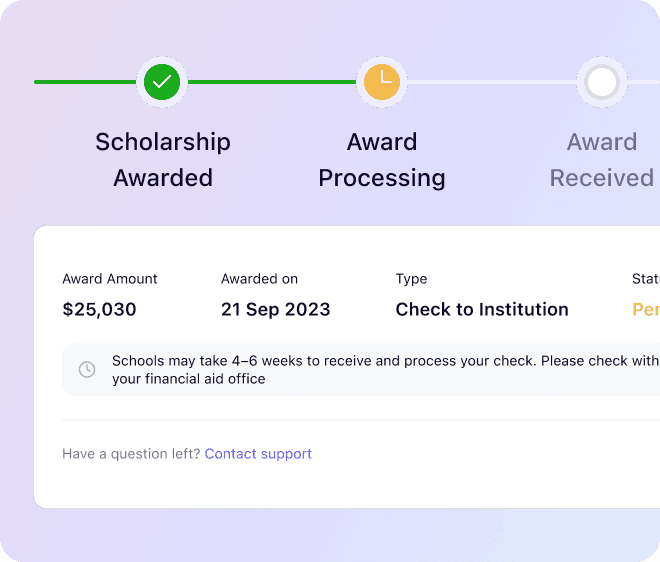
Scholarship dollars are disbursed through Bold.org to help students pay for school.
FAQ
When is the scholarship application deadline?
The application deadline is May 27, 2026. Winners will be announced on Jun 27, 2026.
How will scholarship application information be used?
Your privacy is a top priority on the Bold.org platform, and you can find our privacy policy in full here. You may opt out of communications from Bold.org at any time, and unless we’ve first notified you and gotten your consent, you’ll never receive communication from any third parties related to personal information you give us.
What is the scholarship award?
Award amounts per winner are designated by the donor. Check the award amount for a detailed breakdown.
When will the scholarship winner be chosen? How will they be notified?
The winner will be publicly announced on Jun 27, 2026. Prior to the announcement date, we may contact finalists with additional questions about their application. We will work with donors to review all applications according to the scholarship criteria. Winners will be chosen based on the merit of their application.
How will the scholarship award be paid?
Award checks will be sent to the financial aid office of the winner's academic institution or future academic institution in their name to be applied to their tuition, and in the name of their institution (depending on the school's requirements). If the award is for a qualified educational non-tuition expense, we will work with the winner directly to distribute the award and make sure it goes towards qualified expenses.
How will my scholarship application be verified?
Before we award the scholarship, the winner will be required to confirm their academic enrollment status. Depending on the circumstances, verification of Student ID and/or their most recent transcript will be required.
How should I get in touch with questions?
If you have any questions about this scholarship or the Bold.org platform, just email contact@bold.org and we’ll get back to you as quickly as we can.
Does the scholarship have terms and conditions?
Yes. The terms and conditions for this scholarship can be found here.
97% of students don't win scholarships. We’re here to change that.