Hobbies and interests
3D Modeling
Advocacy And Activism
Artificial Intelligence
Engineering
Data Science
Community Service And Volunteering
Coding And Computer Science
Human Rights
Machine Learning
Yoga
Writing
Math
Reading
Volunteering
Teaching
Public Speaking
Knitting
Cognitive Science
Coaching
Mental Health
Mentoring
Poetry
Spirituality
Singing
Social Justice
Research
Robotics
STEM
Reading
Leadership
Academic
Education
How-To
Literary Fiction
Adventure
Social Issues
Psychology
Romance
I read books multiple times per month
Hawa Nayaga
2x
Finalist1x
Winner
Hawa Nayaga
2x
Finalist1x
WinnerBio
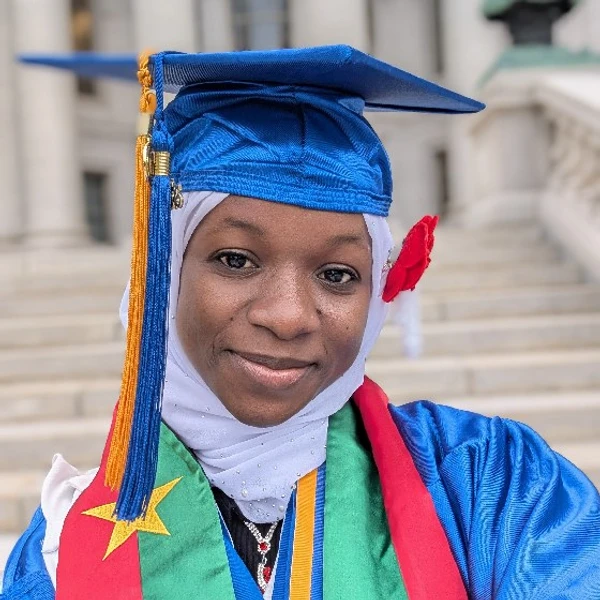
Hi, I am Hawa Nayaga, a recent graduate in Electrical Engineering and Technology from Madison College. Originally from Burkina Faso, I moved to the U.S. with a deep desire to use engineering to create solutions that uplift communities.
My academic journey has been driven by hands-on innovation: building microcontroller systems, FPGA-based circuits, and mobile-controlled devices fueled by a passion for access and equity. As Vice President of Fellowship for Phi Theta Kappa and Outreach Coordinator for Madison College’s Volunteer Center, I’ve led service projects, mentored peers, and connected students with opportunities to grow. My Honors Project focused on building low-power, offline communication networks for underserved areas in Africa.
I’m currently on my Optional Practical Training as an Automation Technician, planning to go back to school as a Junior Undergrad, diving into power systems and digital substation technologies, with a long-term goal of designing sustainable, impactful systems for the communities that need them most. Engineering, for me, isn’t just a career—it’s a calling to serve.
Education
Milwaukee School of Engineering
Bachelor's degree programMajors:
- Engineering, Other
- Engineering, General
- Electrical, Electronics, and Communications Engineering
- Electrical and Computer Engineering
- Computer Engineering
- Engineering Science
- Engineering/Engineering-Related Technologies/Technicians, Other
Miscellaneous
Desired degree level:
Bachelor's degree program
Graduate schools of interest:
Transfer schools of interest:
Majors of interest:
- Electrical and Computer Engineering
- Electrical, Electronics, and Communications Engineering
- Electrical/Electronic Engineering Technologies/Technicians
Career
Dream career field:
Computer Hardware
Dream career goals:
Engineer: Hardware/Software Integration, Electronics Design, Avionics, Medical Devices or Embedded Systems)
Automation Technician
Ultratec2025 – Present1 yearAssembly Technician
Orascoptic2025 – 2025Orientation Leader
School Student Life2025 – 2025Welcome Center Front Desk Attendant
Madison Area Technical College Welcome Center2023 – 20252 years
Sports
Volleyball
Intramural2025 – 2025
Research
Mechatronics, Robotics, and Automation Engineering
Madison College — Student2024 – 2025Electrical and Computer Engineering
Madison Area Technical College Honor Project — Honor Student2024 – 2024
Public services
Advocacy
Girls'Inc — Stem Mentor2024 – 2024Volunteering
The River Food Pantry — Customer Service / Talk to incoming People2024 – PresentVolunteering
Habitat for Humanities — Painter/Builder2024 – 2025
Future Interests
Advocacy
Politics
Volunteering
Philanthropy
Entrepreneurship
Eric W. Larson Memorial STEM Scholarship
I am writing this essay during my lunch break in the middle of a ten-hour shift. Around me, my coworkers are resting, but I am here, using every minute to fight for a future that still feels uncertain. I am the only female technician on a team of twelve, and every day I remind myself that I did not come this far just to stop here.
I come from Burkina Faso, where I am one of eight children. After losing my father at a young age, my mother was left to raise us on less than $60 a month. Education was never guaranteed—it was something I had to fight for. In a place where girls are often expected to follow paths that do not include higher education, especially in STEM, my dream of becoming an engineer felt distant. There were no role models to guide me, no clear path to follow. I built my journey from nothing but determination, studying with limited resources and holding onto the belief that education could change my life.
Through perseverance, I earned a scholarship through Leading Change Africa to study in the United States. Leaving my family behind was one of the hardest decisions I have ever made. I came alone, carrying not only my dreams but the responsibility to succeed for those who could not have this opportunity. At Madison College, I pursued computer engineering, balancing rigorous coursework with leadership and service. As Vice President of Fellowship for Phi Theta Kappa and Outreach Coordinator for the Volunteer Center, I worked to uplift others while striving to excel academically.
However, when my scholarship ended after my associate degree, I was forced into a gap year. I turned to my Optional Practical Training and worked full-time—often overtime—determined to save enough to continue my education. I pushed myself physically and mentally, believing that hard work alone would secure my future. Yet even after months of long hours and sacrifice, I now face uncertainty again. As an international student, I am limited to part-time work while expected to cover rent, food, tuition, and personal expenses. The savings I built are not enough to guarantee that I will finish my degree.
This is the reality I carry every day: working tirelessly, yet still unsure if it will be enough.
Despite this, I refuse to give up.
My passion for computer engineering is deeply rooted in my lived experiences. Growing up, I saw how lack of access to technology limits opportunity—how students without internet or resources are left behind, not because they lack intelligence, but because they lack tools. This is why I chose this field. I want to design solutions that close that gap. For my honors project, I developed an offline research server that allows students without reliable internet access to access educational materials locally. It was more than a technical project—it was personal. It was a reflection of the barriers I once faced and the solutions I wish had existed.
Beyond academics, I have worked in environments dedicated to improving lives through technology. I contributed to accessibility-focused innovations, including captioned telephones that help individuals with hearing loss communicate more independently. Being part of work that restores connection and dignity to others reaffirmed my purpose: engineering is not just about building systems—it is about serving people.
I have also dedicated myself to mentorship and community impact. I have mentored young girls interested in STEM, helping them see themselves in a field where they are often underrepresented. I have volunteered in food pantries and community service projects, understanding that impact begins with meeting people where they are. These experiences have shaped not only my skills, but my values.
My goal is to become an engineer who creates affordable, inclusive technologies that expand access to education and healthcare in underserved communities. I want to design systems that ensure that where someone is born does not determine what they can achieve. I want to be part of solutions that make opportunity accessible, not exclusive.
This scholarship would mean more than financial support—it would mean stability. It would mean the ability to continue my education without the constant fear of interruption. It would allow me to focus fully on learning, innovating, and giving back, rather than constantly questioning whether I will be able to afford the next step.
Every day, I carry both the weight of uncertainty and the strength of everything I have overcome. I am not asking for an easy path. I am asking for the chance to continue the one I have fought so hard to build.
Because for me, this journey is not just about earning a degree. It is about transforming struggle into purpose—and using that purpose to create a future where others no longer have to fight as hard just to be seen, to be heard, or to learn.