Janisse Berry Memorial Scholarship


Janisse E. Berry was a beloved mother, daughter, sister and friend.
It was her passion to help others, particularly those dealing with intellectual disabilities and mental illness. Mental struggles often go overlooked in today’s society, with few people understanding the severity of disorders like depression, bipolar, and schizophrenia. Mental health is often considered taboo to talk about, making many people too scared to have vulnerable conversations and attain the help they need. Therapy, medication, and other treatments can be truly lifesaving, and everyone should be encouraged to ask for assistance.
Education is the spark that unleashes a young mind and heart to dream and achieve. This scholarship seeks to honor the memory of Janisse E. Berry by supporting students and advancing educational equity.
Any Black, low-income high school senior in Maryland, Virginia, or Washington, D.C. may apply for this scholarship opportunity. Applicants who aspire to work in mental health or who have navigated mental health challenges in their own lives are encouraged to apply.
To apply, tell us about a time that shaped your motivation to pursue higher education and how that experience influences the kind of future you hope to create. You may also upload an image, whether you created it or captured it in a photo, that captures an aspect of your essay.
Describe a moment or experience that shaped your motivation to pursue higher education, and explain how it influences the kind of future you hope to create.
Explore All Kinds of Scholarships for All Kinds of Students
Winners and Finalists
July 2026





Winning Applications




How it works
Bold.org is Built to Make Scholarships Feel Possible
Step 01
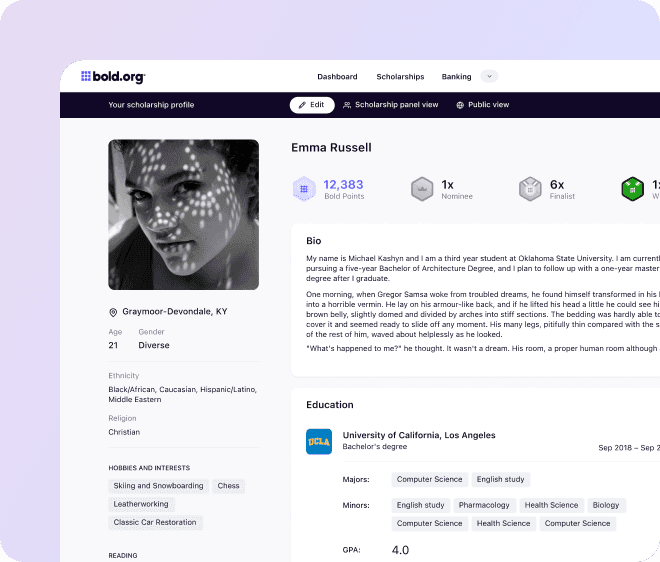
Start with your story
Bold.org helps students show donors who they are beyond a transcript.
Step 02
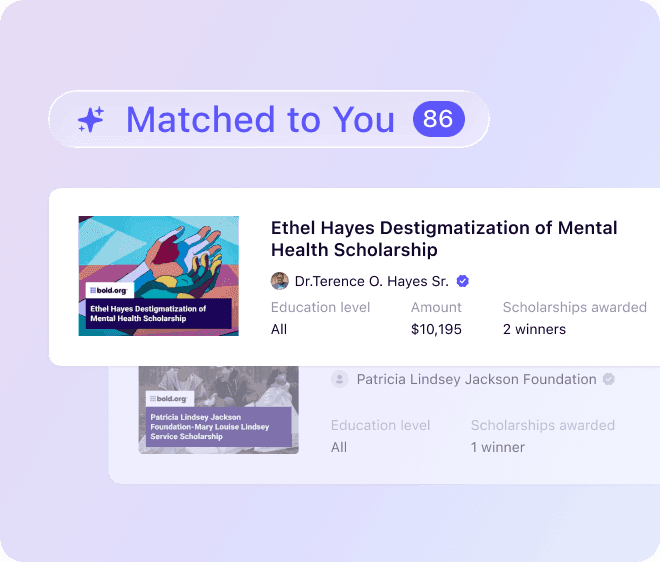
Where scholarships are awarded
Every scholarship is funded by donors and managed directly on Bold.org.
Step 03
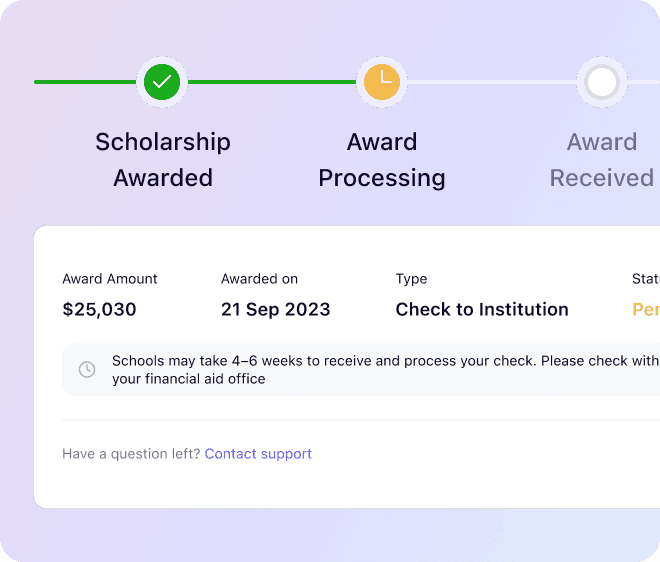
Fund your future
Scholarship dollars are disbursed through Bold.org to help students pay for school.
FAQ
The application deadline is Jun 11, 2026. Winners will be announced on Jul 12, 2026.
Your privacy is a top priority on the Bold.org platform, and you can find our privacy policy in full here. You may opt out of communications from Bold.org at any time, and unless we’ve first notified you and gotten your consent, you’ll never receive communication from any third parties related to personal information you give us.
Award amounts per winner are designated by the donor. Check the award amount for a detailed breakdown.
The winner will be publicly announced on Jul 12, 2026. Prior to the announcement date, we may contact finalists with additional questions about their application. We will work with donors to review all applications according to the scholarship criteria. Winners will be chosen based on the merit of their application.
Award checks will be sent to the financial aid office of the winner's academic institution or future academic institution in their name to be applied to their tuition, and in the name of their institution (depending on the school's requirements). If the award is for a qualified educational non-tuition expense, we will work with the winner directly to distribute the award and make sure it goes towards qualified expenses.
Before we award the scholarship, the winner will be required to confirm their academic enrollment status. Depending on the circumstances, verification of Student ID and/or their most recent transcript will be required.
If you have any questions about this scholarship or the Bold.org platform, just email contact@bold.org and we’ll get back to you as quickly as we can.
Yes. The terms and conditions for this scholarship can be found here.
