There are many ways to lead an impactful life that benefits others, but some of the easiest fields in which to help the world are teaching and STEM.
Teachers directly shape the leaders, thinkers, and artists of tomorrow, and educators can have a monumental effect on young people’s ambitions and self-confidence. While many STEM professions have a less hands-on approach to guiding the rising generation, they are critical in creating the progress and innovation that will be appreciated in the future. From developing vaccines, cures, and treatments to studying and combating climate change to designing useful products and beyond, STEM careers are the backbone of advancement.
This scholarship aims to support students who desire to make a difference in the world through their future careers.
High school students from the Greater Houston, Texas, area who are underrepresented in higher education or are first-generation college students are eligible to apply for the need-based Smith & Moore Uplift Scholarship if they plan to pursue a degree in Education or a Science, Technology, Engineering, or Mathematics (STEM) field.
To apply, tell us how pursuing an education or STEM-related career will prepare you to improve the world. Additionally, upload a portrait of yourself and a copy of your resume.
Selection Criteria:
Ambition, Drive, Impact
Essay Topic Requirements
How will pursuing a career in a STEM and/or education field allow you to benefit our society?
400–600 words
Attachment Requirements
Upload a portrait of yourself and resume.
File limits: 1–2 files
$15,000
15 winners, $1,000 each
Awarded
Application Deadline
Apr 26, 2026
Winners Announced
May 27, 2026
Education Level
High School
5
Contributions
Share
Explore All Kinds of Scholarships for All Kinds of Students
What drives me? A trust in science, steady and sure. Since childhood, curiosity pulled me toward learning - not fast answers, but slow truths uncovered through effort. That mindset didn’t just guide hobbies; it defined direction. Becoming a neurosurgeon isn’t merely one option among many. Rather, it reflects years of questioning, moments of doubt, attempts to grasp what lies beneath the skin and the mind, alongside a desire to help without grand gestures. The path fits because it grew from real weight, not ideals.
Growing up around many family members with various medical careers, I naturally developed an interest in the field. Over time, what I thought was a simple observation turned into genuine curiosity about a path to becoming a medical professional. Questions began popping up - why things worked, how bodies responded, what caused change. Wrestling with tough concepts wasn’t always smooth; confusion often lingered longer than clarity. At times, comprehension slipped away just as I thought I had it, leaving doubt behind. Still, these obstacles did not drive me from medicine - they drew me nearer. Learning, especially during hard moments, grew meaningful since each effort edged me toward supporting people. Though tough at times, progress felt purposeful when tied to care.
Witnessing illness firsthand reshaped how I saw life as a whole. Suddenly, the thin line between health and hardship became impossible to ignore. Life feels shorter once you have lived through its unpredictability. Medical progress stops being abstract when your survival depends on it. Moments filled with worry often carried quiet sparks of optimism - medicine offering a way forward. What emerged was a clearer conviction: advancement in care matters deeply because without it, options vanish.
What grabs my attention most is neurosurgery - it sits at the edge of medical complexity where outcomes can reshape lives. Since the brain shapes how we think, remember, and understand ourselves, working within it carries deep weight. The demand for accuracy pulls me in, along with the quiet intensity each decision holds. Success here does not depend on knowledge alone; instead, steady hands grow from persistence, long focus, and care learned over time. My path so far has shaped those traits without aiming for them directly.
One reason I see value in a STEM path - particularly medicine - is how it lines up with wanting to make a real difference. Change happens slowly, yet every step forward counts. Becoming a neurosurgeon could mean standing where science meets human need, moving discoveries ahead while being present during fragile moments. Not only healing, but showing someone else that uncertainty does not have to define their limits matters deeply. Moments of doubt used to shape my own view; now they fuel a quiet kind of hope.
Deep down, I’m certain my path involves supporting others. Beyond emergencies, it means offering hope, stability, something to believe in. The road hasn’t been smooth; clarity often felt out of reach. Still, each step brought me closer to intent, resolve, and a picture of what comes next. With medical training, impact isn’t limited by location - help reaches those needing even one small reason to stay standing.
Statistically, my story was told! It said I was born on the margin; destined to a life torn asunder by inequality, victimization, drug addictions and disparities to which I was to fall victim. Theoretically, my success was a gamble. But the true story was yet to be written.
I was born to parents who believed in love, education and the pursuit of excellence. We lived and thrived in Urban America, but we were not confined by the environment nor the stories others had written about us. Having lived in Abu Dhabi, Trinidad and Houston, Texas, I came of age with a contrasting worldview. Living in Abu Dhabi, no other kid in the foreign mall had the same kinks in their hair that I did. I was unmistakably noticeable. In Trinidad, I encountered cousins with Trini accents, divergent from my southern twang. Even living in Houston, I have always stood out. At my Spanish immersion school, I was the only black girl in my entire grade. Even so, I answered math problems with such ease in an unfamiliar language. I had become accustomed to being “the only one” in the crowd like me.
My story, written by a strong sense of self worth, exposure and perseverance fueled my desire to learn, hence my enrollment in Calculus BC my junior year. There were no other females in the class. Perhaps the boys felt odd at my being there, but I was not phased. I’ve since discovered a great power in being alone in the crowd, a rarity in my STEM educational experience. There, I discovered a new responsibility, to redefine the standard because visibility in and of itself is not enough.
I aim to break barriers and build bridges that rid our world of marginalizing and giving up on the “disadvantaged.” Too often, the voices of the marginalized communities are silenced due to lack of representation. But fitting into a mold is not a sustainable solution. The remedy begins by reshaping the mold, and ensuring that the bridge built allows others to follow. When I wrote and illustrated my children's book highlighting equity in STEM, my goal was to empower generations of minority students who felt different. For me, this wasn't merely a silly hobby. It was an engineering endeavor. I didn't just pinpoint a problem in society. I was designing a solution, one page at a time. Designing a setting where the characters lived in a society that would invest in them rather than disqualify them for their differences. A setting I hope will become the future.
As a Junior Servant Leader Intern with HYPE Freedom School, I was able to empower young scholars to become changemakers, believing they can exceed society's expectations of them. After committing to over one hundred hours each summer, I noticed the most introverted students were the most influential voices in the room. Playing a role in the blossoming of these scholars in both reading and self-esteem is the most impactful engineering I've ever done.
My vision for my future in STEM was crystallized at the Blacks at Microsoft Summer Mentorship Program. Not only did these professionals represent a future that was possible for me, but they also represented an attainable future for all of the kids I'd been mentoring thus far.
In spite of the accepted statistics written for me, I get to be the engineer of my own life. My vision is not driven by a need for recognition or notice, but by the desire to design solutions to make the unseen visible and unheard impossible to ignore.
Sitting bedside reading a book aloud to distract from the sounds of beeping monitors. A warm touch soothes a child's cry. Countless questions from families are met with clarity for their diagnosis. My heart beats for the field of nursing. Just as every rhythm ensures physical life, my passion will be the pulse for patient well-being. I plan to earn my Bachelor of Science degree in Nursing, ultimately starting my journey towards becoming a Pediatric Nurse.
Caring for others, especially children, has always felt natural to me. I have fond memories of bonding with my younger brother, Nicholas, where I would help him put his lego sets together. His excitement of starting a new project was sometimes met with sadness when the pieces would not fit. I had to teach him to remain calm, as we discussed how to find the solution. The warm embrace he gave me when we finished the project inspired me to become a passionate caregiver. Now as a Youth Volunteer at multiple churches, I find ease in building positive connections with children. Nurses are among the closest advocates for patients, where they respond to their most immediate needs and remain with the patient to ensure that they receive quality care. Whether it is greeting each child with a warm smile, celebrating the small wins of the day, or comforting campers when they are having a rough moment, I remain a dedicated advocate for children’s well-being and happiness, encouraging me to pursue a degree in nursing.
As a future Class of 2030 college graduate, I envision being one of the nearly 200,000 newly hired nurses that the Bureau of Labor Statistics projects are needed to enter the workforce by that time. Growing up as a minority female in an urban Houston community, I understand the importance of representation in healthcare. My goal is to provide personalized family-centered care in a clinic that nurtures underserved communities.
Keeping the lines of communication open and maintaining a welcoming bedside manner lie at my core to provide effective treatment for my future patients. Taking the time to support medical care can have profound effects on patient outcomes. Whether it is demonstrating how to use an inhaler or explaining when to use an EpiPen, these simple interactions can reduce unnecessary, and potentially expensive, emergency care.
I am also driven to foster a sense of trust beyond the clinical setting. A recent Bayer survey revealed that nearly 1 in 3 individuals avoid medical care due to fear or lack of knowledge. I want to eliminate this concern by also establishing mobile bus clinics in disadvantaged neighborhoods to educate families about health topics, such as nutrition, physical fitness, and mental wellness through school partnerships. I want to meet families in their own communities (especially since transportation is often a barrier) to support vaccinations, physical exams, and other preventative care services. Providing this reassurance in a medically hesitant society will result in better health outcomes for these children, thus positively impacting their lives.
The Smith and Moore Uplift Scholarship will allow me to afford the education needed to give back to my community, aligning me with the non-profit’s mission to change lives and increase the quality of life. Your financial support would provide additional time for me to gain clinical experience at hospitals and community centers near my college institution. I am fueled to make healthcare a promise for all, not a right for some. Your investment in my journey will bring me purpose to provide safer and more accessible healthcare, one child at a time.
As someone who was raised to love and treat others the way that I would love to be treated. I believe that it is my duty to give that same amount of care and kindness that I have received all of my life. In my mission of giving back, I believe that by encouraging others I can give them hope in times that it is most needed.
Throughout my childhood, I have always been heavily involved: I did sports, dance, I sang in the choir at church and learned how to play the Viola and Cello. I always had my hand in more than one pot. I have been an active member of my community. Helping in the best ways that I could. I've always enjoyed being busy. Having things to do kept me going, it opened my mind and helped me gain skills that will carry me through in the future. Being involved in all of these activities taught me life lessons that have prepared me for what is to come. Although doing all of these things at the same time wasn't very easy. It was important that I obtained the ability to sustain while living my life to the fullest. At times I felt like I was doing a lot. I eventually learned a valuable lesson, and that was to pace myself in order to maintain an equilibrium in my life.
In the second semester of my sophomore year of high school. I had a really bad knee injury, that required a knee reconstruction surgery. Immediately after, I went through intense physical therapy for nearly two years. I was limited to what I could do as far as capability, and it put me in a sad place. I was in a lot of pain and had little trust in how my physical therapy would help me. Though with a lot of faith and encouragement from my therapist, I improved a lot sooner than I believed that I could.
The same way that my therapist helped me, I want to help people find their next step in life. My plan is to pursue an education majoring in kinesiology then going on to grad school to become a licensed physical therapist. By studying bone structure and the way that muscles and tendons work together to mobilize our bodies. I can create exercises that will strengthen my patients' bodies, and build their confidence in their movement. Physical therapy is training the body to do what it is meant to do. It isn't easy, and it can be physically and emotionally draining. The transition can be overwhelming and takes time to get used to. But having someone who understands, and that can help you beyond the training aspect. Makes everything so much clearer and motivating. After experiencing what it is like to go through that process. I can relate to those patients as they go through their treatment.
As someone that has been a part of the STEM and P-TECH academy since the seventh grade. I have learned numerous ways that STEM impacts the world. To work in STEM, you have to have the passion for wanting to change the world and lives. STEM is all around us, and through research, innovation, and creativity. Those who work in STEM-related fields are tasked to find innovative ways to improve the quality of life. Just as my physical therapist encouraged me to Improve my quality of life, I would like to do the same.
Pursuing a career in a STEM field, specifically as an anesthesiologist, will allow me to serve others at some of the most critical and vulnerable moments of their lives. My desire to enter healthcare is not just rooted in science, but in compassion, resilience, and a deep understanding of what it means to endure and overcome hardship.
My name is Faith Idowu, and I am a proud Black Nigerian woman shaped by my faith, my family, and my love for basketball. From the age of four, sports have taught me discipline, leadership, and how to push through adversity. But the most important lessons I’ve learned did not come from the court—they came from my life at home.
Watching my mother work tirelessly as a nurse, often balancing two RN jobs while caring for our family, showed me what true service looks like. She gave everything she had to support us, even when life was overwhelming. Seeing her dedication to helping others during their most vulnerable moments inspired me to pursue a path in medicine. I want to provide that same sense of care, safety, and trust to patients who may be facing fear or uncertainty.
My experiences with family challenges, including navigating conflict and fear within my own home, have shaped my ability to empathize with others. I understand what it feels like to carry emotional pain while still trying to move forward. Through my faith, I’ve learned the importance of healing, forgiveness, and compassion—qualities that are essential in the medical field. As an anesthesiologist, I will be responsible not only for managing pain but also for reassuring patients and advocating for their well-being during procedures where they must place complete trust in their care team.
In addition, representation in STEM fields matters. As a Black woman pursuing a career in medicine, I hope to inspire others who may not see themselves reflected in healthcare professions. I want to help break barriers and show younger generations that their circumstances do not limit their potential.
Beyond the operating room, I hope to give back to my community by mentoring youth and promoting both education and wellness. Whether through healthcare or future community initiatives, I want to create safe, supportive spaces where others can grow and feel seen.
My journey has taught me that strength is not just about endurance, but about using your experiences to uplift others. By pursuing a career in anesthesiology, I will not only contribute to the advancement of healthcare but also serve as a source of comfort, representation, and hope for those who need it most.
Changing society has been my dream since I was young. I've seen countless examples of how negatively people can be treated especially coming from the STEM field. Let's face it, STEM has been used to produce bombs, bioweapons, harmful technology, and so much more to leave a stain on humanity. I believe though, that STEM is a tool. A tool like a hammer can be used to hurt someone just as much as it can be used to fix up a house. When I look at society, I see clearly that there are far too many people using STEM the wrong way. I would like to use STEM to help heal our society by providing a new wave of medical care.
My dream profession is to be an ophthalmologist. I have been lucky enough to have shadowed under one and seen how the profession works first hand. There is a surprising amount of the "T" and "E" from STEM used within this job. There are many complex and invasive operations that can be done to fix glaucoma, that now have a machine alternative that can leave much less damage and do a better job. What is so amazing to me about this is that about thirty years ago someone with macular degeneration would have needed lots of medical care and extensive surgery to do a minimal amount of fixing. In today's time, this type of treatment can be given so quickly that some patients can leave the clinic the day of the procedure and go to work the next morning.
I seek to be a part of moving society forward in this direction improving medical care infrastructure. As I go through my years in college, I am determined to study medical technology and engineering in addition to my studying of the eyes. I want to take this technology a step further so that a patient may not need invasive cataract surgery or have to take months of antibiotic medications to deal with some post surgery symptoms. I dream of being able to send a glaucoma patient home glaucoma free. My benefit to society will undoubtedly be a facilitation and implementation of the best and newest medical advancements for patients of all income levels, walks of life, and conditions. As I see so many patients a week with my mentor, I realize that some people simply don't have access to the same care. I want to bring that care to all people.
Should there be a machine that could do a typically invasive procedure, patient costs will go down, and suddenly a grandma on food stamps can get the same excellent treatment as a patient driving a BMW. I know without a doubt, my career in STEM will leave a long lasting and positive impact on society.
From my childhood, I had the desire to challenge myself and create change. I soon discovered that the interest would be engineering. I remember the rides to visit my Gma, falling asleep on the long car ride and knowing exactly when to wake up. The roads became bumpy and my mom suddenly anticipated potholes, driving slowly with caution. As I opened my eyes I saw streets and sidewalks filled with cracks. Being young I wasn't aware of this issue or how it could be fixed. However, in high school I began researching civil engineering and learned that low income communities are often not maintained with the same level of care. I discovered that land use polices and zoning regulations discourage investment, hindering economic growth and innovation. This has educated me on the potential challenges that I can face as an engineer. Despite this challenge, through the study of engineering I want to actually improve the environment where these decisions are made.
My passion for civil engineering comes from my desire to create meaningful change through innovation and problem solving. Engineering will allow me to use my knowledge and creativity to make structures that directly impact how people live, move, and connect. The community East Oakland has been a big part of my life with the generation before me growing up there and part of my family still living there. Over the years, I've watched how the community has been neglected, there was an absence of safe roads, maintained public spaces, and reliable infrastructure. But, as there's been a shift in people moving into these communities, nearby areas became rapidly gentrified, invested in, and cared for. Furthermore, while those areas have become the priority, other areas with cultural significance have continued to be overlooked.
With my studies, I hope to gain skills in structural design, construction and more where I can directly contribute to a diverse range of communities. Guided by principles of leadership and service, I plan to use engineering to address the inequalities in infrastructure positively impacting communities and changing the patterns that have caused communities to be neglected.
Ultimately I aim to reduce the likelihood of injuries caused by unsafe environments by creating stronger and long-lasting highways that are not prone to damage such as potholes. Rather than relying on temporary solutions, I will work to design structures that prevent damage and maintain long term stability. Through my education at a University, I hope to become an engineer that will make a positive impact on communities and professional environments.
For society to thrive, it must foster an environment where everyone has equal opportunities to succeed and where no one suffers in silence. I want to help ensure that our society benefits those who are currently suffering alone and to reach out with a helping hand.
In my own case, I witnessed my father’s unresolved brain trauma sustained in his final year of medical school cause him to degrade as time passed, with no solution but to hope he got better. Before I was even born, my life was drastically changing with the sequence of events my dad went through. His actions as an emergency medicine doctor, despite his hardships, would inspire me to follow in his footsteps. Even after he had another accident that caused two of his spinal discs to rupture, I saw him open his own clinic to be able to manage his injury better, yet still help people. I grew up playing behind the front desk, admiring his resilience, no matter how much he hurt.
However, life got the better of him, and he suffered yet another injury, confining him to a hospital bed in the center of my living room, as if life was ensuring I would never forget his misery. The multiple surgical failures from doctors who were not experienced enough and the constant hospital visits I witnessed as a kid made me realize my dad was only going to get worse as his condition progressed. As I overheard doctors telling my dad there was not much they could do, it revealed the gap in knowledge in the medical field regarding neurological injuries to me. Seeing the pain my dad endured both physically and mentally gave me the determination to make a change by helping people exactly like him, and to follow in his footsteps as a doctor.
I plan to major in neuroscience with the intention of becoming a neurosurgeon after medical school, and I will make a substantial impact on numerous patients and change how we perceive and treat neurological injuries. As I further my studies, I will gain an understanding of the mechanisms within the brain and examine the cognitive consequences of neurological conditions. By joining the labs of professors working in conjunction with nearby medical centers, I can witness the real care neurosurgeons take to help patients, as well as learn about the forefront of new medical treatments and the potential for improved care.
One thing in particular I wish to utilize is the brain’s unique feature of neuroplasticity, which is the brain’s ability to reorganize neural connections that may have been lost due to an injury. My father’s own injury is something that neuroplasticity has the potential to help amend. As a neurosurgeon, I want to apply modern techniques to help people like my dad and others. My own experience has given me a broader understanding of what it really means to be a doctor, from my father’s unwavering determination. I want to be part of the next generation of doctors who build on the mistakes of the past to usher in a future of care for everyone, no matter how impossible the condition seems to treat.
Today, it may not be possible to fix brain damage. Still, in a decade or two, I see myself as one of the people who contribute to solving a vital issue of humanity as a whole. I wish to spend my life committed to giving back, just as my dad did, and I want to inspire others to help me in this mission to uplift our society as a whole.
A career in nursing would give me the chance to be of service and have a positive influence on my society on a daily basis, while also improving people's health and overall quality of life. Nurses have an important place in the health care system because they are usually the people who spend the greatest amount of time with patients. In addition to assisting with treating diseases, nurses provide comfort, support, and reassurance to patients at some of the most difficult times in their lives.
By being involved in nursing, I believe that I am helping to improve people's health and, therefore, improving their quality of life. Nurses work with patients from infants to elderly people, and provide care to patients as they recover from illness or injury, and also assist them in preventing illness and injury. This is important because when a person is healthy, he or she can live a better life, go to school, work, and be a contributing member of society. By helping to keep people healthy, nursing also helps to keep communities healthy by ensuring that individuals have access to health care services when required.
Education is another method for the nursing profession to provide society with benefits. Nurses provide education to patients on how to manage their own health (for example, how to manage chronic conditions properly, take medications correctly, and make healthier lifestyle choices), which keeps patients from developing larger health problems in the future and decreases the number of individuals who seek emergency services.
Nurses also play a very important role in emergencies and in situations of public health crises (like natural disasters or disease outbreaks). During these situations, the nurse is usually one of the first responders, providing care to patients while at the same time maintaining control of the situation. This illustrates just how much nurses contribute to both the individual and society.
Nursing also provides a valuable service to society by offering emotional support. Many patients deal with fear, stress, and pain when dealing with an illness or injury; having a caring, supportive person to talk to, in addition to receiving the care they need, can make a tremendous impact on how the patient feels about their situation. This connection between a nurse and a patient is something that no technology can ever replace.
In conclusion, pursuing a career in nursing would enable me to provide substantial and meaningful assistance to people. Nursing is a profession where I can make a difference in life every day, by providing care and education to individuals and by enhancing the health of the community.
Pursuing a career in STEM will allow me to benefit society by addressing many challenges in the human body that affect families every day. My interest in the medical field comes from the personal experience of losing many of my loved ones to health struggles, and I want to use science to not only understand how the body works but also to create solutions that can save lives.
Growing up, I had many family members who suffered from many health issues, the majority of it being a variety of cancers. Watching them go through the pain, treatment, and the many moments where they were way too vulnerable, made me question what is going on in their body. Was their body falling apart? Was it fighting back too hard? Was that why my granny was so sick? Was that why my mom almost had to remove her ovaries? These questions were the cause of my decision to major in biomedical science because while I do want to know more about the human body, I also want to learn about every living thing and what causes to learn for the future.
By studying biomedical science, I hope to be a part of the research that can lead to better treatment and possibly cures for long-term illnesses. Many STEM careers play a big role in the advancement of healthcare, from developing new medications to improving tools. Through research and experimentation, I plan to contribute to the future discoveries that will reduce suffering and maybe even improve the standard life expectancy. I also want to make an impact through education and awareness. Many communities lack access to clear, reliable health care, which can delay diagnosis and prevent them from seeking help, including people who believe in anti-vaccine. With the number of people who aren't getting their children vaccinated, it can create a lot of outbreaks and problems. For instance, there could be a resurgence of the poliovirus, a virus that causes paralysis in children, a whole different kind that is immune to the vaccine that exists now. I wish that in the future I can use this knowledge to educate others about the importance of getting an early diagnosis, creating a healthy lifestyle, and having medical resources that are available for all. Because to me, everyone deserves and should have the opportunity to live a healthy life, and I want to be part of making that possible.
By pursuing a career in research science, I will be able to benefit society by gaining the foundation, resources, and education needed to not only show my abilities but also my passion for science and my love for learning. Science has always been my favorite subject. Even when I was a little kid, I always found a way to learn more about anything that interested me. Curiosity is a big part of my personality, and I truly thrive on fulfilling it, whether it is in a classroom through textbooks and curriculum or at home by reading articles, watching videos, and exploring related nonfiction books. I have always been interested in discovery and understanding how things work.
Last year, I took AP Biology, which further strengthened my enthusiasm for science. Every time we conducted a lab using microscopes or examined data from experiments, I felt very engaged in the activity. This is because I enjoyed the process of observing details, drawing conclusions, and connecting scientific concepts to real-world applications. These simple lab days encouraged me to want to spend my future doing something related to science, where I can actively explore, think, and make discoveries. I am a very driven person, and I am looking forward to bringing this into my future work.
Because of this passion and determination, I hope to turn my personal interest in discovery and innovation into work that creates real and lasting benefits for others. Many people do not realize that research scientists play a vital role in developing new technologies, improving healthcare options, creating stronger materials, and solving environmental problems. These contributions help make our community a better place to live, making it safer and allowing us to continue progressing for years to come.
Aside from this, I also want to inspire other people to develop an interest in science. This is important for the overall growth of STEM fields, especially for young women who wish to pursue STEM careers but lack representation. I want to be a role model who can inspire young people to develop an interest in science by sharing my experiences with them and helping them stay motivated throughout their academic journey. In this way, I can make a difference through my research work while also encouraging others to explore science.
Overall, a career in STEM will allow me to use my interest, determination, and passion for learning to make a difference in society.
From a young age, I have been curious about how things work. Whether it was exploring technology, asking questions about how everyday systems function, or participating in STEM activities, I have always been fascinated by how innovation can solve real-world problems. This curiosity developed into a strong passion for science, technology, engineering, and mathematics. Pursuing a career in STEM will allow me to apply creativity, critical thinking, and innovation to develop solutions that benefit society and improve others' lives.
STEM plays a critical role in addressing some of the most important challenges facing our world today. Advances in technology, engineering, and data science are transforming industries, improving infrastructure, strengthening cybersecurity, and creating tools that make our communities safer and more connected. By pursuing a career in STEM, I hope to contribute to the development of technologies that solve complex problems and help build a more innovative and sustainable future.
My interest in STEM has been shaped by hands-on learning opportunities and mentorship. One of the most influential experiences was my participation in the Girls Talk Tech Internship with ConocoPhillips, where I gained exposure to cybersecurity and technology development. During this program, I had the opportunity to learn directly from professionals in the field and see how technology is applied to solve real-world problems. Meeting successful women working in STEM, particularly women of color, helped me see the possibilities for my own future and reinforced my belief that diverse voices are essential in shaping the future of technology.
Another important influence has been the mentorship and leadership development programs I have participated in through organizations like INROADS College Links and Jack and Jill of America, Inc. These experiences have helped me understand the importance of leadership, community service, and giving back. Through workshops, service initiatives, and leadership opportunities, I have learned that success is not just about personal achievement but also about using knowledge and skills to uplift others.
One way I hope to benefit society through a STEM career is by expanding access to opportunities in science and technology for young people. Representation in STEM fields remains limited for many communities, and I believe visibility and mentorship can play a powerful role in changing that. By sharing my experiences and mentoring younger students, I hope to inspire the next generation to explore STEM fields and believe in their potential.
In addition to mentoring, I hope to work on projects that create practical solutions that benefit communities. Technology has the power to improve communication, increase efficiency, and provide tools that help people live healthier and more productive lives. Whether it is through developing new technologies, improving systems, or contributing to innovative research, I want my work to have a positive and lasting impact.
Ultimately, pursuing a career in STEM will allow me to combine my passion for problem-solving with my desire to serve others. By applying what I learn in college and throughout my career, I hope to contribute to innovations that strengthen communities, open doors for future generations, and create meaningful change in society.
I believe that my purpose is connected to making the world a better place. I believe that my experiences thus far have prepared me to take the next steps in finding and pursuing my purpose. And I believe that a successful STEM career will be a key factor in my journey.
I have attended 10 schools and lived in 5 different countries. In high school alone, I attended 3 schools in 3 different countries. With all the moving around, I had to become proficient in managing change. The key, for me, was balance. Sometimes I was genuinely excited about the changes, and other times I was petrified. I forced myself to see the positive aspects while keeping a grip on the reality that not all the changes would be pleasant for me. I leaned into opportunities to gain perspective from others’ points of view so that I could think about change in a balanced way. I watched as politicians, TV personalities, and social media influencers drove one-sided conversations designed to convince us that there was only one solution to every challenge. Anything mentioned on the contrary had to be completely flawed, as evidenced by efforts to quickly discount alternative viewpoints.
One thing the world needs more of is balanced thinkers, people who appreciate various perspectives and incorporate them as key decisions are being made. That’s why I am excited about my future career in STEM. STEM fields offer a problem solving process that seeks opposing data points so that the solution offered can be strengthened.
I plan to become a chemical engineer, concentrating in the energy field. I want to make significant headway with nuclear power. Through study and research, I hope to find ways for it to be more sustainable and safely executed as the world transitions its energy sources. I understand that there are both positives and negatives associated with all of the world’s options for energy sources. One “correct” solution cannot be our goal. The 7 years I spent living in developing countries have shown me that the loudest demands on energy policy are connected to how much access a nation has to energy resources and infrastructure. While energy-rich nations may desire to advance movement from fossil fuels to cleaner or renewable energy sources, energy-poor nations see access to reliable and affordable energy sources as the main goal. Based on their immediate needs, they are not as interested in the less-stable experimental stages of alternative energy.
My learned ability to understand various perspectives and represent them in a way that turns opposing viewpoints into stronger solutions will be needed as society continues the discussion around energy transition.
I look forward to being a necessary spark when our society is stuck with a hard problem, and my career in STEM will prepare me for this responsibility. The world is quickly evolving, and in 10 years, I want to be one of the reasons we’re not left behind.
Pursuing a career in psychology through the lens of both STEM and education is not only a personal goal of mine, but also a path I believe will allow me to make a meaningful impact on society. As an applicant to this scholarship, I am committed to using my education to help advance mental health awareness, improve education, and help others grow closer to Christ. Building a strong foundation in psychology, I aim to connect scientific research and what I have learned about human well-being, to help make a lifelong impact in the church, our education system, and society as a whole.
Although psychology is its own field of study, I do believe that is also a STEM discipline that applies scientific methods to decipher human behavior, emotions, and knowledge. By studying psychology, I will gain the skills needed to properly analyze intricate problems, conduct research, and find solutions that are backed up by data and theory. This scientific approach will be essential to fully understanding learning disabilities, designing intervention, and advancing mental health treatments so that they truly work. With the knowledge I will have from psychology, I will be equipped to ask critical questions, think analytically, and contribute to innovation in both education and healthcare. I am particularly interested in how psychological research can help improve the design of mental health programs in schools. In addition, I believe that the same research can help improve parenting and mental health programs for adolescents, where support systems are needed.
Not only is psychology connected to the STEM field, but it also serves as a powerful tool for change in the field of education. It enables educators to fully understand how different students learn, what motivates them to work harder, and how to create an environment where students have all the support that they need. As a student myself, I have witnessed the importance of mental and emotional support when it comes to finding success in academics. I believe that it is important that educators understand that all students are not alike. Many students come from various backgrounds, which means that some students may not understand the same teachings as their peers. I am passionate about becoming a professional psychologist who can advocate for students, help them thrive both in and out of the classroom, and encourage them to persevere no matter what the challenge may be.
Beyond these two fields of study, I aspire to take what I have learned about psychology and connect it to ministry. I believe that several of the topics that are discussed in psychology can be related to some of the teachings in the bible. Many individuals in society have a lack of knowledge about mental health and are misled when it comes to fully knowing Christ. I want to be able to share God’s love to many, while also informing our community on the importance of taking care of their mental and emotional health. With the help of this scholarship, I will be able to continue my education and advance my knowledge on my desired field of study.
Having the opportunity to receive this scholarship would not only ease the financial burden of higher education, but also enable me to pursue a career that is grounded in service, social impact, and scientific research. I am committed to using my education in psychology to bring a positive change in society by supporting individuals, improving learning systems, and helping people understand that they are loved by God. Thank you for considering my application and for supporting students who are ambitious about making a difference in communities.
One of my fondest memories in elementary school was when it was time for the
Scholastic Book Fair! In first grade, I bought a book called "Your Amazing Body." As I read the book, I was fascinated by how each organ had a specific role, yet all the organs worked together harmoniously to keep the body functioning smoothly. That moment sparked a curiosity in me that would grow into a lifelong fascination with how the body works. I plan to use my future education to empower people and change lives as a physician. By pursuing a career in medicine as an African-American woman, I have the power to inspire and encourage future generations to achieve their dreams.
Throughout my life, I have always wanted to be a doctor. People always ask,
"Clarissa, did your parents force you to be a doctor?" I always say no. Science has always interested me, particularly biology, human anatomy, and physiology. Knowing I wanted to be a doctor and enter a rigorous profession, I knew I would have to dedicate my time to working hard for the position. Throughout my elementary, middle, and high school years, I have devoted a tremendous amount of time to studying and making the best grades possible to further my academic career. Additionally, I attended DeBakey High School for Health Professions to gain experience in a medical setting, where I would eventually work. I shadowed physicians and healthcare professionals and asked them questions to learn more about working in the healthcare industry. I remember shadowing a general surgeon who calmly explained the surgical process to a 70-year-old woman. It wasn't just her knowledge that reassured the patient; it was also her compassion. That's the kind of physician I want to be: both knowledgeable and kind.
It is essential for me to give back to my community because it has gifted me with many
opportunities, so I'm not trying to reach the goal of becoming an anesthesiologist just for me, but for my community, too. Only 37% of anesthesiologists are women, and while shadowing at hospitals, I didn't see much female representation in the surgery rooms or the patients' rooms. I'm drawn to anesthesiology because of the focus and precision it demands. It's a field where you often meet patients at their most vulnerable moments before surgery, and I want to be the one who helps ease their fears and keeps them safe when they can't advocate for themselves.
I want the next and future generations to be exposed to diverse places, so when African-Americans or girls shadow or go on tours in the hospital, they will see someone who looks like them, and then they can say, "I can be whatever I want to be." I want future generations to be uplifted and confident that they can be anything if they work hard and break barriers. I want to show the next generation that no matter where you come from, you can chase your dreams and make them real.
Ranging from being the family babysitter, to volunteering at church on Sunday’s with little kids, I have always been a natural at communicating and bonding with the younger generation. As I further my education in the next four years, I have chosen to major in early education. Choosing this major stems from my passion for connecting with and positively shaping the minds of young children. I believe strongly that teachers in the earlier years play a crucial role in shaping a child’s future.
After 12 years and as a senior in high school, I still often think about my kindergarten teacher, Ms. Hlavaty, who took the time to bond with every student and even their families. She made each of us feel valued and created a nurturing environment where we were excited to come and learn at school. I hope to provide that same kindness and care she showed each day to my future students. In addition, my mom has also had a significant impact on my life, larger than anyone else. She is currently in her second year of teaching high school special needs and won LCISD Rookie Teacher of the Year last year. Watching her show patience, empathy, and dedication in helping her students reach their greatest potential amazes me every day. Even after a rough day, week, or month, my mom would never give up on her students and shows 100% commitment to them daily. Her passion for making a difference as a teacher sparked my desire to enter the education field.
In the past four years, I have gained many leadership skills through the extracurriculars and community service that I have been involved in. Throughout high school, I have demonstrated excellence in leadership and community service by consistently pursuing roles that allow me to positively impact others. One of these extracurriculars include my school's National Honor Society, where I participate in community service projects. Through this, I have strengthened my leadership, service, character, and scholarship by surrounding myself with a group holding similar values. I am also involved in the Peer Assistance Leadership (PAL) program which has further heightened my ability to serve as a mentor and guide to my peers. I help them navigate through personal challenges and learn the importance of building strong connections with others. Every Sunday, I volunteer at my church, working with children birth through five years old. This role has taught how to be patient, empathetic, and the significance of shaping our younger generation's minds through kindness and dedication. Creating a nurturing environment for these children fosters a sense of community.
Studying early childhood education will give me the tools and knowledge to create engaging and supportive learning environments. I want to foster a classroom that grows students’ knowledge but also invites curiosity and a love for learning. I am pursuing this major because I am passionate about creating a space where every child feels valued and understood. I aspire to shape the students of the future generation into strong individuals and make a lasting difference in each child. I believe in the power of connection and bringing people together to create a sense of belonging. This belief has shaped my values and my aspirations, including my goal of becoming an elementary teacher. I place a great value on building connections, so I understand the importance of fostering a sense of community in everything I do. As I begin my studies in college and begin my teaching career, I will continue to focus on creating meaningful connections in every aspect of my life.
Pursuing a career in STEM, specifically in cognitive science and neuroscience, will allow me to make a lasting impact on society by addressing disparities in healthcare and advocating for those who are often overlooked. As a future OB/GYN with a background in cognitive science, I want to improve reproductive healthcare, particularly for Black women, who face higher maternal mortality rates and systemic neglect in medical settings. Understanding how brain function influences behavior, decision-making, and patient care will allow me to provide more holistic and empathetic treatment.
Growing up in an underserved community, I witnessed firsthand how many people lack access to proper healthcare resources and education. My Nigerian parents immigrated to America to provide a better life for me and my siblings, constantly reminding me that I had to work ten times harder to succeed. Their sacrifices motivated me to pursue a career that honors their efforts and allows me to give back to my community. By studying cognitive science, I want to explore the relationship between brain function and human behavior. I will use this knowledge to address issues such as medical biases, mental health disparities, and how these factors influence maternal healthcare.
One of the biggest challenges in healthcare is the lack of trust between marginalized communities and medical professionals. Many Black women do not receive the care they need because their pain is dismissed or their symptoms are not taken seriously. Through my career, I hope to bridge this gap by conducting research that informs better medical practices and policies, ensuring that all patients are treated with respect and empathy. I also want to work on initiatives that provide more reproductive health and mental health resources to underserved communities, both in the U.S. and in Nigeria.
Beyond patient care, I believe representation in STEM is crucial. Black women are underrepresented in medicine, and I want to inspire the next generation to pursue careers in healthcare and science. By mentoring young women and advocating for STEM education in underserved communities, I can help create opportunities for those who may not have considered these paths before.
My involvement in community service has already given me a glimpse into how much impact I can have. Through volunteering at Fonde Recreation Center, mentoring kids, fundraising for my class, working with AliefVotes to promote civic engagement, and assisting with outreach at Second Baptist Church, I have seen how small efforts can create big change. I plan to continue this work by using my knowledge in cognitive science to advocate for better healthcare policies, increase awareness about the impact of mental health on reproductive health, and ensure that underserved communities receive the support they need.
Education has always been my way of pushing forward and breaking barriers. By studying cognitive science in college and eventually becoming an OB/GYN, I am not just achieving my personal goals—I am working toward a future where Black women receive the medical care they deserve, where underserved communities have better access to healthcare, and where more young Black girls feel inspired to enter the world of STEM. Science and education are powerful tools, and I intend to use them to leave a positive mark on society.
In an era defined by rapid technological advancement and complex global challenges, pursuing a career in Science, Technology, Engineering, or Mathematics (STEM), presents an opportunity to benefit society. The intersection of these fields not only fosters innovation but also equips individuals with the tools to tackle societal issues. By engaging in STEM education and careers, I aspire to contribute to a more informed and sustainable world.
STEM fields are at the forefront of addressing some of the most critical challenges faced by humanity today. For instance, as a future computer engineer, I would have the opportunity to design sustainable software as well as contribute to the future enhancements of the world’s technology. By developing new and more innovative ways to use technology, I could actively participate in the global effort to a more efficient economy. Moreover, advancements in software and technology can lead to breakthroughs in medical research, allowing for more effective treatments and improving the quality of life for countless individuals.
Education also plays a pivotal role in empowering individuals and communities. By pursuing a career in education within the STEM field, I aim to inspire the next generation of thinkers and problem solvers. Access to quality education in STEM subjects is crucial for fostering innovation and ensuring that all individuals, regardless of their background, have the opportunity to contribute to society. As an educator, I would focus on creating inclusive learning environments that promote diversity and encourage underrepresented groups to engage in STEM. This effort not only enriches the learning experience but also broadens the perspectives and ideas that drive innovation.
STEM education inherently promotes critical thinking and problem-solving skills. These skills are vital not only in scientific and technical contexts but also in everyday decision-making. By teaching students how to approach problems methodically, analyze data, and draw conclusions, we equip them with the abilities necessary to navigate an increasingly complex world. As a future educator, I would emphasize project-based learning and real-world applications of STEM concepts, allowing students to see the relevance of their education in addressing societal issues.
In conclusion, a career in STEM and education offers a unique platform to make a meaningful impact on society. By addressing global challenges, promoting equity in education, encouraging critical thinking, and fostering collaboration, I aspire to contribute to a more informed and resilient society. The potential to inspire and empower future generations is both a privilege and a responsibility that I take seriously. Through my dedication to STEM, I aim not only to advance my field but also to create a positive ripple effect that benefits individuals and communities alike.
Growing up in an academically driven household, education is a priority for my family. From a young age, I have been captivated by how our nervous system controls everything we do, inspiring me to pursue a career in neurology. This is why I have chosen to major in Neuroscience with a Bachelor of Science degree because of my fascination with the human brain and its complexities. Neurology provides the foundational knowledge to understand the intricate systems that allow us to think, feel, and move.
My academic focus stems not only from curiosity but also from a deep desire to make a meaningful impact by helping individuals facing neurological challenges. After earning my Bachelor’s degree, I plan to attend medical school to specialize in neuroscience. My educational journey will include rigorous trials and tribulations, hands-on experience, and continuous learning to become a physician dedicated to understanding and treating brain disorders. Beyond my clinical practice, I aim to use my expertise to conduct research and develop innovative solutions that improve patient’s quality of life.
Ultimately, I plan to act upon my educational and career goals by attending Texas A&M University and participating in their neuroscience program. At Texas A&M University, I am eager to engage with faculty who are leaders in these fields. I hope to participate in research labs that focus on medical research, where I can contribute to the development of innovative treatment approaches. Ultimately, being allowed to engage and study in these research labs would develop my skills and enhance my knowledge in these subjects, further leading me in the right direction in my intended field. In addition to this, I also would love to gain knowledge on aneurysms, strokes, and other brain complications. Hence, furthering my understanding of how these conditions begin, how to properly identify them, and how best to treat such circumstances. I believe that research is vital for advancing our understanding of neurological conditions and improving patient care.
Additionally, my professional and life goals center on providing service and equity in healthcare. I aspire to open a nonprofit clinic providing neurological care to individuals with low income or no insurance. Through the situation with my aunt- who was a victim of insufficient medical treatment due to a lack of insurance- I witnessed how limited access to healthcare can impact families, and I am determined to address this disparity. Through this clinic, I hope to offer comprehensive care while fostering trust within underserved communities.
Everyone has aspirations, but it is how one acts upon their goals that make the dream possible. The pursuit of professional success is not about reaching a destination—it is about the journey of growth and exploration along the way. By empowering individuals with knowledge and resources, I want to ensure that everyone, regardless of their background, has the opportunity to live healthier lives. These goals drive me every day, shaping my education and personal growth into tools for creating a more equitable world. I, Favian Williams, aspire to become a Neurologist and change accessibility to healthcare. The Smith & Moore Uplift Scholarship will allow me to do this.
Bold.org is Built to Make Scholarships Feel Possible
Step 01
Start with your story
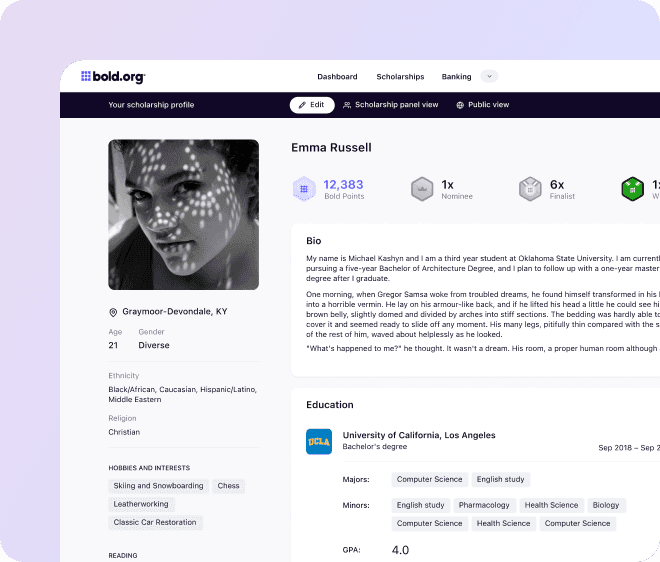
Bold.org helps students show donors who they are beyond a transcript.
Step 02
Where scholarships are awarded
Every scholarship is funded by donors and managed directly on Bold.org.
Step 03
Fund your future
Scholarship dollars are disbursed through Bold.org to help students pay for school.
FAQ
When is the scholarship application deadline?
The application deadline is Apr 26, 2026. Winners will be announced on May 27, 2026.
How will scholarship application information be used?
Your privacy is a top priority on the Bold.org platform, and you can find our privacy policy in full here. You may opt out of communications from Bold.org at any time, and unless we’ve first notified you and gotten your consent, you’ll never receive communication from any third parties related to personal information you give us.
What is the scholarship award?
Award amounts per winner are designated by the donor. Check the award amount for a detailed breakdown.
When will the scholarship winner be chosen? How will they be notified?
The winner will be publicly announced on May 27, 2026. Prior to the announcement date, we may contact finalists with additional questions about their application. We will work with donors to review all applications according to the scholarship criteria. Winners will be chosen based on the merit of their application.
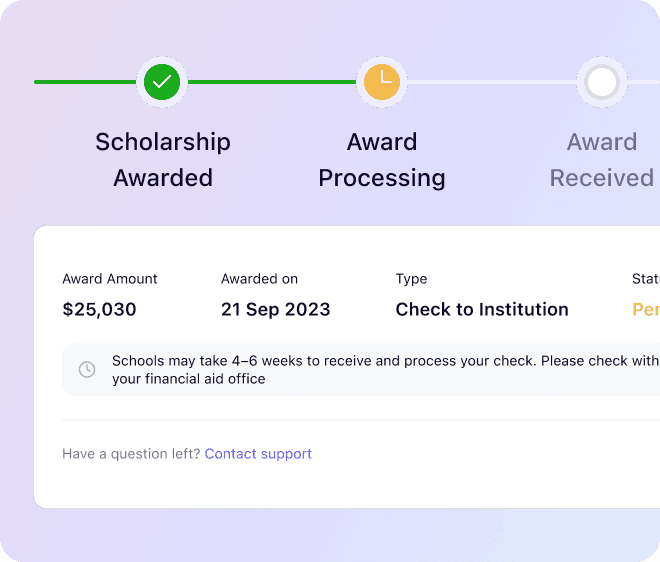
How will the scholarship award be paid?
Award checks will be sent to the financial aid office of the winner's academic institution or future academic institution in their name to be applied to their tuition, and in the name of their institution (depending on the school's requirements). If the award is for a qualified educational non-tuition expense, we will work with the winner directly to distribute the award and make sure it goes towards qualified expenses.
How will my scholarship application be verified?
Before we award the scholarship, the winner will be required to confirm their academic enrollment status. Depending on the circumstances, verification of Student ID and/or their most recent transcript will be required.
How should I get in touch with questions?
If you have any questions about this scholarship or the Bold.org platform, just email contact@bold.org and we’ll get back to you as quickly as we can.
Does the scholarship have terms and conditions?
Yes. The terms and conditions for this scholarship can be found here.
97% of students don't win scholarships. We’re here to change that.