The Marcia Bick Scholarship was established to help disadvantaged or financially challenged high school students afford college or trade school.
Today's students often face significant hurdles as they prepare to leave high school and pursue their academic goals. Financial hardship, limited family or community support, and uncertainty about how to navigate the path to college or a career can create overwhelming anxiety. These challenges can make even the most motivated students feel unsure about their future—despite their talent, drive, and potential.
Any high school senior who is motivated to pursue college or trade school and has financial need may apply for this scholarship opportunity, but students who excel in mathematics or quantitative sciences and those from the New York tri-state area are especially encouraged to apply. Students who applied last year, including finalists and winners, are encouraged to reapply.
To apply, tell us why students from underserved backgrounds deserve opportunities, how you have worked to overcome obstacles, and how this scholarship would help you achieve your goals.
Selection Criteria:
Ambition, Drive, Impact
Essay Topic Requirements
Many young people face significant challenges in life due to financial hardship, family circumstances, or lack of resources. However, some students rise above these difficulties through hard work, determination, and a strong desire to succeed.
In 500 words or less, explain why motivated and high-achieving students from disadvantaged backgrounds deserve opportunities such as scholarships or grants. Share how you have worked to overcome obstacles in your own life and how support through this grant would help you achieve your goals.
Be honest, specific, and show how your effort and potential reflect your commitment to success.
300–500 words
$30,000
6 winners, $5,000 each
Awarded
Application Deadline
Sep 9, 2026
Winners Announced
Oct 10, 2026
Education Level
High School
Share
Explore All Kinds of Scholarships for All Kinds of Students
When I moved from Ghana to the United States during tenth grade, I quickly learned that wanting an opportunity and knowing how to reach it were two different things. I entered a new school system while trying to understand college admissions, scholarships, and the path toward a career in medicine. I did not have the advantage of already knowing how everything worked. What I did have was the willingness to learn, ask questions, and keep moving forward.
I believe motivated students from underserved backgrounds deserve opportunities because talent should not be limited by the resources someone happens to be born with. A scholarship can mean more than help paying tuition. It can give a student the freedom to take an unpaid opportunity, participate in research, buy necessary academic materials, or attend a college that once seemed financially impossible. When someone has the drive to succeed but lacks the resources to get there, an opportunity can change the entire direction of their future.
I have tried to create opportunities for myself rather than wait for them. I sought out STEM programs and internships that introduced me to experiences I had never imagined having. During my NY Bioforce internship, I worked on biomedical research involving magnetic beads, DNA methylation, and a microfluidic platform. I learned to micropipette, use a NanoDrop, and design microfluidic chips. Through Future Minds, the Harlem Children’s Zone, and the YMCA, I also developed communication, teamwork, and service skills. Each experience required me to step into unfamiliar environments and prove to myself that I belonged there.
My motivation comes from more than academic ambition. Losing my grandmother made me want to understand medicine deeply enough to help other families facing illness. I hope to study neuroscience or biomedical engineering, pursue medicine, and eventually become a physician who combines patient care with research and technology.
The financial reality of reaching that goal is significant. As a first-generation student, I am determined to make college possible while being thoughtful about the financial burden it can place on my family. Receiving the Marcia Bick Scholarship would help reduce that burden and allow me to focus more fully on my education, research, and preparation for a medical career.
I have already learned how to keep going when the path is unfamiliar. What I need now is the opportunity to keep building on that effort. I want to prove that where a student begins does not have to determine how far they can go.
I have known since a young age that success is not measured by where you come from, but by how hard you are willing to work to reach your dreams. My parents have always provided my siblings and me with a home full of love, faith, and support. However, financial need has forced my family to make sacrifices and be very budget conscience. Seeing my mother struggle and work as a public-school teacher to help provide for our family while sending three kids to college has taught me perseverance. She has shown me what hard work and determination can do.
During my years in high school I never let setbacks define where I would end up in life. Instead I used obstacles as an opportunity to work twice as hard. I graduated with a 4.6 GPA, in the Top 5% of my class with my Associates in Arts degree from Miami Dade College before receiving my high school diploma. I was able to accomplish this by maintaining a rigorous course load of dual enrollment classes while managing leadership positions, activities, and volunteering. There were many late nights where I had to juggle much on my plate and wondered if I could do it, but I pushed through.
As Vice President of the Student Government Association, President of the Thespian Honor Society, Vice President of the Math Honor Society, and founder of Summer S. P. E. A. K. (Stand Proud, Express Authentically, and Know Your Worth) club, a leadership organization that helps empower students and young adults by building self-confidence, I have become passionate about bettering the lives of others. With over 1,200 community service hours tutoring youth and my community I have found my dream in wanting to become a pediatric physician.
Hardworking and motivated students should receive scholarships and grants because they come from backgrounds where they know education can be life changing, not only for themselves but for families and communities. There are many students with the drive and capability to succeed and go far in life but don’t have the financial support to fully achieve their dreams. By receiving scholarships, students are able to help ease the stress of financial burden and focus on what matters: learning, creating leadership opportunities, and giving back to their communities.
When I become a physician my goal is to not only further my education, but to use it to help children and families, fight for equitable care, and inspire the next generation to know where they come from doesn’t dictate where they are going.
Work hard and let your dreams take you places you’ve never imagined. I have learned how to take my challenges and turn them into opportunities and with your help I will continue working to better others’ lives.
Some of the strongest people I know have never had an easy life.
The first one I think of is my mom.
For most of my life, she raised my two older brothers and me on her own. My dad chose not to be part of our lives and does not contribute financially, so every opportunity I have been given has come because my mom worked incredibly hard to provide it. She never let me see her give up, even when I know life would have been easier if she had. Instead, she taught me that our circumstances do not determine our future. Our choices do.
That lesson has shaped every goal I have ever pursued.
I learned early that if I wanted opportunities, I would have to earn them. I poured myself into school, leadership, volunteer service, and agriculture because I believed every experience could become a stepping stone toward something bigger. Today, those choices have led me to earn the Illinois FFA State Degree, serve as Chapter President and Section 16 Treasurer, dedicate more than 3,300 hours to volunteer service, and be selected for a very competitive internship with the United States Department of Agriculture in Washington, D.C., where only 40 students were chosen from more than 1,200 applicants nationwide.
None of those accomplishments happened because life was easy. They happened because I refused to let difficult circumstances define what I believed was possible.
Growing up, I watched my mom work tirelessly so I could participate in FFA events, leadership conferences, animal projects, and educational opportunities she believed would help me build a better future. Seeing those sacrifices made me determined to make every opportunity count. I apply for every scholarship I can find because scholarships will change my life. They are not simply financial assistance. They are investments that allow students like me to continue building dreams that would otherwise be out of reach.
This fall, I will attend Millikin University to study Biology while continuing to pursue my passion for animal science, veterinary medicine, and public service. My goal is to use science, education, and advocacy to improve animal welfare while helping others understand the important connection between agriculture, conservation, and healthy communities.
Receiving this help will allow me to live on campus and become fully involved in leadership opportunities and campus organizations that will strengthen my education and my future career. More importantly, it would ease some of the financial burden carried by my Mom who has sacrificed the most to help me get here.
She has spent years opening doors for me.
My goal is to spend the rest of my life making sure her support grows while I open doors for myself and others.
Scholarships do so much more than help students pay for college. They recognize determination, reward hard work, and give students opportunities to turn hard beginnings into meaningful futures.
Thank you for believing in students who refuse to let challenges determine their potential.
I remember the smell of food cooking on a small camp stove in my grandmother’s tent, one of few scattered across MacArthur Park, where I spent early mornings before she walked my siblings and me to school. After school, my mother would pick us up and take us "home." That meant wherever we could lay our heads for the evening: a cheap motel, a car, or another tent. I didn't grow up with tutors, test prep, or a quiet room to study in. I grew up learning how to find stability where there was none, and how to keep going when the path forward was unclear.
School meant more than learning. It meant steady meals and a safe space for eight hours. Yet, even in my safe haven, something was wrong. My world was blurry: the whiteboard, the book in front of my face, and the people standing before me. I assumed everyone saw the world this way, until someone noticed I was struggling and gifted me my first pair of glasses.
The moment I put them on, everything snapped into focus, from the intricate patterns on my classmates’ shirts to the words on the whiteboard. The experience did not just correct my vision; it changed how I understood the world. I began asking questions: How does light bend through glass? How does the eye translate what it sees into something the brain can understand? Science stopped being abstract. It became personal.
I pursue honors science classes because I understand science as something tangible, something that solves problems and changes lives. From CRISPR gene editing that can treat disease to research that helps crops withstand climate change, science turns curiosity into discoveries that people can actually feel.
Realizing that science could change lives made me question why so few people from my background get the chance to be a part of it. Students from disadvantaged backgrounds don't lack ambition or ability. We lack access to resources and early support that changes the direction of a life. For me, that first life-changing turning point was a pair of glasses. Without it, I might never have found my way to science at all.
That experience also shaped how I think about service. Seeing how one person's investment changed my future led me to Guatemala for two spring breaks to help build homes for families. When I returned, I started my own organization to bring vision care to under served communities.
I have studied without stability, managed anxiety, and built a vision for my future from very little. This scholarship would allow me to attend college without financial barriers standing between me and my goal of becoming a medical researcher. A scholarship is more than financial aid, it is an investment in potential. Someone once noticed that I could not see clearly and changed my life. This investment will give me the tools to build a future where I can create life-changing breakthroughs for the communities that need them most.
Growing up, I thought a lot of things were normal that I later realized were not.
I thought it was normal to use food stamps at the grocery store. I thought it was normal to avoid going to the doctor unless it was absolutely necessary because my family did not have health insurance. I thought it was normal to translate forms, school paperwork, and medical documents for my parents because their English was limited. As the daughter of Chinese immigrants, I often found myself helping my family navigate systems that were unfamiliar to all of us.
My parents worked incredibly hard. My father spent long hours working as a cook, and my mother was unable to work because of health issues. They always emphasized the importance of education, but when it came to college admissions, research opportunities, financial aid, and scholarships, they could not show me the way because they had never gone through those processes themselves. Like many first-generation students, I had to figure things out as I went.
That is why I believe students from underserved backgrounds deserve opportunities such as scholarships and grants. Financial hardship does not make someone less capable. If anything, it often forces students to become resourceful, independent, and resilient long before they reach adulthood. The problem is not a lack of talent or ambition. The problem is that many students never receive the same access to opportunities, guidance, and resources as their peers.
I worked hard to seek out those opportunities myself. After my grandmother developed Alzheimer's disease, I became interested in neuroscience and pursued research opportunities to better understand neurological disorders. I founded NeuroHub, a nonprofit organization that makes neuroscience education more accessible to students around the world. I tutor underserved students in English, volunteer at a free clinic serving uninsured patients, and spend time with seniors in memory care communities. Many of these experiences began with a simple email, a question, or a chance that someone was willing to take on me.
This fall, I will attend Stanford University to study Bioengineering and pursue my goal of becoming a physician-scientist. Receiving this scholarship would help ease the financial burden of college for my family and allow me to focus more fully on my education and service. More importantly, it would reinforce something I have learned throughout my life: that when motivated students are given opportunities, they often do far more with them than anyone expects.
I am grateful for every opportunity I have received. Through my college education, I hope that one day I can create those same opportunities for others.
Success Academy High School of the Liberal ArtsNew York, NY
I discovered that resilience would come through adversity as a child. I was raised in Mali, living with my grandparents and learning to persevere and have hope. When I returned to America at age six, I did not know the language. I was isolated, but art was a language that I knew. With the colored pencils themselves, I discovered a means of expression, a connection to humans, and the self-assurance that would sustain me through all the misery to come.
Home life wasn't a breeze. I resided in public housing with broken windows, finicky heat, and one functional elevator as a normal occurrence. Even reliable Wi-Fi was at times a luxury, so it was hard to get schoolwork done. Family life also involved segregating schooling from family chores, sometimes grueling late nights after finishing household work. But instead of deterring me from these challenges, they motivated me to work even harder. I was taught how to do tasks in advance, at the library for it would serve as my office, and recalling how I should handle time. All these challenges made me tougher and disciplined, something one could not learn in school.
At the same time, I committed to service. I helped give out food and books at giveaways, supported toy drives, and collaborated with Senator Cordell Cleare to get the 110th Street Plaza named in Malcolm X's honor. I also joined The Met's teen research team and collaborated with others on fashion, Black history, and underrepresented populations like Seneca Village. And it occurred to me that my path has to be about service and creativity.
Art taught me about oneness, yet architecture taught me about change. I was inspired by Zaha Hadid's work, where she unites design and nature to create spaces to dignify human beings. Architecture is not buildings to me; it is dignity. I want to build safer, more beautiful homes for families like mine and my grandparents' village in Mali, where I first had the privilege of living under limited means. My AP Art portfolio was unity, keys of different shapes but the same purpose, and hopefully my future architecture performs the same purpose: opening doors for all people in the world.
These kinds of scholarships are not merely money; they're an investment in potential. To me, it would be a question of access to resources, opportunities, and experiences that previously weren't open to me. Above all, it would allow me to be free to pursue a career in which I can transform adversity into hope, not for me, but for those whom I seek to assist.
Irrespective of the adversity I have faced, I am committed to further education and the future. My personal philosophy is that by refusing to give up and asking for help, I can transcend setback and harness architecture to build spaces which remind people they are seen, heard, and worthy of possibility.
Growing up in New York, Mount Vernon, I quickly realized that life doesn’t hand out equal opportunities. My family faced financial challenges that often made even simple resources like tutoring, extracurricular programs, or test prep feel out of reach. Yet, instead of letting these obstacles define me, I used them as motivation to work harder and pursue every opportunity available.
Balancing academics with responsibilities at home became a constant part of my life. I helped care for younger siblings while my parents worked long hours, and sometimes I had to navigate schoolwork with limited resources. There were moments when I doubted whether I could keep up with my peers, but I refused to let circumstance dictate my potential. Instead, I leaned into hard work and discipline, maintaining a 4.0 GPA through freshman and sophomore years and pushing through even when challenges felt overwhelming.
I’ve sought to maximize every opportunity despite these limitations. I actively participate in academic and STEM-focused programs, including an aerial robotics course at Stony Brook University, where I’ve gained hands-on experience coding and piloting drones. Beyond academics, I’ve pursued leadership and service, contributing to school clubs and mentoring younger students when possible. Each achievement reflects not just ability, but determination, resourcefulness, and resilience qualities, I believe, that are essential for success.
Receiving this scholarship would remove barriers that still stand in my way. It would give me access to programs, resources, and experiences I cannot afford on my own, allowing me to focus fully on college preparation and my long-term goal of pursuing engineering. It would also ease the financial strain on my family, giving me the space to fully dedicate myself to academics and personal growth without distraction.
I believe motivated students from disadvantaged backgrounds deserve opportunities like this because circumstances do not define potential. What defines potential is the willingness to rise above challenges, embrace growth, and remain committed to achieving goals despite setbacks. I have faced financial hardship, limited resources, and personal responsibilities, yet I have consistently worked to excel academically and personally. This scholarship would be both a recognition of my past efforts and a critical stepping stone toward future impact, allowing me not only to pursue my dreams but also to inspire and support others facing similar challenges.
Through determination, persistence, and hard work, I have learned to turn obstacles into motivation. I am committed to transforming opportunities into tangible achievements and to making a meaningful contribution to my community and field. This scholarship would not just help me succeed, it would allow me to rise fully into my potential and give back in ways that matter.
My family has always struggled with money. Both my parents worked endlessly, but it was never enough. Going to grocery stores with my mother, we would always have coupons and food stamps in hand. For a long while, I thought that was the way everyones families were, grabbing Great Value products over name-brands in efforts to ease the burden by even a few cents. I would hear my parents sighing over bills before we went another hot summer week without air conditioning.
Everything got harder after my father passed away from stage four lung cancer. Without the second income, the money got tighter, and the house felt colder. Then came the pandemic, shutting down my mother’s source of income as the restaurant she worked long hours at closed. I would pull open the fridge, after virtual classes, to bare shelves and half-empty condiments.
My primary meals were provided by the school, the free lunch program filling my stomach. Packaged in plastic bags for sanitation, the surplus of school food that would have gone unused went back to the community, those in need.
Eventually my older brother found a job to help support the house, and my mother returned to work, as I continued through middle school into my first years of high school. Since sophomore year of high school, I've been finding ways to make my own money, from babysitting to working a job at the same restaurant as my mother. I am saving up as much as possible for my college education, and I can only hope to not press a major financial burden on my family by continuing my education. I have given up my weekend mornings, and some weeknights to my job, and give the rest of my time to my education, working hard on homework assignments.
I’ve always done my best to make my parents proud by maintaining high grades. Having immigrant parents, from a town in Greece, I would be going to college not just for myself; but for them as well. Financial difficulties are some of the most difficult challenges to overcome, but our community has been pivotal to helping my family, and I could not be more grateful. I hope that my community scholarships, and even national scholarships, can support my family as I enter the next chapter of my life. The chapter where I learn to give back, support my mother financially so she no longer sighs over bills, so I can give her as much as I can, to reflect the way she gave everything she could.
This scholarship is not a charity. It is an investment into the most hardworking students imaginable; those who need to do well to advance. Students like me, who work harder for everything they are given. With the support of this scholarship, I can reach my goals with less weight on my shoulders, achieve financial comfort with a well-paying job after college, continue working hard, and be thankful for everyone who got me there.
Students from underserved backgrounds deserve opportunities such as scholarships and grants because talent and potential are not defined by financial status. Many motivated students face barriers not of their own making—financial hardship, family circumstances, or limited resources. What they lack in opportunity, they often make up for in resilience, drive, and determination. Scholarships can level the playing field by ensuring that these students are not held back simply because of where they come from, but are instead given the chance to reach their full potential.
I know this personally, because I grew up in a single-parent, low-income household. My mom worked tirelessly to provide for me, often sacrificing her own needs so that I could pursue mine. There were times when money was tight, when activities, trips, or even basic school expenses felt out of reach. Those challenges could have easily discouraged me, but instead they pushed me to work harder. I understood early that my circumstances did not define my ceiling. What I lacked in financial stability, I had to make up for through effort, discipline, and focus.
One way I have overcome these obstacles is through academics. At Seton Hall Preparatory School, I have challenged myself in math and science courses, areas where students from my background are often underrepresented. These subjects taught me that persistence and problem-solving can overcome even the toughest challenges. They have also prepared me for my goal of pursuing a degree in business and communications, where I hope to combine analytical thinking with leadership and creativity.
Service and leadership are also central to who I am. Through Jack and Jill of America and my school’s Spectrum Big Brothers program, I mentor younger students and encourage them to believe in their abilities. At Liquid Church’s Sunday Buddy program, I volunteer with children who have special needs, helping them feel included and supported. These experiences matter to me because I know what it feels like to need guidance and support. They have taught me that success is not just about personal achievement, but about lifting others along the way.
This scholarship would have a profound impact on my journey. College tuition represents a significant challenge for my family, and receiving this support would ease the financial burden while allowing me to focus on academics, leadership, and service. It would also validate the hard work I have put into overcoming my circumstances and demonstrate that others believe in my potential.
In the end, I believe students from disadvantaged backgrounds deserve opportunities because we embody resilience and ambition. With the right support, we can transform challenges into stepping stones toward success. I am committed to using my education not only to build a better life for myself, but to create opportunities for others as well.
Growing up in a disadvantaged environment often means facing obstacles that others never have to consider worrying about basic needs, lacking academic resources, or carrying family responsibilities beyond our years. But despite these challenges, many of us develop resilience, determination, and a work ethic that goes far beyond the classroom. Motivated and high-achieving students from underserved backgrounds don’t just deserve opportunities like scholarships or grants we need them to level the playing field and continue proving what we're capable of.
For me, financial hardship has shaped much of my journey. I come from a family where every dollar mattered. While some classmates had tutors, quiet study spaces, or even the ability to focus solely on school, I balanced academics, and a sport with part-time jobs to help at home. I’ve studied late at night after work shifts, learned to navigate school with limited access to resources, and taught myself skills through free online tools when no other support was available.
One major challenge I faced was when money was low and me and my family were on the brink of eviction, thinking we were going to lose everything , this caused a shift in my focus trying to support my family but I never let those setbacks define me. Instead, they became fuel. I pushed harder, stayed on top of my studies, and eventually earned recognition for academic excellence and leadership.
What I’ve learned is that potential isn’t limited by background, it's defined by effort, mindset, and support. Given the right opportunities, students like me not only succeed, we thrive. We bring a unique perspective, grit, and commitment that come from fighting for every step forward.
This grant would be more than financial help, it would be an investment in my future and in the values I stand for. It would allow me to continue pursuing my education without the constant weight of financial strain, and to focus more fully on developing my skills and giving back to my community. I hope to one day mentor and support students facing the same struggles I did.
My goals are big, not just for myself, but for the impact I want to make. With the help of this grant, I will continue to rise, not despite my circumstances, but because I’ve learned how to turn hardship into strength.
Growing up in Irvington, I’ve seen how hard it can be for students like me to chase big goals when money is tight and resources are limited. Scholarships like this one aren’t just helpful—they’re necessary. They give students from tough backgrounds a real shot at success, even when the odds feel stacked against us.
I was raised by a single mom who works long hours to keep things going. We’ve had our share of struggles—times when bills piled up, and college felt more like a dream than a plan. But I’ve always believed that where you start doesn’t have to decide where you end up. That’s why I’ve worked hard in school, even when things outside of class were stressful. I’ve taken the most challenging classes I could, including AP English, and I’ve kept my grades up while helping out at home. I don’t have a long list of awards or leadership roles, but I’ve stayed focused and determined. I’ve learned how to manage my time, push through setbacks, and keep showing up—even when it’s hard. That’s something I’m proud of.
I want to study architecture because I’ve always been drawn to design and how spaces can shape people’s lives. I want to create buildings that feel welcoming and safe, especially in communities like mine. I believe good design shouldn’t only be for the wealthy—it should be for everyone. This scholarship would mean I could focus more on my education and less on how I’m going to afford it. It would take a huge weight off my shoulders and help me keep moving toward my goals. I know I still have a lot to learn, but I’m ready to put in the work. I’m not asking for a handout—I’m asking for a chance. Thank you for the opportunity to express myself.
How it works
Bold.org is Built to Make Scholarships Feel Possible
Step 01
Start with your story
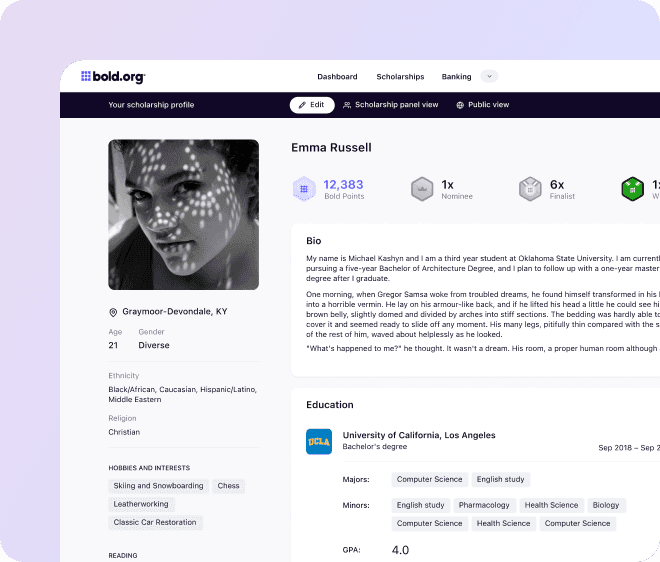
Bold.org helps students show donors who they are beyond a transcript.
Step 02
Where scholarships are awarded
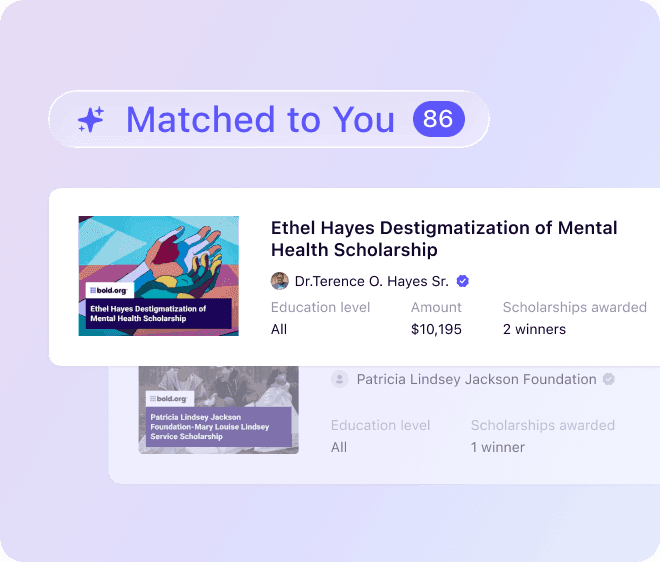
Every scholarship is funded by donors and managed directly on Bold.org.
Step 03
Fund your future
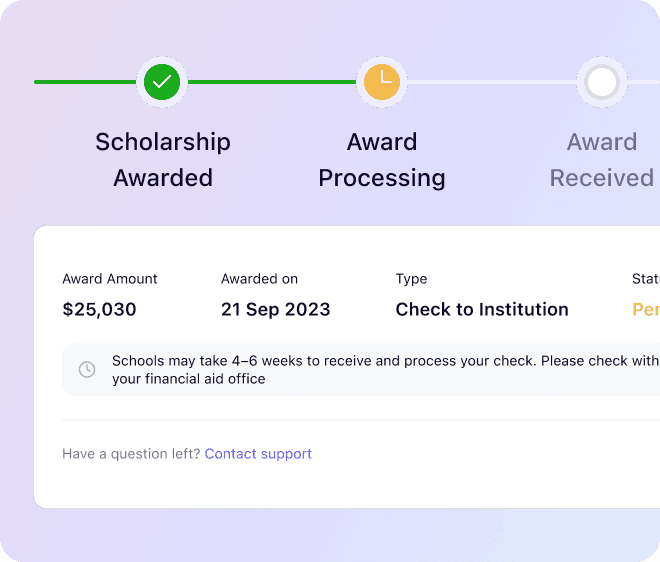
Scholarship dollars are disbursed through Bold.org to help students pay for school.
FAQ
When is the scholarship application deadline?
The application deadline is Sep 9, 2026. Winners will be announced on Oct 10, 2026.
How will scholarship application information be used?
Your privacy is a top priority on the Bold.org platform, and you can find our privacy policy in full here. You may opt out of communications from Bold.org at any time, and unless we’ve first notified you and gotten your consent, you’ll never receive communication from any third parties related to personal information you give us.
What is the scholarship award?
Award amounts per winner are designated by the donor. Check the award amount for a detailed breakdown.
When will the scholarship winner be chosen? How will they be notified?
The winner will be publicly announced on Oct 10, 2026. Prior to the announcement date, we may contact finalists with additional questions about their application. We will work with donors to review all applications according to the scholarship criteria. Winners will be chosen based on the merit of their application.
How will the scholarship award be paid?
Award checks will be sent to the financial aid office of the winner's academic institution or future academic institution in their name to be applied to their tuition, and in the name of their institution (depending on the school's requirements). If the award is for a qualified educational non-tuition expense, we will work with the winner directly to distribute the award and make sure it goes towards qualified expenses.
How will my scholarship application be verified?
Before we award the scholarship, the winner will be required to confirm their academic enrollment status. Depending on the circumstances, verification of Student ID and/or their most recent transcript will be required.
How should I get in touch with questions?
If you have any questions about this scholarship or the Bold.org platform, just email contact@bold.org and we’ll get back to you as quickly as we can.
Does the scholarship have terms and conditions?
Yes. The terms and conditions for this scholarship can be found here.
97% of students don't win scholarships. We’re here to change that.