Clark Emerging Leaders Scholarship


For a variety of personal and societal reasons, many students face unique challenges in pursuing further education after high school.
These challenges can be even more pronounced for those attending Historically Black Colleges and Universities (HBCUs) due to limited funding at these institutions. Many students at HBCUs come from lower-income backgrounds than students at other colleges, largely due to the racial wealth gap. Financial struggles can make higher education inaccessible and overwhelming.
This scholarship aims to support students in need so they can successfully complete their college degrees and embark on their futures.
This scholarship opportunity is open to incoming students at an HBCU or rising sophomore at an HBCU who resides in Tarrant or Dallas County, Texas. Applicants must be an underrepresented minority with a minimum 3.0 GPA, pursuing a business-related degree (such as management, accounting, finance, etc), and have experience in volunteering and leadership.
To apply, tell us about a time when you faced adversity, how you overcame the challenges, what you took away from the experience, why attending an HBCU is important to you, and how graduating from an HBCU will set you up for success.
Describe a time when you faced adversity and how you overcame it. What did you learn from the experience? Why do you want to attend an HBCU, and how do you think it will help you succeed in the future?
Explore All Kinds of Scholarships for All Kinds of Students
Winners and Finalists
July 2026


August 2025


Winning Applications

How it works
Bold.org is Built to Make Scholarships Feel Possible
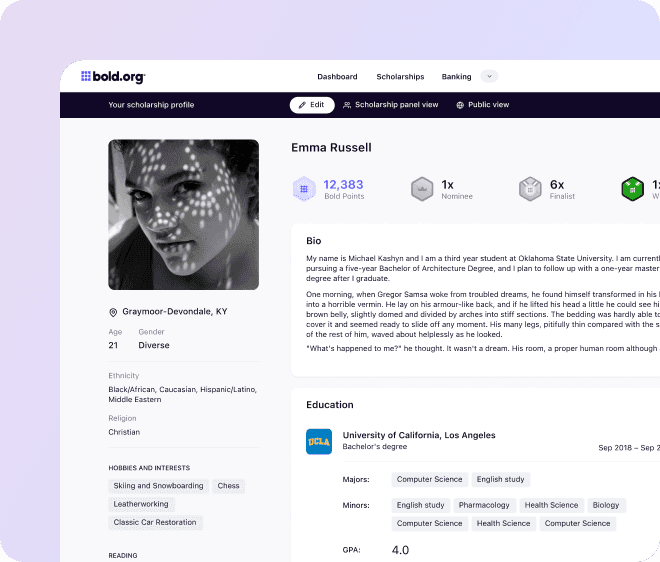
Step 01
Start with your story
Bold.org helps students show donors who they are beyond a transcript.
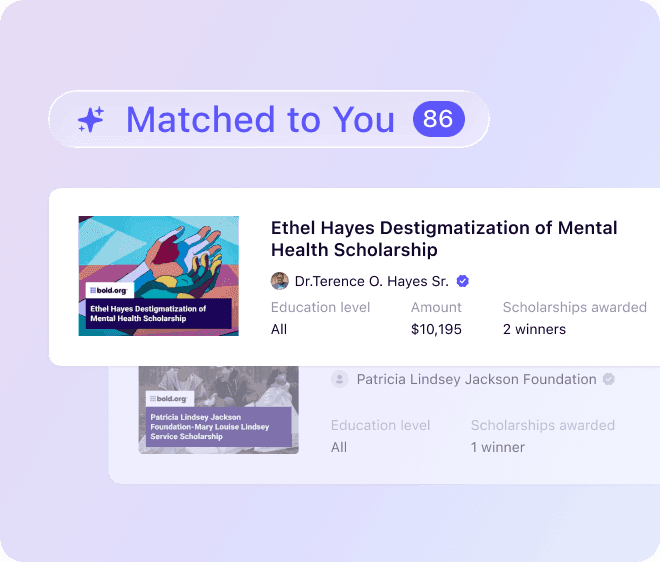
Step 02
Where scholarships are awarded
Every scholarship is funded by donors and managed directly on Bold.org.
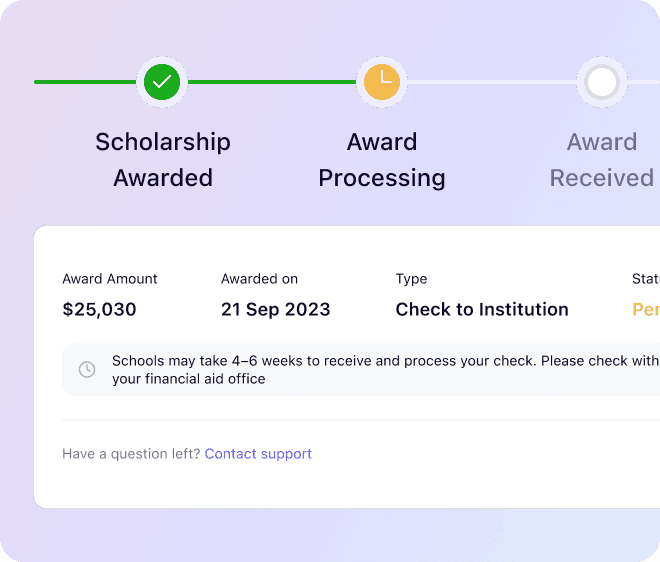
Step 03
Fund your future
Scholarship dollars are disbursed through Bold.org to help students pay for school.
FAQ
The application deadline is Jun 30, 2026. Winners will be announced on Jul 31, 2026.
Your privacy is a top priority on the Bold.org platform, and you can find our privacy policy in full here. You may opt out of communications from Bold.org at any time, and unless we’ve first notified you and gotten your consent, you’ll never receive communication from any third parties related to personal information you give us.
Award amounts per winner are designated by the donor. Check the award amount for a detailed breakdown.
The winner will be publicly announced on Jul 31, 2026. Prior to the announcement date, we may contact finalists with additional questions about their application. We will work with donors to review all applications according to the scholarship criteria. Winners will be chosen based on the merit of their application.
Award checks will be sent to the financial aid office of the winner's academic institution or future academic institution in their name to be applied to their tuition, and in the name of their institution (depending on the school's requirements). If the award is for a qualified educational non-tuition expense, we will work with the winner directly to distribute the award and make sure it goes towards qualified expenses.
Before we award the scholarship, the winner will be required to confirm their academic enrollment status. Depending on the circumstances, verification of Student ID and/or their most recent transcript will be required.
If you have any questions about this scholarship or the Bold.org platform, just email contact@bold.org and we’ll get back to you as quickly as we can.
Yes. The terms and conditions for this scholarship can be found here.
