Dr. Hassan Homami was a beloved husband who recently passed away after a life dedicated to education and engineering.
Hassan was a strong believer in the importance of learning, expanding one’s mind, and pursuing higher education. He was passionate about helping the next generation of young learners access the education they sought. Dr. Hassan worked full-time while earning his PhD, and he gave back as a mentor to interns throughout his career.
This scholarship is dedicated to supporting graduate students who are pursuing degrees in engineering. His journey as a first-generation immigrant and his work in intelligent and smart transportation systems inspired this award’s focus. By helping students who share his values, we hope to continue his legacy of mentorship and educational empowerment.
This scholarship will be awarded in January, and then run for a second round to be awarded in late June.
Eligibility Criteria
Any graduate student who is studying engineering may apply for this scholarship opportunity. Preference will be given to: 1) First-generation immigrants; 2) Engineering Students specializing in transportation systems.
Application Instructions
To apply, please address the following in your application essay:
Describe your specific interest in engineering and your chosen field of study.
Share how you first became passionate about engineering and identify particular areas within engineering (especially transportation systems, if applicable) that excite you most.
Explain your plan for expanding your knowledge and making an impact in your field.
Share your story, your vision, and your commitment to making a difference—just as Dr. Hassan did throughout his life.
Selection Criteria:
Ambition, Drive, Potential for Positive Impact
Essay Topic Requirements
Please address the following:
Describe your specific interest in engineering and your chosen field of study.
Share how you first became passionate about engineering and identify particular areas within engineering (especially transportation systems, if applicable) that excite you most.
Explain your plan for expanding your knowledge and making an impact in your field.
Share your story, your vision, and your commitment to making a difference—just as Dr. Hassan did throughout his life.
400–600 words
$3,240
3 winners, $1,080 each
Awarded
Application Deadline
May 19, 2026
Winners Announced
Jun 20, 2026
Education Level
Graduate
Share
Explore All Kinds of Scholarships for All Kinds of Students
I grew up in my hometown Sirjan in the south of Iran․ My parents did not have the opportunity to receive formal literacy education. However, they deeply believed in the power of knowledge. They always encouraged me and my siblings to study, to think beyond our circumstances, and to believe that every successful path passes through learning. Even without formal education, they gave us one of the most valuable lessons of my life: there should be no limitation on belief, effort, or imagination.
In high school‚ I was particularly interested in math and engineering․ I loved the idea that engineers took an idea from the mind and turned it into something real that made a difference‚ that made people's lives better․To me, engineering was not only about formulas; it was about creativity, innovation, and responsibility. I also believe that true creativity comes from a deeper source. Rumi writes in the Mathnavi, “For those brickbats were made solid by the brick-maker, the rock was hardened by Divine art.” This verse reminds me that human creativity can shape the world, but it should also be used with purpose.
In Iran‚ I saw how much life‚ time‚ money‚ and environmental quality could be lost every day because of transportation problems․ So my interest became focused more and more on transportation after my undergraduate degree in civil engineering․ The crashes‚ congestion‚ unsafe roads‚ delayed response‚ and inefficient systems not only affect drivers‚ but also families‚ workers‚ and entire communities․ At the same time, I was strongly interested in technology and computer science. The possibility of combining transportation engineering with modern technology motivated me to continue in this field.
Today‚ I am a PhD student in Transportation Engineering at the New Jersey Institute of Technology (NJIT)‚ and my dissertation is in the field of smart transportation systems․ My dissertation focuses on improving traffic incident response through a system called IRIS, the Incident Response Intelligence System. The goal of this work is simple but meaningful: to help transportation operators make faster and better decisions when crashes or incidents happen on freeways. If incident response can become faster and more informed, it can help reduce delays, prevent secondary crashes, support emergency response, save money, reduce fuel waste, and potentially save lives.
Other projects that have been connected to this mission include crash safety analysis‚ truck parking prediction‚ bicycle travel demand modeling‚ speed camera safety analysis‚ and traffic operations research․ While grounded in data and technology‚ the goal is to improve safety‚ mobility‚ sustainability and reliability of transportation systems for the benefit of the traveling public․
While I write my dissertation‚ I continue to work half time as a research assistant․ I hope to defend my dissertation proposal this summer and submit a couple papers to the Transportation Research Board․ This scholarship would help support my graduate education, research progress, conference participation, and the cost of presenting my work to the transportation community. Attending and presenting at conferences such as TRB would allow me to learn from experts, receive feedback, and share research that can contribute to safer and smarter transportation systems.
Dr․ Hassan Homami inspires me because he represents education‚ perseverance‚ engineering‚ mentorship‚ and the courage to build a meaningful life as an immigrant․ I believe higher education should not only be a platform for individual advancement but also an opportunity to create value in others' lives- like Dr․ Homami has in mine․ I aspire to improve the responsiveness‚ safety‚ and life-saving nature of transportation systems through engineering‚ technology‚ and research‚ and help others on their paths to education․
New Mexico Institute of Mining and TechnologySocorro, NM
Growing up in Sri Lanka, I was always curious about how things worked. As a child, I enjoyed science and mathematics, but I was especially fascinated by materials, machines, and how engineering could improve people’s lives. I did not grow up surrounded by advanced technology or research opportunities, so I learned to observe, question, and solve problems creatively with the resources available to me. Over time, that curiosity developed into a passion for engineering and eventually led me to pursue a Ph.D. in Materials and Metallurgical Engineering at New Mexico Tech in the United States.
My academic journey has not been straightforward. I initially entered graduate studies through Physics, but over time I realized that I wanted to apply scientific principles more directly to real-world engineering challenges. That realization motivated my transition into Materials and Metallurgical Engineering. I became deeply interested in understanding how materials behave under extreme conditions and how engineering research can improve safety, reliability, and sustainability in modern technologies.
My research focuses on material behavior under high strain-rate conditions, particularly micro-particle impacts and microscopic failure mechanisms. I am especially interested in how materials respond in extreme environments and how this knowledge can improve systems used in aerospace, manufacturing, transportation, and protective technologies. Even a small material failure in these environments can lead to serious consequences. Understanding these behaviors can help engineers design safer and more reliable materials for future technologies.
Before joining my current Ph.D. program, I worked on solar-energy-related research at the Open University of Sri Lanka, where I studied dye-sensitized semiconductor materials for solar-cell applications. That experience strengthened my interest in sustainable engineering and showed me how materials research can contribute to solving global challenges. Later, during my master’s degree in Applied Electronics at the University of Colombo, I designed and developed a 2-D ultrasonic anemometer and wind vane weather-parameter measuring system. Through these experiences, I realized that engineering is about creating solutions that improve safety and quality of life.
Coming to the United States as a first-generation immigrant student was one of the biggest transitions of my life. I had to adapt to a completely new educational system, research culture, and environment while balancing financial pressure and the challenges of graduate school. Although the journey was difficult, those experiences strengthened my resilience and determination. They also taught me the importance of mentorship and supportive academic communities.
Dr. Hassan Homami’s story deeply resonates with me because he believed in education, lifelong learning, and helping others while pursuing his own goals. Like him, I understand the challenges of balancing responsibilities and higher education while continuing to move forward with purpose. His dedication to mentorship is especially meaningful to me because I know how important guidance and encouragement can be for students who sometimes feel isolated in engineering environments.
Throughout my journey, I have tried to support and encourage other students whenever possible, especially women and international students in STEM. Through organizations such as AAUW and SWE, I have connected with communities that promote educational access and support women in engineering. Recently, I was honored to receive both the Robbie Jones Memorial Scholarship and the NMT-AAUW Scholarship, which encouraged me to continue pursuing my goals despite financial and personal challenges.
My long-term goal is to continue expanding my knowledge in materials engineering while contributing to research that improves the safety and reliability of advanced technologies. At the same time, I hope to mentor and encourage future students from underrepresented and immigrant backgrounds. I want my work to combine technical innovation, resilience, and mentorship in the same spirit that Dr. Hassan demonstrated throughout his life.
Standing four stories underground at the HANA Financial Group construction site, I was supposed to be focused on the concrete pouring plan for the next day. But I kept thinking about the voids we'd found in our mockup test—air pockets below the EPS inserts that could compromise the entire Double Beam System. My supervisor wanted a quick fix, but I knew this wasn't just about passing inspection. Somewhere above this foundation, people would work for decades, trusting that we'd done this right. That's when it hit me: engineering isn't about having all the answers. It's about taking responsibility when you don't.
I didn't always think this way. When I researched concrete at Nagoya University, I loved that everything had a clear answer. My work on moisture transport earned top presenter at a national conference, and I felt like I'd found my path—stay in research, keep things controlled and measurable.
Then I started working at Hyundai E&C. The $343 million project didn't care about my lab protocols. We had weather delays, worker shortages, and schedules that didn't pause for problems. When workers couldn't get proper concrete consolidation around those EPS inserts, I had to get on site and demonstrate the technique myself, working with people who'd been doing this for twenty years. It was frustrating and messy. It was also when I actually started understanding construction engineering.
I think about Dr. Hassan working full-time while doing his PhD, and I get it now. It's not just about being busy or determined. It's about seeing problems from both sides—the theoretical side that knows what should work, and the practical side that knows what actually can work. That tension is where real solutions happen.
Being a first-generation immigrant adds another layer. I moved to Japan at eighteen, spent my first year translating every lecture in my head, always feeling one step behind. When I finally got comfortable, I started tutoring other international students because I remembered how isolating it felt. Later, working as a technical translator, I saw how communication breakdowns become engineering risks—a mistranslated specification can compromise an entire project.
Now I'm at UT Austin starting my M.S./Ph.D., and I'm that international student again. But I'm also bringing something valuable: I've seen how different countries approach construction, and they each have insights the others need. My research focuses on construction productivity and quality management—finding better ways to bridge the gap between planning and execution on site.
What really gets me about Dr. Hassan's story is that while battling cancer and managing everything else, he still mentored interns. That's understanding that the work doesn't end with your own achievements. As someone who's been the lost international student, the junior engineer making mistakes, I know how much it matters when someone takes time to help you.
I'm not going to pretend I have Dr. Hassan's level of resilience—working through cancer while pursuing a PhD is extraordinary. But I understand the core of it: believing education matters enough to pursue it despite obstacles, staying committed to practical work while deepening your knowledge, and helping others navigate the path you've walked. Those aren't just nice values. They're what move our field forward.
This scholarship would connect me to Dr. Hassan's legacy. Being a first-generation immigrant isn't just a challenge to overcome—it's a perspective that enriches engineering. We bring different approaches, different solutions, different ways of seeing problems. That's what Dr. Hassan brought to transportation systems, and that's what I hope to bring to construction engineering. Not despite the challenges of being an immigrant pursuing advanced education, but because of them.
Growing up in Kasoa, a small town in Ghana, I learned engineering before I knew what engineering was. With limited resources, my childhood was filled with creativity born of necessity. I crafted toys from discarded cans, transforming waste into wonder. Those early experiences taught me that engineering is fundamentally about problem-solving, resourcefulness, and seeing potential where others see limitations. This foundation, combined with exposure to science fiction and medieval technology in films during middle school, ignited my fascination with how humans have continuously innovated to overcome challenges, from ancient metalworking to futuristic transportation systems.
My specific passion lies in Computational Materials Science, focusing on understanding how manufacturing processes affect material properties and performance. During my undergraduate studies, courses in Materials Science and Manufacturing revealed the intricate relationship between how we make things and what those things can accomplish. I became captivated by metal casting, one of humanity's oldest manufacturing techniques, which remains fundamental to modern transportation systems. From lightweight alloys that improve vehicle fuel efficiency to high-performance materials for aerospace applications, the materials we develop directly impact how people and goods move across our world.
Currently pursuing my PhD in Mechanical Engineering, I am investigating the effect of post-processing treatments on the fatigue behavior of additively manufactured titanium alloys. This research directly connects to transportation applications, where lightweight, high-strength materials are critical for sustainable vehicle design. As a Teaching Assistant for Design of Machine Elements, I work daily with students analyzing cast components used in automotive and aerospace systems, helping them understand how material selection and manufacturing processes determine performance, safety, and efficiency.
My plan for expanding knowledge and making an impact follows a dual path. Academically, I am deepening my expertise in computational modeling to predict material behavior, reducing the costly trial-and-error approach that makes advanced materials inaccessible to smaller manufacturers. I aim to bridge the gap between cutting-edge research and practical implementation, ensuring innovations reach the industries and communities that need them most. Professionally, I envision a career in research and development followed by education, where I can mentor the next generation of engineers while contributing to our understanding of materials for transportation and other critical applications.
Dr. Hassan's story resonates deeply with me as a first-generation immigrant pursuing graduate education. Like him, I believe education is the most powerful tool for creating positive change. My commitment extends beyond technical excellence to making engineering more accessible and sustainable. Growing up in Ghana, I witnessed firsthand how transportation infrastructure shapes economic opportunities and the quality of life. I have seen how resource constraints drive innovation, and how sustainable engineering practices are not luxuries but necessities for communities like the one where I was raised.
My vision is to contribute to transportation systems through innovative materials that prioritize both performance and sustainability. Whether developing lighter alloys that reduce fuel consumption, improving manufacturing efficiency to lower costs, or mentoring students who will tackle tomorrow's challenges, I am committed to making engineering more accessible, sustainable, and impactful. Dr. Hassan dedicated his life to education and mentorship while advancing intelligent transportation systems. I aspire to honor that legacy by pursuing the same dual commitment: pushing the boundaries of Materials Science while empowering others through education, ensuring that the next generation has the knowledge and resources to build a more sustainable connected world.
My name is Amin Golkarfard, and I am a Ph.D. student in Civil Engineering (Transportation Engineering) at the University of Louisville, KY. As a first-generation graduate student and immigrant from Iran, I am deeply honored to apply for the Dr. Hassan Homami Memorial Scholarship. Dr. Homami’s legacy of excellence in transportation systems and his commitment to supporting future engineers strongly resonate with my personal journey and professional goals.
I earned both my bachelor’s and master’s degrees in Iran, graduating with a 3.89 GPA from Amirkabir University of Technology (Tehran Polytechnic). My interest in transportation began early, shaped by firsthand experience living in a city where poor infrastructure and traffic safety were daily challenges. These early observations inspired me to pursue civil engineering with the goal of improving transportation systems for everyone.
Now, in my doctoral studies, my research focuses on Intelligent Transportation Systems (ITS). I study how emerging technologies such as mobile sensing, video processing, artificial intelligence (AI), and virtual reality (VR) can be integrated into transportation engineering. As an example, one of my current projects uses smartphone cameras and video analytics to measure nighttime roadway lighting levels. My research helps agencies detect poorly lit areas and improve nighttime safety. This work was presented at the ASCE International Conference on Transportation & Development 2025, where I was honored to be selected as a finalist among hundreds of submissions.
I have also collaborated with the Kentucky Transportation Cabinet (KYTC) on several state-level projects. These experiences have allowed me to apply academic research to real-world challenges in transportation infrastructure and safety. I take great pride in my work, and I strive to uphold the same values that Dr. Homami championed: dedication, innovation, and service to the public. I currently hold a 4.0 GPA in my doctoral coursework and actively contribute as a Graduate Research Assistant, mentoring undergraduate students and sharing knowledge with them.
Looking ahead, I plan to pursue professional licensure by taking the FE and PE exams to advance my career as a transportation engineer in the United States. My long-term goal is to develop scalable, low-cost ITS tools that help cities and states use connected vehicles, IoT networks, and real-time data to improve traffic safety and mobility. I want to make smart transportation systems more accessible to public agencies, especially in underserved areas, an effort that strongly aligns with Dr. Homami’s vision of impactful and inclusive engineering.
Despite my academic success, I currently face significant financial challenges. As an international student from Iran, I am unable to receive financial support from my family due to extreme currency devaluation. I funded my move to the U.S. using my retired parents’ savings and personal loans, covering essential costs like travel, housing, and initial living expenses. I am now managing credit card debt while continuing full-time studies and research. I also need support to cover the costs of registering for the FE and PE exams.
Receiving this scholarship would greatly help me stay focused on my academic and research goals during this difficult time. It would also mean a lot to be supported by a program that honors someone like Dr. Homami, a dedicated engineer and immigrant who made lasting contributions to this field. I hope to carry forward his legacy through my work in ITS and by supporting others in the future, just as I am being supported now.
Thank you for considering my application. I also want to say, with respect, may Dr. Homami’s soul rest in peace, and may his life and work continue to inspire and guide future engineers like me.
Best regards,
Amin Golkarfard
How it works
Bold.org is Built to Make Scholarships Feel Possible
Step 01
Start with your story
Bold.org helps students show donors who they are beyond a transcript.
Step 02
Where scholarships are awarded
Every scholarship is funded by donors and managed directly on Bold.org.
Step 03
Fund your future
Scholarship dollars are disbursed through Bold.org to help students pay for school.
FAQ
When is the scholarship application deadline?
The application deadline is May 19, 2026. Winners will be announced on Jun 20, 2026.
How will scholarship application information be used?
Your privacy is a top priority on the Bold.org platform, and you can find our privacy policy in full here. You may opt out of communications from Bold.org at any time, and unless we’ve first notified you and gotten your consent, you’ll never receive communication from any third parties related to personal information you give us.
What is the scholarship award?
Award amounts per winner are designated by the donor. Check the award amount for a detailed breakdown.
When will the scholarship winner be chosen? How will they be notified?
The winner will be publicly announced on Jun 20, 2026. Prior to the announcement date, we may contact finalists with additional questions about their application. We will work with donors to review all applications according to the scholarship criteria. Winners will be chosen based on the merit of their application.
How will the scholarship award be paid?
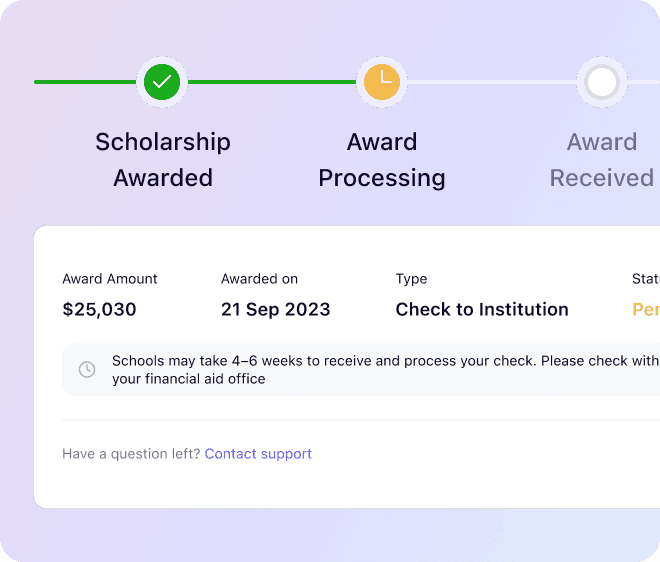
Award checks will be sent to the financial aid office of the winner's academic institution in their name to be applied to their tuition, and in the name of their institution (depending on the school's requirements). If the award is for a qualified educational non-tuition expense, we will work with the winner directly to distribute the award and make sure it goes towards qualified expenses.
How will my scholarship application be verified?
Before we award the scholarship, the winner will be required to confirm their academic enrollment status. Depending on the circumstances, verification of Student ID and/or their most recent transcript will be required.
How should I get in touch with questions?
If you have any questions about this scholarship or the Bold.org platform, just email contact@bold.org and we’ll get back to you as quickly as we can.
Does the scholarship have terms and conditions?
Yes. The terms and conditions for this scholarship can be found here.
97% of students don't win scholarships. We’re here to change that.