Attends high school within 50 miles of Hercules, CA
Education Level:
GPA:
Field of Study:
Background:
High school senior
3.0 GPA or higher
Engineering or science
Attends high school within 50 miles of Hercules, CA
Bio-Rad creates reliable, easy-to-use tools that help scientists and medical professionals better understand health and disease. For more than 70 years, we’ve focused on making a meaningful difference in labs and hospitals—and our mission is, “we advance discovery and save lives, together.” Bio-Rad also recognizes the importance of being involved in our local communities and uplifting the next generation of students who may become the scientists and engineers of tomorrow.
The Bio-Rad Scholarship Program provides financial assistance to deserving, graduating high school students who wish to pursue careers in science or engineering. Applications are evaluated based on students’ personal connection to science and engineering; the originality, clarity, and persuasiveness of their answers to essay questions; and their personal alignment with Bio-Rad’s mission and values. Bio-Rad's values include Focused, Accountable, Sustainable, and Together.
This scholarship aims to support students who are preparing to graduate from high school and pursue higher education.
This scholarship offers two awards at the $3,000 level, the Ron Mardigian Scholarship and the David and Alice Schwartz Scholarship. The Ron Mardigian Scholarship was created in the memory of the late Ron Mardigian, who spearheaded Bio-Rad’s educational program in the 1990s, while the David and Alice Schwartz Scholarship was created to honor David and Alice Schwartz, who founded Bio-Rad in 1952 to accelerate the scientific research process.
Any graduating, college-bound high school senior who is pursuing engineering or science with at least a 3.0 GPA may apply for this scholarship opportunity if they attend a high school within 50 miles of Hercules, CA. Please note: Dependents of Bio-Rad employees should apply to the Bio-Rad Employee Dependent Scholarship instead of this opportunity.
To apply, respond to one of the prompts below about the power of science and engineering, future advancements in the field, or who your heroes are. Please also submit a letter of recommendation.
Bio-Rad may award additional scholarship awards per location based on the pool of qualified applicants, up to an additional $30,000 for the 2026 cycle.
Selection Criteria:
Ambition, Drive, Impact
Essay Topic Requirements
Please respond to one of the following prompts:
1. How is science or engineering making life better for people across the globe right now?
2. What do you think the next big scientific or engineering advancement will be, and how will it affect society globally? (Please be as specific as possible.)
3. Who are your heroes in science or engineering? (Please describe their contributions and explain their importance.)
400–600 words
Attachment Requirements
Please submit your letter of recommendation.
File limits: 1–3 files
$38,000
1st winner$3,000
2nd winner$3,000
3rd winner$2,000
4th winner$2,000
Awarded
Application Deadline
Jun 6, 2026
Winners Announced
Jul 9, 2026
Education Level
High School
2
Contributions
Share
Explore All Kinds of Scholarships for All Kinds of Students
My hero in science is not someone I know only through a textbook, research article, or history lesson. She is someone who sat across from me in an exam room and helped me understand my own body when I felt like it had become a stranger to me. My scientific hero is Dr. Vo.
When I was struggling with PCOS and an eating disorder, my body felt unfamiliar to me. I did not fully understand why I was experiencing the symptoms I was, or why my health felt so complicated and difficult to explain. PCOS affected far more than my physical health. It shaped my confidence, my relationship with food, and the way I viewed my own body. Combined with an eating disorder, it created a cycle of confusion and frustration that made me feel isolated inside experiences I could not clearly put into words.
What made Dr. Vo extraordinary was not only her expertise, but the way she applied it. She never reduced me to a diagnosis or a list of symptoms. Instead, she treated me like a whole person. She answered my questions with patience, explained the science behind my condition in ways I could understand, and made me feel that my experiences were real and worthy of attention. In moments when I felt disconnected from my own body, Dr. Vo gave me language, clarity, and direction. She turned what felt like silent confusion into something I could begin to understand and confront.
That is why she became my hero in science. She showed me that medicine is not only about treatment. It is about empowering people with understanding. She reminded me that scientific knowledge becomes most powerful when it is paired with compassion. For the first time, I saw science not as something distant or abstract, but as something deeply personal and transformative.
More importantly, Dr. Vo pushed me to think beyond recovery. She encouraged me to see my growth not as the end of a difficult chapter, but as the beginning of a purpose. She helped me realize that what I had learned through my own health struggles could become something larger than myself. Instead of allowing my experiences with PCOS to remain only personal challenges, she inspired me to turn them into innovation.
Because of that influence, I began pursuing research in women’s health with a renewed sense of purpose. I now work with Dr. Maheedhar Kodali from Texas A&M to explore how GLP drugs affect PCOS and hormone cycles. That research is especially meaningful to me because it sits at the intersection of lived experience and scientific inquiry. I know firsthand how misunderstood PCOS can be and how urgently women’s health needs more attention, better treatments, and deeper research. Studying how GLP medications may shape hormonal regulation and symptom management allows me to contribute to questions that matter not just academically, but personally and clinically.
In many ways, that research exists because of Dr. Vo. She was the first person who made me believe that my experiences could become a foundation for discovery rather than something I simply had to endure. She taught me that healing and innovation are not separate paths. Sometimes, one becomes the reason for the other.
Because of her, I want to keep asking questions, pursuing research, and advocating for women whose health concerns are too often overlooked. Dr. Vo did not just help me heal. She helped me imagine how I could transform my growth into work that improves the lives of others.
My heroes in science/engineering are the educators who are shaping the minds of future generations. Specifically, it has been my great science teachers who imbued me with love for science and challenged me to become the best thinker I could be.
Ms. Penglin was my freshman Living Earth teacher, and it was also her first year teaching high school. What impressed me the most about her was that students were not afraid to ask her questions. She had almost built a brand for herself for being a great explainer of scientific concepts, without making you feel dumb for asking questions. That was a core reason why I asked her to be the advisor for my Biology Club, knowing her guidance and openness to new challenges would make my club successful. Ms. Penglin’s passion for teaching seeps into the minds of students and future scientists, ensuring them that their curiosity deserves to be prioritized.
Mr. Adams walks his Engineering students through complex challenges while ensuring that they are the main masterminds behind solving their problems. He asked important questions like ‘Would this be the best way of doing things?’ or ‘Would Isabel have additional helpful thoughts?’ getting the cogs of his students' minds to spin constantly and innovate to the best version of themselves. He does so in a soft manner, which I respect as his critiques are shown to be from a place of care and not just merely doing his job. Mr. Adam’s style of teaching ensures his students become autonomous and intelligent, independent thinkers–a valuable skill to have stepping into the STEM field.
Ms. Masiha is obsessed with Jurassic Parks, tearing up when my friends and I gifted her a replica of the mosquito stuck in amber resin, the main catalyst of the Jurassic Parks franchise. Her voice goes higher when lecturing about microbiology, and she would constantly show the class exciting news every week. She has gone above and beyond, showing me many opportunities I never would have reached out for beyond the classroom that correspond to my interest in biomedical sciences. Her excitement about science sparks my and my peers’ interest in science further, like a contagious disease.
Every scientist can only be successful thanks to the heroes who showed them the ropes in their early days. Scientific educators around the globe shared the same amazing traits as my science teachers, teaching students to be confidently curious, self-reliable, and enthralled in their craft, weaving the capes of the next generation of innovators.
Sitting in Chinese class, I learned when ancient alchemists searched for the elixir of immortality, they accidentally stumbled upon gunpowder. Ironically, their attempt to evade death eventually delivered it to millions. I, too, became haunted by the idea of living forever. Immortality would change the world forever.
Diving headfirst into TED Talks and literature, I learned that our cells already carry an enzyme called TERT that can slow aging. By maintaining protective caps on the ends of our chromosomes, TERT gives cells endless replicative abilities, allowing them to stay alive long after they normally would. It seemed almost magical but it seemed too good to be true. If we already had the key to immortality within our cells, then why isn’t it used?
I later found my answer: Cancer.
It turns out that when TERT is active, that “immortality” becomes cancer. Paradoxically, the same enzyme that could make you live forever could also kill you.
But I saw something more. If TERT lets cancer divide indefinitely, couldn’t taking it away make cancer die off? I lay in bed unable to sleep, fantasizing over my new fixation. At first, the answer seemed obvious: destroying TERT equals no cancer. But looking into it further, I found that TERT did have a role in healthy cells by maintaining stem cells, so destroying TERT directly would spell disaster. Seemingly hopeless, I wondered what other interventions were possible.
That question drove me to Dr. Costello’s UCSF Lab where I became obsessed, not with TERT itself, but with GABP, the protein that turns TERT on in only cancer cells. Rather than target TERT directly, if I could control TERT activation in only cancer cells, I could end cancer immortality while keeping stem cells alive.
I envisioned sending GABP to the cell’s recycling system, destroying it entirely. It failed. On paper, it made perfect sense. But in real cancer cells, weeks of meticulous design amounted to nothing. After another round of reviewing and redesigning, I finally saw the slowed cancer growth I was pursuing. By attaching a “degrader” I was able to weaponize a subunit of GABP against itself, causing GABP to be sent to the proteasome and degraded, preventing it from ever activating TERT in cancer cells.
While on the stage of the International Science and Engineering Fair, receiving my Second Place Grand Award, I came to a realization that my experiments were never just about cancer. My search started with immortality, but I had stumbled upon something far more significant.
The next major scientific advancement will not be immortality itself, but the ability to precisely control the protein pathways that determine how cells function.
For centuries, medicine has relied on treating symptoms, but scientists are learning how to control the root cause of those symptoms by regulating proteins. However, transcription factors, the main regulators of the cell, have remained difficult. Due to their size and lack of small molecule binding sites, traditional drugs refuse to work. However, my approach finally allows for an effective way to target transcription factors through degradation. And this is only the beginning.
By manipulating transcription factors, altering signaling pathways, and changing protein expression, we can reprogram cells at the proteomic level. We can cure genetic diseases without the need for invasive changes in the DNA. Researchers are already exploring ways to stimulate the growth of new teeth, restore hearing, and regenerate limbs.
Rather than treat thousands of diseases individually, we may gain the ability to rewrite the pathways that cause them. Those same technologies may one day repair spinal cord injuries, reverse neurodegenerative disorders, or even, grant true immortality.
The Next Big Advancement
During my medical manufacturing engineering internship at SMC Ltd., I was tasked with updating design drawings and assisting with product improvements. I quickly learned that engineering is often less about creating something entirely new and more about solving hundreds of small problems. Watching experienced engineers analyze designs, test solutions, and make decisions showed me how much time and effort goes into finding the best answer. That experience led me to think about how artificial intelligence could transform the field. I believe the next major scientific advancement will be Artificial General Intelligence (AGI), a type of AI that can think, learn, and solve problems across many different areas rather than being limited to a single task.
What makes AGI so exciting is its potential to help solve challenges that have affected society for years. During my internship, I saw how engineers relied on data, testing, and collaboration to improve products. AGI could take that process to an entirely new level by analyzing enormous amounts of information in a fraction of the time. Researchers could use it to identify new treatments for diseases, develop cleaner energy sources, improve food production, and create innovative solutions to environmental issues such as climate change. Instead of spending months sorting through data, experts could focus more on evaluating solutions and making informed decisions.
The workplace would likely change as well. Some repetitive tasks could become automated, allowing people to focus on work that requires creativity, leadership, and critical thinking. While some jobs may be replaced, new opportunities would emerge as industries adapt to the technology. History has shown that major technological advances often create concerns about job loss, yet they also open the door to new careers and industries. The rise of computers and the internet are examples of innovations that transformed the workforce while creating opportunities that previously did not exist.
Another area where AGI could have a significant impact is education. Students around the world could gain access to personalized learning tools that adapt to their individual strengths and weaknesses. A student in a remote community could receive the same quality of instruction as someone attending a highly funded school. By making education more accessible, AGI could help reduce learning gaps and create opportunities for people regardless of their location or circumstances.
Of course, AGI would also present important challenges. Society would need to address issues such as privacy, security, and the ethical use of artificial intelligence. Governments, educators, and technology companies would need to work together to ensure that AGI is developed responsibly and benefits society as a whole.
Overall, I believe AGI has the potential to become one of the most important advancements of the twenty-first century. My internship gave me a firsthand look at how engineers solve problems and use technology to improve the world around them. AGI could amplify those efforts on a global scale, helping humanity tackle complex challenges and create a better future for generations to come.
Salesian College Preparatory High SchoolEl Sobrante, CA
Response to Prompt #3
"Excellence of performance will transcend artificial barriers.” Spoken like a true hero, these are the famous words uttered by Dr. Charles Richard Drew to his students at Freedman’s Hospital in Washington, D.C., where he trained and mentored Black surgeons.
Born June 3, 1904, in Washington, D.C., Dr. Charles Drew was a pioneering surgeon, medical researcher, and educator. His most notable accomplishment was the development of techniques used for long-term storage of blood plasma, which earned him the sobriquet "Father of the Blood Bank". Dr. Charles Drew’s techniques revolutionized emergency medicine and laid the groundwork for organizing America's first large-scale blood banks. He discovered that plasma contained no blood cells; therefore, it could be transfused into anyone regardless of their blood type. His findings first proved crucial in preserving lives of American and allied soldiers during World War II. His process for safely drying and reconstituting plasma, made it easy to transport to the battlefield.
As a prominent scientist, Dr. Charles Drew received many accolades throughout his career. After resigning from his post with the Red Cross in protest of their scientifically unfounded, racially segregated blood donation policies, he dedicated his career to teaching and training the next generation of Black surgeons at Howard University. It’s here that he taught on the premise that if you are highly skilled at your craft, you need not worry so much about racism and other barriers designed to stifle Blacks’ progress.
Triumphant efforts in STEM are also evident in [civil] engineering. Iconic bridges such as the Golden Gate and Bay Bridge here in the Bay Area attract tourists from around the world that come to gaze at their structural magnificence. Not only are they awesome in appearance, they’re also crucial forms of infrastructure. But I would be remiss if I did not acknowledge and pay homage to a noteworthy individual that contributed to civil engineering feats that preceded the aforementioned. Heroic figures such as Emily Warren Roebling, who is perhaps one of the most famous figures in civil and traffic engineering.
Born September 23, 1843, in Cold Spring, New York, Emily Warren Roebling was educated at the Georgetown Visitation Convent, a prestigious all-girls school in Washington, D.C. She later became an advocate for women’s suffrage and social services for the poor.
During the latter part of the Civil War, Emily met Washington Roebling and the two were married in 1865. At the time, Washington Roebling was the chief engineer overseeing the construction of the Brooklyn Bridge. However, when Washington fell ill, Emily took over as chief engineer (fearing her husband would lose the contract). Although Washington officially remained the chief engineer and oversaw some work from home through a telescope, it was Emily who visited the construction site daily, attended board meetings, and managed the project. She studied everything she possibly could about bridge construction; it was her mission to see the project to fruition. She once said, “I have more brains, common sense, and know-how generally than any two engineers civil or uncivil that I have ever met.”
Emily maintained discretion during the decade she assumed the duties of chief engineer. Finally, on May 24, 1883, the Brooklyn Bridge opened to the public. At the time, it was the longest suspension bridge in the world and Emily Warren Roebling would be the first to walk cross it.
As we approach 250 years as an independent nation, let us be reminded of what truly makes our nation great: the ability of two minorities, from different backgrounds, whose heroism in STEM contributed to the fabric of American society, despite political climate.
I think the next big scientific or engineering advancement is already coalescing and will soon have far-reaching effects on society: the merging of artificial intelligence with physical systems, creating intelligent machines that can perceive, decide and benefit humans in many ways including safety, efficiency and productivity, and improved health and comfort.
AI is getting a lot of research and development dollars as the race is on to discover how it can be utilized and monetized. In just a few years it has gone from ChatGPT, a tool that provides human-like responses to queries, to being able to design new chemical formulas and predict protein folding. If we extrapolate this trend further, the possibilities of AI are tremendous: essentially, the ability to do whatever the human brain can conceive but faster, more accurately and more efficiently, and even be able to learn from the experience faster than humans could and come up with better methods on their own. Then, engineers will devise ways to interface this next generation artificial intelligence with machines and devices which will open up a new era in human civilization where much of the day-to-day routines in cities, states, and countries are carried out mostly by artificial intelligence machines. This will result in profound changes to society, and life as we know it.
For simplicity, I’ll refer to AI machines as “intelligent machines/ devices.” One example already in use is self-driving cars like Tesla and Waymo, which use a combination of sensors and traffic pattern recognition data interfaced with the mechanical systems to control the car. In fact, I rode in a Waymo self-driving car last year and it performed spectacularly. Secondly, the DaVinci robotic surgical assistant which adds precision to surgeries by controlling the instruments and imaging the internal body structures and recognizing things that the surgeon might miss. Lastly, wearable med tech devices that monitor various biometrics and warn of potential health issues before they manifest.
Intelligent machines that are currently in development include those that involve interfacing the brain directly to computers that control robotic limbs. This could be life-changing technology for paraplegic or stroke victims, or, in the case of intelligent eye prosthetics, legally blind individuals. In disaster response, intelligent robots could enter collapsed buildings or hazardous environments where humans cannot safely go and make split-second, life-saving decisions based on their machine learning. In education, adaptive systems could respond to each student’s needs in real time, making learning more personal and effective. Intelligent teacher robots will play a larger role in education, where they can give one-on-one attention to children who have learning disabilities.
Looking further out, intelligent machines will comprise entire systems that humans depend on, such as in industry, energy, agriculture, transportation and social services. These intelligent components will communicate with one another, compile and analyze data through sensors thus growing more intelligent by the day, and modify actions in real time based on the data. This will increase efficiency and productivity perhaps more than ten-fold. I can imagine farmers being able to produce more food using less water, city traffic flowing smoothly throughout the day, manufacturing plants producing more widgets for less, and elderly parents living independently longer.
I believe that in the near future, machines will not just be tools anymore: they’ll be collaborators with us humans, constantly learning, adjusting, and helping us do more with less strain, less waste, less uncertainty, and more safety. In short, the merging of AI and machines will be most powerful and impactful in the everyday systems that service human needs and keep the world running smoothly.
Ever since I was little, my ambitions made it hard for me to figure out what exactly I wanted to do. But there was always a pattern found in each of my dreams involving my future in a career, and it was that I was making some kind of impact on the world. I bounced around paleontology, political roles, and engineering. But then came a day when I saw something that changed my life after watching the movie Big Hero 6, and that was robotics. I saw how much a creative mind could change, and I was inspired. This led me to pursue any robotics activities I could.
Inspiration has been a fundamental part of my journey in robotics since it is what has allowed me to learn, network, and create my own impact. One of my heroes who embodies this inspiration to me is Dean Kamen, who is a businessman, an inventor holding over 1,000 patents, and the creator of a program I hold dear, FIRST Robotics. What is inspiring to me about him is not all of the choices he made, but the things he invented and designed specifically to change the lives of many. He took the initiative to solve problems others wouldn't see potential or gain in to enable the disabled with the iBot wheelchair, hydrate those with limited access to safely drinkable water with the Slingshot water purification, and introduce convenient ways to travel with Segway electric scooters.
Another inspiration of mine would be Hiro Hamada (yes the fictional character from Big Hero 6). He is a very talented robotics engineer but he had to learn where to use his intelligence. He faced struggles in his life that can make you steer from your path but ultimately, he chose to make choices for the better and meet new people who could help him along the way. He taught me how rewarding it is to overcome struggles, how inspiring it is to keep moving forward, and how cool robotics is all in one.
A final inspiration of mine would be my parents. They always supported me and taught me things I needed to know to learn how to be an engineer, despite them not being official engineers. They taught me how to problem solve, work with a team, and always pushed me to pursue big things in my life. All in all, I wouldn't be where I am or have done what I have done without the work of my heroes. I thank them all.
Prompt 3:
I have two main heroes in science, Dr. Mikhail Oskarovich Varshavski (Dr. Mike) and Dr. Edward Jenner. Dr. Mike is a family medicine physician who practices in New Jersey and a YouTuber. Dr. Edward Jenner was the person who invented the first vaccine. They are both sources of inspiration for me because of their great contributions to medicine and science in general.
Dr. Mike makes entertaining YouTube videos teaching his viewers about how to stay healthy and that has gotten him up to 14.9 million subscribers. In addition to that, he also has 5.3 billion views in total on his channel. He is a family medicine physician, the same kind of physician I want to be. Like him, I also want to make YouTube videos teaching others about the importance of staying healthy and how to do it. He is one of the reasons why I chose family medicine.
Dr. Edward Jenner was an English physician and scientist. He created the first vaccine, the smallpox vaccine. He discovered that infecting people with cowpox granted them immunity from smallpox. Being the first vaccine, the world was in awe of this new idea. His work opened the door for the fascinating and extremely important world of vaccines. I plan to do research on vaccines and how to create new ones in college and medical school.
Along with Dr. Mike's YouTube videos, I have others reasons why I want to become a family medicine physician. I was born and raised in Oakland, California, a city riddled by poverty and homelessness so I often see people in my community who desperately need medical care but are unable to access it. I want to do my part in fixing that problem. I hate to see people in my community suffer. I am interested in medicine for that reason and because it has affected me personally. My grandmother died of cancer just before the COVID-19 pandemic started and if it were not for medical professionals, she would have passed a lot earlier. Also, my grandfather is currently battling stage 3 lung cancer and medicine has been extremely helpful in keeping him relatively fine. Neither of my immigrant parents attended college so I am a first generation college student. College is extremely expensive but I am confident that I will be able to cope with the debt and succeed.
Before being able to achieve my goal of becoming a family medicine physician, I have to go through the necessary education. First is a bachelor’s degree, I am doing human biology at UC Davis. Next is completing medical school. Then it is residency, hopefully in family medicine. Lastly, I would finally be an independent family medicine physician. I will come back to Oakland to practice as a family medicine physician because this city has raised me and I will forever be indebted to it. This has been my dream since I was a kid.
So far to bring me closer to my goal, I have grown my leadership skills. I am currently on the fundraising committee of the Oakland Tech Key Club. I organize and oversee fundraising events. I have also attended several leadership camps to further build my leadership skills. One of those events is called Rotary Youth Leadership Awards. There, I hosted the Speech and Debate workshop. I was responsible for introducing and making outros for the workshop participants. Through this experience, I learned the importance of working with others to complete a task. By working with others, I was able to make the experience for everyone as memorable as it was.
When I think of scientific heroes, I think of my family. Not all of them are blood-related, but they saved me and countless others.
My family is my dad, his friends, and all his colleagues who work at UCSF Benioff Children’s Hospital. Respiratory therapists my dad taught, nurses my dad works with, doctors my dad admires. For privacy’s sake, I won’t name any names, but I'll name what they are: healthcare workers who persevere with smiles. The perseverance can be minute: the hour long commute my dad takes from Fairfield to San Francisco for the sake of keeping his job there after we moved from Daly City. Or, they can be massive: what follows my dad back from a night shift, sitting silently on the couch after a shower, contemplating how he tried his best to save the sickest baby he was in charge of hours earlier. Yet, he and these workers continue, maintaining kindness they’ve built through training to heal.
These heroes may not be at the forefront of research, nor do they brandish medals regarding cures, but what they do is put those accomplishments of others’ to good use. From being born jaundiced to anaphylactic shock due to contaminated school food, to severe lymph node infections and bedridden-ness—I was and am very sick kid, and when worst came to shove, my dad would always consult colleagues at UCSF for guidance and a spot in the pediatrics’ ward every time my neck became swollen and limited in range, every time my throat welled up all I could swallow was warm water (and ice cold Ito En behind his back. Sorry!).
Even now in Solano, my dad’s knowledge always comes back to me, de-escalating panic attacks, reminders to pace myself after athletic injury. Going to parties with his colleagues may be filled with laughter, drinks I can’t touch, and gossip about delusional young coworkers, but when any hints towards pain are dropped, especially around children, their concern is unmatched.
I think what makes integrity in a healthcare worker is their natural concern and the instinct to act. With them being these family friends of mine, it can feel overbearing, but they’ve accompanied me in true sickness. It’s not annoying when Tito Rudel is making sure he's giving me the IV because he’s the best at it, or when Tita Quendy and I gossip about her coworkers as she wraps my knee, securing a misplaced cap. It’s never embarrassing when Tita Len barges into my room with waters and constantly asking, “Did you pee? Maumihi ka? You don’t want dialysis, girl.” It’s never malicious—the concern about even the most silly human functions is just love.
Medicine intertwines with consideration. That knowledge is their secret superpower. Because when a kid breaks their knee, a mother is too weak to push, a baby can’t breathe, my dad has the splints and aid kit, the reassurance and exercises to instruct, the pump, breathing machine, and tube that travels the baby’s throat to simulate respiration when its body becomes frailer. Despite fear, he moves intentionally like all the others, inspiring me as they witnessed my worst moments.
When my throat swells, my body aches from shock, I panic, yelp, cry—Dad says, even if he too is panicking, watching me: “Breathe.”
I breathe. I remember how. Oxygen, conversion, bronchioles, capillaries. Like he taught.
That simple reminder makes me believe he and my family are superheroes. They don’t freeze in place. With all the love in their heart, with every inch close to death, they move. They mean it. And it means a lot to me.
2. A highly plausible next major scientific and engineering breakthrough is asteroid mining. Starting with extracting water and basic materials in space and later expanding to high‑value metals from near‑Earth asteroids. This transition from merely visiting asteroids to using them as resource depots could fundamentally reshape how humanity accesses critical materials and expands into the solar system.
The first big step will not be giant platinum payloads landing on Earth, but robotic missions that autonomously locate, anchor to, and process small near‑Earth asteroids. Early missions have already shown that it is possible to rendezvous with and sample asteroids. Building on that, the key innovation will be robotic processing units to extract water and volatiles directly on the asteroid. That water can be purified for life support or split into hydrogen and oxygen to make rocket propellant. Once this becomes reliable and somewhat affordable, we effectively gain gas stations and supply depots in space.
The immediate global impact is on space infrastructure rather than everyday consumer markets. Launching mass from Earth is extremely expensive; if spacecraft can refuel and restock materials in orbit or in cislunar space, missions to the Moon, Mars, and the outer planets become cheaper and more frequent. This could enable permanent human and robotic outposts, large orbital factories, and even solar‑power satellites built mostly from asteroid‑derived metals. In turn, that supports Earth’s clean‑energy transition by making it more realistic to generate large amounts of power in space and beam it down, or by supplying abundant metals for batteries, electronics, and renewable‑energy hardware without tearing up as much of Earth’s surface.
Over the longer term, asteroid mining may extend to nickel‑iron and platinum‑group metals. Asteroids contain much higher metal concentrations than typical terrestrial ore deposits. Carefully managed, this could ease pressure on fragile ecosystems and reduce environmentally destructive mining in biodiverse or conflict‑affected areas. It might also cut some of the leverage that a few countries currently hold over global supplies of rare, strategically important minerals. However, these benefits are not automatic. A rapid influx of metals, if dumped into terrestrial markets without coordination, could destabilize economies that depend heavily on traditional mining and deepen inequality between high‑tech and resource‑exporting nations.
This leads to my questioning the geopolitical and ethical side of the breakthrough. Current space treaties say that outer space is the “province of all humankind,” but they are vague about who owns extracted resources and how benefits should be shared. As asteroid mining becomes practical, there will be fierce debates over property rights, licensing, and taxation. Without thoughtful global governance, a small group of wealthy states and corporations could monopolize off‑world resources, concentrating power and wealth even further. If new frameworks deliberately build in profit‑sharing mechanisms, technology transfer, and open scientific access, asteroid mining could be used to support more equitable development to fund climate adaptation, education, or health initiatives worldwide.
Finally, this advancement will change how societies think about scarcity and risk. On one hand, knowing that the solar system holds enough metals and volatiles to support civilization for millennia could reduce resource scarcity mindsets and make long‑term planning easier. On the other, it may tempt humanity to see Earth as less unique or to defer hard choices about consumption and conservation. The net effect will depend on how deliberately we integrate asteroid resources into a broader ethic of planetary stewardship.
In sum, the move to autonomous, in‑space resource extraction from asteroids—starting with water and moving toward metals—has the potential to unlock a space‑based industrial ecosystem, relieve some terrestrial resource constraints, and significantly shift global economic and political dynamics, for better or for worse.
University of Washington-Seattle CampusBerkeley, CA
The possibility of my throat swelling to the point where I couldn't breathe was a potentially lethal consequence of my severe peanut allergy. This frightening threat controlled me, placing embarrassing constraints on my life from an early age. I sat alone in the school cafeteria, birthday dinners were often ruined by cross-contamination, and most of my Halloween candy remained uneaten. It seemed that I’d live with these inconveniences forever, but after meeting with several doctors, we found a possible solution: Oral Immunotherapy.
The treatment was straightforward, but not without risks: I would slowly build up my tolerance by increasing my exposure to peanuts; if my immune system became overwhelmed, I could go into anaphylactic shock. For eight months, my Fridays became five-hour ordeals in the doctor’s office. Despite the controlled environment, with gradual changes in dosage and constant vital checks, there were times when my immune system would short-circuit, sending my body into anaphylactic shock.
These risks were not confined to my doctor’s office; during a home treatment, I reacted and needed to be rushed to the hospital. My surroundings blurred, and a burning sensation consumed my body as my throat swelled and my stomach throbbed. The pain was excruciating; I desperately cried out to pull over so my mother could administer an EpiPen. The experience was terrifying, and I contemplated quitting, but the fear that shook me in those moments also fostered an unwavering curiosity.
As a result of my experience, I became motivated to test, calculate, and experiment in my school's Biotechnology Program. The same scales I used to measure my doses every night were also used to weigh the components of my solutions in class. When learning about epinephrine’s role in cell signaling, I was intrigued, as it had saved my life on multiple occasions. The web of connections between the treatment I was bound to and the concepts I explored in class made science a subject that resonated with me.
Over the Summer, the weeks spent running experiments and analyzing data as a Cardiovascular Cell Biology intern shifted my perspective. It felt gratifying, like I belonged. This wasn't just because of my excitement to be in the lab; it seemed as though I was paying it forward. Being able to eat something every day, which at one point could have killed me, was only possible due to groundbreaking scientific advances. The realization that the work I was doing in Research & Development was once done by someone else to develop Oral Immunotherapy was what impacted me the most. It demonstrated that, while there is still much to be discovered in science, the solutions produced have the potential to benefit millions.
Oral Immunotherapy remains a long, tedious, and sometimes scary journey, with my treatments continuing today. Nevertheless, it led me towards a commitment to science, cultivated through the traits, lessons, and perspectives drawn from this unconventional experience. As I look back at how far I've come and ahead to what my future holds, I realize that it all stems from this one scientific breakthrough, my own personal experiment. This experience has helped me realize that my passion for science isn’t solely for experimentation and research: it’s a passion to work on something that can help others, change others, just as I was through Oral Immunotherapy.
Bold.org is Built to Make Scholarships Feel Possible
Step 01
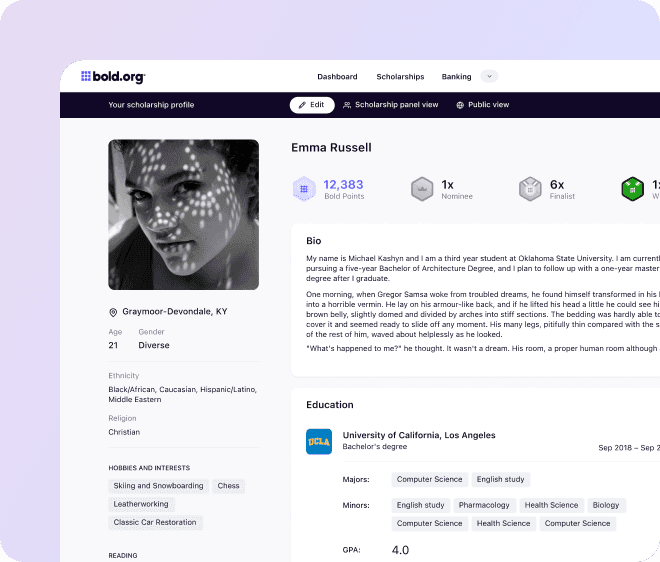
Start with your story
Bold.org helps students show donors who they are beyond a transcript.
Step 02
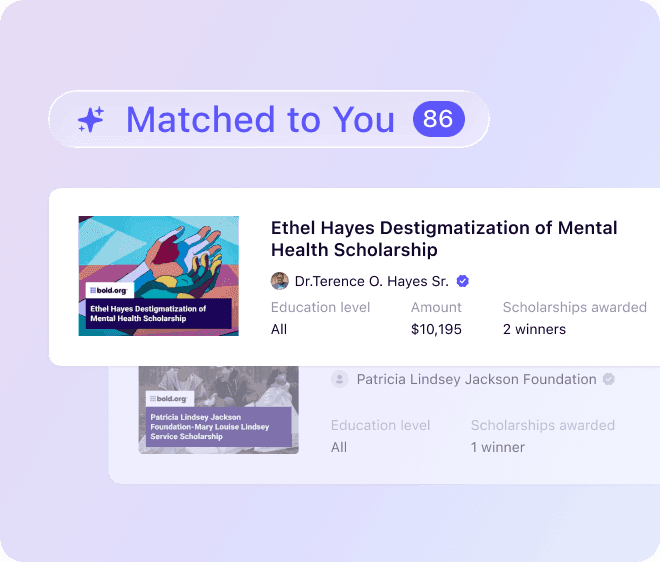
Where scholarships are awarded
Every scholarship is funded by donors and managed directly on Bold.org.
Step 03
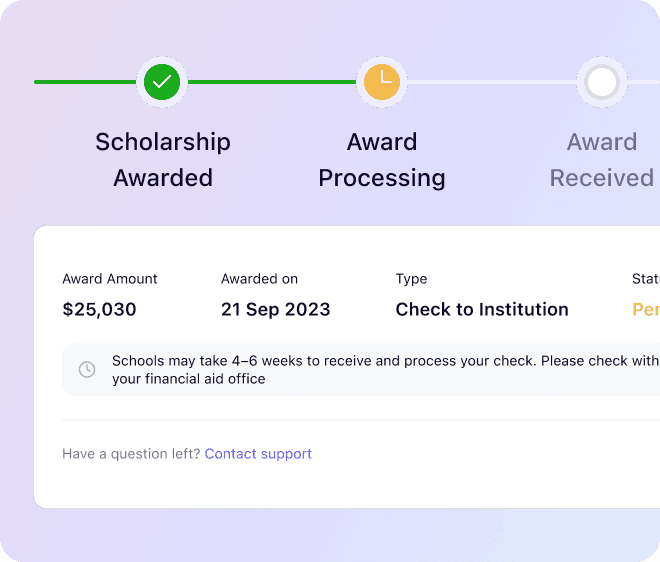
Fund your future
Scholarship dollars are disbursed through Bold.org to help students pay for school.
FAQ
When is the scholarship application deadline?
The application deadline is Jun 6, 2026. Winners will be announced on Jul 9, 2026.
How will scholarship application information be used?
Your privacy is a top priority on the Bold.org platform, and you can find our privacy policy in full here. You may opt out of communications from Bold.org at any time, and unless we’ve first notified you and gotten your consent, you’ll never receive communication from any third parties related to personal information you give us.
What is the scholarship award?
Award amounts per winner are designated by the donor. Check the award amount for a detailed breakdown.
When will the scholarship winner be chosen? How will they be notified?
The winner will be publicly announced on Jul 9, 2026. Prior to the announcement date, we may contact finalists with additional questions about their application. We will work with donors to review all applications according to the scholarship criteria. Winners will be chosen based on the merit of their application.
How will the scholarship award be paid?
Award checks will be sent to the financial aid office of the winner's academic institution or future academic institution in their name to be applied to their tuition, and in the name of their institution (depending on the school's requirements). If the award is for a qualified educational non-tuition expense, we will work with the winner directly to distribute the award and make sure it goes towards qualified expenses.
How will my scholarship application be verified?
Before we award the scholarship, the winner will be required to confirm their academic enrollment status. Depending on the circumstances, verification of Student ID and/or their most recent transcript will be required.
How should I get in touch with questions?
If you have any questions about this scholarship or the Bold.org platform, just email contact@bold.org and we’ll get back to you as quickly as we can.
Does the scholarship have terms and conditions?
Yes. The terms and conditions for this scholarship can be found here.
97% of students don't win scholarships. We’re here to change that.