Bio-Rad creates reliable, easy-to-use tools that help scientists and medical professionals better understand health and disease. For more than 70 years, we’ve focused on making a meaningful difference in labs and hospitals—and our mission is, “we advance discovery and save lives, together.” Bio-Rad also recognizes the importance of being involved in our local communities and uplifting the next generation of students who may become the scientists and engineers of tomorrow.
The Bio-Rad Scholarship Program provides financial assistance to deserving, graduating high school students who wish to pursue careers in science or engineering. Applications are evaluated based on students’ personal connection to science and engineering; the originality, clarity, and persuasiveness of their answers to essay questions; and their personal alignment with Bio-Rad’s mission and values. Bio-Rad's values include Focused, Accountable, Sustainable, and Together.
This scholarship aims to support students who are preparing to graduate from high school and pursue higher education.
Any graduating, college-bound high school senior pursuing engineering or science with at least a 3.0 GPA, whose close relative or legal guardian is a Bio-Rad employee, may apply to this scholarship.
To apply, respond to one of the prompts below about the power of science and engineering, future advancements in the field, or who your heroes are and share the name and relation to a Bio-Rad employee. Please also submit a letter of recommendation.
Selection Criteria:
Ambition, Drive, Impact
Essay Topic Requirements
State the name of the Bio-Rad Employee and your relation.
AND
Please respond to one of the following prompts:
1. How is science or engineering making life better for people across the globe right now?
2. What do you think the next big scientific or engineering advancement will be, and how will it affect society globally? (Please be as specific as possible.)
3. Who are your heroes in science or engineering? (Please describe their contributions and explain their importance.)
400–600 words
Attachment Requirements
Please submit a letter of recommendation.
File limits: 1–3 files
$12,000
6 winners, $2,000 each
Awarded
Application Deadline
Jun 6, 2026
Winners Announced
Jul 9, 2026
Education Level
High School
1
Contribution
Share
Explore All Kinds of Scholarships for All Kinds of Students
What do you think the next big scientific or engineering advancement will be, and how will it affect society globally?
I believe it will be the development and proliferation of nuclear fission power plants.
This fall, I will be attending Oregon State University and majoring in Nuclear Engineering. Nuclear power plants have always fascinated me. At a basic level, it’s incredibly simple: use atomic-scale chain reaction to boil water. Yet in practice, it is incredibly precise and challenging to perfect. This challenge and feeling of charting an untamed territory of physics is what drew me to nuclear engineering.
I believe that when nuclear fusion is mastered, and usable for widespread energy production, it will be the most important achievement of human history. We’re right on the cusp of developing this technology with companies around the world, one of which being Helion Energy here in Redmond, WA.
Our current trajectory as a species and a planet is not sustainable. We’ve been burning the candle from both ends since the start of the industrial revolution when we started using absurd amounts of coal and oil. We’ve already pumped so much CO2 into the environment, and with our current means of producing energy, it’s not getting much better. The rise of data centers and artificial intelligence have created extreme demand for clean energy production, and the industries’ futures rely completely on the access to large quantities of electricity.
Widespread use of nuclear fusion for energy production would slash global emissions. This is one of the only large-scale clean energy sources we have. Switching to such a clean method of energy production would allow us to stop or possibly even reverse global warming, while still providing enough energy to progress as a species.
As well as clean, renewable energy, it has the incredible benefit of producing helium as a byproduct of hydrogen fusion. The world may soon face massive helium shortages, which will heavily impact the semiconductor and medical industries. These industries are backbones of the world, relying heavily or fully on helium for chip production and MRI machines, respectively. If many countries around the world produced even a fraction of their energy with nuclear fusion, we would have more helium than we could ever need.
My greatest dream is to be a part of making this a reality. The number of people this technology could help is unfathomable. It would change the course of human history, powering and protecting our planet for generations. Humans have always had a drive for conquering unknown frontiers, and what if we could say the next one we conquered was the Sun?
Both of my parents have worked at Bio-Rad, and my mother, Ellen Steen, still does. A little over 20 years ago, my parents met at Bio-Rad through a volleyball team. My father, R. Perry Steen, resigned to become a stay-at-home parent for my brother and I. He has recently gotten a master's degree in teaching biology and is looking to become a high school teacher.
Bio-Rad Employee: Sandeep Baliga, Father
Growing up, I always thought that engineering was about finding the right answer. It was not until I spent weeks redesigning the same landing leg mounting system over and over that I understood what engineering actually is: a process of testing ideas, finding what works, and finally building something that helps people.
This year, I worked with a friend on a thrust vector control (TVC) self landing rocket. The goal was to build a rocket that is able to actively correct its orientation during flight and landing in a controlled manner. While my friend focused on the software, I was responsible for the hardware. Using Autodesk Fusion 360, I designed the entire airframe, developed landing legs and their mounting system, and made sure to make space for the gimbal mechanism that controls the rocket’s orientation.
The landing leg mounting system became one of my hardest problems. It needed to be strong enough to absorb landing forces without shifting or breaking, while staying light enough not to compromise how high the rocket goes. After finding out that a single set of legs could not distribute the landing load reliably, I redesigned the entire system to use two sets of legs, spreading the impact force across a wider base and making the structure significantly more stable. Another big challenge was designing the ejection system for our dual motor configuration. The rocket uses a larger F motor for launch and a smaller D motor for the landing burn, so the spent F motor has to be ejected mid flight before the D motor can provide thrust for landing. I solved this by designing a lip into the motor tube that holds the F motor in place during launch. When the D motor ignites, its thrust pushes down against the F motor, and that force is what breaks the lip and ejects it out the bottom of the rocket, clearing the way for the landing burn. This process taught me more about engineering than any class had.
That kind of problem solving is happening everywhere right now. Engineers are making solar panels cheap enough that communities that never had reliable electricity are getting it for the first time. Researchers are developing diagnostic tools that can detect diseases earlier and even more accurately than ever before. Which means more people get treated in time. Even in aerospace, reusable rockets are starting to bring down the cost of getting to space, opening up possibilities that did not exist a few years ago.
Those same principles, careful design, testing, iteration, and reliability, show up in every field of engineering. In medical technology, an unreliable instrument is not just an inconvenience. It can affect a diagnosis. In scientific research, a poorly designed tool limits what discoveries are even possible. Four years ago my dad started working at Bio-Rad, and since then I have gotten a closer look at what it means to do engineering in service of something that actually matters. Seeing that up close is a big part of why I want to pursue this field.
As I begin my mechanical engineering degree at UC Irvine, I want to contribute to that same mission. Science expands what we understand about the world, and engineering turns those discoveries into tools that can actually help people. I am excited to be a part of a field where getting the design right, and then making it better, matters.
Bio-Rad Employee: Suja Sojan, my mother.
How is science or engineering making life better for people across the globe right now?
I’ll answer this question by sharing my own experience.
I grew up in the small town of Rindge, New Hampshire, and I lived there until the age of six, when my family moved to California. Growing up, I stood out in many ways. I struggled to speak and couldn’t even hold a crayon in kindergarten. After undergoing several tests and evaluations, I was diagnosed with dyspraxia, a condition that affected my motor and coordination skills. I then received a system of support, including adaptive technologies, speech and physical therapy, learning tools, and an Individualized Education Plan (IEP) by first grade. While I felt ashamed being singled out in front of the class for IEP sessions, it was working. I worked hard and overcame many of my early struggles, eventually coming off IEP, and found myself excelling in academics.
We visit my parents’ hometown in India regularly. During one such trip, I sat in as a guest student at a rural school where forty students shared two worn-out iPads. It was a striking contrast compared to my upbringing in Silicon Valley, where Teslas outnumber squirrels, innovation is constant, and technology is everywhere. As someone who is neurodivergent, I couldn’t help but wonder: if I had grown up there, would I have received the same diagnosis, support, or encouragement? Or would I have been dismissed as an “idiot “by the community and left behind?
I began to understand how access to technology can shape opportunity and realized how privileged I was. So when I won a hackathon in junior year that paved the way to a summer internship at XceptionalLEARNING, a company focused on making special education tools accessible globally, I saw an opportunity to act.
Today, advances in engineering and computer science are helping lower the geographic and economic barriers. We live in a connected world, and knowledge is not limited to classrooms or libraries. The evolution from physical textbooks to the internet and now to powerful AI systems that can personalize and expand learning has fundamentally changed how people access information.
So, during my summer internship at XceptionalLEARNING, I worked alongside software developers to integrate AI into the backend of a learning application, including emotion detection and voice‑input features that support interactive learning. These features helped create an AI-assisted personalized virtual assistant for learners with disabilities.
Three months flew by, and when school resumed, I continued working to see the project to completion. When the feature I helped develop was finally released in Indian languages, I felt an indescribable sense of fulfillment. I had helped create something that now helps children halfway across the world access the same kind of therapies that once supported me during my IEP days.
This is a small example of how science and engineering are improving lives today. Along with scientific breakthroughs and engineering advancements, increasing accessibility is also making life better for people across the globe. Advances in medicine improve diagnosis, helping people live longer and more fulfilled lives. Educational technology is making learning more inclusive and accessible. Engineering is improving infrastructure, housing, and transportation. And breakthroughs in computer science continue to transform how we process and share information at an unprecedented scale.
Science and technology provided the tools for my diagnosis, the treatments that helped me overcome my challenges, and are now allowing me to help others with similar challenges today.
Thank you very much for considering my application for this scholarship!
My father, Kenneth Oh, is the Global Marketing Manager II at the BioRad campus in Hercules. He is my greatest hero in the field of science, since he has changed the lives of my family and I massively through simply pursuing his interest and career in the field of science. He has grown my curiosity in a plethora of subsections of STEM, as well as changing the way I think and process things.
From a young age, as any adult in my life can tell you, I have always been full of questions. Why is the sky blue? Why do Dad’s beard hairs feel like cactus needles? Is my hypothesis that all elements are on a spectrum of radioactivity correct? Despite my age, my dad never shied away from answering my questions like an adult, and it furthered my comprehension of scientific topics. It taught me ways that scientists express their findings and ideas, and most importantly, challenged me to think on a level I may not have been comfortable to think about before, making me at a level more advanced than my age. Also, he always took my questions as an opportunity to create more abstract discussion, answering them with more statements and theory, opening up more broad scopes of what we could have been talking about. I love how he can never stay on the original topic I ask him about, because it forges connections that I never would have made, opening my mind to advanced topics, constantly stoking the fire that my questions ignite. He is adept at keeping theoretical and scientific speculation thriving in conversations I have with him, which I believe makes me a smarter and more creative person.
Though it sounds cliché as a math major, I often find patterns or effects much easier to plot through the use of common metrics and statistics. Often, I plan out elaborate experiments in my head where I can create a personal experiment, where I find a number or percent that will tell me if one phenomenon is actually present, or if one particular thing can cause another thing. For example, I want to understand if the magnesium glycinate that I am taking will actually improve my sleep, so I consider using a fitness watch to track the amounts of REM and deep sleep I get on and off the vitamin. Maybe this isn’t so different from the conventional methods of taking a vitamin and tracking its effects in your head to see if you can feel its influence, but I believe subtle nuances like this make my cognition a little more unique and in the format of science. I believe this comes from the way my dad taught me to approach finding solutions, as he did in my 4th-grade science project, which went on to win a school award for excellence. He taught me the scientific method and ways to accurately measure and contrast things that you are measuring so that you can answer a question in the best way possible.
Without my father to steadily drive abstract thought in my developing mind through scientific exploration, I am not sure of the person I would be today. I am glad that he has shaped me the way I am because I see the unique perspective I have and the figurative science goggles I wear every day as a strength, which gives me a point of view others may not consider. I believe that makes me a valuable part of discussions, and it is all thanks to my hero, my dad.
Bio-Rad Employee Dependent Scholarship
June Russell
June 4th, 2026
Relation to Bio-Rad Employee: Bryan Russell, Father
As someone who has multiple diabetic family members, I’ve done a lot of research on the disease’s history. Before the 1920s, a diabetes diagnosis was considered a death sentence until insulin was discovered. In the 1980s, patients had to constantly measure their glucose levels through their urine, and in the 21st early century something called continuous glucose monitoring entered the diabetic-care field. Continuous glucose monitoring allowed diabetic patients to constantly have access to how high or low their glucose levels were in their blood.
New biomedical technology that has entered the diabetic care field has saved countless lives.
In April, I got the pleasure of visiting The University of California Santa Barbara’s Open House Day. To my excitement, I got to sit in on a lecture taught by Dr. Kevin W. Plaxco. Dr. Plaxco is a chemistry professor who teaches mostly graduate students at the University, so I was grateful to hear what he had been working on with fellow Gauchos and scientists like myself. He had been working on Molecular Diagnostics, but more specifically- drug monitoring. He and his team were trying to apply what had worked so well with continuous glucose monitoring to other prescription drugs.
Hearing about this inspired me. I began to see how the lives of people around me could be affected by this technology. One of my friends, for instance, had previously taken Lithium for clinical depression. However, it became dangerous when her psychiatrist kept adjusting the dose. She became at risk for lithium toxicity, and had to switch to a different medication. Now imagine if her medical team had access to this technology. Globally, continuous drug monitoring could revolutionize healthcare for patients by making drug dosing quicker, more precise, and more safe.
After I came home from UCSB’s Open House Day, I immediately submitted my statement of intent to register. Their research programs, especially in biomedical engineering, couldn’t compare to any other school I was considering. At UCSB, I look forward to finding my own spot on a research project. I hope I will get the chance to work with other young scientists like myself to make medical care easier for both the patient and the doctor. After all, everyone deserves to have safe access to prescription drugs and that’s why I believe continuous drug monitoring is the next scientific advancement that will change lives.
How it works
Bold.org is Built to Make Scholarships Feel Possible
Step 01
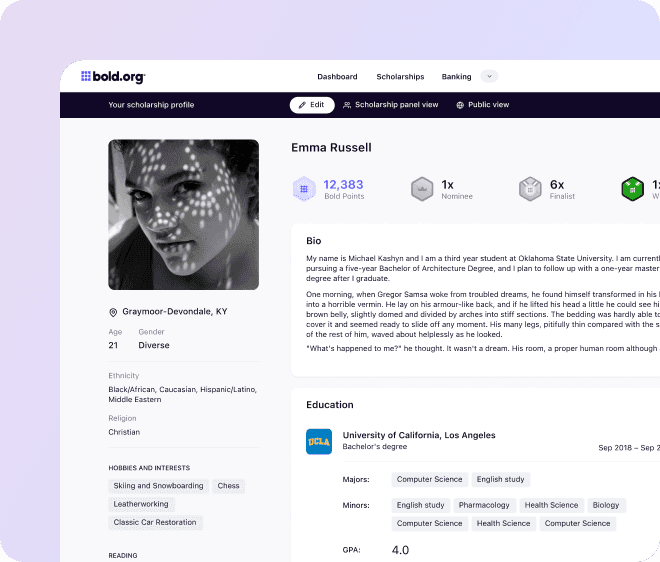
Start with your story
Bold.org helps students show donors who they are beyond a transcript.
Step 02
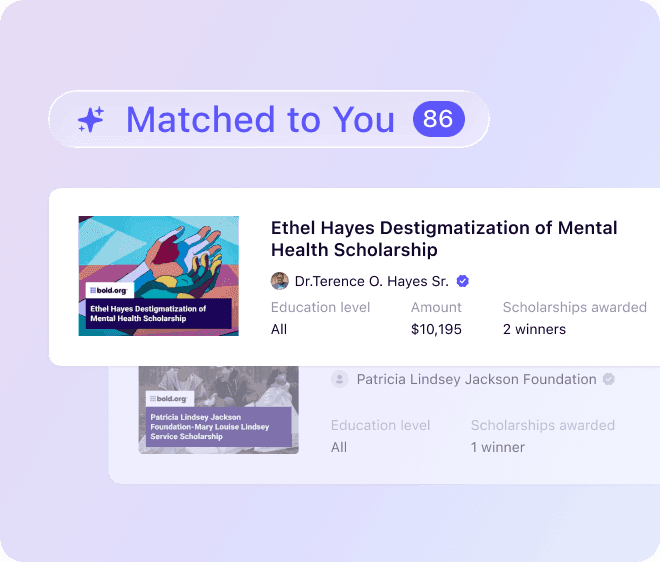
Where scholarships are awarded
Every scholarship is funded by donors and managed directly on Bold.org.
Step 03
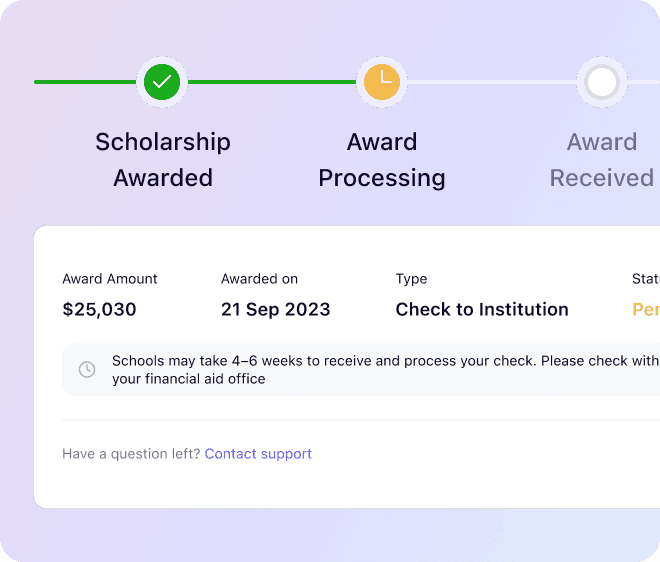
Fund your future
Scholarship dollars are disbursed through Bold.org to help students pay for school.
FAQ
When is the scholarship application deadline?
The application deadline is Jun 6, 2026. Winners will be announced on Jul 9, 2026.
How will scholarship application information be used?
Your privacy is a top priority on the Bold.org platform, and you can find our privacy policy in full here. You may opt out of communications from Bold.org at any time, and unless we’ve first notified you and gotten your consent, you’ll never receive communication from any third parties related to personal information you give us.
What is the scholarship award?
Award amounts per winner are designated by the donor. Check the award amount for a detailed breakdown.
When will the scholarship winner be chosen? How will they be notified?
The winner will be publicly announced on Jul 9, 2026. Prior to the announcement date, we may contact finalists with additional questions about their application. We will work with donors to review all applications according to the scholarship criteria. Winners will be chosen based on the merit of their application.
How will the scholarship award be paid?
Award checks will be sent to the financial aid office of the winner's academic institution or future academic institution in their name to be applied to their tuition, and in the name of their institution (depending on the school's requirements). If the award is for a qualified educational non-tuition expense, we will work with the winner directly to distribute the award and make sure it goes towards qualified expenses.
How will my scholarship application be verified?
Before we award the scholarship, the winner will be required to confirm their academic enrollment status. Depending on the circumstances, verification of Student ID and/or their most recent transcript will be required.
How should I get in touch with questions?
If you have any questions about this scholarship or the Bold.org platform, just email contact@bold.org and we’ll get back to you as quickly as we can.
Does the scholarship have terms and conditions?
Yes. The terms and conditions for this scholarship can be found here.
97% of students don't win scholarships. We’re here to change that.