Hobbies and interests
3D Modeling
Aerospace
Artificial Intelligence
Badminton
Basketball
Aviation
Chess
Coding And Computer Science
Cooking
Cricket
Engineering
Driving
Exercise And Fitness
Martial Arts
Mathematics
Mentoring
Mythology
Motorsports
Movies And Film
Physics
Photography and Photo Editing
Piano
Robotics
Statistics
STEM
Teaching
Weightlifting
Volunteering
Aryan Baliga Punjalkatte
1x
Finalist1x
Winner
Aryan Baliga Punjalkatte
1x
Finalist1x
WinnerBio
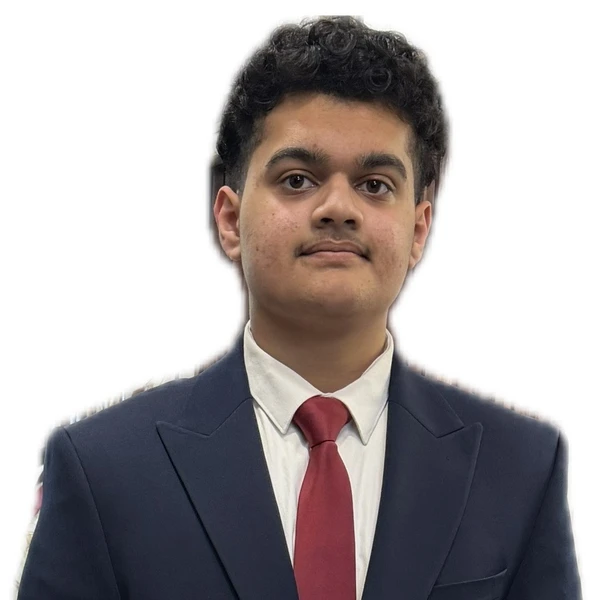
I'm a high school senior and fascinated about physics and how technology help improve our lives. Hence, I am interested in mechanical engineering which gives me an opportunity to solve real problems hands-on. My key interest areas are Aerospace and Automotive specifically Formula 1 cars. I like building technical skills through coursework and personal projects, especially when there's a creative side to it that connects to problems and physical needs. Growing up, I moved around different cities and countries, so I adapt quickly and comprehend how people from different cultures think and communicate. I speak and understand 5 different languages, and I always attempt to bring that same curiosity to pretty much everything I work on. Outside to my academics, I have completed 4 years of Karate and have accomplished Brown-Belt certification. I have also mastered playing Piano. I have in the past participated in Cricket and Basketball teams prior to the Covid era.
Education
Albany High
High SchoolMiscellaneous
Desired degree level:
Bachelor's degree program
Majors of interest:
- Mechanical Engineering
Career
Dream career field:
Mechanical or Industrial Engineering
Dream career goals:
Sports
Cricket
Club2014 – 20162 years
Basketball
Club2017 – 20203 years
Arts
Personal
Photography2022 – Present
Public services
Volunteering
Upchieve — Tutor and Mentor2023 – 2025
Future Interests
Volunteering
Bio-Rad Employee Dependent Scholarship
WinnerBio-Rad Employee: Sandeep Baliga, Father
Growing up, I always thought that engineering was about finding the right answer. It was not until I spent weeks redesigning the same landing leg mounting system over and over that I understood what engineering actually is: a process of testing ideas, finding what works, and finally building something that helps people.
This year, I worked with a friend on a thrust vector control (TVC) self landing rocket. The goal was to build a rocket that is able to actively correct its orientation during flight and landing in a controlled manner. While my friend focused on the software, I was responsible for the hardware. Using Autodesk Fusion 360, I designed the entire airframe, developed landing legs and their mounting system, and made sure to make space for the gimbal mechanism that controls the rocket’s orientation.
The landing leg mounting system became one of my hardest problems. It needed to be strong enough to absorb landing forces without shifting or breaking, while staying light enough not to compromise how high the rocket goes. After finding out that a single set of legs could not distribute the landing load reliably, I redesigned the entire system to use two sets of legs, spreading the impact force across a wider base and making the structure significantly more stable. Another big challenge was designing the ejection system for our dual motor configuration. The rocket uses a larger F motor for launch and a smaller D motor for the landing burn, so the spent F motor has to be ejected mid flight before the D motor can provide thrust for landing. I solved this by designing a lip into the motor tube that holds the F motor in place during launch. When the D motor ignites, its thrust pushes down against the F motor, and that force is what breaks the lip and ejects it out the bottom of the rocket, clearing the way for the landing burn. This process taught me more about engineering than any class had.
That kind of problem solving is happening everywhere right now. Engineers are making solar panels cheap enough that communities that never had reliable electricity are getting it for the first time. Researchers are developing diagnostic tools that can detect diseases earlier and even more accurately than ever before. Which means more people get treated in time. Even in aerospace, reusable rockets are starting to bring down the cost of getting to space, opening up possibilities that did not exist a few years ago.
Those same principles, careful design, testing, iteration, and reliability, show up in every field of engineering. In medical technology, an unreliable instrument is not just an inconvenience. It can affect a diagnosis. In scientific research, a poorly designed tool limits what discoveries are even possible. Four years ago my dad started working at Bio-Rad, and since then I have gotten a closer look at what it means to do engineering in service of something that actually matters. Seeing that up close is a big part of why I want to pursue this field.
As I begin my mechanical engineering degree at UC Irvine, I want to contribute to that same mission. Science expands what we understand about the world, and engineering turns those discoveries into tools that can actually help people. I am excited to be a part of a field where getting the design right, and then making it better, matters.