The Social Change Fund United, founded in 2020 by philanthropists, entrepreneurs, and NBA superstars Carmelo Anthony, Chris Paul, and Dwyane Wade, was created to address critical issues impacting the Black community.
Social Change Fund United is proud to continue its annual scholarship opportunity to support students at Historically Black Colleges and Universities (HBCUs) pursuing business-related degrees.
This scholarship will award $5,000 each to eight students who are committed to driving social change and economic empowerment through their careers in business.
Eligible applicants are undergraduate and graduate students currently enrolled in business-related majors at HBCUs.
To apply, please share your vision for how economic empowerment and business innovation can uplift underrepresented communities and create lasting change. Describe how your career goals in business align with your desire to drive social equity and justice.
Selection Criteria:
Ambition, Drive, Impact
Essay Topic Requirements
To apply, please share your vision for how economic empowerment and business innovation can uplift underrepresented communities and create lasting change. Describe how your career goals in business align with your desire to drive social equity and justice.
400–600 words
$40,000
8 winners, $5,000 each
Awarded
Application Deadline
Jun 15, 2026
Winners Announced
Jul 24, 2026
Education Level
Undergraduate, Graduate
Share
Explore All Kinds of Scholarships for All Kinds of Students
Florida Agricultural and Mechanical UniversityHyattsville, MD
Economic empowerment and business innovation, when done responsibly, can create lasting change by helping underrepresented communities gain access to opportunity and ownership. To me, economic empowerment is not only about earning income. It is about having the resources, knowledge, and support to make informed decisions, build something sustainable, and reinvest in the people and communities around you. When businesses are intentional, they can create jobs, support education, expand access to information, and open doors that have historically been closed.
One of the most powerful tools for this work is data. Many opportunity gaps in education, income, health, and career access are easy to overlook when they are only discussed in general terms. Data helps make those gaps visible. It allows us to ask better questions, understand where systems are falling short, and create solutions based on evidence instead of assumptions. In my experience, data is most meaningful when it is connected to real people and real outcomes.
As a Computer Information Systems major, I have seen how data and business strategy can work together to support equity. Through my work with the FAMU Computational Data Science Research Group, I have helped analyze and visualize socioeconomic and educational data to better understand inclusive growth and opportunity gaps. That experience showed me that technical skills are important, but they are even more powerful when used to help leaders make better decisions. It also helped me understand that innovation is not always about creating something brand new. Sometimes innovation means improving systems so they serve more people fairly.
My interest in business has also grown through my internships and leadership experiences. At the Export-Import Bank, I was exposed to global business development and saw how economic decisions can impact communities and markets around the world. Through INROADS, I learned more about career access, professional development, and the importance of creating pathways for students who may not always have direct exposure to corporate opportunities. These experiences helped me see business as more than profit. Business can be a tool for access, strategy, and long-term community growth.
My career goal is to work at the intersection of data, technology, and business. I want to use data to identify problems, but I also want to help shape the strategies that come from those insights. As I continue growing as a data professional, I want to build practical tools such as dashboards, reports, and data models that help organizations identify opportunity gaps, measure progress, and make decisions that lead to real community impact. Whether I am working in consulting, corporate strategy, data analytics, or eventually pursuing an MBA, my goal is to be in spaces where I can influence decisions that affect access and opportunity.
Economic empowerment also requires mentorship and representation. Many students from underrepresented backgrounds have the ability to succeed in business and technology, but they may not always know what paths are available to them. I know how important exposure can be because programs, mentors, and opportunities have helped shape my own journey. That is why I want to continue mentoring, speaking with students, and sharing what I learn along the way.
My vision is to be part of a generation that uses business innovation with purpose. I want to help build systems where underrepresented communities are not just included after decisions are made, but considered from the beginning. By combining data analysis, business strategy, and a commitment to equity, I hope to contribute to solutions that create access, build wealth, and support lasting change.
University of the District of ColumbiaWashington, DC
"Not just another statistic," those were the words I declared at the 2018 March for Our Lives rally in Washington, D.C., speaking in front of over 850,000 people and televised to millions nationwide. But behind those words was a 17-year-old boy from Northeast Washington, D.C., grieving the loss of his twin brother, Zaire, who was shot and killed on his way home from a college prep course. That moment did not just define my voice, it ignited my mission.
For the past nine years, I have dedicated my life to addressing the systemic issues that drive violence in our communities. My journey has taught me that gun violence is not simply a public safety issue, it is an economic one. Homicide is the leading cause of death for Black males aged 15–24, and research consistently shows that these rates are highest in communities where economic disparities are the greatest. Poverty, lack of opportunity, and decades of disinvestment create conditions where violence becomes more prevalent. To address violence, we must address its root cause: economic inequality.
This understanding shapes my career goals. I earned my Bachelor's degree in Public Relations from Florida A&M University and am currently pursuing a Master of Business Administration with a concentration in Public Management at the University of the District of Columbia. These two disciplines, communication and business leadership, equip me with the tools to not only lead organizations, but to tell the stories of the communities they serve and advocate for the resources they deserve.
My vision is to lead organizations that invest directly in underrepresented communities, creating access to economic opportunity, workforce development, and systemic change. Specifically, I aspire to serve the most economically challenged neighborhoods in my hometown of Washington, D.C. When communities are economically stronger, young Black men have greater opportunities to beat the odds, to become positive contributors to their communities rather than another statistic. The impact extends beyond one generation; economic investment today creates a safer, more prosperous foundation for the next.
One of the most powerful forms of business innovation is leadership that reflects the communities being served. As someone who grew up in the very neighborhoods I seek to uplift, I bring both the academic preparation and the lived experience necessary to lead with authenticity and impact. My background in Public Relations equips me to amplify the voices of underserved communities, attract investment, and shift narratives. My MBA in Public Management equips me to build and sustain organizations that are data-driven, accountable, and designed to deliver measurable change. Together, these tools allow me to approach community development differently, not as an outsider looking in, but as a native son committed to the place that shaped me.
My brother was a victim of the very systemic failures I am committed to dismantling, and his legacy is the fuel that drives my mission. This scholarship would support my education, invest in a mission I am deeply passionate about, and advance the belief that economic empowerment is the foundation for safer, stronger, and more equitable communities for generations to come.
My grandparents are from Little Rock, Arkansas, and worked incredibly hard their entire lives. My grandaddy was in the Air Force, and my grandmother was a school teacher. My parents did too. Both of them spent decades serving others as officers in The Salvation Army. They dedicated their careers to helping families find stability, housing, and opportunity. But only more recently (in 2020) did my parents purchase their first home. Watching that shaped how I think about opportunity, wealth, and what it means to create something that lasts beyond one generation. It also shaped my belief that lasting economic empowerment requires more than helping people meet their immediate needs. Underrepresented communities need equitable access to business ownership, capital, professional networks, and opportunities to build something that will endure.
Throughout my career in philanthropy, I have worked to expand access to those opportunities. I have led grantmaking operations, cross-sector partnerships, and community investment initiatives focused on economic mobility and systems change. At the California Black Freedom Fund, I oversaw grantmaking operations that resulted in millions of dollars in investments in community organizations. At the Sacramento Region Community Foundation, I managed regional scholarship and grantmaking portfolio supporting postsecondary access and career pathways for first-generation students and young men of color. And while serving as the Director of Communications for the Lodi District Chamber of Commerce, my interest in business ownership and building wealth for myself grew. Working with more than 600 small businesses, I saw how local companies built their family’s wealth, created jobs, and became part of their communities’ identities.
My career goal is to work at the intersection of corporate social responsibility, community investment, and entrepreneurship through acquisition. I want to help companies align their resources and business strategies with the priorities of the communities they serve while building a business of my own.
As I move forward to complete my dual Master of Business Administration and Master of Social Work at Howard University, I haven’t just imagined the career I see for myself; I’ve actively pursued it. I completed Georgetown University’s Executive Certificate in Philanthropic Leadership to strengthen my ability to lead and drive change within the philanthropic sector. I completed a social finance fellowship with a Washington, D.C.-based consulting firm, where I gained experience in research and supporting nonprofits through revenue-generation strategies. As a graduate assistant with Howard University’s PNC Center for Entrepreneurship, I expanded my exposure to entrepreneurship and the steps required to start and own a business. Currently, I am conducting informational interviews with leaders at Fortune 500 companies, including JPMorgan Chase, Wells Fargo, and Bank of America, and have developed mentoring relationships within each organization as I prepare to transition into corporate social responsibility. At the same time, I am beginning my search for a company to acquire and grow through entrepreneurship through acquisition.
My HBCU business education and roles that I've had while in school have strengthened my ability to evaluate companies, manage operations, lead teams, and build sustainable growth strategies. My social work education has ensured that equity, community voice, and human impact remain central to those strategies. And I've acquired this learning and skill-building through the support of scholarships and loans. Had it not been for financial aid, I would not be a student or leader here. By aligning business strategy with community priorities, I hope to demonstrate that business success and social justice are not competing goals. Together, they can leave a more secure foundation for future generations.
When asked why I started NextPlay, most expect a business story.
The truth is, it started with frustration.
Growing up in the Dallas, Texas area, more specifically in Collin County. I constantly met talented people whose potential never matched their opportunities. Athletes who deserved recognition couldn't get in front of the right people. Creators with incredible ideas lacked the equipment or platform to share them. Small businesses struggled to compete simply because no one knew they existed. I realized that talent was everywhere—but access wasn't.
I couldn't stop thinking about that.
So when I arrived at Prairie View A&M University to study Business Management, I didn't want to spend four years learning how to build companies someday. I wanted to build one now. During my freshman year, my co-founder and I launched NextPlay from the ground up. What began as two students with cameras and a vision has grown into an ecosystem supported by three teams working alongside us. That growth didn't happen because we had endless resources—it happened because people believed in one another and proved that relationships can turn an idea into something far greater than anyone imagined.
NextPlay uses storytelling to create opportunity. Every video we produce, every athlete we work with, and every partnership we pursue is built around the idea that visibility can change someone's life. When an athlete lands a brand deal, a local business reaches a new audience, or a young creator gains confidence because their work is finally being seen, that's economic empowerment in action.
Business, to me, isn't about maximizing profit. It's about maximizing possibilities.
Earning my Eagle Scout rank taught me that leadership isn't measured by the number of people following you but by the number of people you choose to serve. That philosophy has become the foundation of everything I build. I don't want success that ends with me. I want success that creates momentum for everyone around me.
Recently, I reflected on how quickly communities can become divided when trust is lost, and people stop investing in one another. It reminded me that real change depends on people choosing to build relationships, create opportunities, and lift each other up rather than tear each other down.
That's why this scholarship means more to me than financial assistance.
As I explored the stories of previous scholars and finalists, I realized this program isn't just funding students—it's connecting people who believe business can be a force for justice. I don't see this community as a list of names but as a network of future collaborators. I hope to exchange ideas with filmmakers, entrepreneurs, and innovators because I believe the intersection of sports, media, and storytelling has the power to redefine how underrepresented communities are seen and valued.
My long-term vision is to grow NextPlay into an ecosystem where athletes, creators, filmmakers, and entrepreneurs don't compete for one seat at the table—they build a bigger table together. I want to create internships, mentorship programs, production opportunities, and business partnerships that allow young people to earn, create, and lead without leaving their communities behind.
I don't measure success by revenue alone. I measure it by how many doors stay open after I walk through them.
If I receive the Social Change Fund United Scholarship, I won't simply use it to earn a degree. I'll use it to keep building something that proves my central thesis: economic empowerment begins with connection, innovation begins with service, and lasting change happens when we stop asking for opportunities and start creating them for each other.
"I don't even recognize this place anymore." Without fail, this is the exclamation my mother, a Washington, D.C., native, makes every time she drops me off at Howard University each semester. A place she remembers as "Chocolate City" is being priced out in front of us both. Her statement always sticks with me because it names something I've watched my whole life without having the words for it.
Community is at the forefront of everything I do. Whether I'm bringing people together through events I produce, mentoring youth inside the juvenile system, or spending time with my friends, I orient my life around the idea that we are responsible to one another. That conviction came from where I'm from.
I grew up in Philadelphia, one of the most impoverished large cities in America, and I watched gentrification grow alongside me. As I've gotten older, everything clicked. Gentrification is not simple. It can bring investment, but at the cost of the people who built the culture that made the neighborhood desirable. There is no real exchange when the demographic that created the culture is pushed out of it. The numbers bear this out: Black homeownership sits around 45 percent compared to 74 percent for white Americans, and that gap alone costs Black communities billions in equity that never passes to the next generation.
I've seen the human cost up close. When I was 14, I watched as my grandmother, 86, lived paycheck to paycheck, which isn't only heartbreaking, it's fundamentally unfair. I've been blessed with access my older brother didn't have growing up, because of where my parents were in their lives at the time—watching him struggle for reasons that had nothing to do with his ability shaped how I understand inequity. I had room to make choices, and those choices trained my judgment.
My career goals grow directly out of this. I want to work in media and entertainment, at the intersection of community, storytelling, culture, and creativity. But my ambition goes beyond creating cool things for cool people; the finish line is alleviating economic disparities in communities that look like the one I grew up in. When I have the capital, I don't want to reverse gentrification; that isn't realistic. I want to build a community development fund that finances affordable housing and keeps existing residents economically tied to their own neighborhoods, paired with a residents' council that gives them real authority over what gets built and who profits. The terms should be set by the people who built the community, not by the capital that arrived after them. Economic inclusion only matters if the community has a hand in shaping the terms.
I also want to build on my parents' work. They opened Suboxone clinics in Kensington, one of the neighborhoods hit hardest by the opioid crisis, to support people that most systems had already written off. They showed me that a business can be a tool for repair rather than extraction, and that you can serve a community while sustaining yourself; a model i intend to scale.
Social equity isn't separate from my business goals. It is the reason I have them. My grandmother spent her life on the wrong side of systems that were never built for her. Every deal I close and every door I open will be aimed at the opposite outcome: putting ownership, decision-making power, and lasting wealth back in the hands of the communities that built the culture everyone else profits from.
Economic empowerment is the ability to access capital, attain education, increase ownership, and create futures unrestricted by systemic inequality. For marginalized communities, particularly Black communities, business innovation becomes an act of resistance. My vision is rooted in the belief that when marginalized people have the resources to create and own, they can lead and reshape the economy.
Conversations about economic development overlook the structural barriers that have historically made wealth-building inaccessible. Predatory lending traps marginalized communities in high-interest debt to strip communities' wealth instead of building it. Limited access to professional and financial networks blocks opportunities for investment, mentorship, and upward mobility, which allows inequality to continue to be prevalent across generations. Business innovation can disrupt these systemic patterns when intentionally designed with equity at its core. Investing in community-based businesses and leveraging technology to make financial tools more accessible will make it easier for marginalized communities to overcome these barriers. It also means valuing businesses for their capacity to sustain communities, not just for profit.
My career goals are grounded at this intersection of business and social justice. I aspire to work in corporate law with a focus on economic justice. Through this work, I aim to use legal frameworks to advocate for equitable business practices and to protect the interests of underserved entrepreneurs, thereby achieving greater equity and helping them grow their businesses. I see law as a critical tool for ensuring that innovation does not come at the expense of equity, which can be accomplished by supporting black-owned businesses by fighting against discriminatory financial policies or systems.
Furthermore, I am interested in building and supporting ventures that prioritize community impact. Through my experiences in social justice initiatives and community-based programs, such as working at a domestic violence shelter, working with my college’s NAACP chapter, and volunteering through my sorority, I have seen firsthand how resource gaps limit potential. I want to be part of creating systems that close those gaps through nonprofit-business partnerships or initiatives that increase financial literacy and access. Economic empowerment should be tangible and measurable.
Attending an HBCU has further shaped my understanding of what is possible when underrepresented communities are empowered rather than marginalized. I’ve seen that power modeled through mentors who have broken barriers in their fields and have made it a priority to reach back, offering guidance, access, and real opportunities. Within Alpha Kappa Alpha Sorority, Incorporated, I have experienced a culture rooted in collective advancement through the way my sisters pour into one another, sharing internship opportunities, exchanging financial literacy resources, and encouraging one another to think expansively about wealth and legacy. Being part of my sorority has reinforced that economic empowerment is about building networks, circulating knowledge, and creating pathways for your community. HBCUs are powerful examples of innovation born out of necessity, historically and continually producing leaders like Stacey Abrams and entrepreneurs despite deep-rooted barriers to access.
My vision is about redistributing power. True economic empowerment challenges who is able to make decisions, and who benefits from growth. By aligning my career in business and law with a commitment to social equity, I hope to contribute to a future in which underrepresented communities are not just surviving within existing systems, but leading and transforming them.
Growing up in Northeast Portland, Oregon, I was surrounded by people who looked like me, yet very few of us had seen examples of success outside the usual paths. In my neighborhood, dreams often stopped at “making it out,” but no one quite knew what “out” looked like. Many of my peers either stayed in Oregon to attend the same universities as generations before them or chose work that felt safe and familiar. Some gave up on the system entirely, believing success wasn't made for people like us.
But I believe economic empowerment and business innovation can be the blueprint for rewriting that story—for changing the trajectory of underrepresented communities like mine. Real, lasting change starts with exposure, opportunity, and the creation of systems that work for us, not against us. That’s the foundation of my vision.
My career goals are deeply rooted in both creativity and justice. As a Marketing major and Film and TV minor at Howard University—an HBCU that changed my life—I’ve found my purpose in storytelling and entrepreneurship. I’m building Shelmor Productions, my future media company, not just to create content but to build infrastructure. I plan to use Shelmor as a vehicle for job creation, mentorship, education, and generational wealth, especially in underserved Black communities.
Economic empowerment means giving people the tools and access they’ve been historically denied. Through Shelmor, I want to invest in local schools, offer scholarships to students who may not have perfect grades but have powerful potential, and fund arts programs that allow youth to explore creativity. Business innovation means using nontraditional methods—like media, digital storytelling, and community-based initiatives—to foster connection, educate, and inspire. I want to host hometown film festivals, partner with schools on creative career pipelines, and create internship opportunities that pay and prepare.
My vision is not just about giving back, but about building up. I believe true social equity happens when people don’t just receive help—they receive ownership, opportunity, and the chance to become leaders in their own right. I want the next generation of Black and Brown creatives to know they don’t have to leave their culture behind to be successful. They can bring their full selves into the room and lead.
This drive comes from my own story. In 2020, during the pandemic, my mom, sister, and I were homeless. We didn’t know what would happen next. But during that time, strangers and organizations offered food, service, and support. It wasn’t just survival—it was love in action. That experience taught me what it feels like to be helped and reminded me of the importance of helping others when I reach a position of power. I don't take that responsibility lightly.
In a world where systemic barriers have held too many of us back for too long, I’m determined to be part of the solution. My career in business is not about wealth for its own sake—it’s about worth, willingness, and widening the path for those who come after me. With every story Shelmor tells and every dollar it makes, I want it to echo one truth: we are worthy, we are powerful, and we can change the world—starting with our own communities.
As a proud Executive MBA candidate at Prairie View A&M University, a historically Black institution rooted in excellence and legacy, I am inspired daily to think critically about how business can serve as a tool for social equity. Economic empowerment and business innovation are not just professional interests, they are my personal missions. I believe both are essential to uplifting underrepresented communities and driving systemic change that lasts.
Growing up in Crockett, Texas, a small, rural town often overlooked in conversations about opportunity, I witnessed firsthand how limited access to resources and economic infrastructure can hinder even the most talented individuals. Yet, I also saw resilience, creativity, and untapped potential. These early experiences shaped my belief that business leaders have a duty to create pathways for those who’ve historically been excluded.
Through my 15+ years in management and now in my current role as a Budget Specialist II, I’ve come to understand how vital financial literacy and equitable economic policy are to building generational wealth. Business innovation can be a transformative force: whether by designing inclusive financial tools, promoting supplier diversity, or launching community-led initiatives that support entrepreneurship. When underrepresented voices are brought to the table—not as tokens, but as decision-makers—real transformation happens.
My career goals reflect my desire to be that decision-maker. I aim to become a Comptroller and, ultimately, a Director or Vice President in finance or business operations. These positions offer the influence and reach to shape organizational culture and investment in ways that promote equity. I want to lead initiatives that reinvest in communities like mine—supporting small businesses, enhancing financial access, and mentoring emerging leaders from underrepresented backgrounds.
My time as a student-athlete at Jarvis Christian University taught me the value of discipline, strategic thinking, and leading by example. Academically, I was a Dean’s List recipient, and in my community work with the Groves Educational Foundation, I’ve seen how targeted outreach can inspire youth and support families. These experiences, coupled with the holistic and culturally affirming education I’m receiving at PVAMU, continue to reinforce my belief that business education—especially at an HBCU—can be a powerful engine for justice.
An HBCU business scholarship would not only help support my academic journey, but also deepen my commitment to this vision. It would be a tangible investment in someone determined to give back through strategic leadership and socially responsible innovation. I am committed to using my skills to break down barriers, build bridges, and help ensure that future generations inherit more opportunities than the last.
I don’t see business and social justice as separate paths—they are the same road. And I plan to walk it with purpose.
Being born and raised in South Los Angeles, in the Crenshaw/Leimert Park district, I witnessed what it looks like to live in an underrepresented community. We have spirit, culture, and pride, but we don’t have the resources that other areas take for granted. The basic things you need, such as quality grocery stores, banks, and places to shop locally, were closed down one after another to the point that there aren’t many left, and the once-vibrant Crenshaw Mall is now an empty shell of what it once was. That reality shaped how I viewed the world — and it’s part of what drives me today.
My parents were fair when it came to giving me things. Once I was in middle school, they made me earn what I wanted, for example, a new pair of sneakers, video games, or money to go out. Whether it was mowing lawns, washing cars, or running errands for neighbors, I had to figure out how to earn what I wanted. I didn’t know what to make of it at the time. But as I grew older, I saw that those lessons prepared me for something bigger. I wasn’t just learning the value of money but also how to be independent. COVID-19 hit, and life for people slowed down — but my ambition didn’t. As many people were sitting at home wondering what to do, I saw it as an opportunity to build something. I started an online business selling custom shoes I’d hand-paint and accessories I made with a cheap 3D printer I found on Amazon. I taught myself how to design, market on social media, and handle customer orders. It started small, but I soon made consistent sales and ran every part of the operation independently. That business became more than just a hustle—it became proof that I could take control of my future.
That experience taught me that business isn’t necessarily about profit but empowerment. Having a little source of income gave me confidence, options, and freedom. It also had me thinking about all the other young people like me in the neighborhood who may have ideas but not the support or resources to help them bring those ideas to fruition.” Now, as a student at Howard University, I find myself surrounded by people who share that same hunger for success and desire to lift our communities. Attending an HBCU has opened my eyes further to the importance of representation and why economic equity is essential.
I want to use my education to create spaces for entrepreneurs in underrepresented communities like Crenshaw and Leimert Park. My long-term vision is to host events at Leimert Park so people can show off their businesses/products and open a business incubator that gives young Black entrepreneurs the resources, guidance, and capital they need to make their ideas become financially sustainable businesses. Our economic empowerment begins in our homes, neighborhoods, and communities. It means teaching people they don’t have to wait for something to be given to them — they can make their own path. This scholarship is more than just financial assistance—it is an investment in someone who has experienced the struggle firsthand and is determined to be a part of the solution.
My grandmother used to keep cash hidden inside books. She didn’t trust banks—not because she lacked financial sense, but because the system had failed her. Growing up in Newark, New Jersey, she experienced redlining firsthand, and after being denied a mortgage for years despite consistent income, she gave up. Instead of interest-bearing accounts or investment portfolios, she relied on cash and caution. This fear is a response shaped by generations of economic betrayal. From the Freedman’s Savings Bank collapse in 1874, which cost formerly enslaved people their first savings, to predatory lending and discriminatory banking practices, Black Americans have long been given reason to be wary. As a child, I never questioned it. As a young Black woman studying accounting at North Carolina A&T, I realize now how deep the damage runs when wealth-building tools are withheld from entire communities.
Generational wealth has long been denied to Black families through discriminatory practices in housing, education, and banking. Today, only 45% of Black Americans own homes compared to 74% of white Americans, according to the U.S. Census Bureau (2022). The gap in homeownership alone costs Black communities billions in lost intergenerational equity. And despite rising college attendance, Black students are still the most likely to borrow, and borrow more, for higher education (Brookings, 2016). This is more than statistics, its a lived reality.
My vision for economic empowerment is rooted in reclaiming access and rewriting systems. So we can enter boardrooms and transform what they value. I plan to become a Certified Public Accountant (CPA), eventually opening a firm that focuses on empowering underserved communities through financial education, tax strategy, and small business development. My goal is to create pathways for families like mine to not only survive, but build, own, and lead.
However, policy must also meet people where they are. Through coursework, internships, and my mentoring experience with high school students in Guilford County, I’ve learned the power of pairing business insight with community context. One solution I advocate for is embedding community-based financial literacy programs within public schools and youth centers, especially in redlined neighborhoods. According to the National Endowment for Financial Education, 88% of U.S. adults say high school did not prepare them to manage money. Teaching budgeting, credit building, and entrepreneurship early can reshape futures.
At the same time, I want to work with HBCUs and local governments to establish “tax equity clinics”- spaces where low-income earners can receive pro bono tax help and learn how to leverage returns toward investment. In 2021, over 20% of eligible families failed to claim the Earned Income Tax Credit (IRS), often due to misinformation or fear. With the right guidance, those refunds can go toward student debt, homeownership, or starting a business. This is how I plan to drive innovation, through systems that work for those who’ve been left out of the equation.
I carry my grandmother’s story with me—her strength, her losses, her resilience. When I enter a meeting or mentor a student, I remember the day I found $300 folded into the pages of a cookbook she gave me. “That’s your college fund,” she said. She didn’t get to see me walk across the stage, but every number I crunch, every policy I write, and every person I serve will be because of her. Economic justice doesn’t begin with wealth, it begins with access. I’m committed to opening that door for others, one spreadsheet, one student and one strategy at a time.
My upbringing in Alief taught me early on that access determines one’s potential. My peers who possessed both great ideas and talent faced uphill battles because we lacked essential resources, mentorship, and exposure rather than a lack of drive. The early understanding I gained ignited my desire to connect creative potential with available opportunities.
While studying at Texas Southern University’s Jesse H. Jones School of Business, I have discovered a community of peers who are constantly generating new ideas. Despite our community's abundant talent pool, many of us encounter systemic obstacles that create unnecessary difficulties for upward mobility. That’s why I chose to study business marketing: I study business marketing to understand the construction of brands and how storytelling and market influence work together. I plan to earn a master's degree in fashion marketing so that I can strengthen underrepresented voices by combining fashion with strategic storytelling.
My understanding of leadership deepened while serving as membership chair for the American Marketing Association (AMA) at TSU. The chapter held multiple events during Fall 2025's AMA Week to create connections between students and industry experts and recruiters, as well as other beneficial resources. The guest speaker unexpectedly canceled their presentation at the last minute. The students had placed their trust in this opportunity. In just one hour we found a replacement speaker because I rapidly connected with our advisor and local contacts. The event didn’t just happen—it had impact. Leadership extends beyond planning because it requires maintaining composure under pressure and ensuring others gain meaningful insights.
Being part of Sigma Gamma Rho Sorority, Inc. keeps me aware of the crucial role service plays alongside sisterhood, scholarship, and service. I continue to champion empowerment through organizing networking events and mentoring others following the path lit by previous trailblazers.
My drive to create a supportive platform for Black creatives and entrepreneurs stems from these experiences. The space I imagine will deliver workshops on personal branding along with financial literacy, marketing strategy, and storytelling skills while remaining culturally relevant and driven by community needs. This platform will serve as a launchpad and support system that focuses on providing access to tools for people who traditionally lack access to them. I’ve encountered numerous talented individuals who need just one opportunity to make their mark. My mission is to close that gap.
My professional journey goes beyond business—it’s about using strategy and creativity to foster community with care. With this scholarship I will advance my vision into actuality, which will develop opportunities for my personal growth and enable others to succeed.
When I was 14, I helped my mother sell homemade candles at a local flea market in South Dallas. We didn’t call it a “business,” but looking back, that table covered in wax-stained cloth was my first lesson in entrepreneurship. I watched how her creativity and grit turned a small idea into real income, enough to help pay bills when times were tough. That experience opened my eyes to the power of business as a tool not just for profit, but for survival, dignity, and ultimately, transformation.
Today, as a senior business management major at an HBCU, my vision is to create systems that allow stories like my mother’s to become the rule, not the exception. I believe economic empowerment and business innovation are essential for uplifting underrepresented communities, especially Black and brown neighborhoods that have long been excluded from access to capital, quality education, and opportunity.
True economic empowerment begins with education and ownership. Too often, underrepresented communities are kept out of the loop when it comes to financial literacy and entrepreneurial strategy. Through my studies and experiences, I’ve learned how business can be used not just to generate income, but to build community wealth. I envision a future where business accelerators are built within urban schools, where minority owned startups receive real mentorship and funding, and where technology is leveraged to democratize access to markets.
Business innovation also plays a key role in creating lasting change. In a world dominated by automation, artificial intelligence, and e-commerce, underrepresented communities deserve a seat at the table of innovation. I want to help build that table. Whether it’s launching mobile platforms for minority freelancers, investing in sustainable local food systems, or supporting tech education for inner-city youth, my goal is to make innovation accessible, equitable, and community-driven.
My career goal is to become a strategic consultant and eventually an investor focused on social enterprises. I want to help small business owners scale their ventures in ways that create jobs, retain cultural identity, and circulate dollars within their communities. Long-term, I aim to establish a fund that backs minority-led businesses with not just capital, but mentorship and ecosystem support. To me, business is not simply about maximizing shareholder value it’s about maximizing human potential.
This scholarship will help me continue my education, deepen my understanding of ethical leadership, and sharpen the tools I need to serve. As I prepare to graduate and step into the world of business, I carry with me not just textbooks and case studies, but the memory of that flea market table and all it represents.
In the end, economic empowerment is about ownership of businesses, of futures, and of the narratives we write for our communities. Through business innovation, I believe we can build systems that don’t just create wealth, but restore justice. I’m committed to being part of that change.
For as long as I can remember, storytelling has been my passion. But as I grew older, I realized that media isn’t just about telling stories—it’s about shaping culture, creating opportunities, and driving change. Today, as a rising junior at Howard University majoring in Strategic Communications with a concentration in Advertising and a minor in Graphic Design, my vision is to build a career at the intersection of creativity, business, and justice.
Economic empowerment begins with visibility and ownership. Growing up, I rarely saw people who looked like me or shared my experiences represented in the media. That lack of representation wasn’t just disheartening, it was disempowering. Now, I aspire to become a Creative Director and eventually launch my own inclusive media agency, focused on amplifying diverse voices and breaking down barriers that have historically excluded underrepresented communities from leadership and ownership in the media industry.
My vision for business innovation involves more than profit, it centers on people. I want to create campaigns that challenge stereotypes, mentor the next generation of creatives, and reinvest in marginalized communities through education, internships, and workforce development. I founded Project Success, a social media initiative helping students, especially those from underserved backgrounds, define success on their own terms. Through accessible content and storytelling, I've reached hundreds of students, offering them tools, representation, and encouragement.
From founding the Black Student Union in high school to leading as Executive Coordinator of the Howard University Royal Court, I’ve always used leadership to elevate others. I see business as a powerful vehicle for social equity—one that can redistribute opportunity, reimagine systems, and rewrite the narrative for communities that have too long been left out.
By blending creativity with purpose, I hope to lead a business that not only delivers results but also drives systemic change. My career goals are grounded in justice, and every step I take is toward building a more inclusive, empowered future.
By blending creativity with purpose, I hope to lead a business that not only delivers results but also drives systemic change. My career goals are grounded in justice, and every step I take is toward building a more inclusive, empowered future.
Receiving the SCFU Scholarship would be instrumental in helping me continue to achieve my goals. It would ease the financial burden of college and allow me to stay focused on my academics, leadership roles, and creative projects. More importantly, it would bring me one step closer to creating a media landscape where everyone, regardless of background, can see themselves reflected and valued.
Growing up, education was always a primary point of emphasis in my family’s values. This was especially true for my late father, a proud Rattler and member of Omega Psi Phi, who instilled in me a deep appreciation for the transformative power of HBCUs. His belief in HBCUs’ impact on students’ lives shaped my understanding of education as more than just a personal endeavor and more towards finding a community, creating a legacy, and creating opportunities for those who come after us. Thus when I chose to attend Fisk University, it wasn’t only for its rich history; it was because I wanted to be part of something greater.
From my first day, I was surrounded by people who challenged me to step up as a leader. Most notably, this same community played a pivotal role in helping me cope with the death of my father which served as a key turning point in my life during my freshman year. Before I knew it a year had passed and I found myself honoring his legacy by joining the Eta Psi Chapter of Omega Psi Phi and serving as President of my chapter of Omega Psi Phi Fraternity while simultaneously directly impacting the campus of Fisk as Student Government Publications Director. Both roles left me with the valuable lesson that it’s not about elevating oneself but lifting others and that leadership is about service and collective growth. This impacted my approach to work and prepared me for future endeavors, including my first few internships and projects.
My first internship with the Los Angeles Lakers was a pivotal experience that reinforced this purpose and clarified how I wanted to make an impact. While working on a social media strategy research project for over 25 professional sports teams, I saw firsthand how teamwork and collective vision lead to impactful results. The Lakers’ emphasis on collaboration showed me that success is built by bringing people together just as in my fraternity and school. This laid the groundwork for my next major collaboration with NASA as an HBCU White House Scholar. Alongside a diverse team, I helped pitch a financial literacy game that aimed to solve youth attention span issues by using NASA’s CBCM technology. Working on this project fueled my passion for leveraging teamwork to create innovative solutions that could directly benefit communities.
Inspired by these experiences, I knew I wanted to make an impact utilizing digital design and business strategy. Thus I founded two businesses, "HBCU Designs" and "The Scholarship Champ," both of which are centered on empowerment and collaboration. Through HBCU Designs, I’ve been able to work closely with students and small businesses, helping them develop strong, lasting brand identities. Our team not only provides services like logos or marketing consultations; we work side-by-side with our clients to ensure their stories are authentically told and their goals achieved. This has profoundly impacted students who might not otherwise have the resources to build their brands.
The Scholarship Champ similarly, focuses on access to education and improvement within the community. With this platform, we intend to help HBCU students find scholarships, and internships, and learn how to secure them. By helping students navigate these opportunities, I’m contributing to their academic and professional growth, which is crucial in leveling the playing field for minority students. All in all my ultimate purpose is to continue building platforms and opportunities that uplift not just individual students but the entire HBCU community as well as honor my late father and the many other mentors that have played a role in my life.
Bold.org is Built to Make Scholarships Feel Possible
Step 01
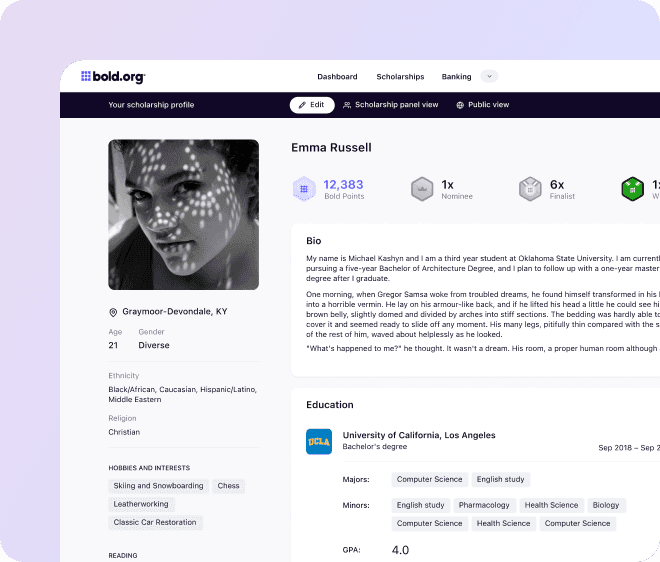
Start with your story
Bold.org helps students show donors who they are beyond a transcript.
Step 02
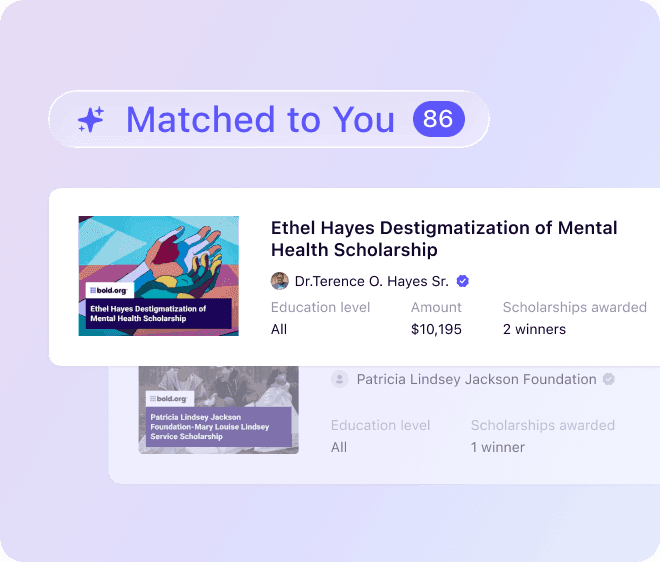
Where scholarships are awarded
Every scholarship is funded by donors and managed directly on Bold.org.
Step 03
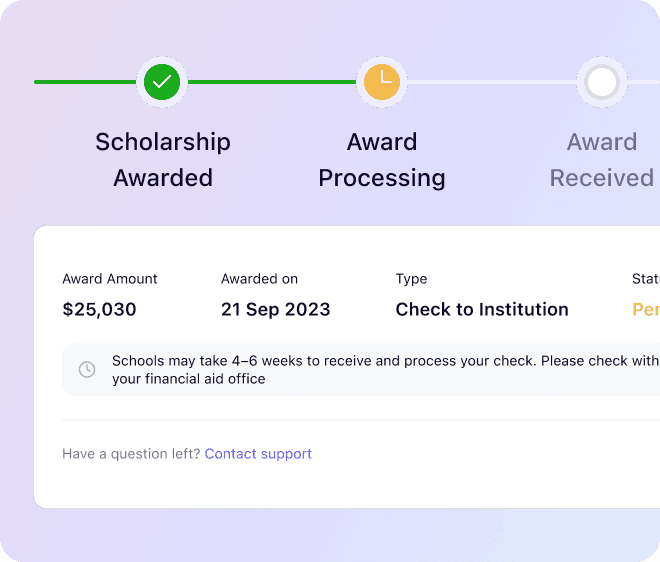
Fund your future
Scholarship dollars are disbursed through Bold.org to help students pay for school.
FAQ
When is the scholarship application deadline?
The application deadline is Jun 15, 2026. Winners will be announced on Jul 24, 2026.
How will scholarship application information be used?
Your privacy is a top priority on the Bold.org platform, and you can find our privacy policy in full here. You may opt out of communications from Bold.org at any time, and unless we’ve first notified you and gotten your consent, you’ll never receive communication from any third parties related to personal information you give us.
What is the scholarship award?
Award amounts per winner are designated by the donor. Check the award amount for a detailed breakdown.
When will the scholarship winner be chosen? How will they be notified?
The winner will be publicly announced on Jul 24, 2026. Prior to the announcement date, we may contact finalists with additional questions about their application. We will work with donors to review all applications according to the scholarship criteria. Winners will be chosen based on the merit of their application.
How will the scholarship award be paid?
Award checks will be sent to the financial aid office of the winner's academic institution in their name to be applied to their tuition, and in the name of their institution (depending on the school's requirements). If the award is for a qualified educational non-tuition expense, we will work with the winner directly to distribute the award and make sure it goes towards qualified expenses.
How will my scholarship application be verified?
Before we award the scholarship, the winner will be required to confirm their academic enrollment status. Depending on the circumstances, verification of Student ID and/or their most recent transcript will be required.
How should I get in touch with questions?
If you have any questions about this scholarship or the Bold.org platform, just email contact@bold.org and we’ll get back to you as quickly as we can.
Does the scholarship have terms and conditions?
Yes. The terms and conditions for this scholarship can be found here.
97% of students don't win scholarships. We’re here to change that.