“Compassion is an action word with no boundaries.” - Prince
Philippe Forton was a loving and compassionate husband and father. After receiving a heart transplant in 2016, he had many interactions with medical personnel. Philippe passed away in 2022, but having compassionate nurses by his side made a world of difference for him.
The Philippe Forton Scholarship aims to honor Philippe by supporting high school seniors pursuing nursing in post-secondary education.
Low-income high school seniors pursuing a degree in nursing may apply.
To apply, please respond to the essay topic below.
Selection Criteria:
Ambition
Essay Topic Requirements
Please write about a situation you are personally aware of involving someone treating another person compassionately. Maybe you were the one who gave compassion; perhaps you received compassion; maybe you witnessed compassionate interaction. This could be about, but is not limited to, medical situations. Also, describe how the situation affected you.
400–600 words
$750
1 winner$750
Awarded
Application Deadline
Jun 21, 2026
Winners Announced
Jul 22, 2026
Education Level
High School
Share
Explore All Kinds of Scholarships for All Kinds of Students
Person Early College for Innovation and LeadershipRoxboro, NC
Caring for someone truly changed my understanding of responsibility when I began working as a CNA. Going into the job I thought the responsibilities included completing simple tasks correctly such as getting vitals, answering call lights, changing linens, and documenting care. To my surprise it was more than this. It was about learning the residents body language and routines, having empathy, compassion, and showing kindness. My perspective completely shifted when I encountered one resident who would change the trajectory of my CNA career forever.
She was quiet and to many she was difficult because she refused help and did not speak or sometimes she would fight if you touched her. One evening I was assigned to her for the whole evening and going into it I was nervous and didn't know what to expect. I went into her room with respect and dignity in mind. Instead of rushing through her bedtime routine like I had done on busier shifts, I took a step back and slowed down. I noticed how she would become tense or scared when someone moved too quickly around her or randomly touched her. Before I did anything I explained what I was doing and gave her choices. I said things such as "I'm going to help you sit up now” or “do you wanna wear a night gown or pajama pants.” I also noticed she had an alexa in her room that always went unused. Before providing her care I asked it to play the most recent song that had been played. As soon as it played she started smiling and singing. It also changed her body language completely. She was relaxed and not scared anymore. That one action changed the trajectory for the rest of the night. Before leaving she thanked me and asked me to keep the music playing and I did.
It's been 2 years since then and that moment has stayed with me and will continue to stay with me throughout the rest of my career and when I start nursing. Afterwards I was able to inform my co-workers on how to approach her and she started getting the care she wanted and deserved. Responsibility stopped meaning to finish my list and started meaning being fully present. Being a cna wasn't just about doing something for someone but it is more about honoring their dignity while doing it. True care requires patience, empathy, and awareness.
Our house smelled like a hospital. Our medicine cabinet filled a bookshelf. A shower chair supported my older sister, Anya, who was too weak to stand from twelve rounds of radiation and 24 months of chemotherapy. Over those two years, my role as a six-year-younger sister shifted to caregiver.
In 2013, Anya was diagnosed with leukemia. She had nausea, restless legs, and body aches that medication didn’t help. Looking for solutions, my mom eventually turned to Reiki, a form of energy healing. At six, I watched closely as she patiently performed Reiki every day, intensely focused, eyes closed, gently hovering her hands above Anya. It became the only thing that eased Anya’s chronic pain as she struggled to wean off powerful medications. After two years, we left Boston Children’s Hospital healthy.
Holistic healing was also fundamentally important to my paternal grandmother, whom we called Nainai, the phonetic spelling of 奶奶, which is Mandarin for grandmother. Nainai resisted seeing a doctor for more than a year after noticing she had lost some mobility in her legs, resorting to herbal remedies and walking sticks to get around. She entrusted her care to an herbalist, who prescribed oils and supplements that further weakened her body. I learned that when a person entrusts someone with their well-being, that caregiver has a responsibility to provide honest treatment attuned to the patient's needs. In March 2020, after several forced doctor’s visits, she was diagnosed with a rapidly progressing form of ALS combined with dementia. The herbal remedies were not just ineffective, they stole the last eight lucid months of her life. The diagnosis came too late for her to make an end-of-life plan, arrange her own care, or say goodbye to her loved ones. Nine months of hospice care followed before she passed away peacefully in her Cambridge apartment.
I was named her official hospice companion. I wasn’t qualified to administer morphine, but once she lost the ability to speak coherently, I became able to read a tiny wince, a slight clench of her jaw, or a sharp exhale. Translating those expressions for her hospice nurse made sure she got the medication she needed when she was anxious or in pain. For the first time, I had a formal role as a caretaker and a written set of responsibilities. The role came naturally to me, these healing practices being nothing new in my family.
First, holistic healing brought my family together during our years with Anya in the hospital, and then it brought me to the bedside of my grandmother. Nainai’s end-of-life treatment consisted of a combination of emotional and medicinal care. Being thirteen, I provided support without practicing medicine.
My family instilled in me a capacity to love and care that I now carry and share wherever I go. My sister’s cancer journey and ultimate recovery taught me that healing is a complex mix of the physical and the emotional. My grandmother’s journey taught me that while we couldn’t heal her physically, we could help in other ways, making the end of her life as comfortable as possible. I learned to perform the emotional side of nursing while I could only observe the physical.
In a sense, I’ve always been a nurse--from my early years of grade school when my classmates would ask that I be the one to accompany them to the nurse's office, to the years of my sister’s illness, to the end-of-life care I provided for my grandmother. I want nothing more than to enter nursing school so that I can bring my passion for warm, responsible, whole-person care to the profession.
Throughout my life I haven’t seen many acts of true love. When it comes down to it people don’t want to give what they have for someone else if it meant their quality of life is affected. Something happened; however, changing my perspective on life a lot. It seems like telling it, that’s a normal thing to do. While it might’ve been to some, to me it wasn’t until then.
Background on what had happened. I grew up in a nuclear family. Brothers with different dads and a sister with a different mom. This story is about that sister. Her name is Kelsey. She was a teen mom and the birth of my nephew almost killed her. Later in her life she had some really unfortunate news, her kidney’s were shutting down. She had a degenerative kidney disease that did unfortunately take her mother’s life before I was even born. It ended up being a genetic issue and slowly her kidney’s began to fail.
This is where I witnessed compassion. Everyone says they would do anything for their child. Myself, because I’m not a parent I didn’t think I would. I guess it’s different based on the narrative. My dad is currently fifty-six and thriving. This event took place back in 2020. My sister was an adult with her kid living independently. After it got bad she was placed on a port and could no longer support herself, she needed a transplant. They had put her on the list and tried finding a donor. My sisters and I were fourteen and sixteen and weren’t viable options. My dad, being the kind of man he is, didn’t even hesitate. He’s always been selfless. He was, however, overweight with high blood pressure issues. He didn’t care if that procedure killed him, so long as my sister could live to watch her kid grow up. Of course the hospital couldn’t accept it at the moment they had to run their tests and he did have to loose weight. He lost that weight within three weeks. He ended up being a match for her and donated his kidney to her. He’s a tough man, so as soon as the anesthetic wore off, he got up and went to go check on his kid. We have a photo with him and a drip tube, in a hospital gown, looking over her. It was just a funny, satire photo at the time, but now it’s almost like he’s her guardian angel in a way.
I had never seen anything like that in my life. To this day, I still can’t believe it. Under my own circumstances, whether that was my twin or any family now, I wouldn’t even think twice. He changed my perspective on how I thought about my life. If you love someone so unconditionally, you would give them the world regardless of how it affects you. If your standard of living is a little different it doesn’t matter because you saved someone. As soon as I got my license, even though my mom didn’t agree, I’m an organ donor. If, god forbid, something were to happen to me I figured, why let my organs die with me? There are people who wait years on lists waiting to receive a donation and if I could help save a life I would. My dad taught me what true compassion is and I’ll bring that with me for the rest of my life.
One situation that comes to mind involving compassionate treatment is when I witnessed a nurse treating an elderly patient with exceptional kindness and care. The patient was a family friend who had recently been admitted to the hospital for a serious illness, and I had gone to visit him. As soon as we entered the room, I could see the compassion and empathy in the nurse's eyes. She greeted us warmly and took the time to introduce herself and ask about the patient's condition.
Throughout the visit, I watched as the nurse went above and beyond to provide exceptional care for the patient. She took the time to listen to his concerns and to answer his questions, and she was incredibly patient and gentle in her approach. She made sure that he was comfortable, that he had everything he needed, and that he understood the treatment plan. She also took the time to check in with us as visitors, making sure that we were comfortable and that we had everything we needed.
The compassionate treatment that the nurse provided had a profound impact on me. It was clear that she truly cared about the patient, and that her actions were driven by a genuine desire to help him feel better. Her kindness and empathy were a stark contrast to some of the other medical professionals we had encountered during the patient's hospitalization, who had been impersonal and rushed. Watching her in action made me realize how much of a difference compassionate treatment can make, not just in terms of patient outcomes, but also in terms of the patient's overall experience and quality of life.
The situation also had a profound impact on the patient. Despite his illness, he seemed to be at ease in the presence of the nurse, and I could see that he felt reassured and comforted by her care. Her kindness and compassion helped to alleviate some of the fear and anxiety that he was experiencing, and it made a significant difference in his recovery.
In conclusion, the situation of witnessing a nurse treating an elderly patient with exceptional kindness and care had a significant impact on me. It made me realize the power of a compassionate treatment in healthcare and how it can make a difference in the patient's overall experience and quality of life. It also made me appreciate the importance of empathy and kindness in all aspects of life, and it reminded me of the value of treating others with compassion and respect, regardless of their circumstances.
How it works
Bold.org is Built to Make Scholarships Feel Possible
Step 01
Start with your story
Bold.org helps students show donors who they are beyond a transcript.
Step 02
Where scholarships are awarded
Every scholarship is funded by donors and managed directly on Bold.org.
Step 03
Fund your future
Scholarship dollars are disbursed through Bold.org to help students pay for school.
FAQ
When is the scholarship application deadline?
The application deadline is Jun 21, 2026. Winners will be announced on Jul 22, 2026.
How will scholarship application information be used?
Your privacy is a top priority on the Bold.org platform, and you can find our privacy policy in full here. You may opt out of communications from Bold.org at any time, and unless we’ve first notified you and gotten your consent, you’ll never receive communication from any third parties related to personal information you give us.
What is the scholarship award?
Award amounts per winner are designated by the donor. Check the award amount for a detailed breakdown.
When will the scholarship winner be chosen? How will they be notified?
The winner will be publicly announced on Jul 22, 2026. Prior to the announcement date, we may contact finalists with additional questions about their application. We will work with donors to review all applications according to the scholarship criteria. Winners will be chosen based on the merit of their application.
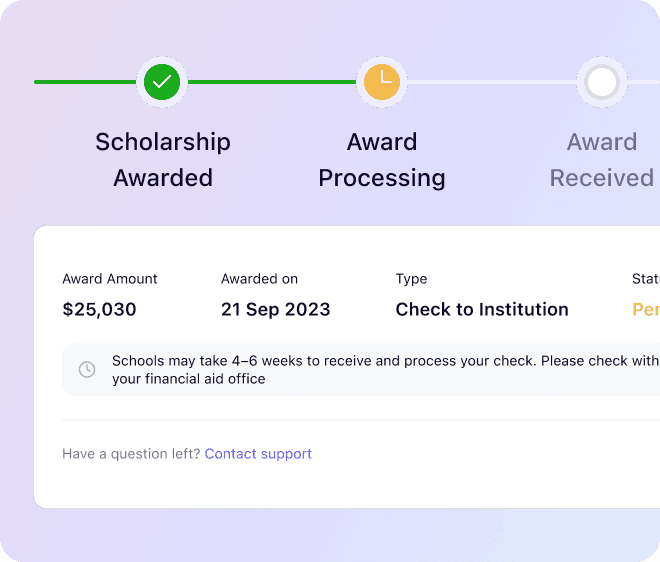
How will the scholarship award be paid?
Award checks will be sent to the financial aid office of the winner's academic institution or future academic institution in their name to be applied to their tuition, and in the name of their institution (depending on the school's requirements). If the award is for a qualified educational non-tuition expense, we will work with the winner directly to distribute the award and make sure it goes towards qualified expenses.
How will my scholarship application be verified?
Before we award the scholarship, the winner will be required to confirm their academic enrollment status. Depending on the circumstances, verification of Student ID and/or their most recent transcript will be required.
How should I get in touch with questions?
If you have any questions about this scholarship or the Bold.org platform, just email contact@bold.org and we’ll get back to you as quickly as we can.
Does the scholarship have terms and conditions?
Yes. The terms and conditions for this scholarship can be found here.
97% of students don't win scholarships. We’re here to change that.