LoginJoin Bold.org
For DonorsFor Applicants
LoginJoin Bold.org
Get in touch
Donor Inquiries
donors@bold.org
Award Inquiries
awards@bold.org
Student Inquiries
contact@bold.org
Join 300k+ followers across
Donors
How It WorksBold FoundationDonor FAQTerms & ConditionsDonor Help Center
Applicants
How It WorksScholarship RulesScholarship BlogWinnersStudent Help Center
Get the app
Download on the App StoreGet it on Google Play
Scholarship Categories
Graduate School ScholarshipsScholarships for Nursing StudentsNo-Essay ScholarshipsMerit-Based ScholarshipsScholarships for WomenScholarships for High School SeniorsUndergraduate ScholarshipsHigh School ScholarshipsScholarships for Black StudentsExplore More Scholarship Categories
Company
About UsContact UsCareersPress CenterPartnershipsReviewsImpact & Transparency
©2026 All Rights Reserved. Bold.org, Inc.
Terms of UsePrivacy PolicyDo Not Sell My Personal Information

Nagle Jackson Liberal Arts and Theatre Award

Funded by
user profile avatar
Jackson-Morton Family
$3,000
3 winners, $1,000 each
Awarded
Application Deadline
Jun 26, 2026
Winners Announced
Jul 27, 2026
Education Level
Undergraduate
3
Contributions
Share
Eligibility Requirements
Education Level:
Four-year undergraduate student
Field of Study:
Double-majoring in theatre and a liberal art (english, literature, history, art history, philosophy, psychology, sociology, anthropology, and political science)
Education Level:
Field of Study:
Four-year undergraduate student
Double-majoring in theatre and a liberal art (english, literature, history, art history, philosophy, psychology, sociology, anthropology, and political science)

Nagle Jackson was a beloved father and an internationally known theatrical director and playwright who was renowned for his skill.

Nagle believed in the importance of liberal arts education, especially for theatre students. While the skills imparted by liberal arts programs often go overlooked in today’s STEM-centric world, the creativity, comprehension, and attention to detail students can learn are invaluable. 

This scholarship seeks to honor the life of Nagle Jackson by supporting students who share his calling to theatre. 

Any four-year undergraduate student who is double-majoring in theatre and a liberal art (english, literature, history, art history, philosophy, psychology, sociology, anthropology, and political science) may apply for this scholarship opportunity.

To apply, tell us about the ways liberal arts can benefit students who are pursuing careers in theatre.

Selection Criteria:
Ambition, Drive, Impact
$3,000
3 winners, $1,000 each
Awarded
Application Deadline
Jun 26, 2026
Winners Announced
Jul 27, 2026
Education Level
Undergraduate
3
Contributions
Share
Essay Topic

Explain the ways you think a liberal arts major can benefit a student who would like to pursue a career in theatre.

400–600 words

Explore All Kinds of Scholarships for All Kinds of Students

Scholarships for High School SeniorsScholarships for College SophomoresUndergraduate Scholarships
Scholarships for College Students
Art ScholarshipsEssay ScholarshipsCollege Students ScholarshipsPerforming Arts ScholarshipsHistory ScholarshipsTheater ScholarshipsAnthropology ScholarshipsScholarships for English MajorsView all

Winners and Finalists

July 2026

Winners
Reagan Feld
Northern Illinois University
Troy, MI
Harper Williams
Oberlin College
Simi Valley, CA
Madison Redmond
New York University
Memphis, TN
Finalists
Laura Bradley
Southwest Minnesota State University
Minneapolis, MN
Sofie Delidow
Sarah Lawrence College
West Bloomfield, MI
Meera Ayyar
New York University
Oakton, VA
Sofia Flores
Pomona College
Upland, CA
Charlotte Brown
Florida Southern College
Winter Spgs, FL
Seohyun Bae
University of Iowa
Irvine, CA

Winning Applications

Reagan Feld
Northern Illinois UniversityTroy, MI
To me, my majors in Acting and Psychology are both necessary pieces of the puzzle that is my future career. I am choosing to pursue both of these fields because I have a strong passion for each of them, but also because of how well they are connected. My hope is that the skills I learn in my education of each of these fields will aid me in a combined purpose as I pursue them professionally. I see psychology everywhere in Acting. To portray a whole person and their story in a truthful way on stage requires a deep understanding of emotions, human relationships, and the effect our memories have on us. This understanding can be achieved through psychology. When first cast as a character actors have to dive into the characters motives, perspectives, wounds and more to give an authentic performance of who this character is and what their role is within the world of the play. Without any understanding of one's own emotions, motives, relationships, perspectives etc. the expectation of playing a character truthfully is unrealistic. When I performed in my first college production this past spring, Shakespeare's Comedy of Errors, I learned so much about how my two degrees are connected. I was prompted to think about the emotional weight of events happening on stage, even if they weren't directly happening to my character. I was prompted to think about my responses, reactions, and internal emotions that occurred both on and off stage and the way that impacted my performance throughout the story. I was prompted to think about societal norms within the play and what was considered outlandish compared to what was considered acceptable. All of these deep psychological intricacies are a crucial part of a truthful performance. Each individual actor must know their own character's identity and their place in the larger story. The skills to decipher these intricacies come from our ability to understand these concepts within our own lives. Psychology is a backbone of theatre. Having emotional perceptiveness and critical thinking for these topics is what allows actors to become engrossed with the worlds they must live inside of for the stage. Pursuing both majors simultaneously has helped me succeed in each one at a much higher rate. Psychology teaches me highly necessary and applicable skills for theatre, and theatre allows me to practice these skills and perfect them more effectively. This concept can be seen across the board with liberal arts fields. Theatre is the closest thing to the real world while still being an artistic escape. Therefore, understanding psychology, sociology, history, English, politics, etc. on a meaningful level means understanding characters and plays more deeply. These liberal arts fields give actors and theatre practitioners the skills and context to create authentic art that is valuable to show audiences. An understanding of liberal arts is the second puzzle piece to a successful theatre career.
Harper Williams
Oberlin CollegeSimi Valley, CA
I was supposed to be researching how to act like a mean pig. That's what acting is supposed to be, right? Not this time. While preparing to play Squealer in Tatty Hennessy’s adaptation of Animal Farm, I got stuck on one question: why does anyone believe him? Squealer is the pig who explains away every broken promise, unfair decision, and abuse of power. At first, I thought of him as a liar. Easy enough. But the longer I rehearsed, the less interesting that answer became. The real question was not why Squealer lied. It was why the other animals listened. So I started researching propaganda. I watched old Disney cartoons, educational films, political speeches, and clips of Baghdad Bob insisting everything was fine while chaos unfolded behind him. I learned that propaganda does not always arrive looking scary or serious. Sometimes it is simple. Sometimes it is funny. Sometimes it repeats itself until people are too tired or too afraid to argue. That changed the way I played Squealer. I stopped treating him like a cartoon villain and started thinking about why a comforting lie can be easier to accept than a frightening truth. I was supposed to be doing character research. Somehow, I ended up studying history, politics, psychology, and media literacy. That is when theatre started to feel bigger to me. Acting was not just memorizing lines, hitting marks, or making “strong choices.” It was trying to understand people. A liberal arts education gives theatre students more ways to do that before we ever step onstage. History, English, political science, psychology, and philosophy are not outside the rehearsal room. They are already in it. I felt that again playing Abigail in The Crucible. Abigail is easy to dismiss as cruel, but psychology made me ask a better question: what happens when a terrified young woman discovers that accusation gives her power for the first time? History and political science helped me understand how fear can spread through a community until truth becomes almost impossible to hear. As Emily in Our Town, I found myself thinking about philosophy without calling it philosophy. The play asks why ordinary moments matter and why we so often fail to notice them until they are gone. English helped me pay attention to the plainness of Thornton Wilder’s language. Emily does not need grand speeches. Her heartbreak is in how ordinary everything is. The same thing happens when I write. In one play, I wrote about an eleven-year-old girl whose parents are divorcing. Instead of writing a realistic living-room scene, I had five future versions of her come out of a closet to tell her what her life might become. That play grew out of psychology, creative writing, and the question of how people become themselves. That is what liberal arts study gives a theatre artist: more doors into a story. History gives us the world around a character. English gives us the language. Political science reveals power. Psychology helps explain behavior that may look irrational from the outside but feels necessary from within. I will be going to Oberlin College, where I will be part of the BA+BFA in Integrated Arts program. After spending weeks studying propaganda to understand a pig, the idea of separating art from history, politics, literature, and psychology no longer makes much sense to me. I wanted an education that would let the thinking show up onstage. Theatre teaches us how to tell stories. Liberal arts study helps us understand the people inside them. For me, those two pursuits are inseparable.
Madison Redmond
New York UniversityMemphis, TN
My love for theatre began in the fiction books I read as a kid. Alongside imagining different worlds and learning about new perspectives, I would spend hours envisioning myself as different characters in the dozens of books I read. I’d often flip from page to page reciting dialogue, switching back and forth between the characters acting out the stories I’d grown so fond of. It was then that I discovered I wanted to spend as much of my life transforming written words to performance and hopefully one day for entire audiences to see. Without first falling in love with English literature I would have never discovered my love for theatre, and after my first year as a full-time acting student the importance of this connection has only grown more apparent. Before I applied to college for Drama, I knew I’d pursue a second major by my sophomore year. But the choice to double major in English came only after I realized just how necessary my understanding of literature is to my theatre studies. Just like it did as a kid, my understanding of my character begins with understanding what the playwright has written. It begins with asking why the playwright has chosen to write the play and for what audiences? It begins with asking why they included my character and asking why they are vital to this particular story. It begins with asking why the playwright chose to write a specific monologue, or line, or word? These are questions that will become easier to answer as I will be asking them daily in my English courses in the fall. As I study English literature across authors, genres, and generations, I will build necessary analytical skills to excel at finding the roots of any play. And it is these questions that will be vital to my performance as an actor. I can create freely with the knowledge of the playwright’s intentions for my character. There will be no second guessing of the choices I make in the rehearsal process as they will be born out of what I have read. I will be confident as an actor because I can trust my work I’ve done off stage with the skills I’ve gained from an education in English literature. From the audience’s perspective, theater is all that which takes place on the stage. It is the moments from when the curtain rises to when it falls. From the first lines spoken to the final bows. It is the hour and a half long of live performance combined with the technical glory of lights, costumes, and set design. But to the theatre maker, it encompasses so much more. It is the research and understanding behind a play’s historical setting to craft appropriate costume and set designs. It is the knowledge of the play’s political references to discover how it can connect to contemporary audiences. It is the analysis needed to understand one’s character to begin to attempt to portray them on the stage. It takes weeks worth of interdisciplinary knowledge to take the stage in order to impact those seated in front of it, and a liberal arts major provides the necessary skills to do so.

How it works

Bold.org is Built to Make Scholarships Feel Possible
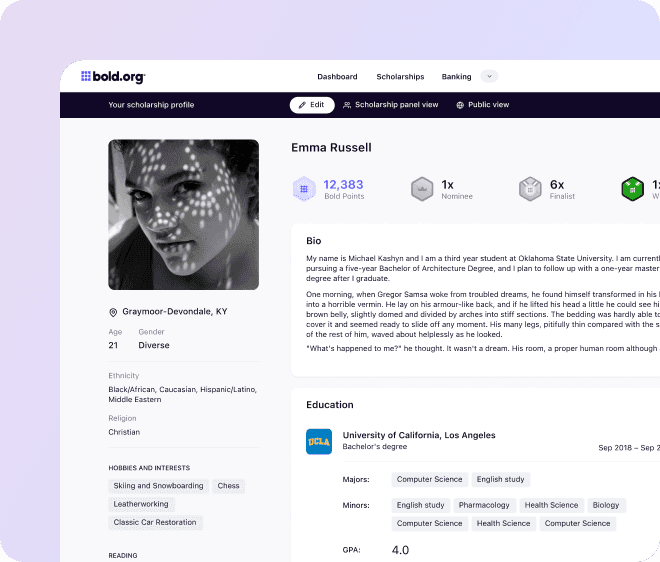
  • Student scholarship profile on Bold.org

    Step 01

    Start with your story

    Bold.org helps students show donors who they are beyond a transcript.

  • Scholarship matches on Bold.org

    Step 02

    Where scholarships are awarded

    Every scholarship is funded by donors and managed directly on Bold.org.

  • Scholarship award tracking on Bold.org

    Step 03

    Fund your future

    Scholarship dollars are disbursed through Bold.org to help students pay for school.

FAQ

When is the scholarship application deadline?

The application deadline is Jun 26, 2026. Winners will be announced on Jul 27, 2026.

How will scholarship application information be used?

Your privacy is a top priority on the Bold.org platform, and you can find our privacy policy in full here. You may opt out of communications from Bold.org at any time, and unless we’ve first notified you and gotten your consent, you’ll never receive communication from any third parties related to personal information you give us.

What is the scholarship award?

Award amounts per winner are designated by the donor. Check the award amount for a detailed breakdown.

When will the scholarship winner be chosen? How will they be notified?

The winner will be publicly announced on Jul 27, 2026. Prior to the announcement date, we may contact finalists with additional questions about their application. We will work with donors to review all applications according to the scholarship criteria. Winners will be chosen based on the merit of their application.

How will the scholarship award be paid?

Award checks will be sent to the financial aid office of the winner's academic institution in their name to be applied to their tuition, and in the name of their institution (depending on the school's requirements). If the award is for a qualified educational non-tuition expense, we will work with the winner directly to distribute the award and make sure it goes towards qualified expenses.

How will my scholarship application be verified?

Before we award the scholarship, the winner will be required to confirm their academic enrollment status. Depending on the circumstances, verification of Student ID and/or their most recent transcript will be required.

How should I get in touch with questions?

If you have any questions about this scholarship or the Bold.org platform, just email contact@bold.org and we’ll get back to you as quickly as we can.

Does the scholarship have terms and conditions?

Yes. The terms and conditions for this scholarship can be found here.

97% of students don't win scholarships. We’re here to change that.
LIVE     
$16,639,905
Total scholarships awarded
Start Winning
user profile avatar
JEANNETH CHAVEZ
Won $500 scholarship
36m ago
First Generation Scholarship For Underprivileged Students