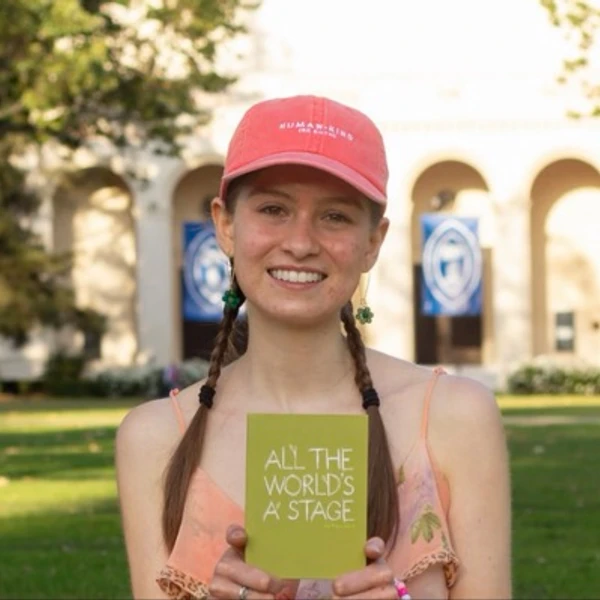
Gender
Female
Ethnicity
Hispanic/Latino, Native American/Indigenous Peoples
Religion
Other
Hobbies and interests
Cooking
Singing
Writing
Baking
Poetry
Crocheting
Education
Reading
Speech and Debate
Acting And Theater
Modeling
Reading
Academic
Adventure
Anthropology
Biography
Classics
Drama
Contemporary
Folklore
Historical
Literary Fiction
Novels
Philosophy
I read books daily
LOW INCOME STUDENT
Yes
Sofia Flores
1x
Finalist1x
Winner
Sofia Flores
1x
Finalist1x
WinnerBio
Hello! My name is Sofía Isabella Flores, and I am a Mexican American college student. In addition to being a Benjamin A. Gilman Study Abroad Scholar, I am an avid lover of activism, education, theatre, music, film, and literature. As an individual who has struggled with mental illness and Autism throughout her life, I hope to educate and uplift the public regarding mental health through my social media platforms and future career as an actor, director, writer, musician, philanthropist, and college professor. Thank you for sharing your time with me!
Education
Pomona College
Bachelor's degree programMajors:
- Drama/Theatre Arts and Stagecraft
- English Language and Literature/Letters, Other
GPA:
4
Fullerton College
Associate's degree programMajors:
- English Language and Literature/Letters, Other
- Drama/Theatre Arts and Stagecraft
Minors:
- Visual and Performing Arts, Other
GPA:
4
Upland High School
High SchoolGPA:
4
Miscellaneous
Desired degree level:
Doctoral degree program (PhD, MD, JD, etc.)
Graduate schools of interest:
Transfer schools of interest:
Majors of interest:
- Journalism
- Political Science and Government
- Visual and Performing Arts, General
- Entrepreneurial and Small Business Operations
- English Language and Literature, General
- Drama/Theatre Arts and Stagecraft
- Film/Video and Photographic Arts
- Music
- English Language and Literature/Letters, Other
- Psychology, General
- Romance Languages, Literatures, and Linguistics, General
- Social Sciences, General
- Sociology and Anthropology
- Literature
- Liberal Arts and Sciences, General Studies and Humanities
- History and Political Science
- History and Language/Literature
- Linguistics and Anthropology
- Multi/Interdisciplinary Studies, Other
- International Relations and National Security Studies
- Arts, Entertainment, and Media Management
- History
Career
Dream career field:
Performing Arts
Dream career goals:
Actress, Writer, Film Director, Professor, Activist, Musician
Student Ambassador, Social Media Director, & Marketing Coordinator
Fullerton College First Year Experience2023 – 20252 yearsHostess & Food Runner
Union on Yale2023 – 20252 yearsCashier
Walt Disney Company2022 – 20231 year
Sports
Dancing
Club2015 – 20216 years
Awards
- 1st Place in the Division all Season
Cheerleading
Club2014 – 20173 years
Awards
- Division Champions
Research
Dance
Pomona College — Researcher & Writer2026 – 2026European History
Independent — Program Researcher2018 – 2019
Arts
Film
ActingLandlord, Cell, Stargazing, Sad Streets of Sanity, Facing Forward, Good Enough, Guardians of the County, A Good American2018 – PresentFullerton College
TheatreThe Wolves, By The Bog Cats, 9 to 52022 – 2025The Grove Theatre
TheatreCinderella, The Little Mermaid , Joseph and the Amazing Technicolor Dreamcoat2008 – Present
Public services
Volunteering
National Charity League — Volunteer & Group Officer2016 – 2022Public Service (Politics)
San Bernardino Registrar of Voters — Supervisor of Poll Workers2022 – 2022Advocacy
Independent — Blogger & Mental Health Advocate2019 – PresentVolunteering
Special Olympics Southern California — District Representative2019 – 2020Volunteering
California Botanic Garden — Volunteer2019 – PresentVolunteering
Helping Out Pets Everyday Animal Rescue — My role is to clean all animal living spaces for dogs and cats, provide food and water, and socialize the animals on multiple days throughout the week.2019 – Present
Future Interests
Advocacy
Politics
Volunteering
Philanthropy
Entrepreneurship
Mad Genius Scholarship
Option C: Writing (Poetry)
“The Mad Villain Thrives in My Mind”
I have been told that roses grow best with blood; maybe I will too. Maybe the blood and tears for everything I love will help me more. Maybe I will be okay. After the smoke from the raging infernos in my mind clears. Maybe it’s okay that I’ve bled and cried more than I’ve loved and been loved.
But I have also been told that
In my words lay every kind of weapon:
Blunt blows to the heart and
Piercing daggers into the soul
With marks everlasting on the minds of us all.
Perhaps: We were born to mourn the friendships we once lived for; the same ones we thought we’d prayed and slaved for always seem to become the ones that never actually “ended” or made us feel bad. They just become fads - things that happened. But I look back on these events. They seem more and more frequent the longer I live. Am I defective? My devotion infected? My heart nothing but a sieve. My loyalty a mere fallback plan when they’re in need of compassion. I suppose I’m nothing if not a noble companion.
But not to myself.
Perhaps
To none.
In fact,
I once told myself:
“I want to live until 27.”
A child
So young,
I knew nothing of the world.
21 I now stand against
The World
The World crushing me
The World I created
Crashing down -
A house of cards I had
No right, no idea
How to play;
I fear
I will not see 27
Nor am I sure I wish to -
Or -
Perhaps I fear I will.
These thoughts
Conflict
And
Confuse
As I continue to cry;
Another safe place -
Another home -
Falls to the ground
With me.
I collapse with utter exhaustion
Screaming at my mind,
“Is this what failure feels like?”
What burden can I blame?
What name can I ascribe this
Utter Sorrow
That has taken hold of me
So
Very
Completely?
How long can one live in
Grief
Before they become
Nothing
More than a shell of what
They one believed?
Perhaps
No answers
Are known.
Perhaps that is truly the
Worst part -
Not the false promises
Or decimated heart that
Aches in my chest.
Perhaps the worst part
Is me.
Maybe.
Maybe I love too quickly,
Maybe I hurt too deeply,
Maybe I take life too seriously.
I know nothing of the world
Still
That has not changed.
Each time
I think
I might have secured an
Understanding,
The last of my strength is
Antagonized -
The last of my
Hope
Is vandalized.
Is nothing left?
Is 21 my End?
I wonder if
Other ages will miss me;
Does 27 await me -
Open arms ready to welcome me:
“You were destined for this.”
I reply,
“Oh, how I’ve prepared and longed
For This.”
Or,
Will no one miss
Me?
I know
Nothing,
I expect
Nothing.
Not while I live and breathe...
Oh,
How
I hold my teddy bear much tighter now;
The monsters he protects me from
are no longer under the bed
The ones in my head have
Overtaken and
Overpowered
All aspects
of my life
I’ve been called crazy by the closest of friends. But I’m not out of my mind - I just want out of it.
Perhaps: The most human parts of us are what make us do the most monstrous things.
ScholarshipOwl No-Essay Scholarship
Michael Rudometkin Memorial Scholarship
Just days before the start of my Junior year in high school, I found out that my treasured and beloved 7th grade English teacher had passed away unexpectedly from an aggressive, previously undetected form of cancer. She was and still remains, without a doubt, among the most influential individuals in all of my life. Without her guidance and unwavering support, I would not have had the strength to survive my junior high years.
Only further compounding the difficulties and pain of the situation, it was the height of the COVID-19 pandemic. I felt hopeless upon hearing the news of her death and knew I simply had to do something in her memory. I immediately contacted her husband - who I had gotten to know at previous field trips and school events - to offer my condolences and propose a gift of celebration in honor of her life. After receiving approval of such and being given his home address for a drop-off, I began working on a collaborative project that would include about 100 of her past students.
I reached out to all individuals from my junior high school and asked if they would like to write a letter of thanks to our former teacher, in the hopes that it could provide a slight solace to her grieving family.
I quickly established a pandemic-safe memorial station at her favorite outdoor spot on the campus that was compiled of banners and photos for any and all former students to write cards, leave flowers, and celebrate her life. Over the span of several days, I published the memorial location online and visited each morning. I accumulated dozens of physical cards left for her while working with fellow students online to write letters on a shared Google Document.
By the end of that week, I gathered all items at the memorial site and printed all of the virtual letters. I myself then sat down to craft a letter of my own - one that will remain ingrained in my soul until my final hours. I purchased a binder, decorated it with photos of my beloved mentor, placed laminated and ringed sheets in the binder, and inserted all letters and cards into them.
My heart was both broken and brimming with gratitude. My teacher - the guide who once saved my life - had touched the lives of countless other students. Her memory would not be confined to her lifetime but instead, it would echo through the halls of Pioneer Junior High and the hearts of her former students.
With the binder and collected gifts in hand, I made my way to the home her husband resided in and left them all at his door. When I later contacted him to ensure that he received all contents well, he told me how much joy the gift had brought him; he deeply feared his wife’s legacy being lost, but these letters and gifts had made him realize that her impact and legacy were simply impossible to forget.
The entirety of this project - from conception to creation - provided me with an opportunity to learn about grief, closure, and making small - yet impactful - efforts to comfort others. I have ever since chased that sensation by working towards bringing compassion, collaboration, and empathy into all aspects of my professional, philanthropic, and personal endeavors.
Nagle Jackson Liberal Arts and Theatre Award
Being a liberal arts major is more than a degree pathway. It is a means of becoming a wiser, more informed, more empathetic, more creative, more resourceful, and a more open-minded person in a world that would rather us be complacent.
Having a liberal arts education has been one of the greatest gifts in my life - as a student, as a theatre-maker, a critical thinker, and a compassionate human. I am a proud double major in English and Theatre Arts - the two fields that have saved my life time and time again. As someone who struggles with the stigmas and symptoms of both Bipolar Disorder and Autism, having a creative outlet in both writing and acting have been the greatest sources of joy and liberation.
I am a proud Liberal Arts College student at Pomona College in Claremont, California. Since my first day of orientation, the potential and honor of a liberal arts education have been of extreme presence in my mind. The opportunities I have each semester - with each class - to gain insight from so many differing minds, majors, and perspectives are astounding. These personalities, worldviews, and ideologies have shaped my own outlook and approach to my craft. That said, the benefits of a liberal arts education to a student pursing a career in theatre are genuinely prolific and immeasurable.
The liberal arts environment is one of immense exploration, discourse, research, and rigorous work. It teaches us as students to take responsibility for our education and professional as well personal development in this ever-changing world. I have been incredibly fortunate to meet a great deal many of fellow liberal arts majors, spanning from political science, history, psychology, and anthropology. I have been even more fortune to take classes in each of these respective fields as well. The concepts, students, and instructors I have encountered throughout this process have provided me with such a vast, rich understanding of this world - and of my own part in it as well as how I am to shape it moving forward.
Pursuing a career in theatre is pursing a career in being human - in presenting the human condition to an audience in the hopes that it can resonate, inspire, and inform them. A liberal arts education provides us as theatre-makers with vital skills in developing our voice, searching for truth, understanding the nuance of history, finding reason and empathy, diving deeper into the human mind, and so much more.
For me, being a liberal arts major and theatre-maker are so beautifully intertwined. They inform one another while feeding one's intellect and strengthening us as members of humanity.
Olivia Rodrigo Fan Scholarship
It was simple. The second I heard “Stumbled over all my words, made it weird, then made it
worse/Each day that I'm alive, it's social suicide” was the second I became a fan and massive admirer of Olivia Rodrigo’s vulnerability.
I spent the majority of my middle school and high school years in an independent study program as a result of bullying and debilitating panic attacks. Remaining undiagnosed for Bipolar Disorder and Autism Spectrum Disorder for nearly a decade, that lyric got to the heart of my experiences - my all-consuming fear that I would never be understood or seen as a genuine person.
My own brain felt like a battlefield that I could not navigate; my thoughts all just land mines that left me spiraling for hours on end. But this lyric. It came to me like a revelation. Finally, someone else had been able to put similar experiences of lonelinesses, questioning their worth, and self-loathing into words.
Olivia’s music came to me during my community college years, and I will never forget how grateful - how validated - I felt on that sunny car ride home from class when I decided to play her album “guts” for the first time.
I found myself listening to the album on repeat each and every day for several months afterwards. “ballad of a homeschooled girl” and “teenage dream” were my most frequented. Something about hearing another person voice their own anxieties about the future and overwhelming fear that things might not get better despite everyone in their lives saying “it gets better the more you grow” provided me with a sense of solace that nothing else at the time could.
I have been struggling with mental illness for the majority of my life; hearing an artist express with such a platform express herself in that raw way made me feel like I was not alone in the battles of my brain and emotions.
My respect for Olivia’s music has only grown since her last album. “I'm a zombie in my body/I'm a train off of the track/I feel dirty,/I feel rotten/And the colors are all flat/I'm a sad shell of a woman/And I've got maggots for brains” blew me away. The mental and emotional numbness, the hollow eyes, the awareness of something being severely wrong but having the energy to help myself; this is what I’ve been battling for years.
Olivia’s music is not just an expression of emotion or creative outlet for her. It’s a series of stories and experiences - physical, mental, figurative, literal, and emotional - that so many people share. Her openness and compassion are beautiful, and the whole of her discography has given me so much comfort and catharsis.
RonranGlee Literary Scholarship
Manuscripts of a Mental Mutiny: A Psychological Interpretation of Emily Dickinson's “I Felt a Funeral, in My Brain”
The topics of mental health, mental illness, identity, and how one’s struggles with such manifest have grown immeasurably in popularity within the last several years. The field of literature, however, has a long history of mental health, sanity, identity-related themes being expressed and explored within the pieces produced by numerous writers. Reviewing texts and works of literature therefore with this specific analytic approach can be immensely fruitful, insightful, eye-opening, intriguing, and thought-provoking.
Acclaimed poet Emily Dickinson’s vast breadth of work spans a myriad of topics, one of particular importance being her own mental health and inner struggles. Historians and literary scholars alike have concluded that Dickinson battled various mental demons throughout her life - potentially Chronic Depression, Social Anxiety Disorder, and/or Agoraphobia most specifically; in studying her life, there is evidence that “as a child, Emily was relatively social…However, in her late twenties, she began retreating from any and all social situations, as she grew increasingly reclusive…She was highly selective in choosing what people she would maintain relationships…[avoided] basic interactions…[and ignored] guests altogether…Dickinson’s retreat into herself and away from the world was a defense tactic” (Moss 4). Whether it be through analyzing her poems and diaries or accounts of her behavior from contemporaries in her company, similar conclusions have been drawn: Emily Dickinson battled problems of an inner, psyche-related nature and used her writing as a creative outlet - a form of escapism. It was how she could most effectively and comfortably make sense of the mental turmoil she experienced - by quite literally putting words to the emotions she felt.
Emily Dickinson’s mournful “I Felt a Funeral, in My Brain” was written in the late 1800s and first published in the 1890s. It is quite possibly one of her most captivating, sorrowful pieces, depicting a rather ominous and grievous scene. In researching her life, one gains an understanding her own personal challenges with mental illness and instability; it is therefore quite plausible to interpret this piece as a representation of the inner pain Dickinson was experiencing in the later part of her life - a microcosmic depiction of her own mind and the struggle to recover both her senses of sanity and identity.
The poem’s first stanza jarringly introduces a funeral scene to the reader. The frankness in which Dickinson approaches this first line can be rather uneasy, thus it serves as a fitting welcome into the workings of Dickinson’s mental state; it depicts the unnerving scene at hand - i.e. the anguish and chaos that is perpetually present in her mind. Dickinson not only utilizes the first person as she states that “I [she] felt a Funeral, in my [her] Brain” (Dickinson) but also personifies the locations of the events - the Funeral and Brain itself; in doing so, it is reasonable to conclude that the locales are alike in one respect - these are the loss and pain are being felt.
Therefore, these two locations are crucial. In likening the Funeral to the Brain, it becomes increasingly clear that these two areas are where the natural stages of grief - denial, anger, bargaining, depression, and acceptance - must be undergone and managed. These stages and their progression are rather similar to the symptoms and cycles individuals with mental health conditions such as various forms of Depression, Mood Disorders, and Anxiety Disorders often experience (Paraphrased from National Institute of Mental Health). Thus, it can be further deduced that Dickinson’s funeral scene serves as a representation for her own mind and the cyclical challenges she experiences therein.
The grief process - arguably uncomfortable and chaotic in its own right - is expanded upon within the remainder of this first stanza; Dickinson notes that “...Mourners to and fro/ Kept treading - treading - till it seemed/That Sense was breaking through -” (Dickinson). The personified “Sense” represents peace, resolution, and the final grief stage of acceptance. The scene depicted in these lines makes it appear that Dickinson fortunately experiences moments of clarity - that she is at times able to cope with her struggles and emotional burdens. This makes a great deal of sense, for in the natural world, the processing of one’s own grief after a significant loss is nonlinear; sorrow itself is not continuous, and there are indeed glimmers of hope, or at least moments that feel lighter and easier to manage than others. Thus, this first stanza encampasses that reality; that sorrow - whether it be due to the loss of a loved one, a loss of self, or general inner struggle - comes and goes in waves.
Further likening the Funeral scene to her own psychological state, Dickinson continues describing the painful funeral experience in the first person and utilizing strategic moments of personification. In the third stanza, Dickinson refers to herself as “I” and states that she is almost utterly alone if it were not for the presence of a “Silence” and “some strange Race” (Dickinson). In this line, it is arguable that Dickinson is alluding to the sensation of feeling lonely despite not being physically alone. In essence, Dickinson makes it appear that she does not feel she fits in with society. Whether it be due to the aforementioned theory of Social Anxiety-related issues, other mental health struggles, a lack of connection with her peers, or other contributing factors, Dickinson feels that she walks alone in the vast world before her - condemned to live a life of solitude and lack of genuine camaraderie and companionship. She therefore chose to turn inward, conducting the remainder of her life in silence and solemnity.
Many literature scholars and professionals agree that Dickinson indeed came to prefer solitude, stating that “When the American poet Emily Dickinson began an ongoing conversation with herself about her own inner world, she discovered one of the most unique sources of creative inspiration in the history of poetry” and that her “[gradual withdrawal] from the social world [allowed] Dickinson [to] became a remarkable transcriber and translator of inner experience – what in 1855 she called ‘a solitude of space’ [in lyric number 1,696] – and her interior tracings often yielded extraordinary poems” (Dr. Magdalena Ostas, PhD). However, this poetically-rewarding isolation came at a great personal cost; it cannot be neglected that, in the final line of stanza three, Dickinson’s “I felt a Funeral, in my Brain” describes her mind as being “Wrecked, solitary, here -” (Dickinson). It becomes apparent in this moment that Dickinson feels she has arrived at the point of no return; the Funeral is for the death of her life as she knew it - a life in the public, a life spent trying to find joy amongst the company of friends, family, and peers. Dickinson’s fate has now been cemented. She is to be henceforth in a perpetual inward state - alone with nothing but her emotions, thoughts, poems, and struggles to accompany her.
In the ending of this piece, it is clear that Dickinson recognized at this point in her life that her social skills and tolerance were in shambles - i.e. “Wrecked” - and deeply feared what this meant for her. At the start of the final stanza of the poem, she not only states that “...a Plank in Reason, broke” within her mind but goes on to describe herself as dropping “...down, and down -’, hitting “a World, at every plunge…” (Dickinson). This is an alarming and frightening scene. It therefore serves as a depiction of the dysfunction, painful fears, taxing burdens, and dark thoughts that weighed heavily upon Dickinson’s mental state. With her Reason - her mental and emotional stability, sense of self, and understanding of normalcy/safety - now broken, Dickinson feels she has no other place to turn but inwards. She feels her sanity has departed - just as the passing of a loved one is referred to as one who has “departed.”
This poem brims with imagery and can easily fuel numerous curiosities as to what Dickinson genuinely sought out to describe within it. That is precisely what makes it such a fascinating piece - the truth that it can be interpreted many different ways and lead differing individuals to differing conclusions. And the psychological approach is merely one method of interpretation. In analyzing this specific text through a strictly mental-health-driven lens, it is evident that Dickinson did indeed battle unseen demons. She struggled to understand what plagued her so severely but was fortunate enough to find solace in literary work - something that very quickly became her refuge. She was able to find not only comfort in this line of work, but she found and refined her voice as a woman and a writer. This land of symbolism, text, story-building, poetry, and prose was the place she felt most herself. While it may never be known exactly what condition(s) history can attribute to her mental turmoils, it is clear that these troubles played a large role in her life and literary pursuits.
Reference Copy of the literary source being analyzed:
Dickinson, Emily. “I Felt a Funeral, in My Brain, (340) by Emily...” Poetry Foundation, Poetry Foundation, 1983, www.poetryfoundation.org/poems/45706/i-felt-a-funeral-in-my-brain-340.
I felt a Funeral, in my Brain,
And Mourners to and fro
Kept treading - treading - till it seemed
That Sense was breaking through -
And when they all were seated,
A Service, like a Drum -
Kept beating - beating - till I thought
My mind was going numb -
And then I heard them lift a Box
And creak across my Soul
With those same Boots of Lead, again,
Then Space - began to toll,
As all the Heavens were a Bell,
And Being, but an Ear,
And I, and Silence, some strange Race,
Wrecked, solitary, here -
And then a Plank in Reason, broke,
And I dropped down, and down -
And hit a World, at every plunge,
And Finished knowing - then -
Full Works Cited:
American Psychiatric Association. “Major Depressive Disorder and the ‘Bereavement Exclusion.’” Psychiatry.Org, 2013, www.psychiatry.org/File%20Library/Psychiatrists/Practice/DSM/APA_DSM-5-Depression-Bereavement-Exclusion.pdf.
Editors. “Depression.” National Institute of Mental Health, U.S. Department of Health and Human Services, Mar. 2024, www.nimh.nih.gov/health/topics/depression.
Moss, Samantha. “Metaphors of Mental Illness: How Emily Dickinson and Vincent van Gogh Understood and Expressed Their Personal Battles with Depression.” Pillars at Taylor University, pillars.taylor.edu/english-student/6/#:~:text=Both%20the%20poet%20Emily%20Dickinson,disorder%2C%20and%20seasonal%20affective%20disorder.
Ostas, Magdalena. “Emily Dickinson and the Creative ‘Solitude of Space’: Psyche Ideas.” Psyche, May 2022, psyche.co/ideas/emily-dickinson-and-the-creativity-of-a-solitude-of-space.
Tee-Melegrito, Rachel Ann. “Stages of Depression: Symptoms, Treatment, and Recovery.” Medical News Today, MediLexicon International, 24 Nov. 2022, www.medicalnewstoday.com/articles/stages-of-depression.
Scholarship Institute’s Annual Women’s Leadership Scholarship
In the Fall of 2023, I served as one of three student representatives for the Fullerton College Theatre Department 2024-2025 Show Selection Committee; I worked alongside the faculty to create a season of productions that would best provide opportunities in all respects for the diverse and inexplicably unique students within the department. Each meeting was enlightening - a chance to learn the inner workings of creating a show season from scratch that took into account not only the interests/desires of the students, but also the needs of the department as a whole: budgetary concerns, the legality of licensing, representation, the messages that these shows would send to the community, and the opportunities granted through these shows to the student performers, designers, and technicians.
This process was one of the most interesting experiences I have ever had in an educational setting. I was able to speak to theatre students I had never met before, venturing into their classes and obtaining feedback from them and their professors; and I was able to have serious yet necessary conversations with individuals amongst the committee itself to better understand what we were to do and how to proceed at each next phase of the selection process. Simply put, I am immensely grateful for this opportunity; it has motivated me all the more to follow my career path of becoming a social justice advocate, professor, screen director, screenwriter, philanthropist, and actor - a teller of stories and proponent of change.
I am pursuing a double major at Fullerton Community College: English and Theatre Arts. I will be graduating with honors in the Spring of 2025 and transferring to either UCLA or another four-year university to pursue a double Bachelor’s Degree in these two fields. Following graduation from university, I will pursue a double Master’s Degree and Educator’s Accreditation at either Yale University, or Stanford University for the two fields above and eventually pursue a PhD/Doctorate in English Literature. After my higher education journey has concluded, I will be working with the North Orange County Community College Future Educators Program to gain experience as a collegiate-level Professor in English Literature and Theatre Arts.
My ultimate goal is to be a simultaneous Professor, Screenwriter, Playwright, Actor, and Philanthropist. The performing arts, animal welfare, student educational success, mental health, and social justice/inclusion are the biggest causes that I support and believe in; after pursuing higher education and establishing a stable, high-power career, I will spend my free time either creating and running my own charity organizations within Southern California.
Share Your Poetry Scholarship
“These are the best of times!
These are the greatest years of your life.”
You worry they might be right
That your best is nothing but strife
You wonder what will appear,
You look at yourself in the mirror;
You see-
Not the light
You hold in your eyes-
But the grief
In which your wrinkles and red cheeks lie
They never told you
That the best would be unbearable
And that everything we once knew
Would one day escape the truth
“These are the best times you’ll ever have.
Oh, what I would give to be in your place.”
Tell me, why is that?
All I can feel are these years holding my heart in a deceitful embrace.
Tell me, can you see?
I am drowning in the waters that were sent to make me clean.