STEM fields remain heavily male-dominated and lacking in diversity, with women and minorities making up small portions of offices and teams. We need to change that!
This scholarship seeks to support and encourage female minority students to pursue STEM majors in college or tech schools so that they can focus on their studies rather than worrying about the costs of attendance.
Any femaleminority undergraduate or graduate student who is a South Carolina resident pursuing STEM may apply for this scholarship if they have extenuating circumstances and have faced adversity.
To apply, please share how your experiences as a minority woman have influenced your decision to pursue a STEM field.
Selection Criteria:
Ambition, Drive, Impact
Essay Topic Requirements
Please share how your experiences as a minority woman have influenced your decision to pursue a STEM field.
You may discuss challenges you’ve encountered, moments where you felt underrepresented, or barriers that have shaped your journey. Finally, tell us about your future goals in STEM and how you hope to support or uplift other underrepresented women in your field.
400–600 words
$10,000
4 winners, $2,500 each
Awarded
Application Deadline
May 25, 2026
Winners Announced
Jun 26, 2026
Education Level
Undergraduate, Graduate
Share
Explore All Kinds of Scholarships for All Kinds of Students
Growing up as a minority woman in South Carolina, I did not often see people who looked like me in STEM fields. Engineering, in particular, felt like a space where I would have to prove myself more than others. Instead of discouraging me, that realization became one of the main reasons I chose to pursue mechanical engineering.
Throughout my academic journey, I have often found myself as one of the only women and sometimes the only minority in my classes. At first, this was intimidating. There were moments where I questioned whether I truly belonged, especially in challenging courses like physics, statics, and electrical engineering. These subjects pushed me far outside of my comfort zone, and at times, I struggled to keep up. However, those experiences forced me to develop resilience, discipline, and confidence in my ability to learn difficult material.
Being underrepresented has made me more aware of the importance of visibility. When you do not see people like yourself in a field, it can be easy to feel like you are not meant to be there. I realized that by continuing in engineering, I could become part of the representation that is currently missing. I want younger girls, especially those from minority backgrounds, to see someone like me and believe that they can succeed in STEM too.
In addition to academic challenges, balancing financial responsibilities and school has also shaped my journey. Working while studying engineering has required strong time management and determination. There have been moments where the stress of finances and coursework felt overwhelming, but those obstacles have strengthened my work ethic and reinforced my commitment to my goals.
My passion for engineering comes from my desire to create practical solutions that improve people’s lives. Through my coursework and projects, I have developed skills in design, problem-solving, and critical thinking. One of my goals is to work in an engineering role where I can contribute to real-world innovations while continuing to grow professionally. I am particularly interested in opportunities that allow me to work on projects that have a meaningful impact on communities.
Looking toward the future, I want to do more than just succeed in my own career. I want to help others along the way. I plan to mentor younger students, especially women and minorities, who are interested in STEM but may feel unsure about pursuing it. Whether through tutoring, mentorship programs, or simply sharing my experiences, I hope to provide the encouragement and guidance that I once needed myself.
Receiving this scholarship would not only ease the financial burden of my education, but it would also serve as a reminder that my journey matters. It would allow me to focus more on my studies and continue pushing forward in a field where diversity is still growing.
My experiences as a minority woman have not limited me, they have shaped my strength, my ambition, and my purpose. I am determined to use my education in STEM not only to build a successful career, but also to help create a more inclusive and supportive environment for future generations.
As a minority woman pursuing a degree in STEM, my journey has been shaped by adversity, resilience, and the desire to create a better future for myself, my children, and my community. I feel it is important to break through stereotypes and stand proudly on the same ground the generations before me fought and sacrificed for. Growing up in the Deep South, I witnessed firsthand how difficult it can be for minorities, especially minority women, to feel encouraged in certain career fields. Women like me are commonly underrepresented in technology and computer science fields, which often made STEM careers feel out of reach for women like me, especially single mothers balancing work, school, and family responsibilities.
I can still remember the first computer my mother received as a gift when I was in elementary school. At the time, I thought it was the coolest thing imaginable. My grandparents used to wait for me to visit on weekends so I could help program the old box television when I was only nine or ten years old. Looking back, those moments opened my eyes to how vulnerable many elderly individuals in my community feel when it comes to technology.
I am currently pursuing my Associate’s degree in Computer Programming with a focus in Networking, with plans to continue toward a degree in Computer Science and a minor in Psychology. As a first-generation college student and single mother of two autistic children, my path has not been traditional or easy. There have been many moments where I questioned whether I could continue pursuing my education while balancing the emotional, physical, and financial demands of motherhood.
One of the biggest challenges I have faced as a minority woman in STEM is feeling underrepresented and underestimated. As a woman entering the technology field, I have often noticed how heavily male-dominated these spaces still are, especially in SC. Although entering these spaces can feel intimidating at times, those experiences have motivated me to push even harder. I am proud to know that one day I will be apart of the conversations involving technology that may impact my culture and other minority communities. I want my children, along with other young girls and minority students, to see that people like us belong in these spaces too.
Raising two children with special needs has deeply influenced my passion for STEM. The limited resources showed me how much technology could improve accessibility for vulnerable families. Acting as the “technical support” person for many elders in my family gave me perspective on how intimidating technology can feel for many minority and elderly individuals. These experiences inspired me to combine technology and psychology to create a better future for families facing challenges similar to my own.
Balancing work, school, and motherhood has required determination and sacrifice. There are nights I stay awake studying after spending hours attending therapies and caring for my children. There are moments of exhaustion, but I continue pushing forward because I know education is the key to changing my family’s future.
In the future, I hope to encourage other underrepresented women in STEM by showing them that their circumstances do not define their potential. My personal experiences and education will help develop technology and support systems for women and families facing similar challenges. This scholarship would give me the opportunity to continue pursuing my education while easing the financial strain that comes with balancing motherhood, work, and school. More importantly, it would bring me closer to creating a future where my community and others like them feel represented, supported, and empowered through technology.
As a Mexican woman, I have had a journey in STEM fields that has been influenced by both obstacles and triumphs that have made me even more committed to my goal of becoming a medical professional. As a first-generation college student and a senior majoring in Biological Sciences at Clemson University, I have had to be very resilient and purpose-driven in my pursuit of a medical degree. I have always known that as a woman of color, I have seen a lack of representation in medical settings not only as a physician but also as a leader or decision-maker. This was especially true as I continued through my academic journey, especially in science courses where I was often one of a few minority women in the classroom. These obstacles have made me even more committed to succeeding and making room for others like me.
Throughout my educational journey, I have had moments when I doubted whether I belonged in the STEM field. Was it the feeling of imposter syndrome, the lack of access to mentors, or the feeling of being invisible in highly competitive environments? Whatever it was, I learned to be resilient and self-advocate. Being a first-generation student meant that I had to figure out many things on my own, from learning to access resources to learning to ask for help and self-advocate in environments that were not always conducive to students like myself. I learned to create a support system and to be confident in my abilities even when no one else was. This experience not only made me the person I am today but also helped me to better understand the obstacles that many minority women face in the STEM field.
Moreover, my identity has given me a distinct point of view on the significance of culturally sensitive care, particularly in the medical industry. As I work towards becoming an OB-GYN, I am acutely aware of the gaps present in women’s healthcare, particularly in relation to Latina women and women of color. This includes, but is not limited to, increased mortality rates, access to quality care, and implicit bias in healthcare. This has given me a passion to advocate for women of color, ensuring that all women feel seen, heard, and respected within a healthcare setting.
Furthermore, aside from my academic journey, my leadership experience has given me a renewed sense of purpose in uplifting others. Through my executive leadership within my sorority, I have been able to mentor young women, promote professional growth, and provide a space where women of color feel empowered to achieve their aspirations.
As I look to the future, I hope to continue my journey in the world of STEM and pursue a career as an OB-GYN not only dedicated to providing quality patient care, but also to fighting to eliminate healthcare disparities. I hope to be able to give back to my community and provide opportunities to young minority women interested in pursuing STEM fields.
As I reflect on my experiences as a Mexican woman and as a first-generation college student, I realize that I have not allowed them to be barriers, but rather motivators for my future career and the impact I hope to make not only as a healthcare provider, but as a role model and advocate for future generations of women in STEM fields.
`As soon as I walk into a room, I can feel the assumptions settle before I even speak. A young Black woman—often the only one in a lab coat or seated at the table—underestimated before I even open my mouth. But I’ve learned that the quiet power of resilience speaks louder than doubt ever could.
This truth followed me all the way to my research internship at the University of North Carolina at Chapel Hill. I had been selected for a competitive lung research program through the Human BioMolecular Atlas Program (HuBMAP). Yet, when I met my principal investigator for the first time, he assumed I was part of the janitorial staff. I stood there—credentials, experience, and ambition in hand—reduced to a stereotype before I could even introduce myself. That moment was painful, but not unfamiliar. It reminded me that my mere presence in these spaces is a disruption to the status quo—and that’s precisely why I must persist.
My story doesn’t begin in the lab, though. It begins in Charleston, South Carolina. Both of my parents were raised there, and my grandparents still live on the same land where their great-grandparents were once enslaved. The deep South carries the weight of a history anchored in racism, segregation, and exclusion. That legacy is not abstract to me—it’s personal. Yet here I am, with the same blood that toiled in bondage, now breaking into rooms my ancestors couldn’t have even imagined. Every lecture I attend, every lab I enter, every patient I shadow—I carry them with me. My success is not individual. It is ancestral.
Pursuing a career in medicine hasn’t been easy. As a first-generation college student and former Division I athlete, I’ve had to master the art of balancing a demanding course load with leadership roles, research commitments, and athletic responsibilities. After undergoing back surgery in 2021, I continued pushing forward in my academic journey, determined to study the very anatomy that once caused me so much pain. I now work as a manager for Howard University’s softball team, assist with neuroscience outreach, and volunteer to mentor underserved students—often while navigating the financial strain of tuition, textbooks, and graduate school preparation.
Even though I’ve made the Dean’s List every year, I still find myself constantly needing to prove that I belong. That I’m not a diversity quota. That I earned my seat at the table.
Receiving this scholarship would relieve a significant financial burden and allow me to focus more deeply on the things that matter—advancing in research, strengthening my medical school applications, and continuing to serve my community. It would free me from the constant anxiety of whether I can afford to keep chasing this dream and instead allow me to fully invest in becoming the physician I know I am meant to be.
This scholarship would not just support my education—it would support the transformation of a system that has long kept women like me on the outside looking in. And I’m determined to change that—from the inside out.
As a Black woman pursuing a degree in chemical engineering, I understand firsthand how underrepresented and often overlooked we are in the STEM fields. But beyond the statistical challenges, my pursuit of higher education has also been shaped by deeply personal obstacles. Over the past few years, I have battled chronic health issues—specifically, recurrent pericarditis, a painful and sometimes debilitating inflammation of the sac surrounding the heart, and a thyroid tumor that affects my energy levels and overall well-being. These medical conditions do not pause for midterms or labs. They come unexpectedly, sometimes with crushing fatigue or hospital stays, and I have had to learn to navigate my coursework while also managing intense physical pain and long-term treatment.
There have been days when it felt impossible to push through, when I was physically exhausted, emotionally drained, and financially overwhelmed. I have had to take exams while recovering from flare-ups, meet deadlines from hospital beds, and face the impossible decision of prioritizing academic materials or critical medical care. But through it all, I have kept going because I know that my presence in this field matters.
What motivates me most is the desire to create real change in the pharmaceutical and medical space. I want to work in drug development, specifically targeting diseases that disproportionately impact communities of color, and often go underfunded or under-researched. As someone who has personally experienced the medical system from both a patient's and an aspiring scientist's perspective, I know how critical it is to have more diverse voices shaping the future of healthcare. Representation in research doesn't just change who gets a seat at the table—it influences what drugs are tested, which populations are studied, and ultimately, who receives effective treatment.
Receiving the Minority Women in STEM Scholarship would significantly alleviate the financial burden that comes with both chronic illness and a rigorous academic path. It would mean fewer hours spent stressing over medical bills and more time devoted to mastering chemical engineering processes or conducting research. It would allow me to take on opportunities like internships, shadowing, or undergraduate research, without constantly worrying about affording transportation or lab expenses. More than anything, it would be a vote of confidence that who I am and what I bring to the table is valuable.
Being a minority woman in STEM isn't easy. But I have learned that our challenges often make us more resilient, more empathetic, and more driven to create solutions that serve everyone. I don't just want to succeed for myself—I want to pave the way for others like me. I want young girls of color to see someone who looks like them in a lab coat, making decisions that impact global health.
This scholarship would not only support my journey; it would amplify it. It would allow me to continue pushing forward despite the odds and move one step closer to a future where STEM is more inclusive, more compassionate, and more reflective of the world we live in. Thank you for considering my application and for investing in the future of women like me.
Pursuing higher education as a first-generation student in a demanding STEM field has come with a series of financial, emotional, and logistical challenges. While I am proud to attend the University of South Carolina as a Computer Engineering major, maintaining a 3.5 GPA and actively participating in leadership and service roles, the path here has not been easy.
One of the most significant challenges I face is balancing financial responsibilities with academic and professional development. I currently work as a Student IT Technician Assistant and a Starbucks barista. These roles not only help cover basic expenses but also support my pursuit of independence. While I value the work experience and the skills I’ve gained—such as customer service, time management, and technical troubleshooting—it can be difficult to juggle these jobs with a full-time course load. Late-night study sessions and early-morning shifts are a regular part of my week, and sometimes, the strain affects my ability to focus fully on my coursework or participate in enrichment opportunities.
Additionally, being a woman of color in a predominantly white and male-dominated field like computer engineering brings its own set of pressures. Imposter syndrome is real, and at times I’ve struggled with feeling isolated or underrepresented. To combat this, I’ve committed myself to organizations that empower minorities in STEM, such as Partners for Minorities in Engineering and Computer Science, where I served as a camp counselor mentoring future students. I also joined Sigma Gamma Rho Sorority, Inc., where I contribute to initiatives focused on education, youth development, and community service—causes that align with my values and aspirations.
Receiving this scholarship would allow me to reduce my work hours, giving me more time to focus on my academics and professional growth. It would relieve some of the financial burden that requires me to stretch myself thin between multiple responsibilities. Most importantly, it would give me space to seek out internships, certifications, and research opportunities that can prepare me for a successful career in computer engineering—opportunities I often have to pass up due to financial constraints.
This scholarship is more than financial aid; it’s a vote of confidence. It reaffirms that the hard work I’ve poured into overcoming barriers is recognized and valued. With this support, I can continue pushing forward not only for myself but also for those who will come after me—especially young minority students in STEM who need someone to prove that their dreams are possible too.
How it works
Bold.org is Built to Make Scholarships Feel Possible
Step 01
Start with your story
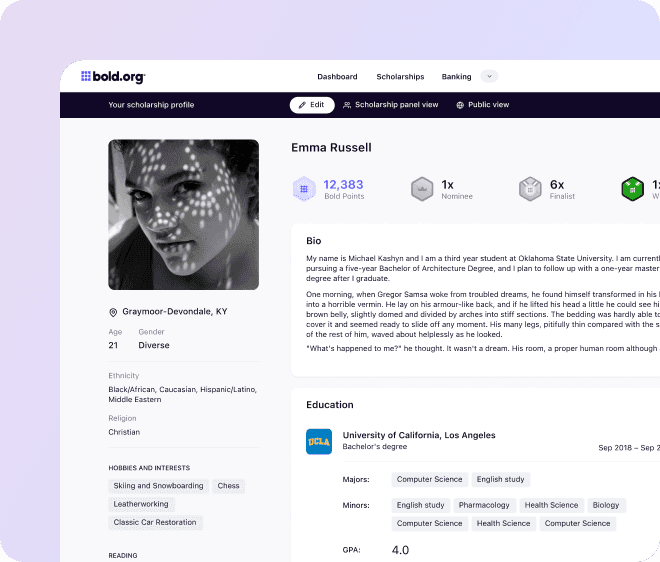
Bold.org helps students show donors who they are beyond a transcript.
Step 02
Where scholarships are awarded
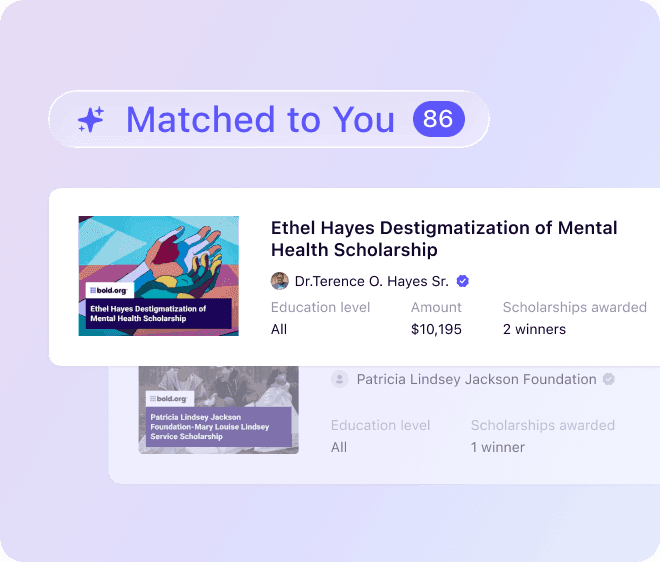
Every scholarship is funded by donors and managed directly on Bold.org.
Step 03
Fund your future
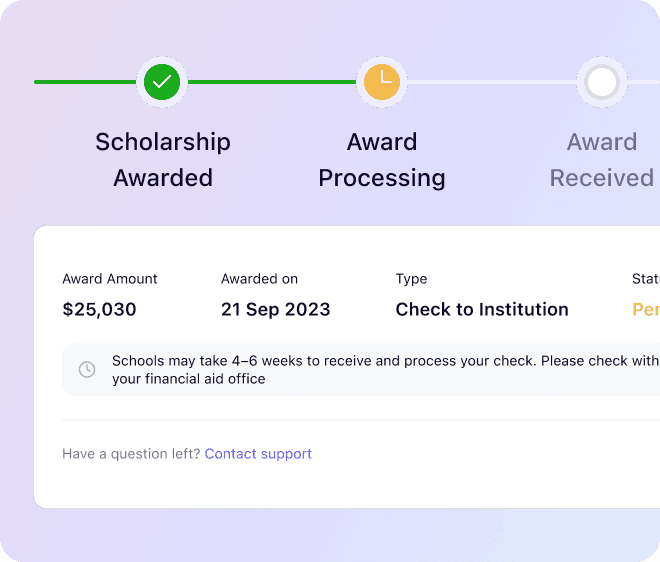
Scholarship dollars are disbursed through Bold.org to help students pay for school.
FAQ
When is the scholarship application deadline?
The application deadline is May 25, 2026. Winners will be announced on Jun 26, 2026.
How will scholarship application information be used?
Your privacy is a top priority on the Bold.org platform, and you can find our privacy policy in full here. You may opt out of communications from Bold.org at any time, and unless we’ve first notified you and gotten your consent, you’ll never receive communication from any third parties related to personal information you give us.
What is the scholarship award?
Award amounts per winner are designated by the donor. Check the award amount for a detailed breakdown.
When will the scholarship winner be chosen? How will they be notified?
The winner will be publicly announced on Jun 26, 2026. Prior to the announcement date, we may contact finalists with additional questions about their application. We will work with donors to review all applications according to the scholarship criteria. Winners will be chosen based on the merit of their application.
How will the scholarship award be paid?
Award checks will be sent to the financial aid office of the winner's academic institution or future academic institution in their name to be applied to their tuition, and in the name of their institution (depending on the school's requirements). If the award is for a qualified educational non-tuition expense, we will work with the winner directly to distribute the award and make sure it goes towards qualified expenses.
How will my scholarship application be verified?
Before we award the scholarship, the winner will be required to confirm their academic enrollment status. Depending on the circumstances, verification of Student ID and/or their most recent transcript will be required.
How should I get in touch with questions?
If you have any questions about this scholarship or the Bold.org platform, just email contact@bold.org and we’ll get back to you as quickly as we can.
Does the scholarship have terms and conditions?
Yes. The terms and conditions for this scholarship can be found here.
97% of students don't win scholarships. We’re here to change that.