Incoming freshman or current undergraduate student
Age:
18-22 years old
Diagnosis:
Type 1 or type 2 diabetes
Field of Study:
Life sciences or a related field
Education Level:
Age:
Diagnosis:
Field of Study:
Incoming freshman or current undergraduate student
18-22 years old
Type 1 or type 2 diabetes
Life sciences or a related field
Al Mann was a visionary in the field of diabetes innovation, making the world a better place through his scientific advancements and his widespread philanthropy.
Despite the progress that has been made in understanding and treating diabetes, it remains a dangerous and difficult condition that must be carefully managed. Those living with diabetes may struggle with fatigue, weakness, blurred vision, and other symptoms that can make daily life challenging, especially on top of the responsibilities of monitoring insulin levels.
This scholarship seeks to empower young adults with diabetes to pursue their dreams in the life sciences.
Any incoming freshman or current undergraduate student who is between the ages of eighteen and twenty-two may apply for this scholarship opportunity if they are living with type 1 or 2 diabetes and if they are pursuing life sciences or a related field. Applicants must be motivated to make a meaningful impact in the diabetes sector and community. The scholarship is currently open to students who are studying or planning to study at a community college or university in the United States.
To apply, tell us about your field of study, how living with diabetes has affected you, what keeps you grounded in the face of challenges, what contribution you hope to make, and how you would describe yourself to your career inspiration. Additionally, submit a video sharing how you would describe yourself to your career inspiration. Reminder: A complete application includes responses to all essay questions as well as submission of the required video.
By applying for the scholarship, you acknowledge that your email will be shared with The Diabetes Link and MannKind for the purpose of providing scholarship-related updates and information about relevant programs and resources.
Selection Criteria:
Ambition, Drive, Impact
Multi-Year Scholarship
This scholarship provides financial support over multiple years. The total award will be distributed in annual installments of $5000 per year, with each disbursement occurring on April 20th. The recipient must continue to meet eligibility requirements each year to receive subsequent payments.
Essay Topic Requirements
1. Why are you pursuing a degree in life sciences, and how has living with diabetes influenced your education, goals, or perspective on your future career?
Please share an example or experience if possible. Consider what inspires you most about your field and how your experiences have shaped your path.
2. When you encounter challenges or setbacks, what keeps you grounded and helps you stay on course?
3. If you could make one meaningful contribution, discovery, or bring a new idea to your field of study or the diabetes community, what would it be, and why is it important to you?
Think about the potential impact, your goals, and your personal vision.
Video Submission Prompt (1–2 minutes)
If you were talking with your career inspiration, how would you describe yourself to show who you are and what matters most to you?
If you don’t have a specific person in mind, imagine speaking to a mentor, role model, or future colleague. This is your chance to share your values, passions, and perspective beyond your written responses. Speak authentically; no professional editing is needed.
400–600 words
Link Requirements
Submit a link to your video as a public YouTube link or a Google Drive link. Settings should be set to "public" or "anyone with the link can view." If we can't access your video, your application won't be considered.
$100,000
10 winners, $10,000 each
Awarded
Application Deadline
Apr 2, 2026
Winners Announced
Apr 20, 2026
Education Level
High School, Undergraduate
Share
Explore All Kinds of Scholarships for All Kinds of Students
Living with diabetes has made biology deeply personal to me. Long before I learned about endocrine signaling pathways in class, I was living them every day. Blood glucose fluctuations, insulin dosing, inflammation, metabolic balance — these were not abstract textbook concepts but real variables shaping my energy, focus, and well-being. That constant awareness sparked my curiosity about how the body regulates itself and, more importantly, how it fails. Pursuing a degree in life sciences felt like a natural extension of that curiosity.
As I progressed academically, I began to see diabetes not just as a condition to manage, but as a complex systems-level challenge involving immunology, metabolism, vascular biology, and bioengineering. In one course on cellular signaling, we studied feedback regulation in hormonal pathways. While others focused on memorizing mechanisms, I found myself thinking about pancreatic β-cell stress, inflammatory cytokines, and long-term complications. Understanding the molecular framework behind something I live with every day was empowering. It transformed frustration into fascination and gave me a sense of agency. I no longer saw myself only as a patient; I saw myself as a future contributor to the science.
Living with diabetes has also shaped how I approach challenges. Chronic illness requires daily recalibration. A single high or low glucose reading does not define overall health — trends and long-term patterns matter more. I apply that same mindset to academics and research. When I encounter setbacks, whether it is a difficult exam or an experiment that fails to produce expected results, I step back and analyze rather than panic. What variables can I adjust? What can I learn from this data? Diabetes has taught me resilience, patience, and analytical thinking under pressure.
One particularly challenging semester tested this perspective. Balancing rigorous coursework with research responsibilities felt overwhelming, and I initially viewed my struggle as a personal shortcoming. But I reframed the situation the same way I would interpret a glucose trend: gather information, identify contributing factors, and make targeted adjustments. I reorganized my study strategies, sought mentorship, and restructured my schedule. The experience reinforced that adaptability is a strength, not a weakness.
If I could make one meaningful contribution to the life sciences or the diabetes community, it would be advancing more personalized, inflammation-aware approaches to diabetes care. Diabetes is often treated uniformly, yet patients experience it differently due to genetic, environmental, and inflammatory factors. I am particularly interested in how chronic inflammation intersects with metabolic dysfunction and long-term vascular complications. By identifying predictive biomarkers and integrating them into tailored treatment strategies, we could move toward more precise, preventative care.
Ultimately, my goal is to bridge lived experience with scientific innovation. I want to contribute to research that not only advances molecular understanding but also improves the quality of life for people managing chronic disease. Living with diabetes has shaped my resilience, deepened my empathy, and clarified my purpose: to transform personal challenge into meaningful scientific impact.
University of Arkansas-Pulaski Technical CollegeJacksonville, AR
Managing my diabetes was a struggle for me, and at first I wasn’t sure what life would look like. With time, I was able to learn how to navigate my life by adjusting, making sure my levels were stable.
Pursuing chemical engineering is my passion; this being heavily influenced by me being a type 2 diabetic. At first, I wasn't sure if I truly wanted to major in this but with research I discovered that chemical engineers develop the skills needed to bring meaningful change. I've learned that being a chemical engineer aligns with my want to help people. This contrasts with how little I actually understood about my food choices and how it truly affected my body. I didn't realize that a combination of both my eating habits and my genetics would cause me to develop type 2 diabetes. This reflects my desire to help others, not just those with diabetes but those with other chronic diseases. Discovering that chemical engineers play a huge role in our pharmaceutical companies and in the process of making new medical devices furthered my curiosity and desire to be the one who makes that change. Now, I'm sure this is a career I will thrive in because I know the work I do will impact those around me in a meaningful way.
Having diabetes helped me overcome many challenges and setbacks that I’ve encountered. During my early years of being diagnosed with diabetes, I have learned important skills such as self control and discipline. Figuring out how much to eat, what to eat and discovering what foods increased my blood sugar helped me focus on the things I want in life, and ultimately led me to discover that I wanted to pursue this career. I can't say it was always easy for me, because throughout my journey I was met with highs and lows, literally. Handling endless corrections with my blood sugar and spikes with certain foods, I felt exhausted. It took me months to figure out a system, but with the help of my endocrinologist and at home support, I was able to achieve success with managing my levels.
A meaningful change I would like to make is to further help those in the diabetic community. So that others will know that it’s possible to manage and thrive with this life changing condition. I’ve learned that by letting go of certain habits, little by little, can help reshape a life. When you identify the source of your illness, any restriction, no matter how small, is progress. My goal is to be the guide for those who are suffering with this disease while also creating and upgrading medical devices used for diabetes to ease their pain and symptoms. This ensures that those who are going through a similar journey as me can better manage and control their diabetes, so that they do not have to suffer the way I did.
Georgia Institute of Technology-Main CampusGaithersburg, MD
Living with Type 1 diabetes, celiac disease, and other metabolic disorders has greatly influenced the decisions I’ve made about my future. These experiences are why I am pursuing a degree in computer science in the healthcare industry. From the beginning, my goal has been simple: Do not let a chronic disease get in the way of living life, and create tools that make managing them a little easier for myself and others.
At the age of 13, I was diagnosed with Type 1 diabetes, and I was surprised to see that there was no easy way for newly diagnosed kids to calculate their insulin doses. I assumed there must be an app that could help, but I soon learned that none existed because creating one required FDA clearance. Instead of accepting that gap, I decided to work toward solving it. Five years later, I created T1D1 (Type 1 from Day 1), the first FDA-cleared, over-the-counter insulin calculator app in the United States. I made it completely free so that anyone who needs it can access it. Today, it has more than 50,000 downloads, and doctors and diabetes educators at children’s hospitals recommend it to their patients.
Building this app showed me how powerful technology can be in healthcare. It also opened my eyes to seeing how many people (especially kids) living with chronic conditions could benefit from better tools and systems. After launching the T1D1 app, another family approached me to create a tracker app for children with incontinence so they could easily share daily data with their doctors. That experience taught me that small innovations can have a huge impact on quality of life. This perspective continues to guide my career path and my current internship with Abbott, where I’m learning how healthcare technology can improve patient outcomes on a larger scale.
Living with diabetes has also taught me resilience. When you have multiple chronic diseases, you get used to managing issues daily whether it’s blood glucose levels, technology failures, or just feeling burned out from having to think about your disease all of the time. On my good days, when I encounter challenges, I focus less on what went wrong and more on how I can recover and improve the situation. Taking action gives me hope and momentum. I’ve also learned the importance of my community and reaching out to friends, mentors, and others for support when I need it.
It has been so amazing to receive emails from doctors, nurses, educators, and PWDs who are benefiting from the T1D1 app. These notes of appreciation keep me motivated to continue innovating and looking for ways to empower others (especially youth) to manage their own diseases. I appreciate the institutions that are conducting research for a cure but my focus is how to improve lives right now. Living with two chronic diseases has shown me that even small improvements in daily management can make a life-changing difference. My goal for T1D1 is to be that small contribution in the diabetes community that creates a huge impact in the way we all live our lives.
Meeting Mike Castagna at the CWD dinner in Barcelona inspired me by opening my eyes to see other amazing innovations easing the lives of PWDs like Afrezza. Mike’s focus on improving lives and expanding to the youth struck a nerve in me to continue my work, enhancing the diabetes community as a whole.
This scholarship would be put towards my education at Georgia Tech so I can continue to build solutions that help people focus less on their disease and more on living their lives.
In high school, my understanding of even the simplest things changed.
Growing up, I understood that certain things happened but never understood why or how. What I learned in my high school science classes made me feel like I could understand anything in the world if I studied hard enough. Even simple things, like getting taller or why metal rusts were more complicated than I thought, and I learned what was happening at a molecular level. I didn’t know that cell division had four stages for one process or why reactions happen in solutions even when no visible change is observed. I felt as though sickness or disease could be cured if we could study at a small enough scale and reveal what didn’t function properly.
I’ve lived with type 1 diabetes (T1D) for 12 years now and some of the technology that I use today was only a dream when I was first diagnosed. I’ve seen how even small improvements in therapies make my life better everyday. I would like to focus my education on something that can benefit others who have conditions that impact their life or health. I’m pursuing a career in life sciences and engineering so nobody will need to go through the challenges that I faced when I was diagnosed.
When I got my first continuous glucose monitor (CGM), the device was a game changer. It was big, sometimes painful to apply, and relatively inaccurate, but it changed my life in ways that I never would have imagined. The daily guessing game of blood glucose disappeared almost overnight and the system helped me recognize my low and high blood sugars on my own. These types of medical and technological advancements have encouraged me to use my skills in the STEM field to help people suffering from chronic health conditions.
Of course, having T1D still sucks and can sometimes be challenging. But I know that all the effort I will put into finding a cure will be well worth it. I’ve spent most of my 12 years with T1D increasing awareness and funding for T1D research. I’ve met with my congressional House of Representatives and Senate staff members multiple times and have been a delegate for Breakthrough T1D’s (formerly JDRF) Children’s Congress twice to advocate for federal funding for T1D research. I’ve volunteered at different Breakthrough T1D events and even dressed up as Rufus the Bear (Breakthrough’s mascot) to help newly diagnosed kids. I’ve also captained my T1D walk team, Evan’s Evangers, and have raised over $400,000 for diabetes research. With unimaginable advancements being made in research fields, I believe that a cure for diabetes is not a question of “if” but “when.” When I encounter setbacks or get discouraged, I think about how close we are to a cure and it helps me keep pushing forward.
One discovery I would make for the diabetes community would be a way to detect active insulin in people’s bodies. In current closed loop pump systems, the amount of “active insulin” is just a calculation of how much was dosed but sometimes that insulin is never actually delivered due to a faulty cannula or other delivery mechanism. If we had an “insulin detection monitor” (IDM), the pump would be even more accurate and effective. This advancement would also help detect if pump systems are failing/not working. Accurate detection of active insulin wouldn’t be perfect, but would solve a problem that diabetics have to endure every day. Even small, simple advancements can make a big difference in our daily lives.
I still recall the blearing white walls and the scent of the sterile hospital room I occupied when I was diagnosed with Type 1 diabetics at the age of five. I still remember the dull pain in my veins from blood being drawn every few hours, the ice-cold sensation of saline that would shoot through my blood vessels whenever they had to flush my iv catheters. I didn’t know that, five years ago, in that big hospital on the island of New Providence was where I would find a call that resonated so deeply with me. Before then, I didn’t know what I wanted to be as a child. I thought that maybe I’d be a gardener, or something of that sort. But in that hospital when I first formed an idea of what I could truly see myself doing for the rest of my life. What sparked it was not that I myself had diabetes, it was the realization that I wasn’t the only child. One day, while I was in the hospital, one of the nurses took me to the NICU. She smiled kindly at me and ushered me over to the incubators and pointed. “Those babies are just like you,” she said, in a hope of helping me feel less alone. But I didn’t. I felt an ache in my chest realizing that when I felt unwell, I could clearly advocate for myself, but these babies could not. All they knew how to do at this age was cry no matter what they felt. Who advocated for them if they couldn’t do it for themselves? This moment was what led me here.
My end game has always been to become a pediatric endocrinologist and serve the most underserved populations, which is the biggest reason I pursued my biology degree. As a diabetic, I have seen and experienced a plethora of challenges and setbacks. This could range anywhere from noncompliance to the stigmas surrounding diabetes. I think the most riveting thing I had learned as a young lady pursuing pediatric endocrinology was just how high the level of noncompliance was where I live. After a recent shadowing experience on my homeland, Abaco, I learned from one Dr. Strachn that noncompliance was the greatest killer of pediatric diabetic patients. She had stated something that stuck with me since meeting her, “Many patients don’t live past the age of 18 in The Bahamas because they’re noncompliant.” While I also struggled with noncompliance as a child, what helped me most was my support system. As a diabetic, when setbacks and challenges arise, stress can be amplified and it’s important to have a steady line of support from friends and family who will push you to excel and stay on your goals. I also feel the assurance I have built up in myself over the last fourteen years helps me stay grounded.
If I could make one contribution to the diabetic community, it would be to complete my studies and become a pediatric endocrinologist. It would be to go back to The Bahamas and give pediatric diabetic patients what my family and I didn’t consistently have, support. To this day, there isn’t a single pediatric endocrinologist in The Bahamas, and I want to change that. I want to be a voice for children who went through the same struggles I have. I want to advocate for children and families who don’t have access to that support. And finally, I want to be representation for my community and allow them to see that illness does not define or limit what we can achieve.
University of California-Los AngelesChula Vista, CA
How it works
Bold.org is Built to Make Scholarships Feel Possible
Step 01
Start with your story
Bold.org helps students show donors who they are beyond a transcript.
Step 02
Where scholarships are awarded
Every scholarship is funded by donors and managed directly on Bold.org.
Step 03
Fund your future
Scholarship dollars are disbursed through Bold.org to help students pay for school.
FAQ
When is the scholarship application deadline?
The application deadline is Apr 2, 2026. Winners will be announced on Apr 20, 2026.
How will scholarship application information be used?
Your privacy is a top priority on the Bold.org platform, and you can find our privacy policy in full here. You may opt out of communications from Bold.org at any time, and unless we’ve first notified you and gotten your consent, you’ll never receive communication from any third parties related to personal information you give us.
What is the scholarship award?
Award amounts per winner are designated by the donor. Check the award amount for a detailed breakdown.
When will the scholarship winner be chosen? How will they be notified?
The winner will be publicly announced on Apr 20, 2026. Prior to the announcement date, we may contact finalists with additional questions about their application. We will work with donors to review all applications according to the scholarship criteria. Winners will be chosen based on the merit of their application.
How will the scholarship award be paid?
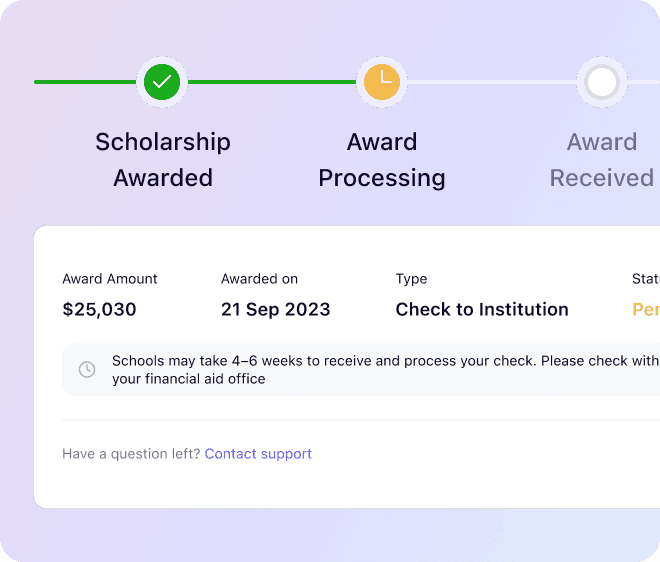
Award checks will be sent to the financial aid office of the winner's academic institution or future academic institution in their name to be applied to their tuition, and in the name of their institution (depending on the school's requirements). If the award is for a qualified educational non-tuition expense, we will work with the winner directly to distribute the award and make sure it goes towards qualified expenses.
How will my scholarship application be verified?
Before we award the scholarship, the winner will be required to confirm their academic enrollment status. Depending on the circumstances, verification of Student ID and/or their most recent transcript will be required.
How should I get in touch with questions?
If you have any questions about this scholarship or the Bold.org platform, just email contact@bold.org and we’ll get back to you as quickly as we can.
Does the scholarship have terms and conditions?
Yes. The terms and conditions for this scholarship can be found here.
97% of students don't win scholarships. We’re here to change that.