Being an older, less conventional student with children can be challenging.
Raising children is a huge responsibility, making it difficult for parents to put ample time into both their children and their education. Many parents take time off of school in order to raise their children. Returning to school as a less conventional student presents its own challenges, so the Jerrye Chenes Memorial Scholarship will support parents who are working hard to earn their education while still raising children.
Undergraduate and graduate students are eligible to apply if they have children. To apply, write about the challenges you’ve faced in returning to school.
Selection Criteria:
Ambition, Need, Boldest Bold.org Profile
Essay Topic Requirements
What challenges have you faced or overcome while returning back to school?
400–600 words
$1,500
1 winner$1,500
Awarded
Application Deadline
Jul 31, 2026
Winners Announced
Sep 1, 2026
Education Level
Undergraduate, Graduate
Share
Explore All Kinds of Scholarships for All Kinds of Students
Asheville-Buncombe Technical Community CollegeGold Hill, NC
Balancing college midterms with two sets of twins is a unique kind of chaos, and my drive to show my children what resilience looks like is fiercely intense. Juggling nursing courses later in life as a single mother means there is no clean separation between my life as an academic and my life as a mom. On any given evening, you can find us crammed at the kitchen table under a mountain of notebooks, navigating a relentless cycle of online portals and due dates. My sixteen-year-old boys are wildly different; Jonah discusses art, while Brendon, who navigates severe anxiety, is homeschooled by me, allowing us to co-navigate mental health in real-time. Meanwhile, my younger twins, Nikolai and Bella, treat my nursing degree like a high-stakes sport, speed-quizzing me with flashcards. By building this sanctuary of safety at our table, my kids physically watch me sweat for our future every single day.
Returning to school as a less conventional student presented deep personal and academic challenges. For a long time, higher education felt like a luxury meant for other people who hadn't battled addiction, mental health crises, and poverty. Stepping back into a college science classroom after years away meant confronting an immense history of self-doubt. The hardest hurdle wasn't a complex clinical formula; it was the intense vulnerability of wondering if I could actually balance it all without shortchanging my family. I spent my last grade-release day refreshing my screen every single hour, terrified that the pressure would break me. Seeing an "A" flash across my classes didn't just validate my work ethic; it restored my absolute confidence and proved that a comeback is always possible.
I don't hide my difficult chapters from my teenagers. Through my active involvement in Narcotics Anonymous, I am completely open with them about my recovery. I want them to have a front-row seat to what accountability, discipline, and redemption actually look like in real time. I might not have a formal hospital badge yet, but I have a PhD in real-life recovery from helping run NA meetings and supporting people fighting for their lives. This lived experience has shaped my deep respect for human autonomy and completely defined my career goals.
My ultimate goal is to graduate and dive straight onto the intense frontlines of mobile crisis intervention and addiction medicine as a first-responder nurse. Away from the classroom, I constantly analyze exactly what specific resource gaps or acts of zero-judgment compassion would have helped me most when I was at the absolute bottom.
Grit alone cannot pay for tuition, and raising four children while maintaining a full-time clinical schedule severely restricts my earning potential. Financial assistance from the Jerrye Chesnes Memorial Scholarship represents the exact lifeline I need to ease this financial strain. Lowering these tuition barriers allows me to forge a new family blueprint rooted in security, hope, and an absolute refusal to give up on the people we are meant to become. I want to spend my career serving as a loud, proud reminder for my teenagers, and my future patients, that failure is just an event, never an identity—that you are never too old to rewrite your story, and that nobody is ever a lost cause.
Returning to school as a single mother with a neurodivergent child, psychological disorders, and limited support has been one of the hardest things I’ve ever done. When I made the decision to go back to school, I knew it wouldn't be easy—but I also didn’t fully grasp just how many obstacles I would need to overcome just to stay on track.
Time management quickly became one of the biggest challenges. Balancing coursework, assignments, exams, and discussion posts with the demands of daily life felt almost impossible. I’m not just a student—I’m also a full-time mom, homeschool teacher, emotional support system, cook, housekeeper, and more. I’ve had to learn how to work late into the night or wake up early to squeeze in study time. There have been many days when my eyes burned from exhaustion, but I kept going because I believed in my purpose.
Finances were another serious struggle. Returning to school as a single mom meant stretching an already thin budget. Tuition and other education costs—on top of bills, food, and other necessary expenses. At moments I questioned if pursuing my degree was financially responsible, but I knew I needed to break the cycle of instability for myself and my child. I applied for scholarships and budgeted every dollar. There were loads of sacrifices like no extras and postponing basic needs.
Childcare was the most complex issue to navigate. My child is neurodivergent and requires extra attention, structure, and support. Reliable, affordable childcare options that understand and accommodate neurodivergence are almost nonexistent. Knowing that, I became both caregiver and educator. I chose to homeschool because it was the only way to ensure my child received the attention and flexibility she needed. Juggling my schoolwork while planning lessons, guiding therapy routines, and managing meltdowns was overwhelming at times. There were days I submitted assignments with tears in my eyes because I had just finished helping my child through a difficult episode and still had work to do.
All of this was compounded by my own psychological and physical health struggles. I live with mental health challenges that can affect my focus, energy, and emotional stability. Depression, anxiety, PTSD triggers, and periods of burnout appeared quite frequently. At the same time, I’ve had to deal with physical health concerns—chronic fatigue, migraines, and other issues that made studying feel like a marathon. On the days my body or mind didn't cooperate, I had to find deep wells of resilience within myself just to get through. Therapy, grounding practices, and small moments of self-care became lifelines.
Perhaps the hardest part of all this was doing it with little to no support. I didn’t have a partner to split responsibilities with. I didn’t have family or friends I could regularly lean on. Most days, it was just me. There were times I would have given anything for someone to say, “I’ve got this, you take a break.” But instead, I kept pushing forward because I had no other choice. My dreams and my child’s well-being were on the line.
Despite all these challenges, I’ve grown in ways I never imagined. I’ve learned how strong and capable I truly am. I’ve proven to myself that even in the face of chaos and hardship, I can thrive. Going back to school hasn’t just been about earning a degree—it’s been about reclaiming my life, my identity, and my hope for a better future. Every assignment turned in, every class passed, is a step toward a life where I can provide more for my child and stand proudly knowing I did not give up.
I've always had a complicated relationship with education.
I love learning. This has been true as long as I can remember. Before I turned three, I taught myself to read. I read anything I could get my hands on, from cereal boxes to VCR manuals. I absorbed all the information I could—facts about elephants' knees, the biological connection between rhinoceroses and horses. I could identify different swords by the shape of their blades. I was an odd kid, certainly. But I was sharp, eager to understand, and motivated to explore the world. I began writing, and by age nine knew that's what I wanted to do with my life.
But when I began public school, everything shifted. Suddenly I was bored, rehashing things I learned very quickly, or I was out of my depth, unable to keep up with my classmates. Our self-paced reading program was the only thing that kept me afloat in a system that became increasingly perplexing. By high school, my GPA had dropped troublingly. Then, after years of struggling in college, my anxiety around math was enough to slow me to a stop. I dropped out just one class shy of my associate's degree.
Leaving school did not mean leaving learning, though. My longing to absorb life and interpret it wisely, to understand what I can of the world, has never grown tired. I started writing for a living, and am now a published poet. I spent a year learning other languages as I traveled—literally—all the way around the world. Still, I have always felt untapped potential hidden somewhere in me. This raised so many questions.
This year, I finally got some answers. At 33-years-old, I was diagnosed with autism. Finally, a clue to why I struggled so much in school. The system was not built for brains like mine, whose growth is asynchronous, whose sensitivity to the environment causes constant overwhelm, whose social difficulties become a bewildering distraction. Teachers dismissed me as lazy, aloof, because my perceived intelligence didn't match my levels of success. I bought into this for a long time. Recognizing I am autistic made me feel less like a failure. Actually, it made me feel proud. Proud that I got so far without support or necessary self-understanding. Seeing myself in this new light sparked something: a desire to try again.
Now I am the mother of a two-year-old boy who is so much like I was at his age. He knows the names of his planets (and corrects me when I mislabel them), his alphabet, his numbers, identifies birds by their calls. He is peculiar and hilarious and precocious and beautifully odd. I am eager to get back to school for myself, for my own yearning and sense of accomplishment. But beyond that, I am eager to show him what brains like ours can do when we enter challenging spaces with self-understanding, trust in our minds and our enthusiasm for learning, and willingness to ask for support when we need it.
Applying for scholarships like this one have been, for me, an act of determination. We don't have the funds to get me back to school, and I'm reluctant to take out loans when we already have a number of outstanding debts. My family is the priority, and making sure we aren't overwhelming ourselves for my schooling is important to me. Finances really are the last hurdle for me in reestablishing myself as a student. I plan to attend school as full-time as finances allow. Thank you so much for considering me for this scholarship - it means everything!
How it works
Bold.org is Built to Make Scholarships Feel Possible
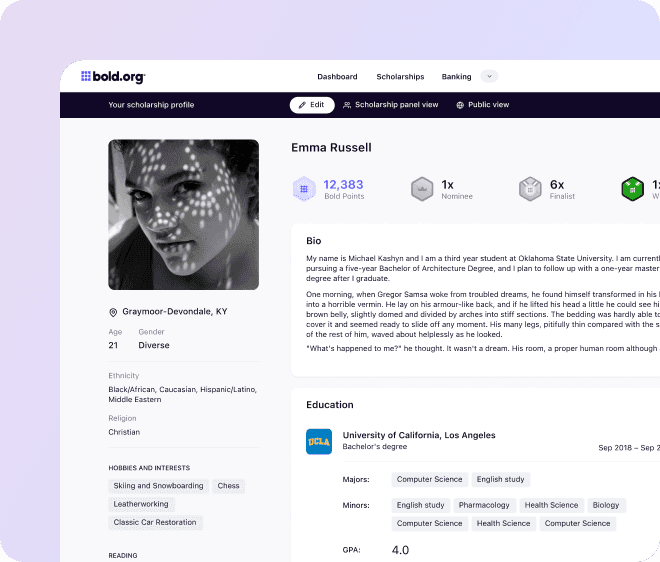
Step 01
Start with your story
Bold.org helps students show donors who they are beyond a transcript.
Step 02
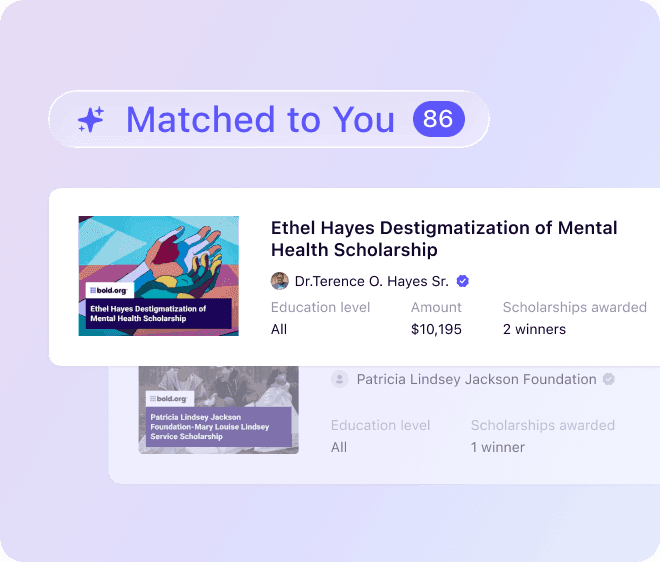
Where scholarships are awarded
Every scholarship is funded by donors and managed directly on Bold.org.
Step 03
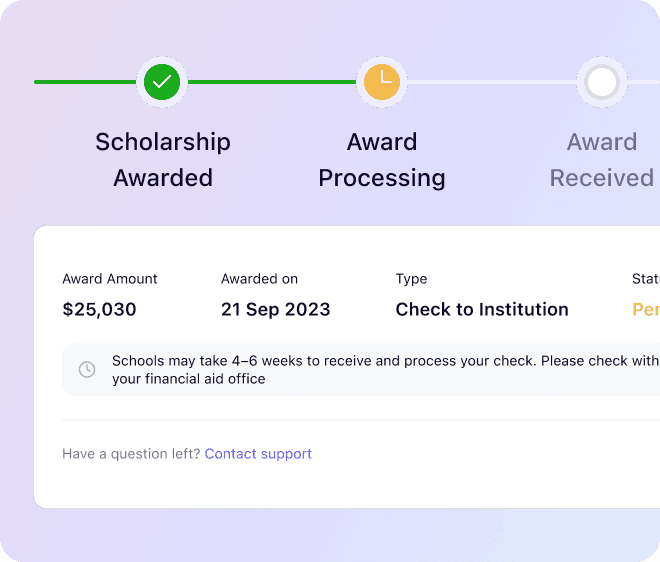
Fund your future
Scholarship dollars are disbursed through Bold.org to help students pay for school.
FAQ
When is the scholarship application deadline?
The application deadline is Jul 31, 2026. Winners will be announced on Sep 1, 2026.
How will scholarship application information be used?
Your privacy is a top priority on the Bold.org platform, and you can find our privacy policy in full here. You may opt out of communications from Bold.org at any time, and unless we’ve first notified you and gotten your consent, you’ll never receive communication from any third parties related to personal information you give us.
What is the scholarship award?
Award amounts per winner are designated by the donor. Check the award amount for a detailed breakdown.
When will the scholarship winner be chosen? How will they be notified?
The winner will be publicly announced on Sep 1, 2026. Prior to the announcement date, we may contact finalists with additional questions about their application. We will work with donors to review all applications according to the scholarship criteria. Winners will be chosen based on the merit of their application.
How will the scholarship award be paid?
Award checks will be sent to the financial aid office of the winner's academic institution in their name to be applied to their tuition, and in the name of their institution (depending on the school's requirements). If the award is for a qualified educational non-tuition expense, we will work with the winner directly to distribute the award and make sure it goes towards qualified expenses.
How will my scholarship application be verified?
Before we award the scholarship, the winner will be required to confirm their academic enrollment status. Depending on the circumstances, verification of Student ID and/or their most recent transcript will be required.
How should I get in touch with questions?
If you have any questions about this scholarship or the Bold.org platform, just email contact@bold.org and we’ll get back to you as quickly as we can.
Does the scholarship have terms and conditions?
Yes. The terms and conditions for this scholarship can be found here.
97% of students don't win scholarships. We’re here to change that.