The families of suicide victims face massive challenges when it comes to dealing with ongoing grief.
After the loss of Jean Ramirez, his brother, Anthony, was able to persevere in the midst of tragedy. Despite the challenges of grief, he pushed forward. The vision of the Jean Ramirez Scholarship is to empower suicide loss survivors to pursue education and to continue the ongoing healing process.
To commemorate the legacy of Jean Ramirez, this scholarship seeks to provide financial support to students who are immediate family members that have experienced the loss of a loved one to suicide.
Undergraduate and graduate students who are immediate family members of a suicide victim are eligible to apply. In your application, please answer the following essay question.
Selection Criteria:
Essay, Perseverance, Dedication
Essay Topic Requirements
Reflect on your journey as a suicide loss survivor, discussing the challenges you’ve faced, the lessons you’ve learned, and how you’ve found resilience and hope in the face of tragedy.
400–600 words
$5,000
10 winners, $500 each
Awarded
Application Deadline
Jul 20, 2026
Winners Announced
Aug 20, 2026
Education Level
Undergraduate, Graduate
1
Contribution
Share
Explore All Kinds of Scholarships for All Kinds of Students
Losing my mother to suicide in 2018 was the most devastating experience of my life. I was 24 years old, only a month away from my twenty-fifth birthday, when I received the call that she had passed away. The night before, she had called me asking for help, and I was planning to see her the next day. Instead, I was left with a lifetime of unanswered questions, overwhelming grief, and the painful reality that I could not save someone I loved.
My mother struggled with bipolar disorder and addiction throughout my entire life. Growing up, there were years when I would not see her because she was actively using substances. In many ways, I felt as though I spent my childhood raising both myself and my mother. Despite her struggles, she was one of the kindest and most selfless people I have ever known. Even during her darkest moments, she always tried to help others. I wish more people understood that addiction and mental illness were not who she was; they were battles she fought every day. The loss brought challenges that extended far beyond grief. I experienced intense guilt, anger, and feelings of abandonment. I still struggle with the belief that I should have been able to save her.
I was responsible for arranging and helping pay for her funeral while taking time away from work and navigating financial hardship. Perhaps most difficult was accepting the milestones she would never be present for: my wedding, future children, holidays, and all the moments when a daughter hopes to have her mother by her side.
My grief also affected my decisions. I delayed returning to school and entered a marriage shortly after my mother's death that ultimately became abusive. Looking back, I recognize that my fear of losing another person and my unresolved trauma influenced choices that were not healthy for me. For years, I carried my pain without fully addressing it.
The turning point came when I committed to healing through therapy and EMDR. Through that process, I learned that resilience does not mean moving on from loss; it means learning how to carry it while continuing to grow. I found support in my fiancée, who provided a sense of security and stability I had never experienced before. I also rediscovered my love for art, which became a healthy outlet for processing emotions that were difficult to express with words. Today, my experiences have shaped my purpose. I am pursuing my degree with the long-term goal of becoming a licensed therapist who works with children affected by trauma and behavioral challenges. I want to help others understand that healing is possible and that no one is beyond hope. My mother's story taught me that every person matters, and that even small acts of compassion can have a lasting impact.
While I will always carry the grief of losing my mother, I also carry the lessons she left behind: empathy, perseverance, and the importance of showing up for others. Her life and death have inspired me to turn my pain into purpose and to help create hope for those who may not yet see it for themselves.
Unexpectedly losing my youngest brother to suicide reshaped my world in ways that are difficult to fully articulate. As a suicide loss survivor, I have faced a complex mix of grief, confusion, guilt, and unanswered questions. I saw no signs, and that reality has been one of the hardest truths to accept. As a nurse, I felt like I should have recognized something—anything—that could have changed the outcome. That belief left me carrying a profound sense of failure, along with a deep, dark hole in my soul that I am still learning to navigate.
Unlike other forms of loss, suicide leaves behind an unrelenting search for “why,” a question that often has no clear answer. In the early stages of grief, I found myself replaying moments, conversations, and missed opportunities, wondering what I could have done differently. This kind of grief is not linear; it comes in waves, sometimes unexpectedly, often tied to memories or quiet moments. I have learned that healing does not mean forgetting or moving on, but finding a way to carry the loss while still choosing to live with purpose.
Watching how this loss shattered my mother and deeply affected our entire family has forever changed me. It revealed how far-reaching the impact of suicide truly is—how it ripples through every relationship, every shared memory, and every future milestone. This experience has deepened my understanding of both love and loss, and it has strengthened my commitment to compassion.
A difficult truth in my journey is that I have not yet fully reached a place of self-forgiveness or healing. Despite my clinical training, I continue to struggle with the belief that I should have identified warning signs. While I am gaining insight into the often unpredictable and concealed nature of mental health crises, internalizing that understanding remains a work in progress. This loss has also highlighted the persistent stigma surrounding mental health in Hispanic men, where cultural norms may discourage help-seeking behaviors, reinforcing my commitment to advocacy and awareness. I feel a strong responsibility to help change that, starting at home by having open, honest conversations with my daughter about mental health and the importance of asking for help and the signs to look for In order to be able to help someone.
This loss has also shaped my purpose. I feel a strong calling to become a mental health advocate, particularly in pediatric populations and families who may be silently struggling. I plan to pursue my Pediatric Primary Care Mental Health Specialist certification so I can better identify early warning signs, support families, and contribute to prevention efforts. I want to be part of the change that encourages open conversations, reduces stigma, and ensures that individuals feel seen and supported before they reach a crisis point.
Resilience, for me, has not meant being untouched by grief, but continuing forward with intention. Hope has returned gradually—in meaningful conversations, in supporting others, and in recognizing that even in profound loss, there can be purpose. While the pain of losing my brother will always be part of me, it has also become a driving force behind who I am becoming.
My journey as a suicide loss survivor continues to evolve. I carry both the weight of my loss and the responsibility to use it for good. Through advocacy, education, and compassion, I hope to honor my brother’s memory and help prevent other families from experiencing the same heartbreak.
Teachers College at Columbia UniversityNew York, NY
The loss of a sibling to suicide is a shattering earthquake, but the loss of a twin is like losing half of your own soul. My twin brother, born just two minutes before me, was my constant companion, the one I grew up alongside every single day. When he tragically took his own life after a grueling battle with severe depression, my world fractured instantly. As a suicide loss survivor, the initial challenge wasn't just the overwhelming grief; it was the suffocating silence and societal stigma that so often follow such a tragedy. Relying on my undergraduate background in psychology, I tried to help my mother navigate the darkness openly, learning to view my brother's passing not as a source of shame, but as the heartbreaking result of a severe illness.
However, the emotional devastation was so catastrophic that it caused my family to completely disintegrate. Incapable of bearing the ongoing grief, my parents divorced. My father abruptly severed all financial and emotional support, completely cutting me off from his life. My mother, earning a very meager salary, desperately wants to support me but simply cannot afford the astronomical cost of my graduate education. Suddenly, as an international student at Teachers College, Columbia University, I went from grieving my twin brother to fighting for basic survival in New York City. Currently, I am doing "double duty"—balancing a rigorous academic schedule while working exhausting industry internships just to afford basic groceries and rent. The financial panic frequently threatens to derail my dream, making the temptation to give up feel overwhelming.
Despite these immense hurdles, I have found a fierce sense of resilience and hope. My journey as a survivor has taught me that we cannot undo the tragedies that break us, but we can choose what we build from the ruins. This experience has deeply redefined my aspirations. I no longer just see higher education as a personal milestone; I see it as a vehicle to build empathetic, accessible multimedia educational platforms and support networks for vulnerable, marginalized youth. I want to create the structural safety nets that might prevent another family from enduring the total destruction we suffered.
The Jean Ramirez Scholarship represents more than financial relief; it is a profound validation of my survival. This funding would alleviate the immediate economic strain keeping me awake at night, ensuring I can stay at Columbia to finish my degree and relieve my mother's heavy burden. By continuing my education, I choose to honor my twin brother's memory through resilient action—transforming my deepest grief into a lifelong commitment to community healing and hope.
University of California-Los AngelesTerre Haute, IN
Losing my younger sister, Tumi, to mental illness during the COVID-19 pandemic forever changed the course of my life. Before her illness, she was joyful, creative, and full of light. Watching that light slowly dim while my family struggled to access adequate mental healthcare was devastating. Living in a rural community meant facing long waitlists, overwhelmed providers, and limited access to specialized care. Although we fought tirelessly to support her, there were moments when the healthcare system felt impossible to navigate. When she passed away, I was left carrying grief, guilt, confusion, and questions I did not know how to answer.
One of the greatest challenges I faced as a suicide loss survivor was learning how to exist in a world that continued moving forward while my own felt shattered. In the Black community, mental health is often stigmatized, and conversations about suicide can feel especially difficult. I found myself suppressing my grief at times because I did not know how to express the depth of my pain. I tried to remain “strong” for others, but I eventually realized that silence only deepened my suffering. Healing required vulnerability, honesty, and allowing myself to ask for support.
Over time, I began to understand that resilience does not mean moving on from loss, but learning how to carry it with purpose. My sister’s life and death transformed the way I view mental health, healthcare, and human connection. I became more intentional about checking on people, listening without judgment, and creating spaces where others feel safe discussing struggles that are often hidden. Her loss also inspired my academic and professional path. At Johns Hopkins University, I pursued studies in public health, molecular biology, and mental health to better understand the systemic inequities and stigma that prevent many individuals from receiving proper care. I later earned a Master of Health Science in Mental Health from the Johns Hopkins Bloomberg School of Public Health, where I focused on culturally competent mental healthcare and improving access for underserved communities.
I also found resilience through service and advocacy. Co-founding the Black Women’s Collective allowed me to help create supportive spaces for students navigating stress, isolation, and identity struggles. Working with children and adolescents in clinical and mentorship settings reminded me how important it is for people to feel seen and valued, especially during vulnerable moments. In many ways, supporting others became part of my own healing process.
Although grief never fully disappears, I have found hope in knowing that my sister’s story continues to inspire the work I do every day. Her life taught me the importance of compassion, and her loss gave me a deeper understanding of how urgently we need open conversations about mental health. This fall, I will attend the David Geffen School of Medicine at UCLA to pursue my Doctor of Medicine degree, and regardless of the specialty I practice, I know mental health advocacy will remain central to my career.
As a suicide loss survivor, I have learned that tragedy can either close us off from the world or deepen our capacity to love, empathize, and fight for change. I choose the latter. I hope to honor my sister’s memory by helping build a future where fewer people suffer in silence and more individuals feel supported enough to seek help without shame or fear.
Southern New Hampshire University- OnlineIndianola, IA
People often ask how someone survives the loss of a loved one to suicide, and I want to share how personal stories like mine can inspire others to take action and support mental health.
The truth is, I don't think you ever truly get over it. I think you learn to carry it. Some days it's light enough to let you breathe, and other days it feels like you're trying to carry the weight of the world on your shoulders.
For me, suicide didn't just take one person I loved. It took two.
The first was my father.
Growing up, our relationship was complicated by addiction, incarceration, poverty, and years of misunderstanding. As I got older, though, something began to change. I wasn't looking at him through the eyes of a hurt child anymore. I was looking at him as a human being who had made mistakes, struggled with addiction and mental illness, and carried burdens I may never fully understand.
We were finally finding our way back to each other.
Our conversations became easier. The anger slowly gave way to understanding. I truly believed we still had time to build the father-daughter relationship we had both missed for so many years.
Then he died by suicide.
The hardest part wasn't just losing him. It was losing him just as I was getting him back.
I wasn't only grieving the father I had lost—I was grieving the relationship we were finally beginning to build and every memory we would never get to make.
I thought that would be the greatest heartbreak of my life.
I was wrong.
Five years later, I lost my husband to suicide.
I found him.
In a single moment, my life split into a before and an after.
While my own heart was breaking, there wasn't time to fall apart. I had to figure out who to call, how to tell his mother, his sister, and my own family, while I was still trying to convince myself that what I was seeing couldn't possibly be real.
His birthday was six days after mine.
Every year since, my birthday has never truly belonged to me again. Every celebration is intertwined with grief. Every accomplishment carries the quiet thought that he should be here to see it.
There isn't a single day that goes by that I don't think about him.
These losses changed me forever, but they also gave my life a purpose I never expected: helping others find hope and healing.
That is why I returned to school.
After earning my associate degree in liberal arts with Highest Honors, I am now pursuing my bachelor's degree in psychology with concentrations in Mental Health and Child & Adolescent Development. My dream is to work with children and adolescents facing trauma, grief, addiction, and mental health challenges so they know they are never alone.
I can't save the people I've already lost.
I believe that even if you're not ready to share your story, small acts of kindness and listening can help someone believe their story isn't over, and you can do this at your own pace.
I refuse to let my past become my legacy. I want my legacy to be the lives I help change and the hope I restore in others.
If my father's story and my husband's story inspire me to save even one life, then their memory will continue to make a difference in this world.
And that is how I choose to honor them every single day.
I used to believe that control could protect me. If I kept everything structured and predictable, nothing could fall apart. That belief took shape early, reinforced by years as a competitive gymnast, during which discipline and precision fostered a sense of safety. Control, to me, meant peace of mind.
That belief was shattered just one month before my seventeenth birthday, when I lost both my aunt and my father to suicide.
There are no words that fully capture that kind of loss, but I once saw a sculpture that came close: a wire frame shaped like a person bent forward, weighed down by heavy rocks. That image looked exactly how my grief felt. I didn’t just feel sadness; it was confusion, anger, and a deep, aching sense of abandonment. I had watched my father change after a bike accident, saw pieces of him disappear long before he was gone. Still, I could not make sense of it. If he loved me so deeply, why did he leave? That question stayed with me. It followed me into my thoughts, my relationships, and the way I saw myself.
Being a suicide loss survivor, you live with questions that never fully resolve. For a long time, I carried anger alongside grief. I felt abandoned by the person who was supposed to stay. Beneath that anger was something quieter but heavier, the fear that maybe love was not enough to keep someone here.
In college, therapy became a turning point. For so long, I had tried to control my emotions, but healing did not come from control; it came from allowing myself to feel what I had been avoiding. Slowly, I began to understand how deeply my grief had shaped me. I also studied psychology during undergrad, seeking to find meaning in the human experience. I wanted to understand suffering. That search led me to a clinical research lab focused on development following trauma, where I began to see how pain can shape, but not define, a person.
Over time, something shifted. My anger softened into compassion. I came to understand that suicide is not a reflection of a lack of love, but of overwhelming psychological pain. If I could speak to my father and aunt now, I would not ask why they left. I would tell them that I see how much they were hurting, that they were not weak, and that they were not alone with their heavy thoughts they carried each day.
That understanding is where I began to find resilience, not in “moving on,” but in learning how to carry loss differently. I am pursuing a path to become a counseling psychologist at the University of Denver, with the goal of becoming someone who can sit with others in their pain and help them through it.
The loss will always be part of me, but it has changed how I move through the world. I listen more closely. I try to understand before I react. I hold space for others in ways I once needed myself. I can choose what to do with my grief, and I choose to turn it into something that reaches outward, into connection, compassion, and hope for those who cannot yet see it for themselves.
The day I lost my brother to suicide was the most heart-wrenching moment of my life. Michael was not just a sibling; he was my confidant, mentor, and best friend. His sudden departure left a void that seemed impossible to fill, plunging our family into a sea of grief and confusion.
In the immediate aftermath, the challenge was to come to terms with the overwhelming sorrow and guilt. Questions of "Why didn’t I see the signs?" and "Could I have done something differently?" haunted my thoughts. Each day felt like an insurmountable battle, as I struggled to make sense of the unimaginable loss. The emotional toll was immense, impacting my ability to focus on my studies and engage in daily activities.
However, it was through this profound pain that I began to understand the importance of resilience and support. I sought solace in therapy, where I could express my feelings openly and work through the complex emotions of grief. These sessions provided a safe space to process my pain and learn coping strategies to navigate the difficult journey ahead. Additionally, joining a support group for suicide loss survivors allowed me to connect with others who shared similar experiences. Their stories of resilience and hope offered a glimmer of light in the darkness, reminding me that I was not alone.
Through therapy and support, I learned valuable lessons about the nature of grief and the importance of self-compassion. I realized that healing is not a linear process and that it is okay to have good days and bad days. Embracing this understanding allowed me to be kinder to myself and to recognize that grief is a testament to the love I have for Michael. His memory became a source of strength, inspiring me to persevere and honor his legacy.
Finding resilience in the face of tragedy also meant rediscovering hope and purpose. I channeled my grief into advocacy for mental health awareness, determined to prevent others from experiencing the same pain. I became involved in campus initiatives focused on mental health education and suicide prevention, organizing events and workshops to raise awareness and provide resources for students in need. This advocacy work became a healing journey, transforming my grief into meaningful action.
Pursuing my education amidst the challenges of grief was another test of resilience. There were times when the weight of loss made it difficult to concentrate or find motivation. However, I drew inspiration from Michael’s dreams and aspirations. He had always encouraged me to pursue my goals and to make a positive impact in the world. I decided to continue my studies in psychology, with the aim of becoming a counselor specializing in grief and trauma. This career path allows me to support others through their darkest moments, offering hope and healing in the way that others had done for me.
In conclusion, my journey as a suicide loss survivor has been marked by profound challenges, but it has also taught me invaluable lessons in resilience and hope. Through therapy, support groups, and advocacy work, I have found ways to navigate grief and transform pain into purpose. The Jean Ramirez Scholarship would provide essential support in continuing my education, empowering me to make a positive impact in the field of mental health. By honoring my brother’s memory and supporting others, I strive to create a legacy of hope and healing for those affected by suicide.
On May 15, 2022 at 4:45 in the morning my eldest brother, a navy veteran committed suicide. It was an unexpected loss. It was tragic and heart-wrenching. There were no signs, letters, or even a phone call to say goodbye. He had plans for later that day, plans throughout the week he would never get to complete. As a Christian, the first thing I wanted to do was pray that he was in heaven safe. It scared me to think that he would punished for this eternally. Although I know that God forgives every sin, the thought frightened me. But who was I to tell my mother who had just lost her firstborn son, that we needed to pray? That day was silent, the most silent my family had ever been. The initial shock, the feeling that I needed to step up, the fear of the future. Would my parents divorce? Would my dad kill himself as well after the news? What caused this? Are we sure it was suicide? Was it the alcohol he consumed? What did we miss? In the weeks leading up to the funeral, I slept in my twin brothers' room while my parents rarely slept. With my father's stone-cold face and my mother's random sobs, it was hard, and awkward. As a Mexican, family runs deep in our roots, so the calls came flooding in, the doorbell rang every five minutes for two weeks, and family friends, cousins from out of town, and people who had just gone on vacation ran back to El Paso. The constant hugs, my grief didn't hit me right away so that was awkward plus I'm not a hug person. Church people, I had never met before had created a food train for the two weeks until the funeral. Our community gathered around to support us. To not break my mother more I called the VA and declared my brother dead. It was hard but my other brother took over halfway through the phone call.
It's been two years since my brother died, and I miss him every day. Since, his death I've realized God has had a plan, he turns graves into gardens. When my brother died I knew I could not turn to drugs or alcohol, because what would that do? I was a sophomore in high school, and in some way that would through my life away. So, I joined the cross-country team and ran. I ran every morning that year and just kept running. It was my escape, it was my peace. God even gave me a strong Christian community that first year I went to bible study and grew even closer with God. I want to continue what my brother started and continue going to college even after previous failures, my brother was a " C's get degrees" type of guy but he instilled the importance of education in me. However, throughout all this, I worried for my family's peace even my dog Chocó's peace. I realized however that as a family we would continue to trust in God in his mysterious ways. We each grew closer to our God and for that, I am forever thankful for. I pray Emilio is happy and at peace on a boat in Heaven.
Losing my father to suicide at the age of eleven shattered my world in ways I couldn’t fully comprehend at the time. In an instant, the man who had kissed me goodbye that morning, who had reminded me to take care of my mother and siblings, was gone. The simplicity of my childhood; waking up to roosters crowing, waves crashing against the pā, and the warm embrace of my family…was suddenly overshadowed by a grief I wasn’t prepared to face.
In the aftermath of my father’s passing, my family made the difficult decision to move back to Dallas, where my mother would now navigate life as a widow raising three children. It was an incredibly hard time for all of us. We were grieving, adjusting to a new environment, and trying to rebuild a life that no longer felt whole. I watched my mother carry the weight of her loss while still showing up for us every day, ensuring we had what we needed despite her own heartbreak. At times, I felt helpless…like a child forced to grow up too soon. The nights were the hardest, when the house felt too quiet, and the absence of my father became impossible to ignore. But in those moments, I also witnessed the strength of my family…the way we leaned on each other, the way my mother refused to let tragedy define our future.
The challenges that followed were relentless. I battled confusion, guilt, and an aching void that no child should have to endure. For years, I questioned if I had missed the signs, if there was something I could have done to change the outcome. The stigma surrounding mental health made it even harder to talk about my loss, leaving me to process it in silence at times. But as I grew older, I realized that my father’s struggle was not a reflection of his love for me, it was the weight of his pain, a battle he fought for as long as he could.
Through my journey, I have learned the importance of compassion, both for others and for myself. I’ve come to understand that grief is not linear, that healing comes in waves, and that it’s okay to carry my father’s memory in both joy and sorrow. His story has ignited a passion in me to pursue a career in healthcare, specifically as a medical dosimetrist, where I can bring hope to those facing their own battles.
Resilience, for me, has come from embracing the love that still surrounds me; from my family, my faith, and the memories I cherish. I have found hope in knowing that my father’s legacy lives on through me, in my pursuit of my dreams, and in my commitment to making a difference. His story is not just one of loss but of love, perseverance, and the reminder that even in darkness, there is always light to be found.
I still remember the last real conversation I had with my brother Omar. It was one of those random conversations where he would share bits of wisdom, often philosophical, urging me to learn from his mistakes and never let life’s hardships define me. At the time, I nodded along, just waiting for him to finish and not at all fully grasping what he was actually saying. Nearly five years later, his voice still echoes in my mind, guiding me through my own challenges and shaping the person I have become. Losing him was devastating, but his lessons have remained with me.
Growing up as the youngest of three siblings, I looked up to my older sister and brother, Omari and Omar, who were both about ten years older than me. Despite having different fathers, we grew up in the same household, with my dad playing a fatherly role for all of us. Omar had already moved out when I was still pretty young, but we did, for a time, share a room. He was always there to challenge me in smash bros, support me with school drama, and remind me to push forward, no matter what obstacles I faced.
Omar’s passing changed my family forever. My mother lost a part of herself, and though she remains strong, I can see the pain in her eyes when the past is brought up. My father became more distant, and my sister threw herself into her future, trying to escape the grief that lingered in our circle. I did not attend Omar’s funeral as my parents wanted to protect me from the pain of seeing him like that, but that decision left me with an ache I still carry. His ashes rest in a vase in our house, and I often find myself talking to him, trying to bridge the gap between the then and now.
Rather than allowing the weight of loss to hold me back, I have chosen to live by the very words Omar left me with: to become stronger through adversity. Throughout high school, I pushed myself beyond my limits, whether in academics, athletics, or my commitment to leadership and research. I have dedicated myself to my studies, maintaining high academic achievements while immersing myself in research and advocacy for underrepresented groups. My passion and drive grew out of the curiosity and competitiveness that Omar had helped nurture.
Even in my personal life, I have embraced perseverance. I have balanced school, athletics, community service, and family responsibilities, knowing that every challenge I overcome is another step forward in becoming the person my brother believed I could be. His influence continues to shape my ambitions, and his absence has taught me the true meaning of resilience. Omar will always be my one and only big brother, and his legacy lives on in everything I do.
As a survivor of suicide loss, I have faced more challenges than I thought I would, but I have been able to see how resilient I have been through it all. The first lesson I learned is that it is okay to carry on and move forward with life, even if you have no clue what you are doing and what life will look like.
I had a counselor who probably said it to me in a way that made the most sense. I could have gone one of two ways, the path I chose to set me up for success, or I could have gone down a path that led to failure and ruining my life. I chose the path that led to success, and it paid off. I was the first member of my high school class to not only get into college but also to know where I would spend the next 4 years of my life, and that was eight years ago as we had this discussion in my senior year of high school. This counselor helped me in more ways than one. He cheered me on and let me be who I needed to be at that time without judgment.
An early challenge I faced, and still face 11 years on, is that I matured so much faster than all my friends, and I still am. I didn’t know how this would affect me in the short term or long term, but I can tell you that it made it so that I do not laugh easily, and smiling is no longer natural to me. However, when working with high school students, I try to use verbal praise so they know I am proud of them, even if I do not show it in my face.
A big piece that showed me how resilient I am is that I was able to figure out what I wanted to do with the next part of my life. I always knew I was going to go to college and get my bachelor’s degree, but the question of what’s next and how I could improve myself was always in the back of my head and as teachers, we are always trying to improve. So, when I saw that I had the opportunity to use my grief, suffering, and PTSD for good, I wanted to take advantage of it. My next phase of studying is for a Master of Education in Curriculum and Instruction with a focus on Trauma Informed Practices. This is so important to me, as I can use everything that I know and have gone through to be a better teacher and also help students who are going through their trauma and are trying to find a “new” ordinary and be successful in the classroom no matter what their future looks like and what they have gone through in their past.
The biggest challenge that anyone faces when they are the one who finds a family member who has taken their life is how to move on. The hardest part must be finding a way to move on and find that new normal. Each day, you put one foot in front of the other and keep going, but finding a way to move forward is the most challenging part of this journey. It has taken me 11 years to begin not to blame myself for the loss of my father when I have been told time and time again that none of this was my fault, and I am still accepting that.
JOSHUA’S LIGHT
The world lost a bright light this year. Joshua, my son, a former Marine grappling with PTSD, depression, and anxiety, died by suicide. He was a student at East State Tennessee University, a fighter for his own mental health, and tragically, a victim of an inadequate system. Joshua sought help, spending 36 agonizing minutes on the veteran crisis line before being deemed "okay." No follow-up, no warm handoff, no intervention – just him alone with his demons. Witnessing this failure ignited a burning desire in me, a former Marine myself, to ensure no veteran ever walks that path alone.
My commitment to social justice, equity, and inclusivity has always fueled my interest in mental health. Seeing the stigma within my family, community, and the military amplifies my mission to break down barriers and make resources accessible. The devastating statistic of 22 veteran suicides a day demands action. I believe deeply in the transformative power of therapy, grief support, and holistic practices like yoga and mindfulness – tools to combat trauma and stress.
Joshua's story ignited a fire within me. My passion lies in the powerful intersection of mental health, cultural competency, and dismantling the existing colonial lens in mental health care. My goal is twofold: become a licensed mental health counselor specializing in trauma-informed crisis intervention specifically for veterans, and establish Solace Mind®, a non-profit extension of my existing practice.
Solace Mind® will bridge the gap between the VA, veterans' coordinators on college campuses, and those in crisis. My current experience as the Washington State CIT Program Manager, training first responders in crisis response, perfectly aligns with this vision. As a Crisis Intervention Specialist with extensive de-escalation and active listening skills, I'm dedicated to equipping responders with the latest suicide prevention tools. Our state-mandated training module, co-created with Dr. Jennifer Stuber and featuring my personal story, fosters empathy and understanding among responders.
My dedication to continuous learning and adaptability extends beyond crisis response. Volunteering on crisis hotlines and teaching yoga and sound healing to diverse populations highlights this commitment. An impactful example is when teaching a disengaged group of youth, I pivoted my approach to incorporate their cultural background, transforming the experience. This emphasizes the importance of cultural competency in mental health care for all.
As a woman of color, a Latina, and social justice activist, I see equity and inclusivity as cornerstones of effective therapy. My mission is to dismantle the stigma that prevents veterans and marginalized communities from seeking help.
With a profound understanding of veteran challenges and the lived experience of loss, I am confident in my ability to make a difference through Walden University's Mental Health Counseling program. Through clinical practice and Solace Mind®, I will honor Joshua's legacy, keep his light burning, and ensure no veteran battles their demons alone.
This is my journey; this is my mission, fueled by love and a desperate need for change.
How it works
Bold.org is Built to Make Scholarships Feel Possible
Step 01
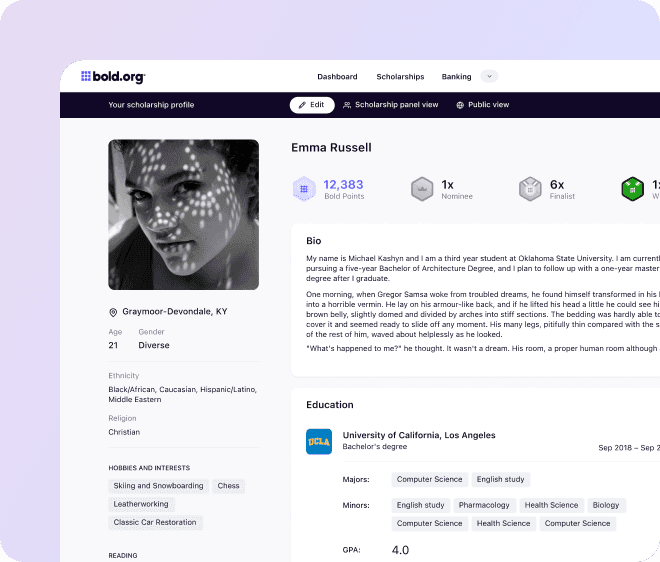
Start with your story
Bold.org helps students show donors who they are beyond a transcript.
Step 02
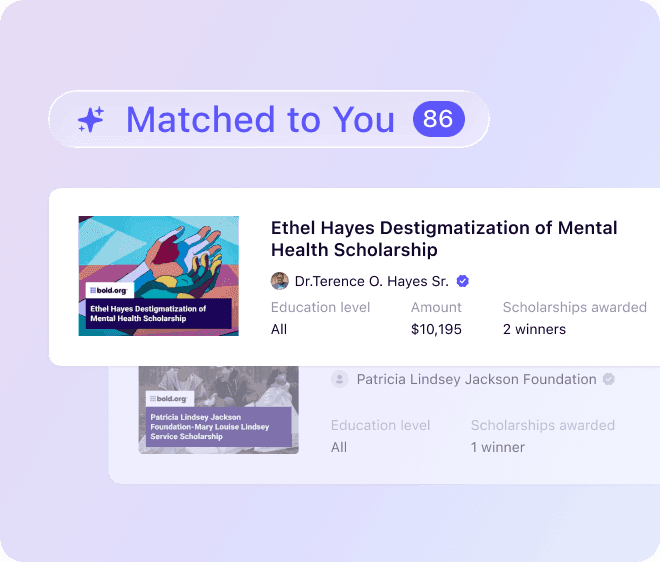
Where scholarships are awarded
Every scholarship is funded by donors and managed directly on Bold.org.
Step 03
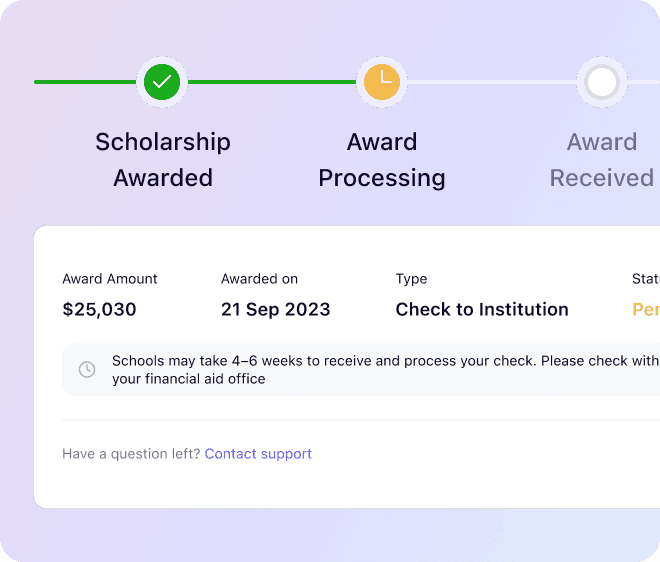
Fund your future
Scholarship dollars are disbursed through Bold.org to help students pay for school.
FAQ
When is the scholarship application deadline?
The application deadline is Jul 20, 2026. Winners will be announced on Aug 20, 2026.
How will scholarship application information be used?
Your privacy is a top priority on the Bold.org platform, and you can find our privacy policy in full here. You may opt out of communications from Bold.org at any time, and unless we’ve first notified you and gotten your consent, you’ll never receive communication from any third parties related to personal information you give us.
What is the scholarship award?
Award amounts per winner are designated by the donor. Check the award amount for a detailed breakdown.
When will the scholarship winner be chosen? How will they be notified?
The winner will be publicly announced on Aug 20, 2026. Prior to the announcement date, we may contact finalists with additional questions about their application. We will work with donors to review all applications according to the scholarship criteria. Winners will be chosen based on the merit of their application.
How will the scholarship award be paid?
Award checks will be sent to the financial aid office of the winner's academic institution or future academic institution in their name to be applied to their tuition, and in the name of their institution (depending on the school's requirements). If the award is for a qualified educational non-tuition expense, we will work with the winner directly to distribute the award and make sure it goes towards qualified expenses.
How will my scholarship application be verified?
Before we award the scholarship, the winner will be required to confirm their academic enrollment status. Depending on the circumstances, verification of Student ID and/or their most recent transcript will be required.
How should I get in touch with questions?
If you have any questions about this scholarship or the Bold.org platform, just email contact@bold.org and we’ll get back to you as quickly as we can.
Does the scholarship have terms and conditions?
Yes. The terms and conditions for this scholarship can be found here.
97% of students don't win scholarships. We’re here to change that.