Top Athletic Scholarships in the US to Apply for in 2026
Apply below right now to the best Athletic Scholarships. Exclusive scholarships found only on Bold.org!
100% Free.

Jennifer Webb-Cook Gameplan Scholarship
Funded byWebb FamilyThis scholarship will support a high school senior athlete from a single parent household.- Education Level: High school senior
- Involvement: Athlete
- Background: From a single-parent household
- Future Plans: Continuing athletic careers at the college level
$1,000Deadline:Oct 29, 2026One Click Apply1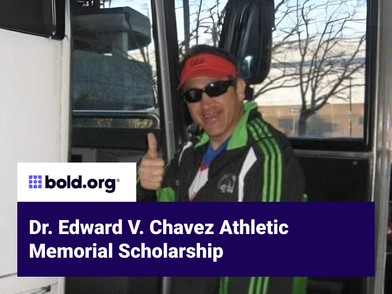
Dr. Edward V. Chavez Athletic Memorial Scholarship
Funded byChavezThis scholarship aims to honor the legacy of Dr. Edward V. Chavez by supporting students who have lost a parent and are passionate about sports.- Education Level: High school student
- Background: Has lost one or both parents
- Passion: Sports
$1,000Deadline:Oct 29, 2026One Click Apply2
FIAH Scholarship
Funded byDaleth EstradaThis scholarship aims to make college more accessible by supporting students who want to further their education in order to make the world a better place.- GPA: 3.0 GPA or higher
- Background: Involved in sports, arts, or community service during high school
- Location: Texas
- Education Level: High school senior or current undergraduate student
$2,500Deadline:Oct 30, 20263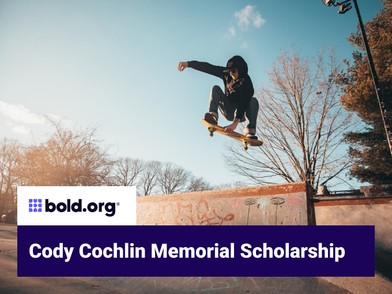
Cody Cochlin Memorial Scholarship
Funded byJaedan FordThis scholarship aims to honor the life of Cody Cochlin by supporting students who share his love for skateboarding.- Education Level: Undergraduate student
- Financial Status: Low-income
- Athletics: Rollerblading, rollerskating, snowboarding and/or skateboarding
$1,000Deadline:Nov 01, 2026One Click Apply4
David G. Sutton Memorial Scholarship
Funded byStacy MenschThis scholarship aims to honor the life of David G. Sutton by supporting athletes who are pursuing higher education.- Education Level: High school student
- Background: Athlete
- State: Pennsylvania
$500Deadline:Nov 30, 2026One Click Apply5
PrimePutt Putting Mat Scholarship for Women Golfers
Funded byPrimePuttThis scholarship will support a woman golfer.- Sport/Hobby: Golf
- Education Level: High school senior, undergraduate, or graduate
- Gender: Female/Female-identifying
$1,000Deadline:Nov 30, 2026One Click Apply6
Vernon Hawkins Memorial Scholarship
Funded byGood Trouble FoundationThis scholarship supports undergraduate golfers with a 2.5+ GPA at select universities.- Education Level: Undergraduate student
- Sport: Competes in golf
- GPA: 2.5 GPA or higher
- Universities: Listed in description
$1,000Deadline:Dec 14, 2026One Click Apply7
Bre Hoy Memorial Softball Scholarship
Funded byRachel Vogt VogtThis scholarship honors the memory of Bre Hoy by supporting high school seniors and undergraduate students with a 3.2+ GPA who play softball.- Education Level: High school senior or undergraduate student
- Sport: Softball
- GPA: 3.2 or higher
$2,000Deadline:Dec 19, 2026One Click Apply8
No Limits Athletic Scholarship
Funded byKai WaymanThis scholarship supports East Coast high school seniors with disabilities or special needs who play sports and have shown resilience, leadership, and passion in their athletic pursuits while working toward higher education.- Education Level: High school senior
- Background: Has a disability and/or special needs
- Involvement: Participates in sports
- Location: East Coast (ME, NH, MA, RI, CT, NY, NJ, DE, MD, VA, NC, SC, GA, FL, VT, PA, WV, DC)
$500Deadline:Dec 24, 2026One Click Apply9
Jefferson High School Scholarship
Funded byAnonymous DonorThis scholarship supports Jefferson High School seniors in Boulder, Montana, who have played volleyball for four or more years as they transition to college.- Education Level: High school senior
- School Name: Jefferson High School
- State: Montana
- Sport: 4+ years of volleyball
$2,500Deadline:Mar 05, 2027One Click Apply10
Boddu Football Impact Scholarship
Funded byBoddu/NekkantiThis scholarship supports Michigan or Virginia high school seniors and undergraduate students who play football.- Sport : Football
- States: MI or VA
- Education Level: High school senior or undergraduate
$500Deadline:Mar 06, 2027One Click Apply11
Coach Ray Memorial Athletic Scholarship
Funded byDerek JindraThis scholarship aims to honor the legacy of Coach Ray by supporting deserving athletes who excel in the classroom and in athletics.- Education Level: High school senior
- Sport: Basketball
- Gender: Female
- State: California
- GPA: 2.8 or higher
$500Deadline:Mar 09, 2027One Click Apply12
Brian J. O'Hara Memorial Scholarship
Funded byO'Hara FamilyThis scholarship seeks to honor the life of Brian J. O'Hara by supporting students who share his passion for football.- Education Level: High school senior
- State: Pennsylvania
- Sport: Football
- Background: Community service experience
$3,000Deadline:Mar 30, 2027One Click Apply13
Jared Ethan Trueba Memorial Scholarship
Funded byThe Trueba FamilyThis scholarship seeks to honor the life of Jared Ethan Trueba by supporting students at Cibola High School in NM who embody Jared’s love for community involvement.- Education Level: High school student
- State: New Mexico
$1,000Deadline:Apr 01, 2027One Click Apply14
Hogan Scholarship
Funded byDavid HoganThis scholarship aims to support college-bound students as they prepare to complete their high school journeys.- State: Ohio
- Education Level: High school senior
- School Name: Reynoldsburg High School
- GPA: 3.0 or higher
$5,000Deadline:Apr 01, 2027One Click Apply15
Matthew Hoover Memorial Scholarship
Funded byMatthew Hoover FamilyThis scholarship seeks to honor the life of Matthew Hoover by supporting student-athletes who are preparing to attend college.- Education Level: High school senior (2027)
- State: Texas
- GPA: 3.5 GPA or higher
- Background: Athlete
$1,000Deadline:Apr 04, 2027One Click Apply16
Skybrook Men's Golf Association Scholarship
Funded bySkybrook Golf MGAThis scholarship seeks to support student golfers who need financial assistance to further their educational goals.- State: North Carolina
- Sport: Golf
- Education Level: High school student
- Background: Financial need
$4,000Deadline:Apr 27, 2027One Click Apply17
Peter T. Buecher Memorial Scholarship
Funded bySamantha NortonThis scholarship supports Minnesota high school seniors and undergraduate students who participate in swimming, diving, and/or synchronized swimming.- Education Level: High school senior or undergraduate
- State: MN
- Sport: Swimming, diving, and/or synchronized swimming
$1,000Deadline:Apr 30, 2027One Click Apply18
Kalia D. Davis Memorial Scholarship
Funded byLaDonna MitchellThis scholarship seeks to honor the memory and incredible legacy of Kalia D. Davis by supporting students who share her work ethic, kindness, and drive.- Education Level: High school senior or undergraduate student
- GPA: 3.0 or higher
- Background: Sports experience, community service or volunteering experience
$2,000Deadline:Apr 30, 2027One Click Apply19
Rob Snyder Memorial Golf Scholarship
Funded byKellie SnyderThis scholarship honors Rob Snyder by supporting high school junior/senior golfers in Massachusetts, Georgia, or Florida with a 3.0+ GPA and demonstrated financial need who play on their school golf team and intend to compete collegiately.- GPA: 3.0 GPA or higher
- State: Massachusetts, Georgia, or Florida
- Financial Status: Demonstrated financial need
- Education Level: High school junior or senior
- Sport: A current member of their high school golf team
- Intention: Intention to play golf at the collegiate level
$3,000Deadline:Jun 18, 2027One Click Apply20
Terry "Frosty" Dalton Memorial Scholarship
Funded byDalton FamilyThis scholarship will support undergraduate student athletes in North Carolina.- State: North Carolina
- Sport: Any
- Experience: Volunteering
- Education Level: High school or undergraduate
$1,000Deadline:Jul 31, 2027One Click Apply21
Olivia Rodrigo Fan Scholarship
Funded byBold.orgThis scholarship is perfect for students who have been impacted by Olivia Rodrigo's "Guts" album!All students are eligible$500Only 6 days left!One Click Apply22
100 Bold Points No-Essay Scholarship
Funded byBold.orgThis scholarship will be awarded to the student whose Bold.org profile is the most bold, and who has earned at least 100 Bold Points.All students are eligible$1,000Only 6 days left!One Click Apply23
No Essay Scholarship by Sallie
Funded byBold.orgThis exclusive no-essay scholarship is for anyone thinking through how to pay for college.All students are eligible$10,000Only 6 days left!One Click Apply24
Current Future Finance Scholarship
Funded byCurrentThis scholarship seeks to support students who are ready to make smarter financial moves and reach their goals faster.- Age: 18 or older
$3,000Only 6 days left!One Click Apply25
Redefining Victory Scholarship
Funded byChris & Mary CarnduffBy embracing diverse avenues for personal growth, anyone can conquer the challenges of life and attain the pinnacle of success.- Education Level: Any
$20,000Deadline:Mar 30, 2027One Click Apply26
Mad Genius Scholarship
Funded byFoodStory BrandsThis scholarship aims to celebrate bold ideas, wild creativity, and the kind of thinking that doesn’t always fit inside the lines.- Education Level: High school, undergraduate, trade school, or graduate student
- Background: Exceptionally creative, inspired, and motivated to achieve in creative fields
$8,000Deadline:Nov 01, 2026One Click Apply27
Amelia Michelle Sanford LGBTQIA+ Memorial Scholarship
Funded bySanford familyThis scholarship seeks to support LGBTQIA+ student-athletes to assist them in the pursuit of higher education.- Education Level: High school senior
- Identity: LGBTQIA+
- Background: Played a sport
$2,500Scholarship is awarded to
1 winnerDeadline:Apr 10, 2023One Click Apply28
Lisa McGinley Scholarship Fund
Funded byFamily & Friends of LisaThis scholarship aims to remember Lisa McGinley and support students who have lost a parent while trying to get through school.- Education Level: High school junior, senior, or undergraduate
- Background: Lost a parent
- Interests: Athletics
$935Scholarship is awarded to
1 winnerDeadline:May 20, 2022One Click Apply29
Nickels Student Athlete Scholarship
Funded byAJ & CKR, LLC dba Nickels StoreThis scholarship seeks to support student-athletes so they can overcome any challenges they face and attain success in the future.- Education Level: High school student
- Background: Student-athlete
$1,500Scholarship is awarded to
3 winnersDeadline:Mar 03, 2025One Click Apply30


How it works
Bold.org is Built to Make Scholarships Feel Possible
Step 01
Start with your story
Bold.org helps students show donors who they are beyond a transcript.
Step 02
Where scholarships are awarded
Every scholarship is funded by donors and managed directly on Bold.org.
Step 03
Fund your future
Scholarship dollars are disbursed through Bold.org to help students pay for school.
Athletic Scholarships: What the Data Shows About Who Applies, Who Wins, and How to Fund Your Sport
Athletic scholarship winners on Bold.org have an average GPA of 3.67. So do all applicants. That zero-point gap — confirmed across 120 winners and the broader applicant pool — overturns the assumption that grades are the deciding factor (methodology). If GPA isn't separating winners from the rest, what is?
This analysis draws on Bold.org's proprietary data covering scholarship awards, applicant profiles, finalist funnels, and selection criteria for athletic scholarships. It combines that with rules and benchmarks from the NCAA, NAIA, NCSA, and ScholarshipStats.com to build a complete picture of the athletic scholarship landscape — from NCAA Division I full rides to $1,000 platform-based awards any student-athlete can apply for.
What Makes Athletic Scholarships Different from Academic Awards
The term "athletic scholarship" covers two fundamentally different systems, and confusing them costs students time and strategy.
Institutional athletic scholarships are roster-bound. The NCAA oversees college athletics across three divisions. Division I and Division II schools offer athletic scholarships; Division III does not — D3 athletes receive only academic, need-based, or merit aid. The NAIA, with roughly 250 member schools, also offers athletic aid. The NJCAA covers community college athletics with its own scholarship rules.
Within D1, the scholarship structure splits into headcount and equivalency sports. Headcount sports include football (FBS), men's and women's basketball, women's volleyball, gymnastics, and tennis. Each scholarship is a full ride covering tuition, room, board, and fees. If a team has 13 basketball scholarships, 13 athletes get full funding. Equivalency sports include baseball, softball, soccer, track and field, swimming, and most others. In these sports, coaches split a fixed number of full-scholarship equivalencies across the roster. A baseball team with 11.7 equivalencies might spread that money across 27 players. Most athletes get partial awards.
This is where the full-ride myth breaks down. The NCAA reports that less than 2% of high school athletes earn any college athletic scholarship. Full rides cluster in a handful of headcount sports. ScholarshipStats.com data shows the average D1 men's baseball scholarship covers about 30% of attendance costs. Women's soccer averages roughly 60% at D1 equivalency programs. D2 limits are lower still. D2 football offers 36 equivalencies compared to 85 full rides in FBS. The result: smaller individual awards spread across more athletes.
The NAIA takes a different approach. NAIA schools can offer athletic aid without the rigid headcount/equivalency distinction, and they also consider athletic ability as a factor in academic scholarship decisions. For student-athletes at smaller schools, the NAIA pathway often provides a more flexible financial package than D2 — though total dollar amounts tend to be smaller.
Platform-based athletic scholarships work on an entirely different model. Awards on Bold.org are not tied to roster spots, recruiting pipelines, or coach evaluations. They are open to student-athletes at any level — high school, college, graduate — and winners are chosen on application quality, not playing time. This matters for the 57.7% of athletic scholarship seekers on the platform who are high school students exploring funding before they know whether institutional athletic aid will come through.
The House v. NCAA settlement (2025) is reshaping this entire system. The landmark $2.8 billion settlement eliminated sport-specific scholarship caps for D1 programs that opt in. Instead of fixed limits per sport, schools now operate under roster caps with flexible scholarship distribution. Coaches can award full or partial scholarships to any rostered athlete at their discretion.
What changed by sport:
- Football (FBS): Roster cap of 105, up from 85 scholarship limit. Schools can now fund the full roster.
- Men's basketball: Roster cap of 15, scholarships flexible (previously 13 headcount).
- Women's basketball: Roster cap of 15, scholarships flexible (previously 15 headcount).
- Swimming: Roster cap of 30 per gender, replacing 9.9 men's / 14 women's limits.
- Baseball: Roster cap of 34, replacing 11.7 equivalencies across 27+ players.
- Track and field, soccer, softball: Roster caps replace old equivalency limits.
Schools can also share up to $20.5 million per year in direct revenue payments to athletes. But no new NCAA funding came with the settlement — schools must increase their own budgets to expand aid. Programs that don't increase spending may offer the same total dollars across more athletes, meaning smaller per-person awards.
For student-athletes researching scholarships now, the key takeaway: the ceiling on institutional athletic aid is rising, but the availability of that aid still depends on your school's budget, sport, and recruiting status. Platform-based scholarships remain unaffected by the settlement and provide funding regardless of how institutional rules change.
Here is how the new roster caps compare to the old scholarship limits across major sports:
| Sport | Old Scholarship Limit | New Roster Cap | Key Change |
|---|---|---|---|
| Football (FBS) | 85 full rides | 105 | Full roster can now receive aid |
| Men's Basketball | 13 headcount | 15 | Flexible distribution replaces fixed count |
| Women's Basketball | 15 headcount | 15 | Same number, flexible partial awards allowed |
| Baseball | 11.7 equivalencies | 34 | Coaches can fund entire roster vs. splitting across 27+ |
| Women's Soccer | 14 equivalencies | 28 | Double the roster spots, flexible distribution |
| Men's Swimming | 9.9 equivalencies | 30 | Flexible distribution per coach discretion |
| Women's Swimming | 14 equivalencies | 30 | Flexible distribution replaces fixed equivalencies |
| Track & Field (M/W) | 12.6 / 18 equivalencies | 45 / 45 | Largest roster caps in Olympic sports |
Note: roster caps apply to schools that opted into the House v. NCAA settlement. Schools that did not opt in continue under the prior system.
Before the settlement, the 40-60-80 rule gave a shorthand for D1 equivalency sport limits. Men's programs can typically cover about 40–60% of the roster, and women's programs about 60–80%, depending on the sport. Under the new settlement rules, these percentage limits no longer apply — but they remain useful context for understanding how institutional aid has historically worked. Even with expanded roster caps, schools that haven't increased budgets may distribute similar total dollars across more athletes. Understanding this gap is the first step toward building a complete funding plan — one that combines institutional aid with application-based awards.
The Recruiting Path: How Institutional Athletic Scholarships Work
If you are pursuing a roster spot and institutional athletic aid, here is the timeline and process.
Recruiting begins earlier than most families expect. The NCAA allows D1 coaches to send recruiting materials starting June 15 after a student's sophomore year. Unofficial campus visits can happen anytime. Official paid visits start September 1 of senior year for most sports. The NCAA Eligibility Center registration should be completed by the end of junior year — a 2.3 core GPA is the D1 minimum, and 2.2 for D2.
The practical recruiting process has three steps. First, build a recruiting profile on a platform like NCSA with your academic records, stats, and highlight video. Second, email college coaches directly — most receive hundreds of emails, so lead with your academic fit and specific interest in the program, not just your stats. Third, attend camps and showcases where coaches evaluate athletes in person. For sports with clear measurables (track times, swimming splits, baseball exit velocity), published recruiting standards help you identify which division levels match your performance.
Under the new House v. NCAA settlement, coaches at opted-in schools have more flexibility in how they distribute scholarship dollars. This may change recruiting dynamics — some programs may recruit deeper rosters while others concentrate funding on fewer athletes. Ask each program directly about their current scholarship allocation approach.
The recruiting path is the only way to access institutional athletic aid. But it serves a small fraction of student-athletes. NCSA estimates fewer than 7% of high school athletes compete at the college level. For everyone else — and even for those who do get recruited but receive only partial institutional aid — application-based athletic scholarships provide a complementary funding source.
Athletic Scholarship Landscape: How Many Exist and What They Pay
An analysis of 197 athletic scholarship awards on Bold.org shows a median of $1,000 and an average of $2,067 (methodology). The gap between median and average tells you that a cluster of larger awards pulls the mean up — but for planning, $1,000 per award is the more realistic baseline.
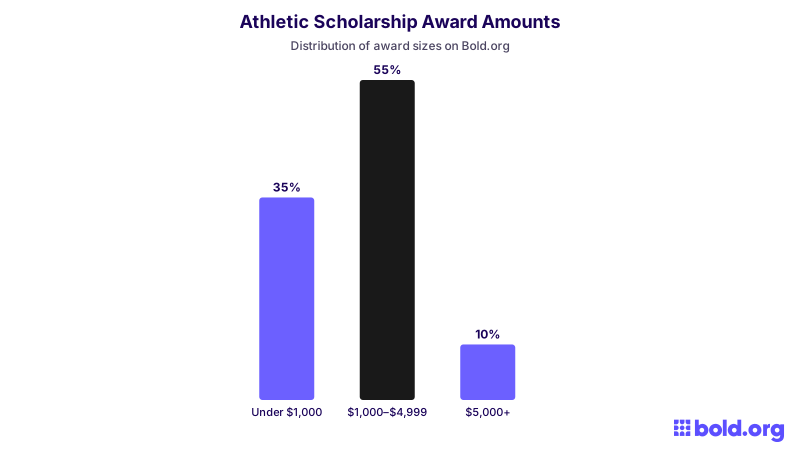
According to platform data, 55.3% of awards fall in the $1,000–$4,999 range. Another 35% come in under $1,000. The top bracket — $5,000 and above — holds 9.6% of awards. The $1,000–$4,999 bracket is where most money flows for platform-based athletic scholarships, and it is the range where students should focus their applications.
Beyond these awards, the platform lists 640+ athletic and sports scholarships from external providers. Among those external awards, the average maximum is $5,192 and the median is $2,500 — higher than the platform's own awards. That gap reflects a mix of organization-sponsored, school-affiliated, and foundation-backed funding in the external database.
The combined landscape gives student-athletes access to awards ranging from a few hundred dollars to five-figure sums — all sortable from a single page. Winning one external award at the $2,500 median plus one platform award at $1,000 puts $3,500 toward your tuition gap. Four wins at the platform median alone covers a semester of textbooks and fees at many schools.
How does this compare to institutional athletic aid? NCAA D1 full rides at public schools can top $50,000 per year when you add tuition, room, board, and fees. But those go to a tiny fraction of athletes in headcount sports. For the vast majority of student-athletes — especially those in equivalency sports, at D2 or NAIA schools, or not recruited at all — platform-based awards in the $1,000–$5,000 range are the most accessible athletic scholarship funding available.
Who Seeks Athletic Scholarships: Applicant Profile
The athletic scholarship applicant pool looks different from the general scholarship-seeking population in one key way: 57.7% are high school students, according to Bold.org data (methodology). That is notably higher than the overall platform mix. It reflects students searching for athletic scholarship funding before they've committed to a school — or been recruited by one.
The rest of the pool: 20.6% are college undergrads, 9.8% are adult learners, 8.2% are in associate degree programs, and 3.8% are graduate students. The high school skew aligns with the athletic recruiting timeline. Students research scholarship options during junior and senior year, whether or not a coach has made contact. For many, these searches run alongside — not after — the recruiting process.
This is an academically strong pool. The median GPA among seekers is 3.7, according to platform data. Two-thirds (65.2%) report GPAs of 3.5 or above. Another 23.8% fall between 3.0 and 3.49. The 25th percentile sits at 3.2 and the 75th at 3.9. Student-athletes seeking funding are, on average, strong students — which makes the GPA finding in the funnel analysis below even more striking.
Fields of study span well beyond sports science. The data shows nursing and clinical fields lead at 7.9%, followed by business (5.2%), psychology (5.0%), health professions (2.8%), and computer science (2.6%). Sports and kinesiology — the field you might expect to dominate — ranks tenth at 1.7%. Student-athletes are pursuing diverse academic paths, and the scholarship pool reflects that range.
Geography shapes the applicant pool too. Platform data shows state-level win rates vary widely — Washington D.C. applicants win at 2.3%, more than triple the rate of California applicants at 0.7%. States with smaller applicant pools tend to show higher per-capita win rates, which suggests that students in less-populated states face less internal competition for the same awards.
Among winners specifically, the data shows 26.7% are first-generation college students and 50.8% come from low-income households. These aren't just athletes — they are students managing financial pressure alongside training schedules and course loads.
What Athletic Scholarship Providers Actually Evaluate
The selection criteria for athletic scholarships reveal a surprise: explicit athletic achievement barely registers. An analysis of 294 athletic scholarship criteria on Bold.org shows what providers actually weigh (methodology):
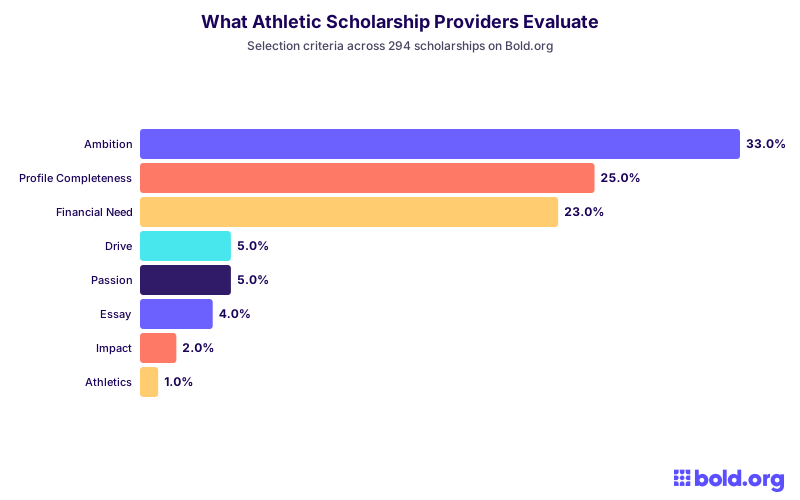
According to the data, ambition leads at 33% — the single most common selection criterion. Profile completeness follows at 25%. Financial need accounts for 23%. These three factors alone make up 81% of the criteria weight. Drive (5%), passion (5%), and essay quality (4%) fill the middle tier. Impact (2%) and explicit athletics criteria (1%) round out the bottom.
That 1% for athletics is the most counterintuitive finding in the criteria data. These athletic scholarships are not primarily evaluating your sport — they're evaluating your story, your ambition, and your need. Institutional athletic scholarships evaluate 40-yard dashes and highlight reels. Platform-based athletic scholarships evaluate who you are and what you plan to do.
This does not mean your sport doesn't matter. It means your sport is the context, not the criterion. The 33% weight on ambition rewards students who can show how athletic discipline translates into career goals and community impact. The 23% weight on need rewards honest financial disclosure. A swimmer heading into biomedical engineering who can connect training discipline to lab rigor — that's ambition in action.
For student-athletes who were never recruited — or who play at D3, club, or intramural levels — this criteria breakdown is an open door. You don't need a coach's endorsement or a highlight reel. You need an application that connects your athletic experience to a larger purpose. The NCSA estimates that fewer than 7% of high school athletes play at the college level. For the other 93%, application-based athletic scholarships represent the clearest path to sport-related funding.
From Applicant to Winner: What the Data Shows
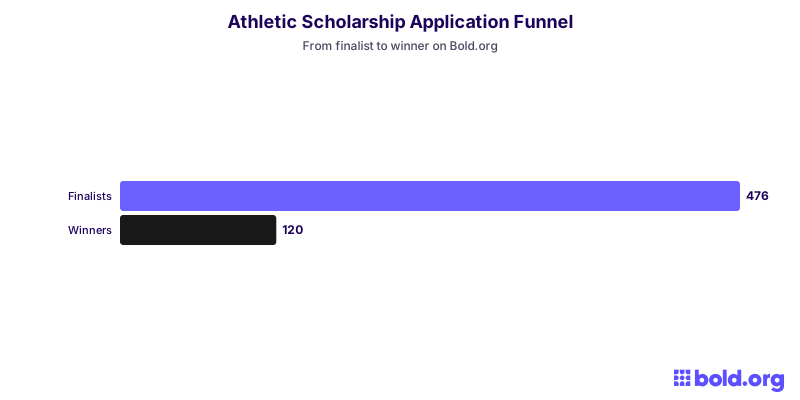
The three-tier funnel — applicant to finalist to winner — reveals exactly where the selection process separates winners from the rest. Among athletic scholarship applicants on Bold.org, 476 reached finalist status. Of those, 120 received awards — a 25% finalist-to-winner conversion rate (methodology).
The GPA finding that changes everything
Winner average GPA: 3.67. Applicant average GPA: 3.67. The differential is exactly zero. Finalist average GPA: 3.70 — fractionally higher. The data is unambiguous: GPA does not separate winners from the broader pool for athletic scholarships on Bold.org.
This means the finalist-to-winner gate is qualitative, not quantitative. Once your application demonstrates academic competence (and at a 3.67 average, the bar is solid but not stratospheric), the deciding factors shift to essay quality, demonstrated need, and how clearly you connect athletic experience to your goals.
Who wins more than expected
The demographic shifts between finalist and winner stages reveal which groups are best represented among winners. According to the funnel data:
- Low-income students: 44.5% of finalists → 50.8% of winners — a +6.3 percentage point lift. Low-income student-athletes win at a higher rate than their finalist share would predict. Financial need carries real weight in final decisions.
- Female applicants: 52.7% of finalists → 55.8% of winners — a +3.1 percentage point lift. Female student-athletes convert from finalist to winner at slightly elevated rates.
- First-generation students: 27.7% of finalists → 26.7% of winners — near parity at -1 percentage point. First-gen status neither helps nor hurts at the winner stage.
The low-income lift is the standout number. A 6.3 percentage point increase at the winner stage means low-income student-athletes win at rates above their share of finalists. For student-athletes from low-income households, the data shows strong representation at the stage that matters most.
What winners plan to do after college
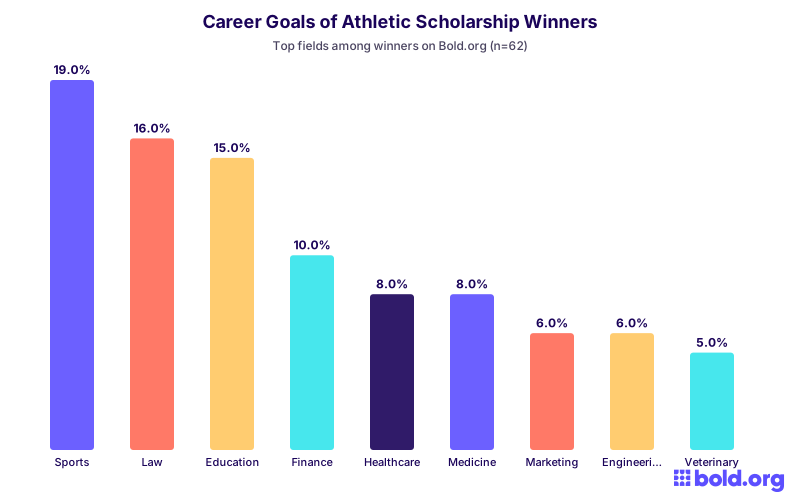
The data on winner career goals reveals the range of paths student-athletes pursue. Sports careers lead at 19% — expected for this pool — but 81% of winners aim for fields outside sports entirely. Law (16%), education (15%), and financial services (10%) follow. Healthcare and medicine together account for 16%. Marketing (6%), engineering (6%), and veterinary science (5%) round out the top fields.
This spread matters for two reasons. First, it confirms that athletic scholarship providers are funding future professionals who happen to be athletes — not just athletes who happen to need money. Second, it means your career goals don't need to involve sports. A volleyball player heading into corporate law, a track athlete pursuing veterinary medicine, a baseball player training to teach high school math — all of these profiles are well-represented among winners.
How to Strengthen Your Athletic Scholarship Application
The funnel data delivers one clear message: GPA is not where you win or lose. At 3.67 for both winners and the general applicant pool, academic performance gets you into the conversation — your application is what closes the deal (methodology).
Connect your sport to your career ambition. Ambition is the top selection criterion at 33% of criteria weight, and 81% of winners pursue careers outside sports. The winning application links athletic experience to a professional path. A track athlete heading into physical therapy can show how understanding injury recovery from the inside shapes their approach to patient care. A soccer goalkeeper pursuing law can draw on split-second decision-making and team accountability. The connection doesn't need to be obvious — it needs to be genuine and specific. Among winners, sports careers account for 19%, law for 16%, and education for 15%. Each of those goals connects naturally to lessons learned through competition.
Name your financial reality. Financial need accounts for 23% of selection criteria, and funnel data shows low-income students gain a +6.3 percentage point lift from finalist to winner. If money is tight, say so directly. Specify what the scholarship would cover — a semester of textbooks, a month of rent, the gap between your aid package and actual costs. Vague references to "financial hardship" carry less weight than "my family's income covers tuition but not housing, and I work 20 hours a week during the season to close the gap." The data confirms that selection panels respond to specificity about need.
Time your applications to avoid the December crush. Platform data shows a massive December spike — volume hits an index of 368, more than triple the average month. January and February stay elevated at 123 and 128. The lowest-volume window falls in May and June (index 14–16), followed by a summer trough that lasts through August. Applying during the late spring and summer means your application lands when reviewer attention is least divided.
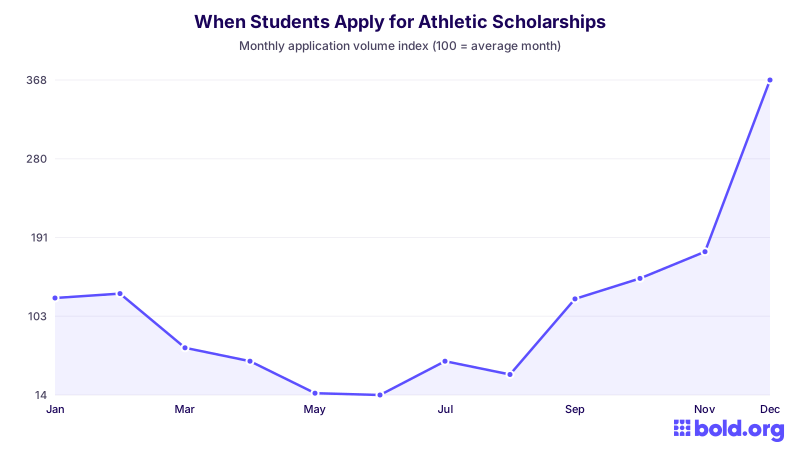
The timing pattern suggests a clear strategy: prepare your strongest applications during the spring semester, submit them in May through July, and use the fall to apply to the higher-volume October–December cycle with refined materials. Spreading applications across both windows maximizes your exposure without competing with peak volume.
Show impact beyond the scoreboard. Only 1% of athletic scholarship criteria explicitly mention athletics, per the criteria analysis. Providers want to see what your sport taught you, not your stats. Community coaching, mentoring younger athletes, organizing team fundraisers, or advocating for equitable sports access — these translate athletic participation into measurable impact. Applications that show community contribution stand apart from those that list only personal athletic achievements.
The pattern to avoid: Listing athletic achievements without connecting them to anything larger. A resume of stats, records, and accolades — without showing how those experiences shaped your goals, character, or plans — reads like a recruiting profile, not a scholarship application. The criteria data makes this concrete: providers weigh ambition (33%) and need (23%) over athletic performance (1%).
The athletic scholarships listed above this article are sortable by deadline, amount, and eligibility. With application volume at its lowest in late spring and summer, the next few months offer the thinnest competition window. Scroll up to browse current opportunities on Bold.org.
Building a Complete Funding Strategy Beyond Athletic Scholarships
Athletic scholarships are one piece of a larger funding puzzle. Platform data shows the average annual tuition cost among athletic scholarship seekers is $24,567, while average annual aid received is $12,348 — leaving a $12,219 gap that scholarships, loans, and personal funds must fill (methodology).
How students currently bridge that gap, according to the data: loans cover 38% ($14,343 on average), family and other sources cover 32% ($11,955), and self-funded savings cover 30% ($11,500). Nearly all seekers — 99.7% — expect to take on additional loans. Every scholarship dollar directly reduces the loan share.
Athletic scholarships stack well with other types:
- Need-based scholarships pair naturally, since 50.8% of athletic scholarship winners are low-income. If financial need is part of your profile, you likely qualify for both.
- Merit-based scholarships reward the strong academics already present in this pool (median GPA 3.7). Your academic profile can open merit awards while your athletic experience strengthens your essays.
- No-essay scholarships provide quick supplemental wins that don't compete for the same time as essay-heavy applications. Mixing formats lets you submit more applications per hour.
- Major-specific scholarships — like nursing, business, or computer science awards — target your academic path rather than your athletic identity. Since only 1.7% of seekers major in sports or kinesiology, most student-athletes can double their eligible pool by applying to major-specific awards alongside athletic ones.
With a median award of $1,000, winning five athletic scholarships in a year yields $5,000 — enough to close nearly half the annual gap. Add two easy-to-apply scholarships and a major-specific award, and you're looking at a realistic $7,000–$8,000 per year in scholarship income. That turns a single lucky break into a structured funding strategy.
Frequently Asked Questions
Is every D1 offer a full ride?
No. Full-ride athletic scholarships exist only in NCAA Division I headcount sports — football (FBS), men's and women's basketball, women's volleyball, gymnastics, and tennis. In equivalency sports (baseball, soccer, track, swimming, and most others), coaches split a fixed number of scholarship equivalencies across the roster, resulting in partial awards. ScholarshipStats.com data shows the average D1 baseball scholarship covers roughly 30% of attendance costs.
What is the 40-60-80 rule?
The 40-60-80 rule is a recruiting shorthand for understanding Division I equivalency sport scholarship limits. It approximates the share of a roster that scholarship money can cover: roughly 40% of men's roster spots in lower-funded equivalency sports, about 60% in mid-tier sports, and up to 80% in well-funded women's equivalency sports. The exact numbers vary by sport — the NCAA publishes sport-by-sport scholarship limits. The rule helps recruits gauge how likely a partial scholarship offer is in their sport.
How can you get an athletic scholarship?
Two pathways exist, and they're not mutually exclusive.
The recruiting pathway involves direct engagement with college coaches. NCSA and other recruiting platforms help athletes create profiles, share highlight videos, and connect with programs. This typically begins in sophomore or junior year of high school and targets institutional athletic scholarships tied to roster spots.
The application pathway targets non-institutional athletic scholarships — awards on platforms like Bold.org that aren't tied to a specific team or coach. These are open to student-athletes at any level, from high school through graduate school. Bold.org data shows 57.7% of athletic scholarship seekers are high school students, many of whom are pursuing application-based awards alongside or instead of the recruiting process. Selection is based on criteria like ambition (33%), profile completeness (25%), and financial need (23%) — not athletic stats.
The strongest strategy combines both: pursue recruiting for institutional aid while simultaneously applying for platform-based athletic scholarships to supplement whatever package your school offers.
Do D3 schools give athletic scholarships?
No. NCAA Division III schools do not offer athletic scholarships. D3 athletes receive financial aid through academic scholarships, need-based grants, and merit awards — the same sources available to non-athletes. The NCAA reports that D3 is the largest division by number of institutions and athletes, meaning a significant share of college athletes receive zero athletic-specific institutional aid. Platform-based awards on Bold.org are open to D3 athletes and fill a real gap in their funding options.
Can you get an athletic scholarship without being recruited?
Yes. Platform-based athletic scholarships on Bold.org do not require coach recruitment, a highlight reel, or a roster spot. Any student who identifies as a student-athlete can apply. According to the platform's criteria analysis, only 1% of athletic scholarship selection criteria explicitly evaluate athletics — the rest focus on ambition, profile completeness, need, and essay quality. For student-athletes at D3 programs, club sports, recreational leagues, or those who weren't recruited, these application-based awards provide funding that the traditional recruiting system misses. The NCSA estimates fewer than 7% of high school athletes compete at the college level — meaning the vast majority of student-athletes have no institutional athletic scholarship path at all.
What GPA do athletic scholarship winners have?
According to Bold.org's funnel data, athletic scholarship winners average a 3.67 GPA — identical to the overall applicant average of 3.67. The zero-point differential is the strongest signal in the data that GPA is not the deciding factor. Finalists average 3.70, and the shift from finalist to winner actually shows a slight GPA decrease. This reinforces that essay quality, financial need, and personal narrative drive final outcomes. Among all seekers, 65.2% have GPAs above 3.5, but the winner data shows that a 3.2 paired with a strong application can compete with a 3.9 paired with a weak one.
What's the easiest sport to get a D1 scholarship in?
The answer depends on how you define "easy" — and the landscape shifted in 2025 with the House v. NCAA settlement. Under the new roster caps, the sports with the most funded spots are football (FBS: 105 roster cap), track and field (45 per gender), baseball (34), and swimming (30 per gender). Larger rosters generally mean more opportunities for partial scholarships.
However, raw roster size is only half the equation. Women's sports with fewer participants at the high school level — rowing, fencing, equestrian — often have lower competition for the available spots. A women's rowing program with 50+ roster spots and a relatively small recruiting pool may offer better per-athlete odds than a men's basketball program with 15 spots and thousands of recruits.
The framing of "easiest D1 sport" also misses the bigger picture. Only about 2% of high school athletes receive any NCAA scholarship. For the other 98%, platform-based athletic scholarships offer a path that doesn't require a D1 roster spot. Bold.org data shows that athletic scholarship criteria weigh ambition (33%) and need (23%) far above sport-specific achievement. The easiest way to get an athletic scholarship may not be finding the right D1 sport — it may be applying for awards that evaluate who you are, not which sport you play.
Are athletic scholarships only for Division 1 athletes?
No. NCAA Division II and NAIA schools also offer institutional athletic scholarships. D2 operates on an equivalency model for nearly all sports, and NAIA schools have their own aid framework. Beyond institutional aid, platform-based athletic scholarships on Bold.org carry no division requirement — applicants include high school students (57.7%), college undergrads at all division levels, and adult learners. Limiting your search to D1 institutional offers means missing the majority of available athletic scholarship funding.
Methodology
The data in this article comes from Bold.org's database of student profiles, scholarship applications, and award outcomes. The analysis covers students seeking and winning athletic scholarships on the platform.
Data sources:
- Award data: 197 athletic scholarship awards on Bold.org, including amounts, winner demographics (GPA, first-generation status, low-income status, gender), and career goals (n=62 with career data).
- Applicant profiles: Self-reported academic, demographic, and financial data from athletic scholarship seekers — GPA, school, field of study, education level, state, and financial information.
- Selection criteria: Analysis of 294 athletic scholarships for stated selection criteria (ambition, need, drive, essay, profile completeness, athletics, etc.).
- Application funnel: Three-tier funnel analysis (applicant → finalist → winner) covering 476 finalists and 120 winners. Funnel metrics include GPA, first-generation status, low-income status, and gender at each stage.
- Application timing: Monthly application volume index across athletic scholarships on the platform, based on 4,514 tracked applications.
- External landscape: 640+ athletic and sports scholarships from external providers listed on Bold.org, with average maximum awards and median values.
- Industry benchmarks: NCAA scholarship rules and division structure, NAIA scholarship data, NCSA recruiting guidance, and ScholarshipStats.com for sport-specific institutional scholarship averages.
Notes:
- GPA data reflects self-reported GPAs with valid entries (above 0.0, at or below 4.0).
- Winner career goal data has a sample size of 62, which limits precision for individual career categories. Directional trends (e.g., sports leading, law and education in the top three) are consistent across extraction runs.
- Financial data (tuition, aid, funding split) is self-reported and may not match actual spending.
- Application timing index uses 100 as the average monthly baseline. Values above 100 indicate above-average volume; below 100 indicates below-average.
- Award amounts reflect actual payouts to winners on the platform, not listed or advertised totals.
- External scholarship data (640+ listings, average maximum $5,192) comes from provider submissions and may vary as scholarships open and close.
- Institutional scholarship rules (NCAA divisions, headcount vs. equivalency, 40-60-80 rule) come from NCAA and NAIA public resources, not platform data.
Last updated: March 2026
Frequently Asked Questions
Division III schools do not give athletic scholarships, since Division III teams typically have smaller budgets. Despite not giving out scholarships for student-athletes, division III schools still offer scholarships. 75% of student-athletes receive need-based or merit scholarships.
Receiving a full-ride athletic scholarship is quite rare and highly competitive. Only a small percentage of high school athletes earn full-ride scholarships to compete in college sports.
In NCAA Division I, American football offers the most scholarships due to its large team size and revenue potential. Basketball is the second most significant in awarding scholarships. Track and field, soccer, baseball/softball, rowing, volleyball, and ice hockey provide notable scholarship numbers influenced by team sizes and sports popularity.