Best Immigrant Scholarships in October 2026
Access scholarships only available on Bold.org with our quick, straightforward application process. Regularly updated with new funding opportunities.
100% Free.

Carlos F. Garcia Muentes Scholarship
Funded byThe Pride Resource NetworkOpen to first-generation college students who are immigrants, children of immigrants, refugees, or asylum seekers.- Immigration status: First- or second-generation immigrant, refugee, or asylum seeker
- Legacy status: First-generation college student
$500Only 5 days left!One Click Apply1
Dr. Soronnadi Nnaji Legacy Scholarship
Funded byNnaji FamilyOpen to first- and second-generation African immigrant high school seniors and undergraduates studying STEM.- GPA: 3.0 or higher
- Background: First or second-generation African immigrant
- Education Level: High school senior or undergraduate student
- Major: STEM-related major
$5,000Only 21 days left!One Click Apply2
Grace In Action Scholarship
Funded byGrace In Action Mission Inc.Open to high school juniors and seniors who are first-generation immigrants active in their church.- Education Level: High school junior or senior
- Background: First-generation immigrant
- Religion: Involved in church
$3,000Only 26 days left!One Click Apply3
STEAM Generator Scholarship
Funded byFrancis Rei IsraelOpen to bachelor's and master's degree students studying STEM.- Education Level: Bachelor's or master's degree
- Field of Study: STEAM
- Background: First or second-generation immigrant or other underrepresented minority
$3,165Deadline:Nov 30, 2026One Click Apply4
It Takes A Village “Bayanihan” Scholarship
Funded byTinidor FoodsOpen to Filipino students from immigrant, refugee, or asylee families in high school, college, or graduate school.- Education Level: High school, undergraduate, or graduate student
- Background: Immigrated from the Philippines
$1,000Deadline:Dec 04, 2026One Click Apply5
Frontier Scholarship
Funded byJohn RodgersOpen to high school seniors and undergraduates who are immigrants, refugees, or children of immigrants.- Citizenship: US Citizen, permanent resident, refugee, or asylee as applicable
- Immigration Background: Child of immigrants; first generation immigrant; refugee or asylum seeker
- Education Level: High school seniors or undergraduate students
$2,500Deadline:Jan 05, 2027One Click Apply6
Ilya Flantsbaum Memorial Scholarship
Funded bySteve FlantsbaumOpen to Jewish graduate students pursuing a master's or doctoral degree.- Religion: Jewish
- Background: Born in another country
- Education level: Graduate student
$2,500Deadline:Feb 28, 2027One Click Apply7
Alexander de Guia Memorial Scholarship
Funded byFamily of Alexander De GuiaOpen to Filipino high school seniors or community college students in California, Oregon, Washington, Hawaii, Nevada, Illinois, New York, or Guam.- Education Level: High school student or two-year community college student planning to transfer
- GPA: 3.5 or higher
- Background: Community service and/or leadership experience
- Identity: Filipino or Filipino-American
- State: CA, OR, WA, HI, NV, IL, NY or Guam
$5,000Deadline:Mar 14, 2027One Click Apply8
American Dream Scholarship
Funded byCharleen CabayOpen to non-U.S. citizen students at any level with community service or volunteer experience.- Citizenship Status: Non-citizen
- Background: Community service or volunteering experience
$1,000Deadline:Mar 30, 2027One Click Apply9
Arthur and Elana Panos Scholarship
Funded byTA WapakonetaOpen to Christian high school juniors and seniors, and undergraduate or trade school students.- Education Level: High school senior or undergraduate student
- Background: Christian - Person of Faith
$1,000Deadline:Sep 10, 2027One Click Apply10
Olivia Rodrigo Fan Scholarship
Funded byBold.orgOpen to all high school, college, and graduate students inspired by Olivia Rodrigo's music.All students are eligible$500Only 7 days left!One Click Apply11
100 Bold Points No-Essay Scholarship
Funded byBold.orgOpen to high school, college, and graduate students who have earned at least 100 Bold Points.All students are eligible$1,000Only 7 days left!One Click Apply12
No Essay Scholarship by Sallie
Funded byBold.orgOpen to students ages 16 and older who are figuring out how to pay for college.All students are eligible$10,000Only 7 days left!One Click Apply13
Current Future Finance Scholarship
Funded byCurrentOpen to students age 18 or older at any education level.- Age: 18 or older
$3,000Only 7 days left!One Click Apply14
Redefining Victory Scholarship
Funded byChris & Mary CarnduffOpen to all high school, college, trade school, and graduate students.- Education Level: Any
$20,000Deadline:Mar 30, 2027One Click Apply15
Learner Math Lover Scholarship
Funded byLearnerOpen to students at any education level who love math.- Education Level: Any
- Interests: Math
$500Deadline:Aug 30, 2027One Click Apply16
Mad Genius Scholarship
Funded byFoodStory BrandsOpen to high school, college, trade school, and graduate students with bold, creative ideas.- Education Level: High school, undergraduate, trade school, or graduate student
- Background: Exceptionally creative, inspired, and motivated to achieve in creative fields
$8,000Only 8 days left!One Click Apply17
La Santana Scholarship
Funded byMango Street DreamingLa Santana Scholarship seeks to support students of immigrant backgrounds so they have the support and funding necessary to complete their degrees.- Education Level: High school senior, trade school student, or two or four-year undergraduate student
- Background: Immigrant
$550Scholarship is awarded to
1 winnerDeadline:Jul 15, 2023One Click Apply18
First Generation College, First Generation Immigrant Scholarship
Funded byJames HongThis scholarship aims to support first-generation immigrants who are paving a new path in their families through their pursuit of higher education.- Financial Status: Low-income
- Education Level: High school senior or undergraduate student
- Background: First-generation college student and immigrant
$6,000Scholarship is awarded to
3 winnersDeadline:Jul 06, 2026One Click Apply19
Vito Martino Memorial Scholarship
Funded byMartinoThis scholarship aims to honor the life of Vito Martino by supporting immigrant students who share his love for education and his calling to help the next generation.- Education Level: High school senior or undergraduate student
- Background: Immigrant
- Field of Study: Education
$1,555Scholarship is awarded to
2 winnersDeadline:May 15, 2026One Click Apply20
Goobie-Ramlal Education Scholarship
Funded byWagnerThis scholarship seeks to offer recognition and relief to college-bound students who stand on the shoulders of their hardworking immigrant families.- Education Level: High school senior or undergraduate student
- Background: First-generation
- GPA: 3.0 or higher
- Experience: Volunteering experience
- Identity: Immigrant or the child of immigrants
- Race/Ethnicity: Caribbean decent
$2,000Scholarship is awarded to
2 winnersDeadline:Jun 10, 2026One Click Apply21
Bulchand and Laxmi Motwani Memorial Scholarship
Funded byMotwani FamilyThis scholarship aims to honor the life of Bulchand and Laxmi Motwani by supporting students who share their passion for pharmacy and service.- Education Level: High school, undergraduate, or graduate student
- Background: Non-profit or volunteering experience
- Field of Study: Pharmacy (including science)
- Identity: Minority (immigrants and children of immigrants preferred)
$6,351Scholarship is awarded to
3 winnersDeadline:Apr 30, 2024One Click Apply22
Joseph A. Monachino Memorial Scholarship
Funded byMonachinoThis scholarship aims to honor the life of Joseph A. Monachino by supporting students who are committed to pursuing higher education.- Financial Status: Financial need
- Education Level: High school student
- State: Nevada
$1,100Scholarship is awarded to
1 winnerDeadline:May 30, 2026One Click Apply23
Overcoming Adversity Cariño Scholarship
Funded byJonnathan Yepez CariñoThis scholarship aims to support students who have demonstrated the ability to overcome adversity and fight for their success.- State: Washington
- Education Level: High school student
- Ethnicity: Latinx
$15,000Scholarship is awarded to
1 winnerDeadline:Jun 30, 2024One Click Apply24
Pablo Nuñez Memorial Scholarship
Funded byPuerco in ActionTo honor the life and legacy of Pablo Nuñez, this scholarship will be awarded to two bilingual graduate students who are currently studying to enter the field of mental health services specifically for immigrant relief.- Career Interest: Something related to mental health services
$1,008Scholarship is awarded to
2 winnersDeadline:Jun 18, 2021One Click Apply25
USMC Sgt. Owen J. Lennon Memorial Scholarship
Funded byLennon FamilyIn honor of Owen J. Lennon, this scholarship will support a student in achieving their educational goals.- Education Level: High school senior
- State: New York
- Background: Volunteering experience
$1,200Scholarship is awarded to
2 winnersDeadline:Oct 28, 2025One Click Apply26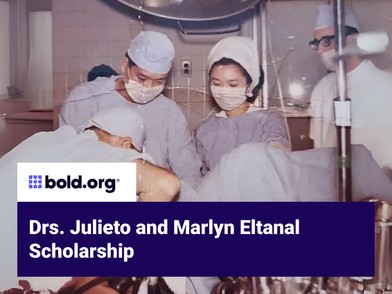
Drs. Julieto and Marlyn Eltanal Scholarship
Funded byRossana EltanalThis scholarship aims to honor Julieto and Marlyn Eltanal by supporting the next generation of doctors as they finish their education.- School: Cornell University
- Field of Study: Medicine
- Ethnicity: Asian
- Education Level: Attending medical school
$6,000Scholarship is awarded to
1 winnerDeadline:Jun 16, 2026One Click Apply27
Mirajur Rahman Perseverance Scholarship
Funded byMirajur RahmanThis scholarship will be awarded to one high school junior or senior who plans to attend college and has persevered through life’s hardship toward a brighter future for themselves and the world.All students are eligible$1,010Scholarship is awarded to
1 winnerDeadline:Sep 30, 2021One Click Apply28
Recent Immigrant Scholarship
Funded byDenis GroszComing to America is often tremendously beneficial for the immigrants themselves, but it yields enormous benefits for our country as well.- US Immigrant: Post-2010 with plans to live & work in US
$1,000Scholarship is awarded to
1 winnerDeadline:Mar 31, 2020One Click Apply29
Mahlagha Jaberi Mental Health Awareness for Immigrants Scholarship
Funded byMahlagha JaberiThe Mahlagha Jaberi Mental Health Awareness for Immigrants Scholarship exists to support more awareness about the mental health of immigrants in the United States.- Background: First or second-generation immigrants in any field of study
$1,000Scholarship is awarded to
1 winnerDeadline:Jun 01, 2021One Click Apply30


How it works
Bold.org is Built to Make Scholarships Feel Possible
Step 01
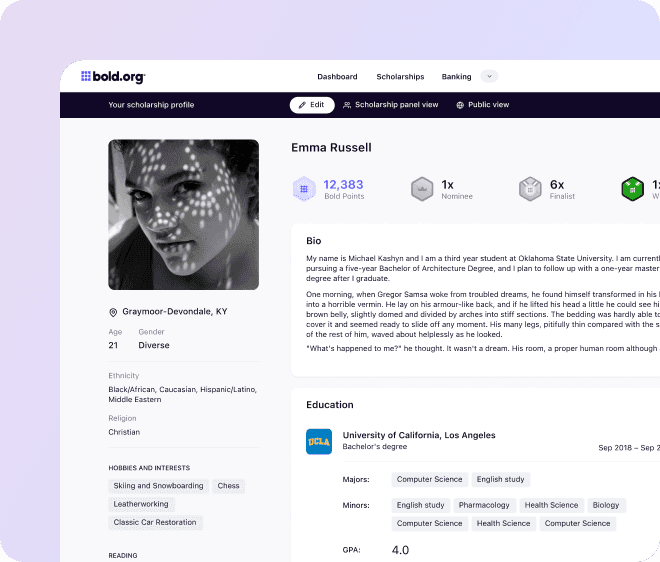
Start with your story
Bold.org helps students show donors who they are beyond a transcript.
Step 02
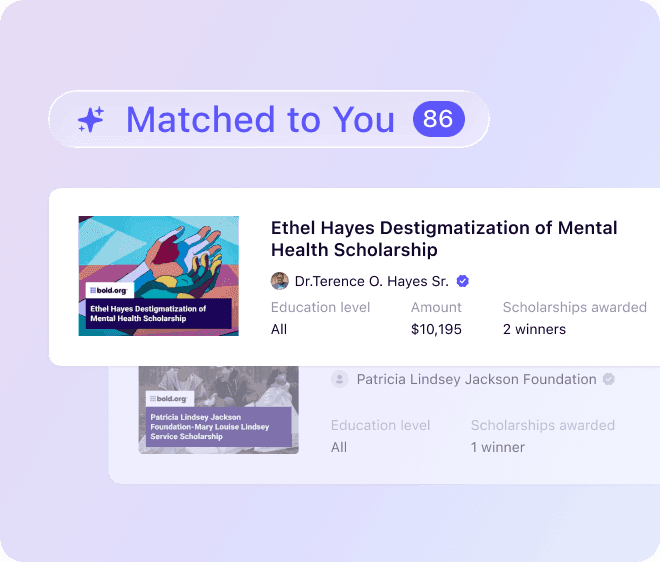
Where scholarships are awarded
Every scholarship is funded by donors and managed directly on Bold.org.
Step 03
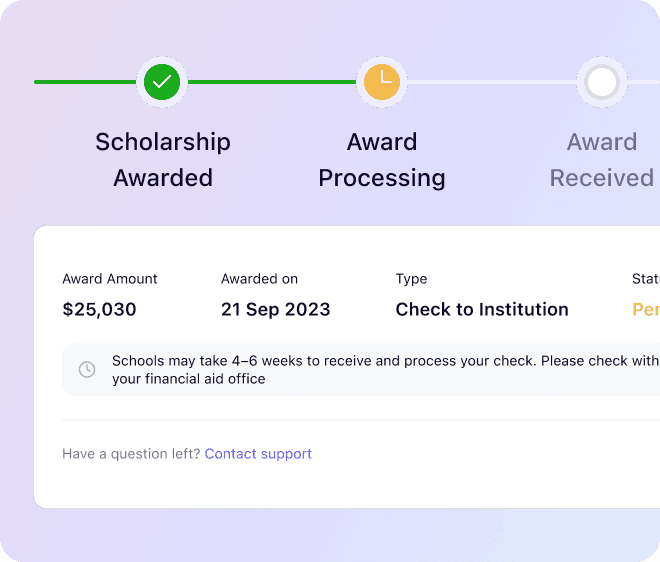
Fund your future
Scholarship dollars are disbursed through Bold.org to help students pay for school.
Scholarships for Immigrants: Data, Landscape, and What Winners Look Like
Immigrant students in the United States face a financial reality that most scholarship guides ignore: millions are ineligible for federal financial aid. Undocumented students cannot file a FAFSA. DACA recipients are excluded from federal student loans and Pell Grants. Even lawful permanent residents who arrived recently may face residency requirements that delay their access to state aid. The result is a funding gap that private scholarships are uniquely positioned to fill — and Bold.org's analysis of scholarship data in the Diversity and Inclusion category reveals exactly what it takes to win them (methodology).
The Funding Gap: Why Scholarships for Immigrants Fill a Critical Need
Among Diversity and Inclusion scholarship seekers on Bold.org, the average annual tuition is $24,569. Average aid covers $12,349 — a gap of more than $12,000 per year. Students fill it through loans, work, or family support. For undocumented students locked out of federal aid, that gap grows wider still.
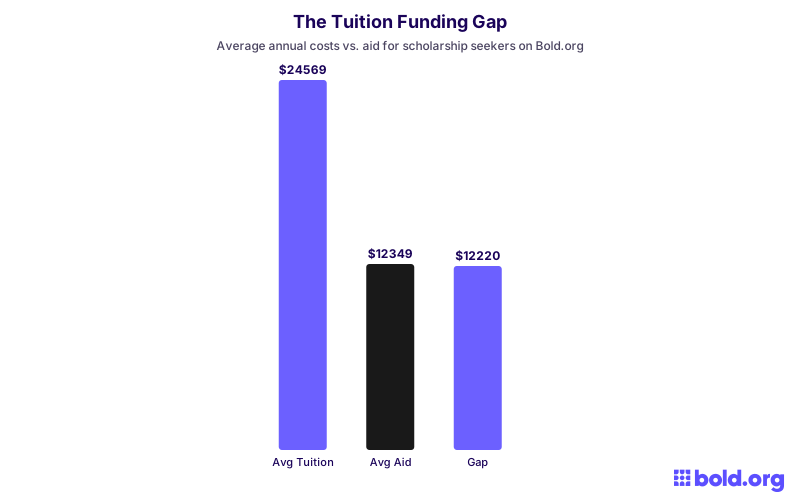
Federal student aid — Pell Grants, subsidized loans, Federal Work-Study — totals roughly $112 billion per year across U.S. higher education (Federal Student Aid, FY 2024). Undocumented students cannot access any of it. DACA recipients can work legally but still cannot receive Pell Grants or federal loans. The result: immigration status, not academic ability, decides who gets the largest source of college money in the country.
The policy landscape varies by state. At least 22 states and D.C. let undocumented students pay in-state tuition — a change that can cut costs by 60% or more at public schools. Key states include:
- California (AB 540 and the California Dream Act): In-state tuition and state financial aid for qualifying students regardless of immigration status
- Texas (HB 1403): One of the earliest states to extend in-state tuition, since 2001
- New York (Jose Peralta DREAM Act): State-level financial aid including TAP grants for undocumented students
- Illinois (SB 233): In-state tuition plus state scholarship eligibility
- Washington, New Jersey, Connecticut, Colorado, and Oregon: In-state tuition policies with varying levels of state aid access
Lawful permanent residents (green card holders) face a different timeline. While eligible for federal aid, recent arrivals may need to meet state residency requirements — often 12 months — before qualifying for in-state tuition or state grants. During that gap year, scholarships fill the same role.
States without in-state tuition policies charge out-of-state rates that top $30,000 a year at flagship schools. For students in these "locked-out" states, private scholarships for immigrants are not extra money. They are the main path to a degree.
What Eligibility Looks Like by Immigration Status
Federal and state aid access depends almost entirely on immigration status. No top scholarship guide lays this out clearly — here is the breakdown:
Lawful Permanent Residents (green card holders) are eligible for federal financial aid — Pell Grants, subsidized loans, and Federal Work-Study — on the same terms as U.S. citizens. The main barrier is state residency: most states require 12 months of domicile before qualifying for in-state tuition or state grants. Recent arrivals face a gap year at out-of-state rates, which can double or triple tuition at public universities. Scholarships bridge that window.
Refugees and asylees qualify for federal financial aid immediately upon receiving their status — no waiting period. Their challenges are different: navigating an unfamiliar education system, language barriers, and getting foreign credentials recognized. Organizations like the International Rescue Committee and UNHCR provide education navigation support.
DACA recipients can work legally and file taxes but cannot receive federal grants, federal loans, or Federal Work-Study. At least ten states (California, New York, Illinois, Washington, New Jersey, Connecticut, Colorado, Oregon, Minnesota, and New Mexico) extend state-level financial aid to DACA recipients. Private scholarships are the primary funding path in all other states.
Undocumented students without DACA cannot file a FAFSA or access any federal aid. Private scholarships and state-level programs in the 22+ qualifying states are the only options.
F-1 and J-1 visa holders are generally ineligible for federal or state aid. They may qualify for university-specific international student scholarships, departmental assistantships, or private awards that do not restrict by citizenship.
Who's Seeking Scholarships for Immigrants on Bold.org
The Diversity and Inclusion scholarship category on Bold.org — which covers scholarships for immigrant, first-generation, and underrepresented students — draws seekers from every state. Their locations match the U.S. immigrant population closely (methodology).
On the platform, Texas leads at 11.7%, followed by California (11.1%), Florida (6.7%), and New York (5.3%). These four states hold more than a third of seekers in this category. All four offer some in-state tuition access for undocumented students — a sign that state-level education access drives scholarship activity.
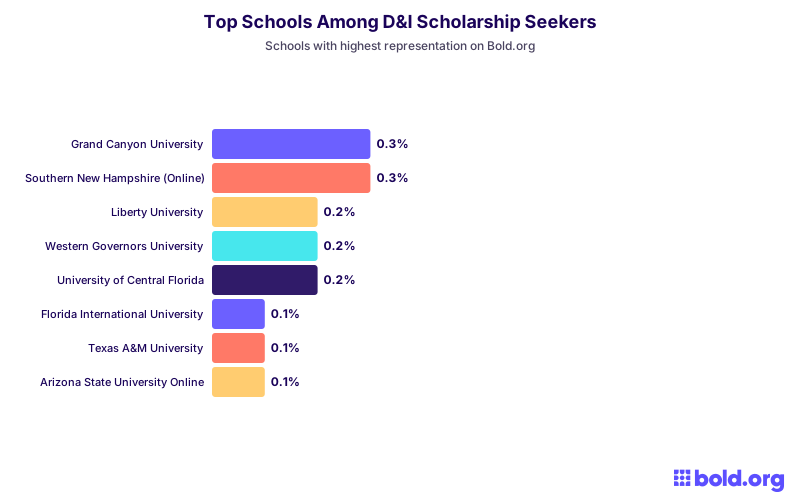
The academic profile is strong. Median GPA among seekers in this category is 3.7, and 65.2% carry a 3.5 or higher. In this category, 57.7% are high school students starting their search early. Another 20.6% are undergrads, with 8.2% at the associate level — a reflection of the community college pathway many immigrant students use before transferring to four-year schools.
Top fields of study among seekers in this category: nursing (7.9%), business (5.2%), psychology (5.0%), health sciences (2.8%), and computer science (2.6%). These choices align with winner career goals. Among winners in this category on Bold.org, medicine (19%), healthcare (17%), and law (15%) top the list of stated career paths.
The Scholarship Ecosystem: What's Available
The immigrant scholarship landscape spans private foundations, university programs, and aggregated listings. Eligibility rules vary widely — a scholarship labeled "for immigrants" may or may not include undocumented students, DACA recipients, or refugees.
Major Scholarship Providers
Several organizations have built sustained, well-funded programs specifically for immigrant and undocumented students:
TheDream.US runs two flagship programs. The National Scholarship covers up to $33,000 for a bachelor's degree at nearly 80 partner colleges. It targets first-generation immigrant students who qualify for in-state tuition. The Opportunity Scholarship — up to $100,000 — serves students in locked-out states, covering tuition and housing at partner schools that do offer access.
Paul & Daisy Soros Fellowships for New Americans provides up to $90,000 for graduate study in any field. Eligible applicants include naturalized citizens, green card holders, DACA recipients, and children of immigrants. The program selects about 30 fellows each year.
Golden Door Scholars serves DACA recipients and undocumented students with tuition funding, mentorship, and career support. Immigrants Rising maintains the most thorough curated list of scholarships that do not require proof of U.S. citizenship — a vital tool for navigating eligibility barriers.
Esperanza Education Fund awards $5,000 to $20,000 to students born outside the United States. MALDEF (Mexican American Legal Defense and Educational Fund) publishes a scholarship resource guide for Latino immigrant students.
Platform and Aggregated Opportunities
As of March 2026, Bold.org lists scholarships for immigrants alongside its own awards in the Diversity and Inclusion category. The median award on the platform is $1,000, with an average of $1,883 (methodology). These awards are smaller than TheDream.US or Soros fellowships — but they are stackable, and most do not require citizenship documentation.
According to Bold.org's aggregated listings, scholarships for immigrants break down by keyword focus: immigrant-targeted (35%), new American (25%), dreamer (20%), refugee (15%), and DACA-specific (5%). The median max award among these external scholarships is $11,250 — well above the platform median. Large institutional programs like TheDream.US and the Soros Fellowships pull that number up.
When to Apply: Timing Patterns
Application volume data from Bold.org's Diversity and Inclusion category shows clear seasonal patterns. Peak months are June (159 applications), April (149), May (147), and February (141). The lowest-volume months are August (45) and January (61).
For students navigating immigration-related barriers that already slow down the process — FAFSA alternatives, document gathering, eligibility verification — timing matters. August and September represent the lowest-competition window on the platform. Applications submitted during these months receive more individual attention from reviewers simply because there are fewer of them.
The strategic approach: use summer to draft essays and gather documents, then submit in August–September when volume drops. Students who need extra time for state-specific forms — California's Dream Act Application, Washington's WASFA — gain a buffer by targeting this window.
Note: Timing data reflects the broader Diversity and Inclusion category on Bold.org, not immigrant-specific applications exclusively.
Barriers Immigrant Students Face in the Scholarship Process
The challenges are built into the system. Knowing them helps applicants for scholarships for immigrants move through it with strategy rather than guesswork.
FAFSA Exclusion and Its Ripple Effects
Many college and state scholarships require a FAFSA on file. For undocumented students who cannot submit one, this locks them out — even when the scholarship itself does not require citizenship. Some states offer alternatives: California has the Dream Act Application, Washington has the WASFA. But the patchwork of state options means students must research what their state provides.
DACA recipients cannot receive Pell Grants, federal loans, or Federal Work-Study. However, some schools require a FAFSA submission to process their own institutional aid — so filing may still matter even without federal eligibility. DACA students should also complete any state-level application available to them, as at least ten states (California, New York, Illinois, Washington, New Jersey, Connecticut, Colorado, Oregon, Minnesota, and New Mexico) extend state financial aid to DACA recipients.
Privacy and Disclosure Concerns
Many undocumented students hesitate to share their status on scholarship forms. That caution makes sense — but it can also cause students to skip awards they qualify for.
- Private scholarships generally do not share applicant data with government agencies
- Citizenship questions on scholarship forms filter for eligibility, not for reporting
- TheDream.US, Golden Door Scholars, and Immigrants Rising all have established records of protecting applicant privacy
- The key distinction: sharing status with a trusted scholarship provider differs from posting it on platforms with unclear data practices
State-by-State Policy Variation
State rules are inconsistent. A student who qualifies for in-state tuition and state aid in California would face out-of-state rates and no state support in Alabama. For students choosing where to attend, state tuition policy should rank as a top factor — it can matter more than any single scholarship.
What Finalists and Winners Look Like: The Three-Tier Funnel
With those barriers as context, application data for scholarships for immigrants tells a striking story. Data from the Diversity and Inclusion category on Bold.org traces the path from applicant to finalist to winner — and the biggest finding upends a common belief about what it takes to win (methodology).
Applicant to Finalist
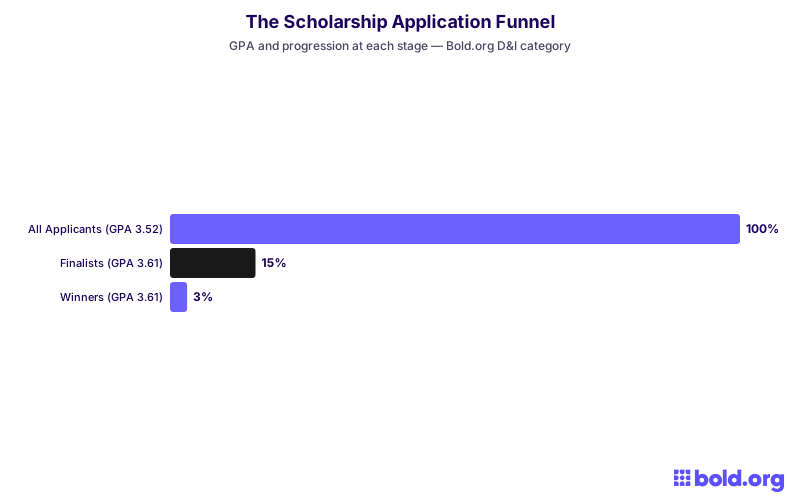
The average applicant GPA in this category is 3.52. Among finalists — those selected for serious review — the average rises to 3.61. That 0.09-point lift shows reviewers screen for academic effort. A 3.5 GPA or above lands an applicant in finalist range.
First-generation students make up 54.2% of finalists in this category, well above the overall applicant pool. Low-income students represent 69.5% of finalists. Reviewers clearly weigh need and first-gen background — not just grades.
Finalist to Winner: Where GPA Stops Mattering
The most striking finding: finalist and winner GPAs are both 3.61. At this stage, grades are not the dividing line. The gap is qualitative.
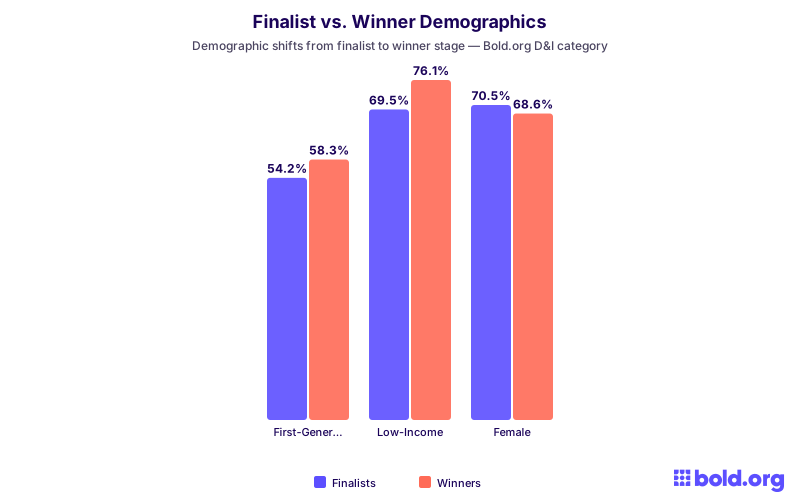
What changes between finalists and winners in Bold.org's D&I category:
- First-generation share rises from 54.2% to 58.3% (+4.1 points). Donors give extra weight to first-gen status at the final stage.
- Low-income share rises from 69.5% to 76.1% (+6.6 points). Need is the strongest signal separating winners from finalists.
- Female share holds steady at roughly 70% for finalists and 69% for winners — gender does not drive selection.
Winners' career goals on the platform cluster in service fields: medicine (19%), healthcare (17%), and law (15%) make up over half of stated paths. This matches scholarship selection criteria on Bold.org: ambition (31%), impact (15%), drive (14%), and need (14%).
How to Strengthen Your Application
The funnel data shows a fact that surprises most applicants: once you reach the finalist stage, GPA is not the deciding factor. Both finalists and winners average 3.61 in this category. What separates winners is how they tell their story, show their need, and align with what donors value.
These strategies come from Bold.org's funnel data and essay analysis in the Diversity and Inclusion category:
Name the federal aid exclusion directly. The 6.6-point jump in low-income representation from finalists to winners is the largest demographic shift in the funnel. Donors who fund immigrant scholarships understand that FAFSA ineligibility creates a financial burden other students don't face. If federal aid is closed to you, say so in your essay — scholarship reviewers in this category respond to it because it's the defining financial reality they created these awards to address.
Connect your family's immigration story to your degree plan. First-generation students rise from 54.2% of finalists to 58.3% of winners in this category. Many immigrant-family students are first-gen by definition — no parent navigated the U.S. college system. The strongest essays in this category don't separate immigration and first-gen into two narratives. They weave them: the specific reason your family came here, how that shaped what you study, and what you'll build with the degree. A pre-med student whose parents left Guatemala for better healthcare access has a more compelling essay than one who lists "overcoming challenges" in generic terms.
Be specific about your immigration experience. Winning essays in this category avoid broad claims about "overcoming challenges." They ground their stories in concrete moments, choices, and outcomes. If your family's journey shaped your academic direction or career plans, draw that connection clearly. Selection criteria in this category weigh ambition (31%) and impact (15%) — donors want to know where you're headed.
Match your essay to the scholarship's stated criteria. The top criteria — ambition, impact, drive, and need — cover 74% of how scholarships in this category select winners. Read each scholarship's criteria before writing. If it values "impact," open with your community work. If it values "need," open with your financial reality. Providers like TheDream.US and Esperanza Education Fund target immigrant students specifically — their criteria will fit your experience better than general merit awards.
Build a layered funding strategy across aid types. With federal aid off the table for undocumented students, a single scholarship won't bridge a $12,000+ annual gap. The approach that works: combine smaller platform awards (median $1,000 on Bold.org) with targeted programs — TheDream.US for tuition, Immigrants Rising fellowships for career development, and state aid where available (California Dream Act, New York's Jose Peralta DREAM Act). Each layer addresses a different cost.
Avoid the "overcoming adversity" trap. The 0.09-point GPA gap between applicants (3.52) and finalists (3.61) accounts for the academic filter. But essay analysis reveals the real sorting mechanism: applicants who stay at the general pool level often write about immigration hardship as the entire story — without connecting it to academic direction or professional purpose. Scholarships in this category evaluate ambition (31%) and impact (15%). An essay that stops at "I struggled" misses two-thirds of the scoring criteria.
Organizations and Resources
These organizations maintain ongoing scholarships for immigrants and related resources:
- TheDream.US (thedream.us) — National and Opportunity Scholarships for undocumented and DACA students
- Paul & Daisy Soros Fellowships (pdsoros.org) — Graduate fellowships for immigrants and children of immigrants
- Golden Door Scholars (goldendoorscholars.org) — Scholarships and support for DACA/undocumented students
- Immigrants Rising (immigrantsrising.org) — Curated scholarship list requiring no citizenship proof, plus fellowships and entrepreneurial support
- Esperanza Education Fund (esperanzafund.org) — Awards of $5,000–$20,000 for students born outside the U.S.
- MALDEF (maldef.org) — Scholarship resource guide for Latino immigrant students
- United We Dream (unitedwedream.org) — Advocacy and resource hub for immigrant youth, including scholarship navigation
- My Undocumented Life (mydocumentedlife.org) — Comprehensive resource blog for undocumented students, maintained since 2013
- DREAMer's RoadMap — Mobile app for locating tailored scholarship opportunities
The scholarship listings above include opportunities from many of these providers. Students in states without in-state tuition policies should look first at TheDream.US's Opportunity Scholarship (up to $100,000, specifically for locked-out states) and Golden Door Scholars, which both cover tuition gaps that state policy creates.
Frequently Asked Questions
Do undocumented students qualify for scholarships?
Yes. Undocumented students are eligible for most private scholarships, which set their own eligibility criteria independently of federal financial aid rules. Organizations like TheDream.US, Golden Door Scholars, and Immigrants Rising specifically serve undocumented students. On Bold.org, most scholarships do not require proof of citizenship. The key distinction is between private scholarships (generally accessible) and government-funded programs (generally restricted by immigration status).
Can DACA recipients apply for FAFSA?
DACA recipients are not eligible for federal financial aid — no Pell Grants, federal loans, or Federal Work-Study. However, some colleges require a FAFSA on file to process their own institutional aid, so filing may still be necessary even without federal eligibility. State aid varies: California, New York, and Illinois extend state aid to DACA students. Others do not. Filing a FAFSA or a state form (like California's Dream Act Application or Washington's WASFA) can unlock school-level awards even where federal money is off the table.
Which states offer in-state tuition for undocumented students?
At least 22 states and D.C. let undocumented students pay in-state tuition at public colleges. The longest-running programs: California (AB 540, since 2001), Texas (HB 1403, since 2001), and New York (since 2002, expanded by the Jose Peralta DREAM Act in 2019). Illinois, Washington, New Jersey, Connecticut, Colorado, Oregon, and Minnesota also qualify. Most states require 2-3 years at a state high school and a diploma or GED from that state. California and New York extend state financial aid on top of in-state tuition. The National Immigration Law Center keeps an updated list at nilc.org.
How can immigrant students apply for scholarships without revealing their immigration status?
Many private scholarships — including most on Bold.org — do not ask about immigration status. When forms do ask, the info is used for eligibility, not shared with the government. Students worried about disclosure should target scholarships that say they do not require citizenship proof. Immigrants Rising keeps a vetted list. When a form asks about citizenship, students can often choose "other" or skip the field. Organizations like TheDream.US, Golden Door Scholars, and Esperanza Education Fund have clear privacy protections for applicant data.
What GPA do scholarship winners in this category typically have?
Bold.org data shows that scholarship winners in the Diversity and Inclusion category have an average GPA of 3.61, compared to 3.52 for the overall applicant pool — a modest 0.09-point difference. The more revealing finding: finalist and winner GPAs are identical at 3.61, meaning once you reach the finalist stage, GPA is not the deciding factor. Students with GPAs of 3.0 and above should apply — the 3.0–3.49 range represents 23.8% of scholarship seekers in this category, and scholarship criteria on the platform prioritize ambition, impact, and need over raw academic numbers.
Are immigrant scholarships only for undocumented students?
No. "Immigrant scholarships" encompass a broad range of eligibility categories. The Paul & Daisy Soros Fellowships, for example, are open to naturalized citizens, green card holders, and DACA recipients — as well as children of immigrants born in the U.S. Many scholarships targeting "first-generation immigrants" include students whose parents immigrated regardless of the student's own citizenship status. Others specifically target refugees, asylees, or holders of specific visa types. Students should read eligibility requirements carefully rather than self-excluding based on the scholarship title alone. On Bold.org's immigrant scholarship listings, filtering by eligibility criteria can surface opportunities that match specific immigration circumstances.
Methodology
This analysis uses Bold.org's database of scholarship applications, finalist picks, and award outcomes in the Diversity and Inclusion category. That category covers scholarships for underrepresented groups broadly — including but not limited to immigrant, first-generation, and minority students. Platform data reflects this broader group, and the article frames findings that way throughout.
Academic profiles (GPA, education level, field of study) come from Bold.org student profiles with valid entries. Finalist and winner data comes from the platform's application pipeline, where donors select finalists and winners receive disbursed awards.
External scholarship data is sourced from Bold.org's aggregated database of third-party scholarships. Named programs (TheDream.US, Paul & Daisy Soros Fellowships, Golden Door Scholars, Immigrants Rising, Esperanza Education Fund, MALDEF) are referenced based on their public program details.
State policy information draws from the National Immigration Law Center (NILC), the National Conference of State Legislatures (NCSL), and state education agency publications. Federal aid data references the U.S. Department of Education.
Essay analysis reflects aggregate patterns across winning application texts in the Diversity and Inclusion category. No individual essays are quoted.
Last updated: March 2026
Frequently Asked Questions
Finding scholarships for immigrants is just like finding any other scholarship. However, the sheer number of websites and sources dedicated to scholarships and higher education can be overwhelming, especially when many sources are not very reliable. A quick Google search may bring up any number of scholarships, but using a credible scholarship search engine like Bold.org will be helpful in finding the right immigrant scholarship for you. Not only can you find scholarships that are exclusive to Bold.org, but you can find scholarships with narrow criteria, whether they are for a specific accredited public university or for a specific gender or area of study.
When it comes to applying for scholarships, the earlier the better. The Federal Student Aid office of the United States even recommends that students begin to apply for scholarships the summer before they become high school seniors. By applying earlier, not only will you be eligible for scholarships with lower school year requirements, but you will also optimize the number of scholarships you have time to apply for. This way, you can ensure that you have the funds you need while you are attending college.
Scholarship eligibility will vary between scholarships, and it is important to ensure your eligibility before you begin to apply. Almost all scholarships include their eligibility requirements in the scholarship description, so be sure to read the description thoroughly. If you fulfill all of the eligibility requirements, then you can begin the application process without any concerns.