Residence in the area of Saratoga Lake & Watershed
Education Level:
State:
Field of Study:
Location:
High school senior
New York
Environmental science or a related field
Residence in the area of Saratoga Lake & Watershed
Environmental issues now effect our daily lives. Understanding complex environmental systems will result in the implementation of practical solutions that can be relevant both locally and globally.
This scholarship seeks to support students who are working to become the next generation of environmental stewards.
Any high school senior in New York attending Saratoga Springs High School, Schuylerville High School, Stillwater High School, Ballston Spa Senior High School, Corinth High School and Spa Catholic High School interested in pursuing a degree in environmental science, environmental studies or related field is eligible to apply. Any student who does not attend one of those high schools but has a residence in the area of Saratoga Lake and Watershed is also eligible.
To apply, tell us about your interest in environmental or natural resource studies, what specific environmental issues interest you, how your education will make an impact, and what connection you feel toward Saratoga Lake or watershed protection. Additionally, list your environmental involvements. Finally, upload a letter of recommendation.
Selection Criteria:
Ambition, Drive, Impact
Essay Topic Requirements
Describe your interest in environmental or natural resource studies. Is there a specific environmental issue that interests you? How will your education contribute to environmental stewardship? Describe any connection you feel toward Saratoga Lake or watershed protection.
Additionally, list any environmental commitments you have been involved with (volunteer work, clubs, projects, internships, advocacy, research, etc.)
500–750 words
Attachment Requirements
Upload a letter of recommendation
File limit: 1 file
$2,000
2 winners, $1,000 each
Awarded
Application Deadline
Jun 19, 2026
Winners Announced
Jul 20, 2026
Education Level
High School
Share
Explore All Kinds of Scholarships for All Kinds of Students
Early on, I saw how easy it was for curiosity to get lost in day-to-day schoolwork, where exploring science and engineering was often replaced by repetitive worksheets and reading drills. That’s what led me to join Science in the Community Club in ninth grade, where we hosted “STEMbrations” at local elementary schools, running hour-long sustainable-themed activities like water filtration, solar kits, and more.
As I watched students explore each table of activities, I recognized the value was in the experience, not just the tangible aspects. When their eyes sparkled after discovering something, I spotted the same enthusiasm that first drew me to STEM. This drove me to engage more and become secretary, vice president, and now president. Despite the effort necessary to run the club, my role is not about me. I’ve made it my mission to create space for kids to ask questions and explore sustainability/environmental problems in a way that sticks with them.
My involvement in this club early in high school bolstered my interest in creating tangible change in the environment. In 10th grade, I began a three-year research project where I designed and built an electric-field assisted crossflow filtration system. This is an innovative approach to advanced filtration of organic chemicals/pollutants by adding an electric field to a membrane-filtration system. However, when I first started, I wasn't able to get access to the filter itself, so I ended up building it in my house out of recycled materials such as a Kids WaterPik and my dad's fish tank tubing. It took months of planning, gathering materials, and executing ideas to finally run and test it. My results not only supported my hypotheses, where an improved fouling ratio, flow rate, and permeate flux suggested greater productivity, but also supported the idea that advanced filtration may not need to be as costly as previously assumed. This could mean such filtration can be more widely accessible to people around the world. Currently, I'm working on incorporating solar power to reduce energy costs.
In March of 2026, I competed at RPI's annual Greater Capital Region Science and Engineering Fair. I not only advanced my project to the NY state level by winning the Stockholm Water Prize, but I also won 1st Place Grand Prize out of hundreds of projects. This qualified me to compete in Pheonix, AZ in May of 2026 at the International Science and Engineering Fair (ISEF) in the project category of "Environmental Engineering". I was incredibly excited that my homemade filtration system was not only successful, but also unique enough to bring me to an international competition where a select 1800 researchers present their projects. However, the best part of this experience was knowing I made an impact on the future environmental research. I hope that my study has broader, real-world applications and can make advanced filtration more affordable and accessible to everyone.
Additionally, last year, I created an animated Earth Day film shown to over 350 students and faculty at Geyser Road Elementary School and across the Saratoga Springs School District. I’ve also spent many hours in Naturalists Club, helping recycle around the school every Monday. Over the summer, I completed RPI's PREFACE Nuclear Engineering Program, where I learned about nuclear energy, why it's sustainable, and I even got to visit a real nuclear power plant. These experiences showed me how STEM can make a real-world impact on people and their environment.
However, water protection is my primary passion; it always has been. Besides doing a research project on water filtration and narrowing my interests on pollution, I truly take time to enjoy the local water bodies. A great memory I have is the summers during elementary and middle school, where my dad and I would go fishing in local lakes. We would spend our days in the hot sun, me with my pink rod, sitting by the lake and absorbing its beauty. Pollution is an imminent threat to the environment in which I spent most of my childhood in and therefore efforts to mend it are important to me.
As I plan to major in engineering at RPI, I’m particularly interested in predictive maintenance systems that require sustainability/reliability. By anticipating possible failures, there'd be less wasted resources, longer life spans, and lower environmental impact. I hope to design technologies that are both innovative and responsible, and with the help of this scholarship, I’d be much closer to my dreams!
Growing up, I knew that there was nothing more beautiful than the natural world. I took note of it every time I stepped outdoors, whether on a hiking trail in the nearby Adirondacks, taking a swim at a glistening lake in Vermont, or simply watching a squirrel climb up a vined-laced tree. Everything held charm.
I was eager to learn more and once that curiosity sparked, there was no putting out that flame. I was unfortunately quick to realize that these ecological spaces were being threatened by human activities that induced climate change, pollution, and habitat destruction. Since then, I began to act on a personal level and urged those around me to do the same because I knew that small individual steps were crucial in fighting environmental collapse. I also realized that preserving our planet’s integrity was about more than just recycling a bottle or composting, but it was about collective change and shifting global priorities. I knew that I wanted to dedicate my future to a mission of environmental protection.
So, at 14, I joined my school’s mock trial team because I knew that law was a way to create widespread and tangible change. I became obsessed, not with the outcome of winning competitions, but with the logic of shaping an argument that could someday hopefully save our finite planet. I drew the connection from the courtroom to the sustainability crisis at hand. I thought of it as The People v. Their Only Home: a court case where the truth was being hidden and delayed by viral misinformation just because it was convenient. I began to see Earth as a plaintiff, and as long as she was a plaintiff, I was going to craft her opening statement.
Along with the law tract I was pursuing, I began my own environmental initiatives. I dedicated myself to taking on plastic pollution with an eco-brick initiative at my local library where nonrecyclable plastics were transformed into not only building material, but educational tools to teach others about environmental responsibility. I utilized this project to show others that sustainability is not a foreign concept. I transformed these bricks into stools and garbage cans for preschoolers to foster curiosity and conversations amongst the youth, so the importance of environmental conservation is not lost within a generation.
I also organized and led a project at my high school to create a yearlong plan to build sustainability. By working with staff and focusing on relevant issues, I was able to pave a path for future generations of students to encourage an eco-friendly environment that aligns with the Green Ribbon Schools standards, a U.S. Department of Education program that emphasizes environmental stewardship, wellness and health, and education.
These activities along with others, such as volunteering for environmental organizations and interning at my local city courthouse, made me certain that continuing a career in environmental law was precisely what I wanted to do.
Once this connection was made, I decided to write a research paper during my junior year summer on the importance of wetlands, purely out of curiosity. I knew that this biome was being especially affected by climate change, and I learned that in the United States they are unprotected, unregulated, and vulnerable. Through extensive research, I learned exactly what wetlands are and what they do, their history and the laws that surround them. I learned that they will continue to be exploited if environmental laws are not implemented and the importance of biodiversity, habitat, and ecosystems continues to be largely ignored. Despite their many economic and ecological benefits, wetlands continue to be taken advantage of due to political priorities within the United States. After 10 pages of research, I was convinced that working with wetlands and their protection was something I wanted to focus on in my future studies and job.
This fall, I will be attending Fordham University, majoring in Environmental Studies, and I feel that this education will allow me to build my environmental stewardship and speak for the planet. This curriculum includes interdisciplinary coursework in the natural sciences, social sciences, and humanities that will help me gain insight into the physical and societal causes and effects of environmental problems, integrating these disciplines in economic, political, and societal policy solutions. I will be able to pursue my own scientific research (hopefully to learn more about wetlands and watershed protection), embody environmental citizenship, and even go abroad to study climate change internationally.
How it works
Bold.org is Built to Make Scholarships Feel Possible
Step 01
Start with your story
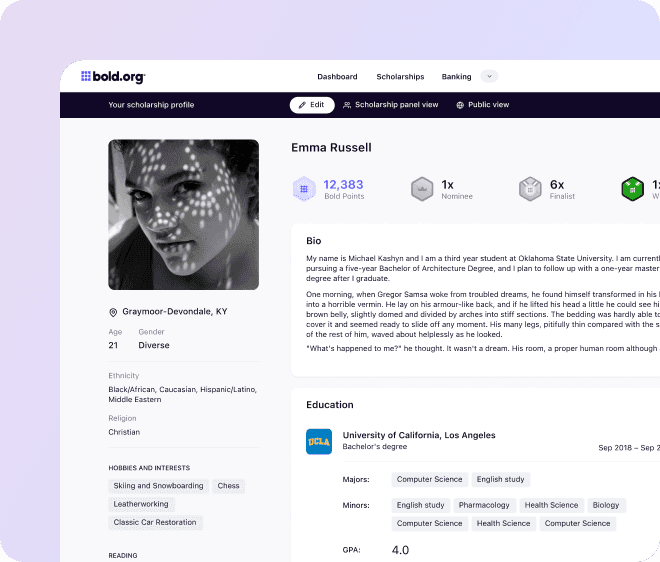
Bold.org helps students show donors who they are beyond a transcript.
Step 02
Where scholarships are awarded
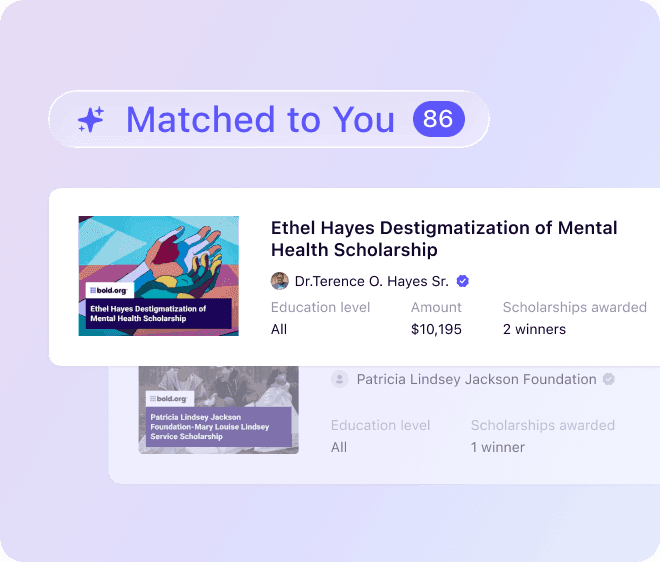
Every scholarship is funded by donors and managed directly on Bold.org.
Step 03
Fund your future
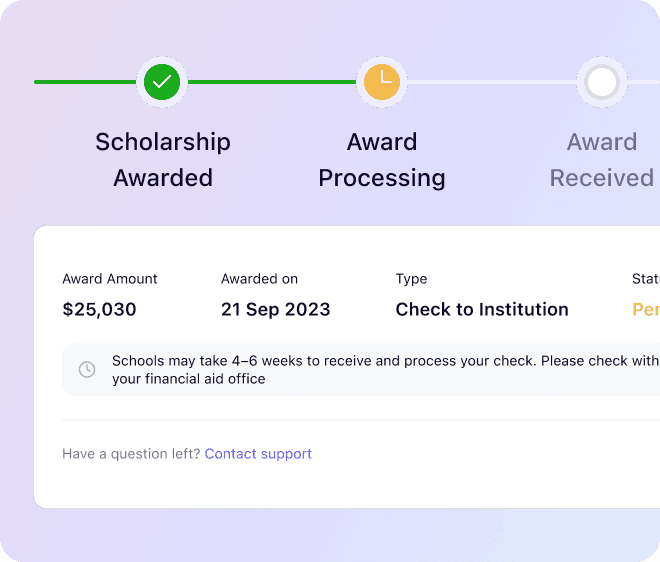
Scholarship dollars are disbursed through Bold.org to help students pay for school.
FAQ
When is the scholarship application deadline?
The application deadline is Jun 19, 2026. Winners will be announced on Jul 20, 2026.
How will scholarship application information be used?
Your privacy is a top priority on the Bold.org platform, and you can find our privacy policy in full here. You may opt out of communications from Bold.org at any time, and unless we’ve first notified you and gotten your consent, you’ll never receive communication from any third parties related to personal information you give us.
What is the scholarship award?
Award amounts per winner are designated by the donor. Check the award amount for a detailed breakdown.
When will the scholarship winner be chosen? How will they be notified?
The winner will be publicly announced on Jul 20, 2026. Prior to the announcement date, we may contact finalists with additional questions about their application. We will work with donors to review all applications according to the scholarship criteria. Winners will be chosen based on the merit of their application.
How will the scholarship award be paid?
Award checks will be sent to the financial aid office of the winner's academic institution or future academic institution in their name to be applied to their tuition, and in the name of their institution (depending on the school's requirements). If the award is for a qualified educational non-tuition expense, we will work with the winner directly to distribute the award and make sure it goes towards qualified expenses.
How will my scholarship application be verified?
Before we award the scholarship, the winner will be required to confirm their academic enrollment status. Depending on the circumstances, verification of Student ID and/or their most recent transcript will be required.
How should I get in touch with questions?
If you have any questions about this scholarship or the Bold.org platform, just email contact@bold.org and we’ll get back to you as quickly as we can.
Does the scholarship have terms and conditions?
Yes. The terms and conditions for this scholarship can be found here.
97% of students don't win scholarships. We’re here to change that.