The Liunbenov family is a part of the powerful educational community that strives for the gift of knowledge.
They are committed to helping students become successful adults and thriving human beings who will play a productive and influential part in society. The Peter and Nan Liubenov Student Scholarship will be awarded to a BIPOC high school senior who demonstrates sensitive awareness of others and chooses to take the moral high ground. This scholarship will support students who work to balance their academics with integrity and the desire to become a lifelong learner.
BIPOC high school seniors are eligible to apply if they have volunteering or work experience. To apply, write about how you see yourself as a positive force in your community and how social norms shape your thinking.
Selection Criteria:
Ambition, Need, Boldest Bold.org Profile
$1,000
2 winners, $500 each
Awarded
Application Deadline
Jun 13, 2026
Winners Announced
Jul 27, 2026
Education Level
High School
Share
Essay Topic
How do you perceive yourself to be a positive force in society both now and in the future? How do the parameters of current social norms shape this thinking?
400–600 words
Explore All Kinds of Scholarships for All Kinds of Students
University of California-Los AngelesWilmington, CA
I perceive myself as a positive force in society because I try to use what I have experienced to help other people feel seen, heard, and supported. I do not believe being a positive force always means doing something loud or receiving recognition. Sometimes, it means showing up consistently, speaking for people who feel ignored, and creating spaces where others feel like their struggles matter.
Growing up in Los Angeles, especially in an underserved community, I saw how many people carry pain silently. I learned this personally after losing my father to gun violence when I was young. That loss changed my life and forced me to understand grief, trauma, and injustice earlier than most children should have to. It also introduced me to the pain that affects not only one family, but entire communities. Through my work with Justice for Homicide Victims, I have been able to support families affected by violence and help bring awareness to an issue that is often overlooked until it happens close to home. Even when I was younger, I understood that staying silent was not enough.
I also live with Crohn’s disease, which has taught me that not every struggle is visible. There are days when I am tired, in pain, or overwhelmed, but I still have to balance school, leadership, athletics, and service. Managing a chronic illness while maintaining a 3.86 GPA, serving as ASB President, being cheer captain, and competing as a four-year varsity track and field athlete has taught me resilience. More importantly, it has helped me understand that many people are fighting battles that others cannot see. Because of that, I try to lead with empathy instead of judgment.
The current social norms around mental health, race, gender, illness, and success shape how I think about my role in society. In many communities, especially low-income communities, people are taught to keep going no matter how much they are hurting. Mental health is sometimes treated as a weakness, and asking for help can feel shameful. As a Black and Latina young woman from Wilmington, California, I also know that people do not always expect someone like me to be in leadership spaces, STEM spaces, or healthcare spaces. Those expectations motivate me instead of limiting me. I want other young girls who look like me to see that they belong in those spaces too.
Right now, I try to be a positive force through leadership and service. At Mary Star of the Sea High School, I lead by including others, listening to student voices, and encouraging people around me. Through over 420 hours of community service with Justice for Homicide Victims, Operation Progress LA, and Special Needs Network, I have supported families affected by violence, mentored younger students, and served individuals with special needs. These experiences taught me that impact is built through compassion and consistency.
In the future, I hope to continue that impact through healthcare. I plan to attend UCLA and major in Physiological Science as a foundation for becoming a mental health nurse practitioner and eventually earning a Doctor of Nursing Practice degree. My goal is to help bridge the gap between physical healthcare and mental healthcare, especially for people dealing with trauma, chronic illness, grief, or limited access to resources.
To me, being a positive force means turning pain into purpose. It means challenging the norm that people should suffer quietly. It means using my voice, education, and compassion to help build a society where people feel cared for physically, emotionally, and mentally.
From volunteering in a hospital to working as a restaurant host, I’ve learned that making a difference in society isn’t just about extraordinary acts but is also in the little interactions we have every day. Whether assisting nurses at work, advocating for patients, or welcoming diners, I believe that kindness and service are what build the foundation of meaningful change. However, my commitment to service is also shaped by society’s evolving expectations of civic responsibility and collective action.
Today's society emphasizes the role and initiative we should take in bettering our communities, whether through leadership, professional work, or volunteering. For example, with the growing recognition of healthcare disparities, there is a societal expectation for healthcare workers to not only provide adequate care but to advocate for systemic improvements as well. This belief has driven my dedication to service: at my local hospital, I assist patients and visitors, ensuring they feel supported during stressful times. I help transport individuals to their destinations, advocate for their needs, and provide comfort in an overwhelming environment.
Beyond my volunteering experience, I have also taken on leadership roles in student organizations that focus on promoting inclusivity and civic engagement, principles that have become significantly emphasized in society in recent years. As president of the multicultural club, I create spaces where diverse voices are heard and establish an environment of cultural appreciation within our school. In student government, I help organize initiatives connecting students to service
opportunities, to reinforce the idea of collective action within my community and encourage lifetime involvement.
In the future, I plan to continue being a positive force by pursuing a career in nursing and health policy advocacy. Social expectations will continue to evolve, but the demand for accessible and equitable healthcare will remain the same. My career goal is to combine patient care with broader efforts to improve healthcare accessibility across large contexts, particularly in underserved communities. By working directly with patients while also advocating for systemic change, I hope to ensure that every individual receives the support and resources they deserve.
I’ve learned that service is not defined by a specific title or setting; instead, it is a mindset and a commitment to others, no matter what role I take on. Through my work, both now and in the future, I will continue my commitment to making positive change and ensure that compassion is the heart of everything I do.
When I was in the fifth grade, my best friend came out to me as bisexual. She’d expected rejection, but all she got was confusion—I had no idea what “bisexual” was. She explained to me that not all girls marry guys: some marry those of other gender identities.
And that’s when I realized that I'm bisexual. But living with this truth was nowhere as easy as realizing it was for me.
In the fifth grade especially, most people had never even thought about the possibility of sexually-diverse relationships. All we’d ever seen on TV were boys with girls, so realizing I was bisexual was an incredibly isolating experience. Even as we grew older and started getting exposed to the idea of homosexuality, bisexuality was still this unknown, mysterious thing that people didn’t understand.
At first, I was defensive. If anyone made assumptions or even asked me questions about my sexuality, I immediately assumed they were trying to belittle or demean me, and I shut them down. I never gave people a chance to learn what I wished they just knew.
Then, in the eighth grade, that same friend came out to me again. This time as genderqueer. And again, she was met with confusion.
So far, I’d learned about different sexualities and the generally-known concept of being transgender (a person who was born physically as one gender but identifies as another), but I didn’t know that people could identify as neither, or both. Yet again, she explained it to me, and I realized that I too was genderqueer.
Furthermore, what I realized was that my lack of knowledge was not purposeful, and I had no intention of offending her when I asked about her gender—so why was I so defensive of it myself? Why didn’t I help others understand too? When this friend of mine had helped learn so much about myself twice just by explaining her own experiences to me, how many could I have helped, just by answering a question or being more open?
From then on, I tried to follow my friend’s example, and tried my best to educate myself and others. I found myself becoming someone people felt like they could talk to and confide in. To some people who I once wrote off as homophobic, I became the first person they came out to. People who once threw around the word “gay” as an insult or joke began to tell others off for doing so after I explained to them that I found it hurtful.
Eventually, after entering the 9th grade and joining my high school’s Gay-Straight Alliance, I restarted an old tradition they had of doing “GSA PSAs” (Gay Straight Alliance’s Public Service Announcements) over the loud speaker once a week, sharing information and current events to help increase school-wide awareness of LGBTQ+ issues and introducing words that were once shied away from, like “gay”, into the school atmosphere. Eventually, in my junior year, I became the president of the club, after having been vice president the previous year. Every year, I’d help organize campaigns such as one for National Coming Out Day and National Day of Silence. I also create posts for and run our Instagram account.
I’ve learned from that friend that instead of getting offended by ignorance, we should take it as an opportunity to educate others, because as long as we’re all open to learn, we should all be open to teach.
How it works
Bold.org is Built to Make Scholarships Feel Possible
Step 01
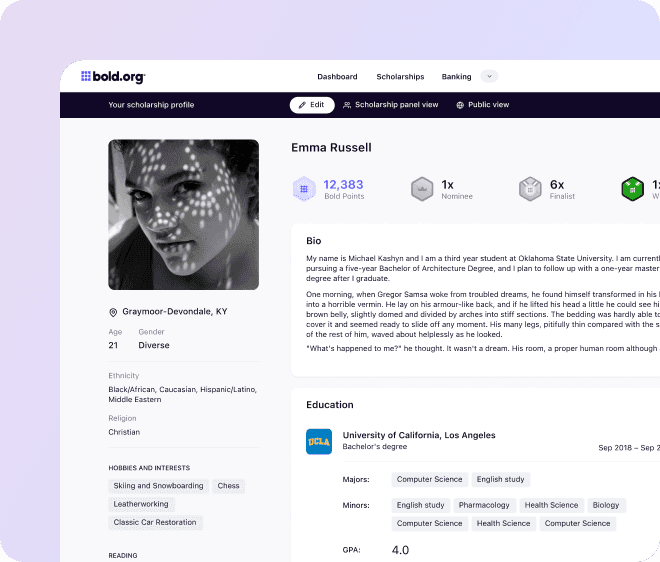
Start with your story
Bold.org helps students show donors who they are beyond a transcript.
Step 02
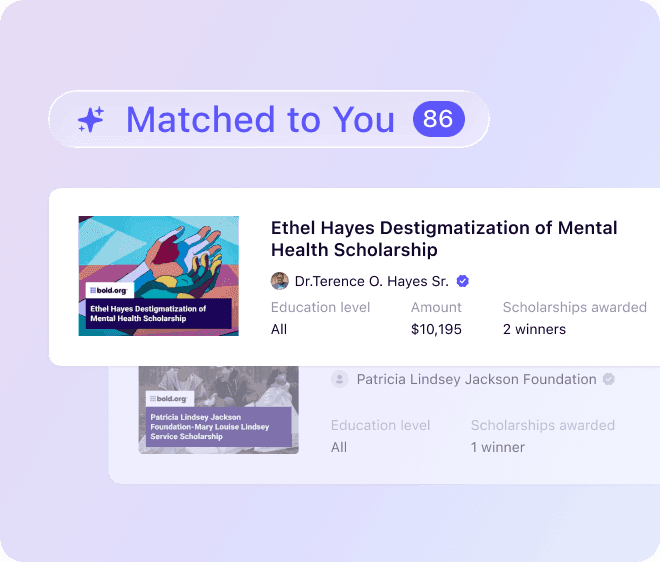
Where scholarships are awarded
Every scholarship is funded by donors and managed directly on Bold.org.
Step 03
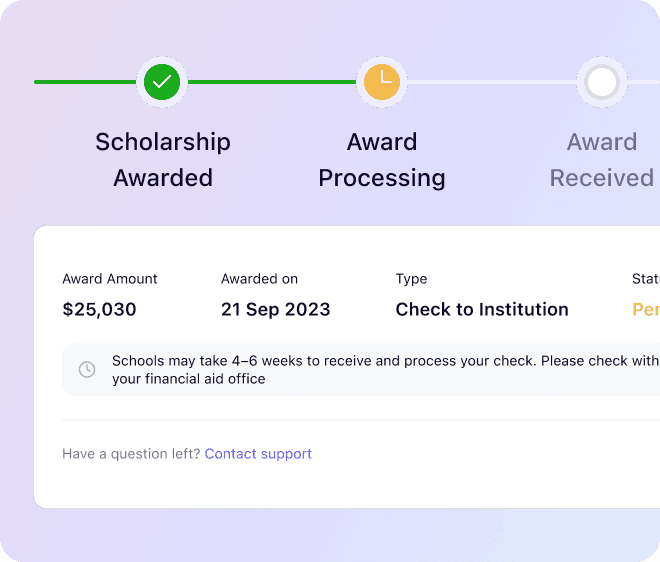
Fund your future
Scholarship dollars are disbursed through Bold.org to help students pay for school.
FAQ
When is the scholarship application deadline?
The application deadline is Jun 13, 2026. Winners will be announced on Jul 27, 2026.
How will scholarship application information be used?
Your privacy is a top priority on the Bold.org platform, and you can find our privacy policy in full here. You may opt out of communications from Bold.org at any time, and unless we’ve first notified you and gotten your consent, you’ll never receive communication from any third parties related to personal information you give us.
What is the scholarship award?
Award amounts per winner are designated by the donor. Check the award amount for a detailed breakdown.
When will the scholarship winner be chosen? How will they be notified?
The winner will be publicly announced on Jul 27, 2026. Prior to the announcement date, we may contact finalists with additional questions about their application. We will work with donors to review all applications according to the scholarship criteria. Winners will be chosen based on the merit of their application.
How will the scholarship award be paid?
Award checks will be sent to the financial aid office of the winner's academic institution or future academic institution in their name to be applied to their tuition, and in the name of their institution (depending on the school's requirements). If the award is for a qualified educational non-tuition expense, we will work with the winner directly to distribute the award and make sure it goes towards qualified expenses.
How will my scholarship application be verified?
Before we award the scholarship, the winner will be required to confirm their academic enrollment status. Depending on the circumstances, verification of Student ID and/or their most recent transcript will be required.
How should I get in touch with questions?
If you have any questions about this scholarship or the Bold.org platform, just email contact@bold.org and we’ll get back to you as quickly as we can.
Does the scholarship have terms and conditions?
Yes. The terms and conditions for this scholarship can be found here.
97% of students don't win scholarships. We’re here to change that.