John Sherman lived in Vermont most of his life from childhood and was proud to return back to Vermont to settle and succeed.
John was able to pursue education across the world, attending high school in England in the 1970’s and then returning back to the US to study Business with a Minor in Film studies at both Johnson State College and the University of Vermont.
John began his career as a financial advisor, where he believed the greatest challenge and pursuit was to help people get where they needed to go. His single greatest achievement was to see it through to the end, until pancreatic cancer forced him to retire in 2021.
John married the love of his life in 2009, which amplified his commitments to his family, friends, and his community. A year later, he was diagnosed with Progressive Relapsing MS, but he never lost his positive outlook on life and his conviction to live life to the fullest. He fought both MS and Pancreatic cancer, which earned him the moniker “Sherman Tank”.
His warm spirit, kindness, courage and gratitude left a lasting impact on everyone that knew him.
You may apply if you are a low-income high school senior or current undergraduate with financial instability who lives in Vermont and has MS or other disabilities.
To apply, tell us how you have persevered through your disability or other obstacles to get to this point in your education for the pursuit of your goals and interests that you are passionate about.
Selection Criteria:
Ambition, Need, Boldest Bold.org Profile
Essay Topic Requirements
Using your creativity and an upbeat spirit, please tell us how you have demonstrated perseverance through your disability or other hardships in order to get to this point in your education.
I have demonstrated perseverance through my disability by always pushing through and staying positive. Throughout my life, I have been bullied and treated poorly by peers for being different. Peers have not always understood why I make so many movements and cannot control my body and that often led to being called names and picked on. During middle school, I decided to take the things that had happened to me and turn it into something positive. I started mentoring other kids, befriending other kids who were seen as "weird" and different. During this time I made a difference in the lives of peers who had not made friends and were excluded from a lot of activities. I took it upon myself to create opportunities to include these peers who were excluded and or picked on. I would invite them to sit with me at lunch, play games at recess, and just have conversation with them. Today, I still remain very close to some of the peers that I mentored and befriended.
As I have grown older, I have learned to accept my physical disability and realize that I can achieve all of my goals if I work hard and stay positive. Days are often hard, my body hurts, I feel sad and frustrated not being able to control my body but I push through because achieving my goals is very important to me.
Baseball has always been something that has motivated me, given me confidence, and given me purpose. I have been able to become a successful baseball pitcher and have faced adversity with my disability but I have been recruited to play baseball in college and I want to be a role model for other kids with physical disabilities. I have shown perseverance by reaching my goal to become a college athlete when at times I just wanted to give up.
In the future my goal is to become a school counselor because being in counseling has saved my life. There was a time I tried to take my life and through counseling I have learned to love my life and when things are hard, I have learned the skills to be able to manage. I want to make a difference in the lives of others. That is my number one goal and mission in my life. I know that if I can achieve the things I have with my physical disability, then so can many other people. I want to help others see their worth and capabilities when they themselves struggle to see that in themselves. I know that my physical disability does not define who I am and I am unstoppable.
I can still feel the warm July air ruffle through my hair as I sped down the zipline at camp in rural Pennsylvania. I was determined to reach the giant oak tree at the end and scream, “I LOVE TREES,” but I came up short by a few feet. Disappointment flashed in my mind, but I soon remembered that I just accomplished something I never thought I could do. Born with Spina Bifida and other medical challenges, I found that activities requiring physical endurance seemed unattainable. It felt humiliating to feel different. Fortunately, camp taught me the importance of embracing differences for making a difference.
A state tucked up in the northeastern part of the United States is the place I call home. Vermont has everything anyone could ask for. The mountains offer excellent trails, and the lake cools me off in the sweltering summers. I have grown up here, and the memories I hold will last a lifetime. However, even the idyllic scenery can present challenges that most people never consider. Most people can wear shorts and not feel ashamed of their slim calves. Most people don't know the feeling of crying in PE class because you can’t climb the ropes course. I always have to think of a different approach to physical challenges while many others can just do it.
Despite all those challenges, no one ever asks why I can’t do something, like climbing a tree. My disability is always there; people notice it, but they don’t think to care. These thoughts rattle at me all day. A constant battle occurs between “Should I put myself out there and embrace my differences?” or “Should I try to blend in and be like everybody else?” This constant battle eats away my confidence little by little. Because no one can quite understand my experience, I have started to question where my home is.
I wish I had known that a place nearly 400 miles away was waiting to welcome me. The moment I walked through the gates with the words “Camp Spifida” engraved on top, I knew I had found my forever home. I was greeted by dozens of lime green shirts printed with puzzle pieces and “Better Together” logos. At first I found it cliché, but the message helped resolve my inner battle. Everyone had Spina Bifida and shared many of my experiences. The fear in my mind had been erased. I could now conquer the ropes course and wear whatever I wanted without being judged. My stomach hurt from staying up laughing until tears rolled down my face. We were all so comfortable in our skin. Although this first year at camp was only a week long, I had found the life I had repressed for 12 years.
Each summer after camp, I think of how to embrace my identity without shame. I ponder how to make a difference. Can I present a case study on “Stem Cell Treatment for Spina Bifida” to my biology class? Yes, I can. I want to advocate for people with disabilities and encourage others to care. The confidence I gained at camp propelled me forward and made Vermont my home.
I hope to use my experiences to create a sense of belonging in my community. I want to be the voice for people who are not able to speak for themselves. The ropes course, like my course through life, can feel uncertain and challenging. Life might not always have a safety net, but through friendships and persistence, I know I can make it through safely and happily.
I’ve always been the quiet type; the back-of-the-room and good grades and small-group-of-friends type. But I have a voice and passion, and for those who will listen, I have quite the story to tell. My life truly began on April 13, 2010, in a busy orphanage in Shenzhen City, Guangdong Province, People’s Republic of China. It’s a sad beginning, but one that has only made me stronger. Unlike many others, I was fortunate enough to be brought into an American family, and given everything, including treatment for a heavy burden.
I live life with a rare genetic blood disorder known as Beta Thalassemia Major, which qualifies as a disability under article 107.05 of the Social Security Administration's bluebook; a physical disability severely affecting stamina and growth. Often referred to as an “invisible disability”, it shapes my life in ways many might never understand, requiring blood transfusions every three weeks, and nightly infusions five days a week. My condition demands meticulous attention—blood transfusions, nightly infusions, and countless hospital visits—but it has also granted me a unique perspective on life. I understand the value of time, the importance of compassion, and the power of perseverance.
One of the most powerful ways I have found to cope with my condition is through writing. Sharing my story, my experiences, and my thoughts on living with Beta Thalassemia Major has been both cathartic and empowering. I write about the strength found in vulnerability, the light in the darkness, and the unspoken solidarity that unites us all. Writing allows me to process my emotions, to reflect on my journey, and to inspire others to find their own strength. For my excellence in writing, I was awarded the Laban Carrick Hill Junior Writers Award by the Essex High School English Department.
I believe everything happens for a reason, and I find truth in that idea. Despite its challenges, my experience with Thalassemia has become a source of inspiration. In October 2020, while receiving a routine blood transfusion at the University of Vermont Medical Center, the hospital was hit by a massive ransomware attack. Seeing the chaos made me realize how vulnerable healthcare systems are, especially for people like me who rely on them for life-saving treatments. This experience sparked my interest in cybersecurity and digital forensics, driving me to defend the critical infrastructure so many rely on. I want to protect those who cannot protect themselves.
In navigating the complexities of Beta Thalassemia Major, I have often felt like a soldier in my own quiet battle. Each day presents a choice: to succumb to the weight of my challenges or to rise above them. My journey mirrors the tenacity displayed by John Sherman, whose unwavering spirit in the face of Multiple Sclerosis and cancer inspired those around him. Like him, I refuse to be defined by my limitations. I continue to pursue my passions—whether it’s through writing or my interest in cybersecurity—because I believe that every challenge has the potential to be a stepping stone. In moments of pain, I draw strength from the love and support of my family, echoing John’s commitment to his community. This scholarship not only represents a means to further my education but also symbolizes hope—a hope that reminds me of the power in resilience and the importance of using my voice for those who cannot speak for themselves.
Thank you for listening to my story, and I deeply appreciate your consideration.
University of Cincinnati-Clermont CollegeWinooski, VT
Tell me I can’t do something, and I will prove you wrong. I have always been told that I am stubborn, headstrong, and one who doesn’t let up. They say it like it’s a bad thing, I don’t see it as all bad. I like being stubborn in some things and I am convinced that my headstrong approach, my stubbornness, or whatever you would call it, is why I am alive and here today.
I am 40 years old. I have been diagnosed with systemic lupus, epilepsy, hypothyroidism, stage 4 endometriosis, ADHD, CPTSD, and various minor issues. I like to half-joke that “at least I kept it interesting”. Currently, I am a sophomore at the University of Cincinnati- Clermont working toward my associate’s degree in health information systems technology fully online. I started my college journey back in January of 2023 and it was not where I would have pictured myself 5 years ago. 5 years ago I was homeless.
Being disabled and homeless is one of the hardest trials I have ever been through. I was homeless for almost 5 years after my landlord at the time gave me 2 weeks to move because he was selling the property. I was on disability benefits at that time and it was barely enough to cover the rent so naturally, I had nothing saved up. I moved out with nowhere to go to, I had the vehicle I was in and that was it.
What no one tells you is being homeless is expensive. I had no savings and was living off of $1,100 per month. A hotel room in the cheapest places was $65 a night so the car was home. I have never felt so worthless and absolutely the lowest of the low when going through that dehumanizing time in my life. My health suffered and I wasn’t able to take care of myself properly. I have mobility issues due to my lupus and arthritis, I deal with severe edema from my hips down. I faced many challenges with my physical health and my mental health. My psyche was shaken to its core. I was convinced that I was going to die if I remained in this place in life. And I would have if not for my stubbornness and want to prove people wrong.
I have lived in the same place for almost 5 years now. At the end of 2022, I decided to go back to school after experiencing my first lupus remission. With lupus, it is unpredictable, and you never know when remission will happen, if it even does, and for how long. The thing you can always count on with lupus is that it will always be back. But I am just as stubborn as my lupus, I will also be back with a vengeance.
I can say that if it were not for my sheer stubbornness, which I now call my resilience and tenacity, I would not be here today embarking on a second chance to escape poverty, be productive, and be able to help people. I have just completed a certificate in medical coding and a micro-credential as an electronic health records specialist at UC. This past spring I was selected to be a student advisor on my school’s student council. I have also made the Dean’s list several times and continue to do well in my classes. I hope to keep proving people wrong by continuing with my BS in health information after completing my AAS in May.
“Fall 7 times, get up 8.”
"Just keep swimming, just keep swimming..." Who would have thought that someone could find inspiration in a fish? Hi, I’m Nick Bishop, and even though I don’t particularly enjoy swimming, this mantra is what got me through some very hard times.
I was born with a congenital abnormality known as clubfoot. Corrections were attempted immediately after my birth, but it is a stubborn defect. As long as I can remember, I experienced frustration and exclusion because I wasn’t “normal” and couldn’t keep up or even stay upright half of the time. I always had a bulky cast or brace showcasing my disability. So we’d sing, “just keep swimming, just keep swimming”, and I’d try again.
Those minor frustrations paled once I started school. Initially, it was quiet exclusion or being picked last for a game. Whispers behind my back grew to name-calling to my face. The teasing and bullying escalated, and I’d pretend to be sick to avoid going to school. Then I didn’t have to pretend anymore, because I was genuinely sick due to the anxiety and fear of facing my bullies every day. Just keep swimming, just keep swimming.
At the insistence of my father, I joined my first athletic team in third grade. The feeling of inclusion was immediate. I discovered a sense of belonging and purpose that I hadn’t found elsewhere. I could connect with peers who had similar interests and experiences. Throughout elementary school, the various teams I joined all helped to build my self-esteem and self-confidence as we learned to work together. Team training activities helped to improve my physical fitness, strength, and endurance, and also helped to reduce pain and increase balance and flexibility. I was able to finally spend less time in the hospital and at physical therapy and more time on the field. Lacrosse became my preferred sport and allowed me to learn new skills and develop new abilities. Mostly, being on a team forced me to challenge my limitations and push beyond what I thought was possible.
Then I entered middle school. Middle school bullies are brutal. Words became shoves and tripping, laughing and pointing. Just keep swimming, just keep swimming. I realized I truly enjoyed proving them wrong and pushed myself even harder to excel both on and off the field. I shifted my thinking, and obstacles became opportunities.
While the teasing and bullying about my much-improved but still noticeable disability didn’t vanish when I reached high school, thankfully I had a trusted support system in place by then. I learned how to advocate for myself and others. Facing challenges and differences in my own life helped me to become more empathetic and understanding toward others. I used my experiences to promote understanding and acceptance and educate people on empathy and inclusivity. I became a Student Activist and founded a club to improve student safety in our high school. I became a Teacher’s Assistant during school hours and a student mentor after school hours, to help struggling students understand the curriculum and achieve academic success. I enrolled in Advanced Placement classes, was inducted into the National Honor Society, and graduated high school Summa Cum Laude.
I am happy to say that I no longer have bullies. My “just keep swimming” mantra stays with me, however, as I persist through new challenges, such as financing my college education. Though I am fortunate to have had some assistance from my parents, as I head into my senior year of college I am now responsible. I would be extremely grateful to have your support.
Hello, my name is Brook Hodgeman and I was diagnosed with epilepsy at the age of 10. At the time, I had hundreds of uncontrolled mini seizures a day which eventually turned into grand mal seizures. Although a surprise to my parents at the time, the diagnosis made sense as I struggled to meet age-appropriate milestones. My diagnosis is officially Juvenile Absence Epilepsy which is considered a lifelong genetic condition. I am fortunate to be under the care of Dr. Greg Holmes at the University of Vermont Medical Center.
And although I suffered for years with the consequences of uncontrolled seizures and the heavy effects of medications we found the right balance of medicine, diet and exercise to manage my disorder; I am determined that adversity is not a defining factor in life; adversity, rather, can give one strength, motivation, and purpose.
After participating in a Yale University study on genetic idiopathic epilepsy, I knew I would one day become a neurologist or researcher. However, that was a far-off goal. Audrey Butler from the Vermont Epilepsy Foundation led the way; she selected me to represent Vermont at Teens Speak Up, a convention of 50 students from across the nation living with epilepsy. Together, we lobbied Washington legislators to support the National Institute of Health by doubling the financial support of the BRAIN Initiative.
While at Teens Speak Up, I learned many people with epilepsy are discouraged from participating in sports. Not surprisingly, young people living with epilepsy are more likely than their siblings to be diagnosed with clinical depression, anxiety and other mental health conditions. Wanting to increase wellness opportunities for people living with epilepsy, I teamed up with a fellow high school physics student to design and build an epilepsy restraint belt for chairlifts. This project was especially meaningful to me as I have seen firsthand (Junior Ski Patrol) how individuals with disabilities are often precluded from participation in sports. Although the project never materialized past our first prototype in the classroom, now as a physics major and future researcher, I hope to use science to create access for all.
In addition to my journey with epilepsy, my childhood girlfriend and partner was diagnosed with aggressive pediatric multiple sclerosis last April on her 18th birthday. In a lot of ways, my road to managing epilepsy has helped me to have hope that we will find a way.......Through diet, exercise and advocating for medications that are not always approved by insurance, I am proud to say that my girlfriend is thriving and now going into her second year at Middlebury College.
Additional details about me:
*Senior at St. Michael's College. 4.0 Average in physics and minoring in math/biology. Currently completing all premed curriculum.
* Worked with the Epilepsy Foundation of Vermont to create a PSA to help give hope to youth and children newly diagnosed with Epilepsy: https://vimeo.com/274191900
*Worked with Athletes vs Epilepsy to spearhead an awareness and fundraising event at one of the largest Nordic Ski Race in New England which I called Ski4Epilepsy - 2019.
*CURE Scholar and awareness interview 2019.
*Currently completing my junior year internship in computational physics.
*Calculus and physics tutor at St. Michael's College.
-Especially find satisfaction helping those living with disabilities and believe they deserve the best instruction!
Although I am fortunate to have been raised in a double-income family and had the good fortune of my mother as a school counselor, I am 21 years old now and financially independent of my parents.
Please help me in my pursuit of completing my degree (senior year) and applying for a PHD or MD.
How it works
Bold.org is Built to Make Scholarships Feel Possible
Step 01
Start with your story
Bold.org helps students show donors who they are beyond a transcript.
Step 02
Where scholarships are awarded
Every scholarship is funded by donors and managed directly on Bold.org.
Step 03
Fund your future
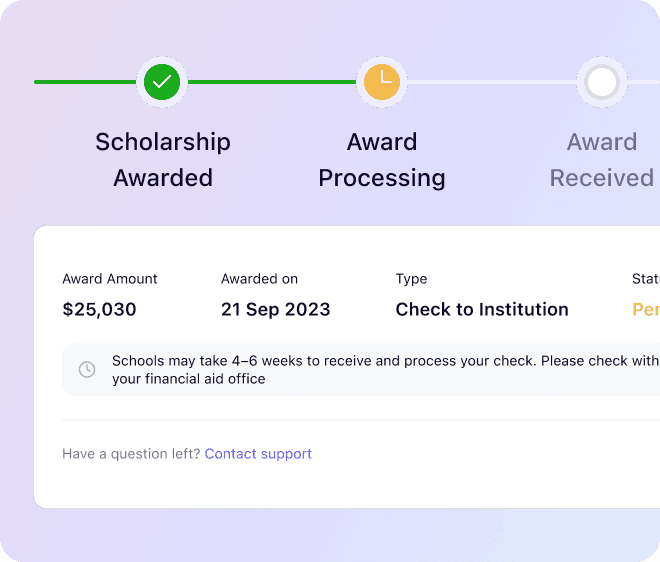
Scholarship dollars are disbursed through Bold.org to help students pay for school.
FAQ
When is the scholarship application deadline?
The application deadline is Nov 5, 2026. Winners will be announced on Dec 5, 2026.
How will scholarship application information be used?
Your privacy is a top priority on the Bold.org platform, and you can find our privacy policy in full here. You may opt out of communications from Bold.org at any time, and unless we’ve first notified you and gotten your consent, you’ll never receive communication from any third parties related to personal information you give us.
What is the scholarship award?
Award amounts per winner are designated by the donor. Check the award amount for a detailed breakdown.
When will the scholarship winner be chosen? How will they be notified?
The winner will be publicly announced on Dec 5, 2026. Prior to the announcement date, we may contact finalists with additional questions about their application. We will work with donors to review all applications according to the scholarship criteria. Winners will be chosen based on the merit of their application.
How will the scholarship award be paid?
Award checks will be sent to the financial aid office of the winner's academic institution or future academic institution in their name to be applied to their tuition, and in the name of their institution (depending on the school's requirements). If the award is for a qualified educational non-tuition expense, we will work with the winner directly to distribute the award and make sure it goes towards qualified expenses.
How will my scholarship application be verified?
Before we award the scholarship, the winner will be required to confirm their academic enrollment status. Depending on the circumstances, verification of Student ID and/or their most recent transcript will be required.
How should I get in touch with questions?
If you have any questions about this scholarship or the Bold.org platform, just email contact@bold.org and we’ll get back to you as quickly as we can.
Does the scholarship have terms and conditions?
Yes. The terms and conditions for this scholarship can be found here.