First-generation college students often do not have the money or resources to realize their full potential impact, and firstborn first-generation students have it that much more difficult.
The first child in a first-generation migrant household usually experiences a unique childhood filled with many trials and errors, experiments, changes, risks, and a lack of resources within their family. These tribulations can affect students in the educational and social realms of their lives quite detrimentally.
The First-Generation, First Child Scholarship will assist first-generation firstborn students at all levels of education in any field of study to achieve their academic ambitions.
To apply, please write about how your experience as the firstborn first-generation child has shaped you into who you are today.
How has your experience as a first-generation, firstborn child been growing up? What makes this specific combination unique to you and how has it affected you in school, mentally, physically, all aspects of life?
I came from a poor family that lived in small towns outside of the big city in Vietnam. My mother was a seamstress, my father an architect who struggled to find jobs when there were not many opportunities around in our small town. When I turned four, my father died from a heart disease that had been building up inside his body as a result of sleepless working nights and poor dietary habits. This sudden loss left a void my mother cannot fill. It also created a financial burden on our family and forced my mother, who just gave birth to my brother, to work days and nights to put food on our table and to take care of our new family member. At a very young age, I learned to take responsibility for my family and myself. Since my mother was always busy with her work and my newborn brother, I had to adapt myself to doing everything alone. While my peers received much help with homework from their parents, I would find myself struggling with questions in the middle of the night until I became too exhausted and fell to sleep. Gradually, I developed a sense of independence and solely focused on doing my tasks by myself without seeking help. To fill the void left by my father on my little brother, I learned to adapt the image of a good role model by teaching my brother proper manners and guiding him in his academics so that he can do well. Being the firstborn child of a family of three imposed immense challenges on me, yet it was the only thing that stimulated my motivation and drove my decisions as I would seek a better life for my family. Even though my mother was the only provider and caregiver for both of us, I always knew that I had to acknowledge my responsibilities and become someone who could protect my small family.
When I was twelve, my mother was married to a man who she met and fell in love with. Together, we decided to migrate to the United States of America to live with our step-father, leaving the place where I call my first home to seek a new life that awaits us in a new country. My mother barely knew English, so I became her translator for medical appointments and in every single interaction with English speakers even though English was also something new to me. Even until now, I still translate for her and I teach my mother conversational English. Sometimes, lacking sufficient proficiency in the English language in daily conversation with native speakers would cast me to the island of self-insecurity and isolation. My fear of interacting with English speakers consumed my mind and brought me back from exposing my true self to the world. Eventually, I realized that the seed of social fear which roots shackled my life needed to be uprooted. I had to conquer my fear of people and learn how to connect and trust them. I started to get out of my comfort zone by forcing myself to raise my hand often in classes. Gradually, I began enjoying class discussions and many activities with my peers. My English skills significantly improved, and my self-confidence soared throughout my class discussion as well as my daily interactions with other people. With my newfound confidence, I soon won my teachers’ heart and received much selfless assistance from everybody, seeing myself exceed both academically and socially at school. I learned to take everything I do seriously and to put in all my effort to complete tasks such as becoming the leader of my school’s publishing club in my sophomore year and Key Club in my junior year. Along the way, I would come into contact with peers whose backgrounds moved me with stories of being born as the first child of a family with three or even four children. Like me, they struggled greatly with English and had to find ways to support their families with financial insecurities. Yet, the way they embraced their life challenges with unmovable determination and motivation would always remind me of my situation and the duty to protect my loved ones.
My years of living without a father have taught me nothing but lessons of resilience and self-belief. Now working part-time to support my family financially and to help pay for my college in the future, I can look forward to fulfilling my potentials and finally realizing my cherished dream for my family. I can imagine stepping onto a U.S college campus as a first-generation student and pursuing a major in neuroscience while discovering the abundant opportunities to give back to the community. I want to become a leader who could lead the long, arduous fight for free health care policies and involve in many impactful decisions that can ultimately improve the quality of life for everyone. I want to be the head of a community organization that combines philanthropic efforts in medicine to deliver health education and care to minority groups all over the city I live in. Personally, I do not see this scholarship as financial aid to earn a lucrative degree for a better life. Rather, I see it as an honor and a responsibility because it means someone has faith in me—that I could eventually become a person who can help better our society no matter how small. It would mean someone is giving me a chance to earn a degree that allows me to help my community beyond the facility. It would mean my chance to become a person who can help stop the blood from bleeding, to help other people from becoming too harmed and damaged before they even have the chance to grow and thrive, like me.
Explore All Kinds of Scholarships for All Kinds of Students
The application deadline is Apr 4, 2021. Winners will be announced on May 1, 2021.
How will scholarship application information be used?
Your privacy is a top priority on the Bold.org platform, and you can find our privacy policy in full here. You may opt out of communications from Bold.org at any time, and unless we’ve first notified you and gotten your consent, you’ll never receive communication from any third parties related to personal information you give us.
What is the scholarship award?
Award amounts per winner are designated by the donor. Check the award amount for a detailed breakdown.
When will the scholarship winner be chosen? How will they be notified?
The winner will be publicly announced on May 1, 2021. Prior to the announcement date, we may contact finalists with additional questions about their application. We will work with donors to review all applications according to the scholarship criteria. Winners will be chosen based on the merit of their application.
How will the scholarship award be paid?
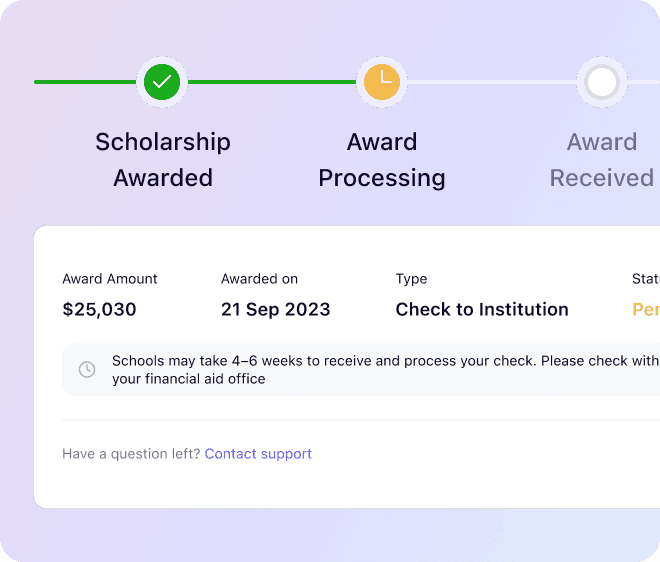
Award checks will be sent to the financial aid office of the winner's academic institution or future academic institution in their name to be applied to their tuition, and in the name of their institution (depending on the school's requirements). If the award is for a qualified educational non-tuition expense, we will work with the winner directly to distribute the award and make sure it goes towards qualified expenses.
How will my scholarship application be verified?
Before we award the scholarship, the winner will be required to confirm their academic enrollment status. Depending on the circumstances, verification of Student ID and/or their most recent transcript will be required.
How should I get in touch with questions?
If you have any questions about this scholarship or the Bold.org platform, just email contact@bold.org and we’ll get back to you as quickly as we can.
Does the scholarship have terms and conditions?
Yes. The terms and conditions for this scholarship can be found here.
97% of students don't win scholarships. We’re here to change that.