This scholarship was established by the De Los Santos family, a group of first-generation Filipino-American cousins born and raised in the San Francisco Bay Area. They are bound by their love of family, appreciation for their heritage and culture, gratitude for the blessings and opportunities afforded to them, and their desire to give back to the communities around them. Education serves as a means to broaden understanding and to open up opportunities for advancement.
Minority students in America often face many challenges throughout their educational journeys that can be discouraging or difficult to push through.
This scholarship seeks to support Filipino-American students who share the same values and connection to their heritage and who demonstrate diligence, determination, and a drive to contribute positively to their communities.
Any Filipino-American high school senior who has at least a 3.0 GPA and will graduate in 2026 may apply for this scholarship opportunity.
To apply, tell us about the most significant challenge you’ve faced, how you overcame it, and how this experience affected your academic achievement. Additionally, tell us how your Filipino-American identity has impacted your sense of purpose in life.
Selection Criteria:
Ambition, Drive, Determination
Essay Topic Requirements
1. Describe the most significant challenge you have faced and the steps you have taken to overcome this challenge. How has this challenge affected your academic achievement?
2. We are first-generation Filipino-Americans born and raised in the San Francisco Bay Area. Our heritage and culture and our surrounding environment in the Bay Area have been central influences in our lives. How has your Filipino-American identity influenced your purpose in life?
400–600 words
$4,000
4 winners, $1,000 each
Awarded
Application Deadline
Jun 10, 2026
Winners Announced
Jul 11, 2026
Education Level
High School
3
Contributions
Share
Explore All Kinds of Scholarships for All Kinds of Students
1. Imagine getting the flu, and it never going away. That's what it's like living with Postural Orthostatic Tachycardia Syndrome (POTS) and Myalgic Encephalomyelitis/Chronic Fatigue Syndrome (ME/CFS). Plagued with constant—and often debilitating—fatigue, brain fog, and muscle pain, my life came to a halt.
I developed both illnesses the summer before junior year. I nearly had to quit my lifeguarding and coaching job and could no longer keep up with swim training. Once school started, even getting through the day left me too exhausted for homework. For over a year, I had no diagnosis. Every doctor ran blood tests and insisted "nothing was wrong." Bouncing from specialist to specialist left me feeling gaslit, not realizing my symptoms didn't fit neatly into any one specialty.
After a year of getting sicker with no answers, I contacted the Mayo Clinic. My mom and I flew to Minnesota for two packed days of nonstop testing, leaving with diagnoses of POTS and ME/CFS—only to realize I'd traded one mystery for another. Both illnesses were neglected in research for decades, leaving few treatment options.
With no magic fix, I learned to advocate for myself: 504 accommodations, working closely with teachers, and collaborating with my coach on a training plan that fit my limits.
Most of all, I learned to trust my body. After a year of dismissal, I doubted whether my symptoms were even real. My Mayo Clinic doctor made me feel believed—and that validation helped me rebuild trust in myself, regain stability I never thought possible, and commit to listening deeply to others whose struggles aren't visible. It inspired my goal of becoming a doctor who, like my Mayo physician, changes the lives of those who have fallen through the cracks.
2. The smell of garlic sizzling in oil was a constant in my Lola's kitchen. In our home, food was never just food—it was how she loved us. My mom carried the same instinct, showing up for people with quiet steadiness: driving relatives to appointments, always knowing who needed something before they asked. Growing up in the Bay Area as a first-generation Filipino-American, I was raised by women who taught me that care arrives quietly—another serving slipped onto your plate, a soft kumain ka na ba?—everyone else nourished before they sat down themselves.
Those rituals were never just habits. They were acts of preservation. Filipino culture survived centuries of colonization and yet something essential endured—not through monuments, but through the everyday: recipes passed down without being written, values carried quietly across generations and oceans. Resistance doesn't have to be loud. Sometimes it looks like refusing to let go of who you are. Sometimes it looks like feeding your family.
When I developed chronic illness, I learned firsthand how easily patients can be dismissed—and I recognized something familiar in that feeling. My mom responded the way her mother had responded to every hardship: with persistence and an unshakeable refusal to give up. Those hard years clarified what I already knew I wanted to do.
This fall, I'll study molecular and cellular biology at UC San Diego on the pre-med track, with the goal of becoming a physician-scientist focused on under-recognized illnesses that disproportionately affect women. I know what it means to fight to be believed, and I intend to carry that fight into medicine.
My Lola and my mom never called what they did caregiving. They just showed up, carrying forward something much older than themselves—a tradition of resilience that survived colonization, immigration, and everything in between. Healing is an act of community, compassion, and resistance. My Lola taught me that. So did my people.
1. After over 2000 hours as a Kumon tutor, I learned to find another approach when one fails. Every obstacle became a chance to improve my teaching.
Out of the twenty students I tutor weekly, four-year-old JJ challenged me the most because my teaching approach wasn't effective. He often cried for his mom and refused to touch his work. I observed how my coworkers adjusted their tone and teaching approaches for each student, and
I even enrolled in a child development class to understand how children think and learn at different stages of life. I revised my strategy so I would be prepared for JJ to come in next class.
In the following week, I drew a ladybug next to JJ’s papers. Knowing he liked bugs, I used his interest to distract him from crying with excitement. I promised to draw new insects for each worksheet he finished, and he eagerly completed every page while I drew beetles.
I saw how supporting JJ required me to be flexible. Helping JJ succeed showed me how patience and flexibility can make a difference, as failure pushed me to find a new way forward. Learning to empathize with children allowed me to support them.
2. To love as a Filipino is to love with actions. It was my first time visiting the Philippines. The rain poured down as we returned from a stroll in Baguio City’s local park, and despite his struggling joints, Lolo Bernie held my hands, “Dapat palaging mainit yung mga kamay mo.” Your hands should always stay warm. I looked at the sincerity in his gentle eyes and smiled, “Opo,” not realizing that his small gesture would stick with me even after my trip. Despite the years of distance and the language barrier, I felt so connected to my roots.
Growing up in America sometimes made me feel alienated from my culture, but Lolo Bernie helped me embody a Filipino’s attentive care. Hospitality and acts of service have become my natural instinct. When Lolo noticed my cold hands, he didn’t just give me warmth; he showed me that caring for others meant paying attention to the smallest details. Filipino culture is not expressed through grand gestures, but with small acts of hospitality and service.
I strive to be the kind of person who advocates for others. I aspire to be a pediatrician because children, like I was that day, depend on caring adults to support them.
My academic goal is to attend medical school so I can provide care to diverse communities, hoping to create exam rooms that feel less intimidating and more like safe spaces.
Growing up experiencing two cultures has taught me how healthcare can be a scary space for people who face language barriers. I hope to create safe spaces where families will feel cared for and understood.
The warmth my Lolo offered me that rainy day shaped my understanding of love and responsibility. My Filipino heritage shaped my dream of caring for others with the same quiet devotion he showed me.
I carry this devotion with me in all of my high school jobs. As a Kumon tutor, I ensure my students feel supported and make the classroom a fun experience that encourages learning. During my time as an activity assistant at a rehabilitation center, I spent every Saturday caring for elderly residents. I observed their needs and offered companionship through small acts such as making them coffee or braiding their hair. I took leadership in clubs like community service, UNICEF, and Clothes for Kids, where I fostered my passion for working and advocating for children.
1. Most significant challenge and its impact on academics
The most significant challenge I have faced in my life has been dealing with major family hardships at a young age. When I was in second grade, my mom passed away after battling ovarian cancer for several years. During that time, she was unable to work, and my dad took on the full responsibility of caring for our family while also supporting her through her illness. After she passed, he became a single parent raising my older sister and me while managing financial and emotional responsibilities on his own.
Later in my freshman year of high school, my dad suffered a stroke that kept him out of work for several months. During this time, I had to grow up quickly and take on more responsibility at home while also staying committed to my academics and athletics. There were moments where balancing everything felt overwhelming, but I learned how to stay disciplined, manage my time, and keep moving forward even when circumstances were difficult.
This challenge affected my academic life by forcing me to develop structure and accountability earlier than most students. I had to learn how to stay organized, complete assignments independently, and remain focused even when my home life was uncertain. While it was not easy, it ultimately helped me become a more responsible and resilient student who understands the importance of consistency and effort.
2. Filipino-American identity and purpose in life
My Filipino-American identity has deeply shaped my values, purpose, and the way I view my future. Growing up in the Bay Area in a Filipino household, I was surrounded by a culture that emphasizes family, respect, humility, and hard work. However, one of the most influential parts of my identity comes from my grandfather’s story.
My grandfather made an incredible sacrifice by coming to the United States and serving in the U.S. Navy. His goal was not only to build a better life for himself, but to create opportunities for his family to come to the United States through his citizenship. His decision required courage, discipline, and selflessness, and it laid the foundation for the opportunities my family has today. Knowing this history makes me more aware that I am part of something bigger than myself.
His sacrifice has shaped the way I approach my own life. It reminds me that the opportunities I have in education, athletics, and leadership were earned through the sacrifices of those before me. Because of that, I feel a strong responsibility to work hard and take advantage of every opportunity I am given. Whether it is in school, soccer, ASB, or my community, I try to carry myself in a way that honors my family’s journey.
Being Filipino-American also connects me to a strong sense of community and resilience. I have seen how my family values supporting one another and staying grounded through challenges. That mindset has influenced my own purpose in life: to grow into someone who leads with discipline, gives back to others, and represents my family and culture with pride.
Overall, my Filipino-American identity is not just a background detail in my life. It is a driving force that reminds me of where I come from, the sacrifices made for me, and the responsibility I have to build on that foundation in everything I do.
1. I used to believe I was invincible, dismissing suggestions to get my ankle taped or wear a knee brace whenever I played basketball. This ignorant mentality abruptly confronted me with the lasting impacts of the medical field. Surprisingly, it was this experience that inspired me to further study rehabilitation and injury prevention.
Despite the number of times I have slipped and fallen in each basketball game I played, my drive to win overpowered any injury I sustained. One day, however, amid a pre-season game, I landed wrong and tore my posterior cruciate ligament. I refused surgery, believing artificially altering my knee would change the way I performed forever. I continued to play and after another year of recklessness, it re-tore. Despite my previous objections, my orthopedic surgeon and coaches convinced me to get my knee operated on.
What I had previously believed was impossible had been achieved through science.
It has been a year since surgically reconstructing my PCL, and I am recovering swiftly. What interests me most about the medical field is its ability to prevent and cure illnesses through innovation. I began a medical science club at my school to educate more on how these innovations, like suturing and surgery, work and their real-life applications. Over the summer at medical science camp, I taught younger students and helped them create their innovations like prosthetic arms. My experiences in the Project Lead The Way biomedical program extended my knowledge of the diversity of healthcare. From assessing patients to designing nanomedicines combating osteoporosis, the program ignited a desire to further my education in biomedical sciences. Moreover, mentoring the youth inspired me to pursue pediatrics in the future. There are thousands of young people like me who believe they are invincible. My dream is to be there for them for every slip and fall they encounter.
2. When I was little, food was a gateway to my Filipino heritage. It was difficult for me to grasp traditions and customs, but the rituals and flavors that came with meals helped me comprehend. I shared meals as a method of communicating and connecting to my culture. I stopped worrying about being unable to hold a conversation in Tagalog because the love from family dinners was universal.
I began baking during the pandemic to cope with the isolation and lack of family gatherings, but soon, baking turned into an obsession. As I followed recipes, I realized how unfamiliar they tasted compared to what I had before; they lacked the vibrant tastes I was accustomed to. I began combining components of Filipino desserts to American recipes, adding halaya to vanilla cupcakes and incorporating pandan extract to snickerdoodles. I continued changing common recipes, and soon they began to taste familiar. My love for baking was no longer just about taste, but about finding my identity as a Filipino-American, paying homage to my childhood.
I continued to bake. My sophomore year, I sold a hundred ube cupcakes at the Homecoming game to raise money for my class. I began baking for family gatherings, and seeing the dishes I once worshiped at the table only fueled my passion. Over the summer, I began to sell my Filipino-American desserts as part of an initiative called the Cafe Care Project. With the money I earn as I continue to bake and sell, I plan to donate 30% of the proceeds to St. Jude’s Children’s Research Hospital to benefit others the way food has helped me. My passion for baking has allowed me to connect with my culture, and I am blessed to help others do the same.
In my sophomore year, my family faced eviction. I remember my parents’ quiet panic as they tried to figure out what to do next. As a teenager, I was used to relying on them for stability. But in that moment, they needed me to be strong too. We packed up our lives in a few days and began moving from place to place, staying with relatives and friends until we could find something more permanent.
The instability affected everything. I missed classes, fell behind on assignments, and struggled to concentrate. My grades dropped for the first time in my life. I felt overwhelmed and ashamed. Not only was I falling apart academically, but I also felt like I was letting my family down. I stopped asking for help and tried to handle everything on my own, which only made things worse. Every day felt like a balancing act between keeping it together emotionally and trying to catch up academically.
Eventually, I realized that staying silent was not the same as being strong. I reached out to my teachers and counselors, explained my situation, and asked for support. They responded with kindness and flexibility, giving me extensions, checking in with me, and reminding me that I was not alone. I built a schedule, set small goals, and slowly started regaining control. I learned how to manage my time more efficiently and prioritize what mattered. By junior year, I had earned back my credits and finished with a 4.0 GPA. That challenge taught me resilience, not just in surviving hardship, but in asking for help, rebuilding from failure, and believing in my ability to grow.
As a first-generation Filipino-American born and raised in the Bay Area, my identity has shaped the way I see the world and my place in it. I grew up in a multigenerational household where we shared meals, told stories, and held tightly to our values. My parents and grandparents taught me about the importance of humility, family, and hard work. At the same time, growing up in such a diverse and progressive community opened my eyes to new ideas and perspectives. It helped me understand that my culture is not a barrier but a foundation.
Being Filipino-American means understanding sacrifice and valuing community. My family's journey motivates me to succeed not only for myself but for them. I hope to become a psychologist serving low-income, immigrant families, especially youth facing challenges like the ones I overcame. I want to be the support I once needed.
1. The summer after my sophomore year, I was selected to conduct a research project in the field of bioinformatics. As a part of the Young Scholars Program at UC Davis, I spent six weeks trying to find answers in an environment where answers were not always concrete or existing. I entered a world in which I knew nothing while having to keep up with students who seemed to know everything. In this program, I was tasked to predict tyrosine sulfation in voltage-gated potassium channels by writing an 18-page long research paper and presenting this research to a symposium filled with professors, graduate student researchers, and my peers. However, in the beginning, I did not know the difference between a potassium channel and a banana. I had not yet taken biology, but I was expected to find information through scientific research papers that were written for people who were experts in their field.
I realized that in order to be successful in this program, I had to take action. I took responsibility for my learning by filling in the gaps in my biology knowledge with videos, research papers, and textbooks in my spare time. I knew that I had to do everything I could to reach my research mentor’s expectations. I improved after each presentation and I expanded my knowledge of voltage-gated potassium channels. After six weeks in the program and over 50 hours spent going back to the lab on weekends to continue my research, I read over 50 published papers, exhausting the academic database.
The Young Scholars Program showed me that a reward (or in my case finding a mutation) is more valuable when I am able to collaborate. My peers created a space where each of us pushed one another to be more curious and more thoughtful, not only in science but in life. This experience taught me to see learning in everything—how to tackle a challenge, how to overcome imposter syndrome, and how to make lifelong friends in six weeks. More importantly, it ignited a renewed enthusiasm within me to seek opportunities for learning in and outside of the classroom.
2. As a part of a Filipino family in the primarily white city of Reno, Nevada, I always wondered why my parents were excited that a new student was Asian, or why my dad came home with $50 for me from my so-called “tita”. We didn’t have any relatives nearby.
Once we moved to the Bay Area and I saw five other Filipinos in my class, I was instantly welcomed into a community I did not have to create or seek. Recognizing the joy this brought me, I created inclusion for others in the same way my classmates did for me. Being Filipino has taught me that with enough effort and courage, strangers become family.
To this day, I continue to extend community to others by leading the Asian Pacific Islander Club at my high school. During potlucks, traditional dance lessons, and games, I see my culture spark excitement and pride, feelings I rarely felt as a young girl. Each meeting, I see my past happiness reciprocated in the faces of people from different backgrounds, heritages, and ages, finding community with people who do and do not look like themselves.
As a person who knows how to seek out and create community, I will continue to help others find the joy of belonging. I now know that it is my responsibility as a Filipino-American, to not only challenge my perspectives but to create environments, where my peers also feel comfortable in expanding their viewpoints.
How it works
Bold.org is Built to Make Scholarships Feel Possible
Step 01
Start with your story
Bold.org helps students show donors who they are beyond a transcript.
Step 02
Where scholarships are awarded
Every scholarship is funded by donors and managed directly on Bold.org.
Step 03
Fund your future
Scholarship dollars are disbursed through Bold.org to help students pay for school.
FAQ
When is the scholarship application deadline?
The application deadline is Jun 10, 2026. Winners will be announced on Jul 11, 2026.
How will scholarship application information be used?
Your privacy is a top priority on the Bold.org platform, and you can find our privacy policy in full here. You may opt out of communications from Bold.org at any time, and unless we’ve first notified you and gotten your consent, you’ll never receive communication from any third parties related to personal information you give us.
What is the scholarship award?
Award amounts per winner are designated by the donor. Check the award amount for a detailed breakdown.
When will the scholarship winner be chosen? How will they be notified?
The winner will be publicly announced on Jul 11, 2026. Prior to the announcement date, we may contact finalists with additional questions about their application. We will work with donors to review all applications according to the scholarship criteria. Winners will be chosen based on the merit of their application.
How will the scholarship award be paid?
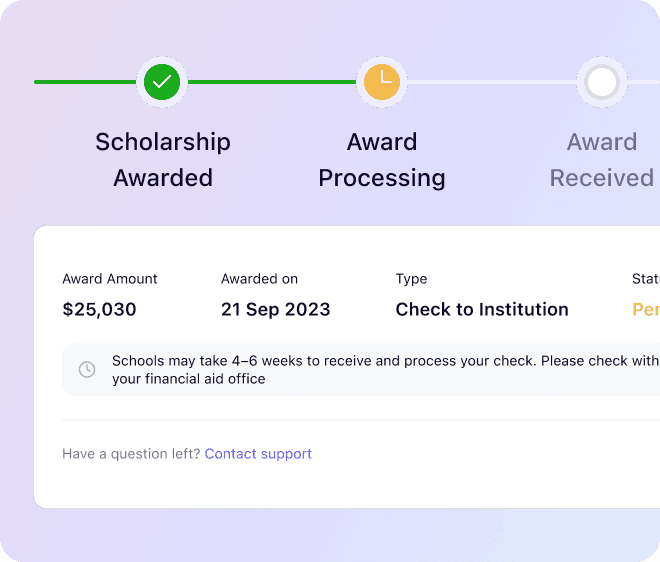
Award checks will be sent to the financial aid office of the winner's academic institution or future academic institution in their name to be applied to their tuition, and in the name of their institution (depending on the school's requirements). If the award is for a qualified educational non-tuition expense, we will work with the winner directly to distribute the award and make sure it goes towards qualified expenses.
How will my scholarship application be verified?
Before we award the scholarship, the winner will be required to confirm their academic enrollment status. Depending on the circumstances, verification of Student ID and/or their most recent transcript will be required.
How should I get in touch with questions?
If you have any questions about this scholarship or the Bold.org platform, just email contact@bold.org and we’ll get back to you as quickly as we can.
Does the scholarship have terms and conditions?
Yes. The terms and conditions for this scholarship can be found here.
97% of students don't win scholarships. We’re here to change that.