Top Scholarships for International Students with Upcoming Deadlines in 2026
Apply below right now to the Best Scholarships for International Students. Exclusive Scholarships found only in Bold.org!
100% Free.

Hines Scholarship
Funded byKristin HinesThis scholarship aims to support underrepresented students who are pursuing higher education so they can overcome the obstacles they face and succeed.- Education Level: High school or undergraduate student
- GPA: 2.0 or higher
- Identity: Minority
$3,000Only 26 days left!One Click Apply1
Pamela Branchini Memorial Scholarship
Funded byDan Branchini, Bruce Ewing, Barbara Bell, and the Glitter Team at Community LutheranThis scholarship seeks to honor the life of Pamela Branchini by supporting students who are pursuing degrees in the fine arts.- Field of Study: Fine arts
$2,000Only 17 days left!One Click Apply2
Edwards Scholarship
Funded byAmera EdwardsThis scholarship seeks to honor the legacy of Michael J. Edwards by supporting international students in their pursuit of higher education in the United States.- Education Level: Undergraduate or graduate student
- Background: First-generation college student
- Status: International student
$600Only 29 days left!One Click Apply3
Hue Ta Asian American Scholarship
Funded byTuan TaThis scholarship seeks to celebrate and empower young leaders who are championing mental health and disability rights within the Asian American community and beyond.- Education Level: Undergraduate student
- Race: Asian American
- Background: Volunteering experience
- Field of Study: Mental health
$1,000Deadline:Dec 07, 2026One Click Apply4
Ann Holiday Memorial Scholarship
Funded byAnwar ArmstrongThis scholarship honors Ann Holiday by supporting undergraduate students at North Carolina A&T State University.- Education Level: Undergraduate student
- School Name: North Carolina A&T State University
$550Deadline:Oct 30, 2027One Click Apply5
Veterans Next Generation Scholarship
Funded byRichard and Stephanie YounkinsThis scholarship supports undergraduate or trade school students who are the children of a U.S. military veteran as they pursue higher education.- Family: Child of a veteran
- Education Level: Undergraduate or trade school student
$1,287Deadline:Dec 13, 2026One Click Apply6
Megan Mills Scholarship
Funded byTracey-Ann HoeltermannThis scholarship aims to support women of Caribbean descent who are first- or second-generation college students pursuing a four-year degree in STEM, pre-medicine, pre-veterinary, or nursing.- Education Level: Four-year undergraduate student
- Heritage: Caribbean descent
- Gender: Female-identifying
- Background: First or second-generation college student
- Field of Study: STEM, nursing, pre-medicine, or pre-veterinary program
- Identity: Underrepresented minority
- Financial Status: From a working-class or limited socioeconomic background
$2,000Only 9 days left!One Click Apply7
HBCU STEM Scholarship
Funded byChrispin RainfordThis scholarship seeks to support students at HBCUs who are first-generation, low-income and have at least a 3.0 GPA and pursuing STEM.- Identity: FGLI (first-generation and low-income)
- GPA: 3.0 or higher
- Field of Study: STEM
- Education Level: Undergraduate
- Current College: HBCU
$10,000Only 9 days left!One Click Apply8
Carlos F. Garcia Muentes Scholarship
Funded byThe Pride Resource NetworkIn honor and memory of Carlos Fredy Garcia Muentes, this scholarship supports undergraduate students from immigrant backgrounds — first- and second-generation immigrants, refugees, and asylum seekers — who have a passion for learning and want to create a better life for themselves, their families, and their communities.- Immigration status: First- or second-generation immigrant, refugee, or asylum seeker
- Legacy status: First-generation college student
$500Only 10 days left!One Click Apply9
Harriett Russell Carr Memorial Scholarship
Funded byFranita PokeThis scholarship aims to honor the legacy of Harriett Russell Carr by supporting female high school, undergraduate, or graduate student who is community service-oriented plans to or is attending an HBCU.- Education Level: High school, undergraduate, or graduate student
- Gender: Female-identifying
- Background: Community service-oriented
- School: Attending or plans to attend HBCU
$1,000Only 10 days left!One Click Apply10
Appily No-Essay Scholarship
Funded byBold.orgThis scholarship is perfect for students interested in college tips and resources.All students are eligible$1,000Only 12 days left!One Click Apply11
WayUp “Unlock Your Potential” Scholarship
Funded byBold.orgKickstart your career with WayUp. Open to undergraduate and graduate students at eligible schools and majors, graduating in 2026 or later.- Education Level: Undergraduate or graduate student graduating in 2026 or later
- School & Major: Limited to students at eligible schools and majors
$1,000Only 12 days left!One Click Apply12
American Dream Scholarship for Nurses
Funded byFVI School of Nursing and TechnologyThe American Dream Scholarship for Nurses aims to support students pursuing their Associates in Nursing at FVI School of Nursing and Technology.- Current School: FVI School of Nursing and Technology
- State: Florida
- Field of Study: Associate's in Nursing
$3,000Only 12 days left!One Click Apply13
400 Bold Points No-Essay Scholarship
Funded byBold.orgThis scholarship will be awarded to the student whose Bold.org profile is the most bold, and who has earned at least 400 Bold Points.All students are eligible$4,000Only 12 days left!One Click Apply14
K-POP Fan No-Essay Scholarship
Funded byBold.orgThis scholarship seeks to support students who have been impacted by the incredible artists and music of K-Pop!All students are eligible$500Only 12 days left!One Click Apply15
$25,000 "Be Bold" No-Essay Scholarship
Funded byBold.orgThe world will be shaped by the bold—the fighters, the risk-takers, the earnest overachievers who won’t take no for an answer. The $25,000 “Be Bold” Scholarship is a no-essay scholarship that will be awarded to the applicant with the boldest profile.All students are eligible$25,000Only 12 days left!One Click Apply16
Cody Cochlin Memorial Scholarship
Funded byJaedan FordThis scholarship aims to honor the life of Cody Cochlin by supporting students who share his love for skateboarding.- Education Level: Undergraduate student
- Financial Status: Low-income
- Athletics: Rollerblading, rollerskating, snowboarding and/or skateboarding
$1,000Only 13 days left!One Click Apply17
José Ventura and Margarita Melendez Mexican-American Scholarship Fund
Funded byBorders FamilyThis scholarship seeks to honor the memory of José Melendez by supporting students who are currently pursuing or looking to begin an undergraduate degree.- Education Level: High school graduate currently pursuing or looking to begin an undergraduate degree
- Identity: Mexican or Mexican-American
- Background: First-generation college student
- Experience: Work or significant volunteer experience
$2,000Only 19 days left!One Click Apply18
MedLuxe Representation Matters Scholarship
Funded byMEDLUXE LLCThis scholarship is designed to support black students dedicated to providing equitable healthcare opportunities for underrepresented minorities and low-income communities across the country.- Ethnicity: Black
- Field of Study: Healthcare-related Major
- Education Level: High school, undergraduate, or graduate student
- Financial Status: Low-income
$500Only 22 days left!One Click Apply19
Ndombe-Carrère International Scholarship
Funded byDan and Colleen Ndombe-CarrèreThis scholarship seeks to support international students who are pursuing higher education in the United States.- Education Level: Undergraduate student
- Background: International student currently studying in the U.S.
- School: Cal Poly Humboldt
$1,500Only 24 days left!One Click Apply20
Eldorado Tools: The Build and Make Scholarship
Funded byEldorado Tools Inc.This scholarship from Eldorado Tools supports undergraduate, graduate, and doctoral students at U.S. institutions pursuing construction- or manufacturing-related fields — such as construction management, civil or mechanical engineering, or supply chain and logistics — who want to make an impact in the field.- Education Level: Undergraduate or graduate student
- Field of Study: Construction or manufacturing
$2,000Only 26 days left!One Click Apply21
Dr. Soronnadi Nnaji Legacy Scholarship
Funded byNnaji FamilyThis scholarship seeks to honor Dr. Soronnadi Nnaji by supporting students who are first or second-generation African immigrants as they pursue higher education.- GPA: 3.0 or higher
- Background: First or second-generation African immigrant
- Education Level: High school senior or undergraduate student
- Major: STEM-related major
$5,000Only 26 days left!One Click Apply22
Sue & Arthur Pawprint Scholarship for Veterinary Medicine
Funded byRachel MurrayThis scholarship honors Sue & Arthur by supporting master's and doctoral students pursuing veterinary medicine-related programs who plan to become veterinarians.- Education Level: Graduate student
- Desired Career Field: Veterinary
$1,000Deadline:Nov 24, 2026One Click Apply23
Sara Molina Memorial Scholarship
Funded byLisandra RichardsonThis scholarship will support a female student of any education level in Puerto Rico.- Education Level: Any
- Location: Puerto Rico
- Gender: Female
$1,000Deadline:Nov 24, 2026One Click Apply24
From Anna & Ava Scholarship
Funded byThe Taylor FamilyThis scholarship aims to honor the life of Anna Sage by supporting students pursuing careers in healthcare, science, or education.- Education Level: Four-year undergraduate student
- State: Pennsylvania
- Field of Study: Healthcare, science, or education
$1,000Deadline:Nov 25, 2026One Click Apply25
Samantha Kolesnik Survivor Justice Scholarship: Fighting Rape by Deception
Funded bySamantha KolesnikThis scholarship aims to support students who are researching, writing, and advocating for the expansion of sexual assault and domestic violence legislation.- Education Level: Undergraduate or graduate student
- Field of Study: Law, women’s studies, gender studies, political science, or sociology
- Background: Committed to researching and advocating for the expansion of sexual assault and domestic violence laws
$1,000Deadline:Nov 30, 2026One Click Apply26
STEAM Generator Scholarship
Funded byFrancis Rei IsraelThis scholarship aims to make college more accessible to students with no family background in higher education so they can have the same opportunities as their peers.- Education Level: Bachelor's or master's degree
- Field of Study: STEAM
- Background: First or second-generation immigrant or other underrepresented minority
$3,165Deadline:Nov 30, 2026One Click Apply27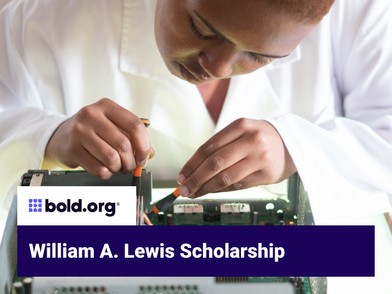
William A. Lewis Scholarship
Funded byEdwards_Lewis FamilyThis scholarship aims to honor the legacy of William A. Lewis by supporting underrepresented students interested in pursuing careers in mathematics or other STEM fields.- Education Level: Undergraduate or graduate student
- School Type: Historically Black College or University (HBCU)
- Race: BIPOC
- Field of Study: STEM
$2,000Deadline:Nov 30, 2026One Click Apply28
It Takes A Village “Bayanihan” Scholarship
Funded byTinidor FoodsThis scholarship supports Filipino immigrant students (from high school through graduate school) as they pursue their education.- Education Level: High school, undergraduate, or graduate student
- Background: Immigrated from the Philippines
$1,000Deadline:Dec 04, 2026One Click Apply29
Velazquez Social Sciences Scholarship
Funded byJorge VelazquezThis scholarship supports Puerto Rican heritage, first-generation-college-bound high school seniors pursuing a two- or four-year degree in social work, psychology, sociology, political science, international relations, or criminal justice.- Background: First-generation college student
- Heritage: At least one parent of Puerto Rican descent
- Education Level: High school senior
- Field of Study: Social work, psychology, sociology, political science, international relations, or criminal justice
$1,100Deadline:Dec 06, 2026One Click Apply30


How it works
Bold.org is Built to Make Scholarships Feel Possible
Step 01
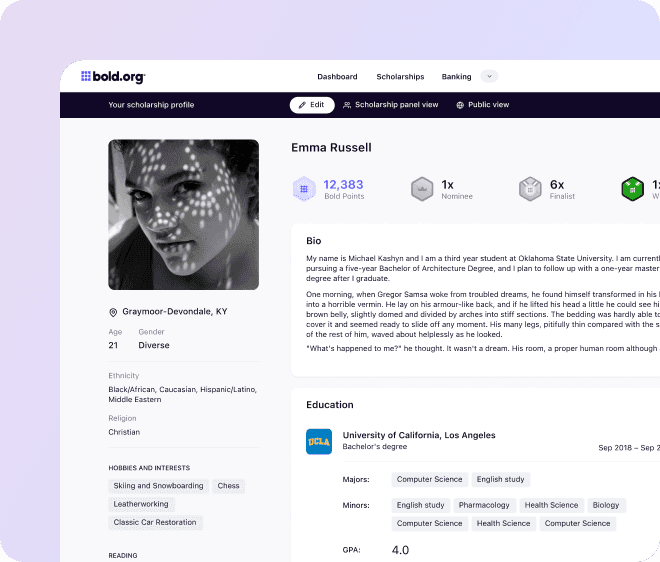
Start with your story
Bold.org helps students show donors who they are beyond a transcript.
Step 02
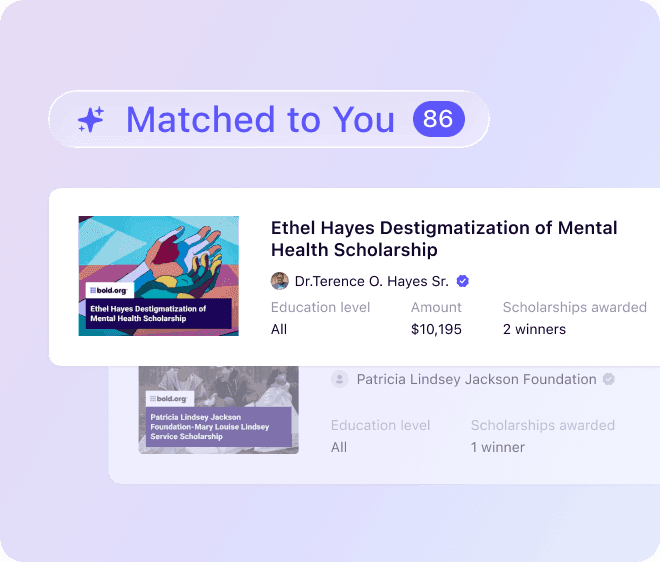
Where scholarships are awarded
Every scholarship is funded by donors and managed directly on Bold.org.
Step 03
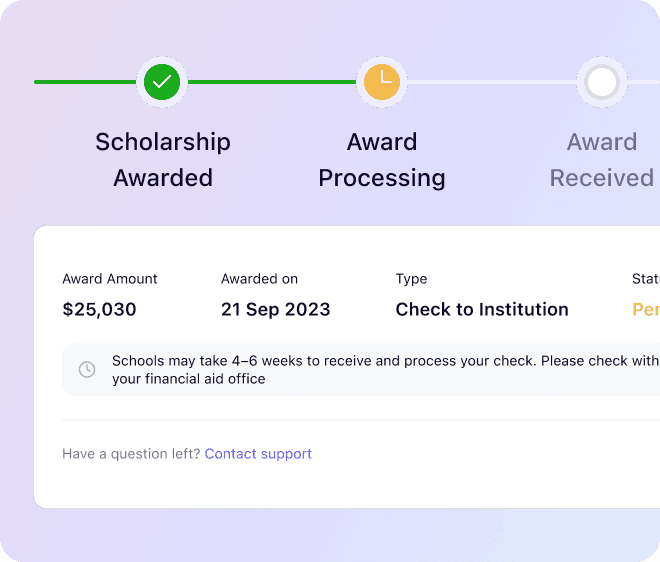
Fund your future
Scholarship dollars are disbursed through Bold.org to help students pay for school.
Scholarships for International Students: Who Wins, What They Earn, and How to Build a Funding Strategy
International students in the United States face a funding gap that no other group shares. Bold.org data shows the average tuition cost for international scholarship seekers is $24,561 per year. The average aid they get is $12,343 — leaving a gap of more than $12,000 annually (methodology). These students cannot tap federal Pell Grants, Direct Subsidized Loans, or Federal Work-Study. The Congressional Research Service reports that federal student aid tops $112 billion per year. International students are shut out of all of it.
The Institute of International Education (IIE) reports about 1.13 million international students enrolled in U.S. schools during the latest academic year. NAFSA puts their economic contribution at $43.8 billion. Among those seeking scholarships for international students on the platform, 99.9% expect to take on extra loans. That number alone shows why private scholarships matter so much for this group.
This article draws on Bold.org's analysis of scholarship awards to international students — covering winner profiles, GPA trends, career goals, and award amounts — plus EducationUSA advisories and benchmarks from IIE and the College Board. The goal is a data-backed plan for finding and winning scholarships for international students.
How International Students Actually Fund Their Education
The way international scholarship seekers pay for school looks nothing like the domestic model. Bold.org data reveals a three-part funding split (methodology):
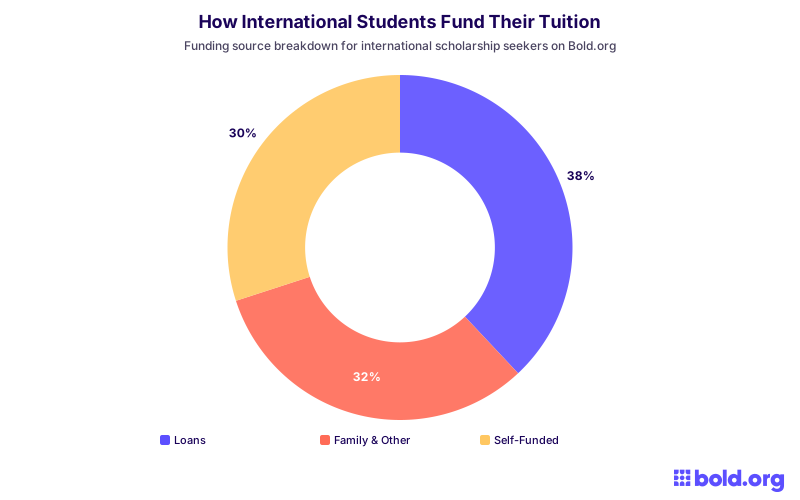
- Loans: 38% of tuition costs ($14,343 on average), per platform data
- Family and other sources: 32% ($11,950 on average)
- Self-funded savings: 30% ($11,500 on average)
What stands out is what's missing. Domestic students lean on federal grants and subsidized loans with low interest rates. International students get none of that. The 38% in loans comes from private lenders — often at higher rates, often needing a U.S. cosigner, and without income-driven repayment.
The College Board's Trends in College Pricing adds context. Out-of-state tuition at public four-year schools runs about $29,000 per year. Private nonprofit schools average around $42,000. Community colleges charge about $9,000 for out-of-state students. Against those numbers, the $12,343 in average aid covers roughly half of public school costs — and less than a third at private schools.
Every scholarship dollar replaces money that would come from savings, family help, or high-rate private loans. A $1,000 award is not symbolic — it is $1,000 less in debt. Pairing no-essay scholarships and easy-to-apply scholarships with larger competitive awards is the smartest way to close the gap.
The self-funded share (30%) says something about this group. These students are already stretching personal and family money to be here. For most, scholarships for international students are not a nice bonus on top of other aid. They are the difference between staying enrolled and going home. Every award — even a small one — shifts that balance.
Understanding where the money comes from, where it falls short, and what winning applicants look like is the first step toward a real funding plan. The sections below break down each of those questions using proprietary platform data and industry benchmarks from IIE, the College Board, and EducationUSA.
What Scholarship Awards Look Like: Amounts and Distribution
What do international students actually get when they win? Platform data paints a clear picture (methodology):
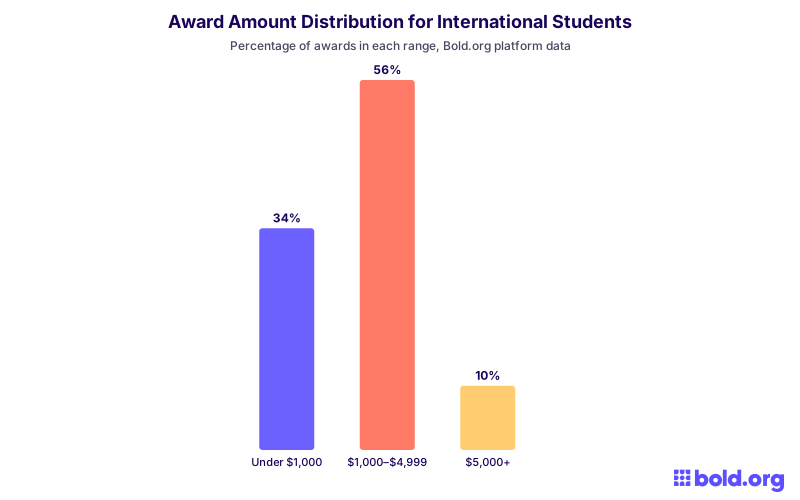
According to Bold.org data, the average award is $1,764 and the median is $1,000. The biggest group — 56.4% — lands in the $1,000–$4,999 range. About a third (33.8%) come in under $1,000, and 9.8% top $5,000.
Half of all awards are $1,000 or less. The average gets pulled up by the 9.8% above $5,000, which include multi-year and larger school-based awards. For your planning, the median is the better number to use.
This data shifts how you should think about scholarships for international students. Going after one big $10,000 award is a long shot. Winning three to five awards in the $1,000–$3,000 range is a steadier path. Four median-level wins total $4,000 — enough for textbooks, a housing deposit, or months of living costs.
The $1,000–$4,999 bracket holds more than half of all awards. This is the sweet spot where the most money flows. Students who focus here — rather than only chasing top-dollar awards — build a real funding base. The scholarships on this page span the full range, from essay-based awards to quick formats that take minutes to complete.
Who Wins Scholarships for International Students
Bold.org's winner data gives the clearest picture available of what scholarship recipients look like (methodology). The findings push back on several common assumptions about who earns funding.
GPA: The Gap Is Smaller Than You Think
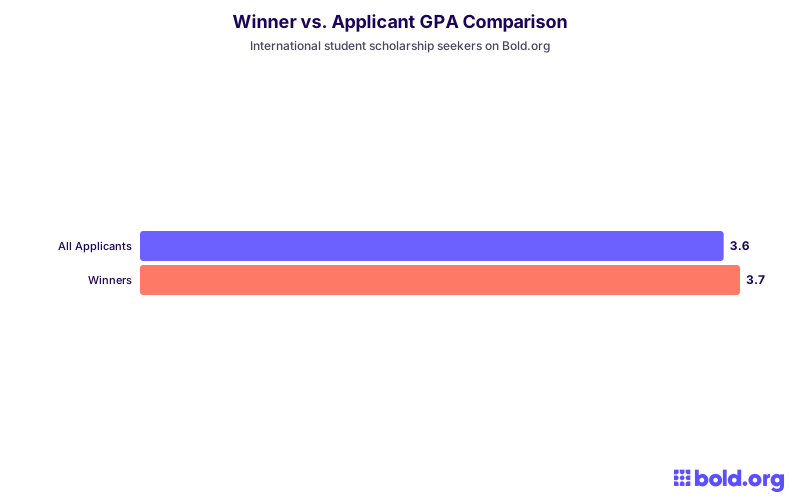
According to platform data, winners average a GPA of 3.67. All applicants average 3.57 — a gap of just 0.1 points. This is one of the most telling numbers in the analysis. The academic gap between winners and the rest of the pool is small. GPA counts, but it is not the main factor. Essay strength, shown need, and personal story carry real weight in award decisions.
If your GPA is in the 3.0–3.5 range, take heart. The winner average of 3.67 is not a cutoff — it is a midpoint. Many winners sit below it. Many applicants above it do not win. The data shows that scholarships for international students are not GPA contests.
Demographics: First-Generation and Low-Income Students Win at High Rates
According to Bold.org data, the winner profile shows who these scholarships reach:
- 62.3% of winners come from low-income households
- 46.2% are first-generation college students
- 69.7% are female, 28.1% male, 2.2% other or not stated
The high share of first-generation and low-income winners shows that review panels weigh need and family education history alongside grades. If you are the first in your family to go to college, that is a strength in your application — not a gap.
The gender split — nearly 70% female — tracks with broader trends on the platform. Women in STEM scholarships and women-focused awards make up a large share of funding for scholarships for international students. Female applicants are winning at strong rates, which reflects both higher application volume and competitive profiles.
Career Goals: What Winners Want to Do
Bold.org data on the career goals of scholarship winners shows a clear cluster in service and healthcare fields:
| Career Goal | Share of Winners |
|---|---|
| Hospital & Health Care | 20% |
| Medicine | 17% |
| Education | 12% |
| Mental Health Care | 11% |
| Law Practice | 9% |
| Medical Practice | 7% |
| Arts | 7% |
| Computer Software | 7% |
| Music | 5% |
| Engineering | 5% |
According to this data, healthcare and medicine make up 44% of winner goals. Add education (12%) and mental health (11%), and two-thirds of winners aim for service careers. This pattern reflects a match between donor missions and applicants who can show plans to serve their communities — both in the U.S. and in their home countries.
For STEM and tech applicants: the 7% for computer software and 5% for engineering reflect the career mix of winners, not lower odds. Students in technical fields can stand out by linking their goals to community impact. Computer science scholarships and engineering awards serve these applicants directly.
The Application Funnel: How International Students Move from Applicant to Winner
Bold.org's three-tier scholarship review process shows the full path from applicant to finalist to winner — a view no other scholarship resource can provide. Among international students, 37,421 applications reached finalist status (the top fraction of all submissions). Of those, 7,816 received awards — a 20.9% conversion rate from finalist to winner (methodology).
The GPA data at each stage tells the most critical story: finalist average GPA is 3.66, and winner average GPA is 3.67 — a gap of 0.01 points. That's not a rounding error; it's a signal. Once you reach finalist status, grades are no longer the deciding factor. Something else is.
What shifts between finalist and winner
The demographic data reveals what selection committees actually favor at the final stage:
- Low-income students represent 57.2% of finalists but 62.3% of winners — a 5.1-point lift, the largest demographic shift in the funnel. Financial need carries substantial weight in final decisions for scholarships for international students.
- First-generation students make up 43% of finalists but 46.2% of winners — a 3.2-point lift. Being the first in your family to attend college is an advantage at the winner stage.
- Female representation moves from 71.7% of finalists to 69.7% of winners — a 2-point decline, suggesting that male applicants who reach finalist status tend to have especially strong final applications.
What the funnel means for international applicants
The 0.01-point GPA gap between finalists and winners is the most actionable insight in this analysis. It means the final selection is driven almost entirely by essay quality, personal narrative, and demonstrated need — not academic metrics. International students often worry their GPA from a different grading system will disadvantage them. The data suggests the opposite: once you're in the finalist pool, your grades have already done their work. What happens next depends on how you tell your story.
The 5.1-point lift for low-income students at the winner stage is particularly meaningful for international applicants. Without access to federal aid, financial need is often more acute — and selection committees are responding to that reality.
Academic Profile: GPAs Across the Applicant Pool
Bold.org data on the GPA spread among international student scholarship seekers gives a useful self-check (methodology):
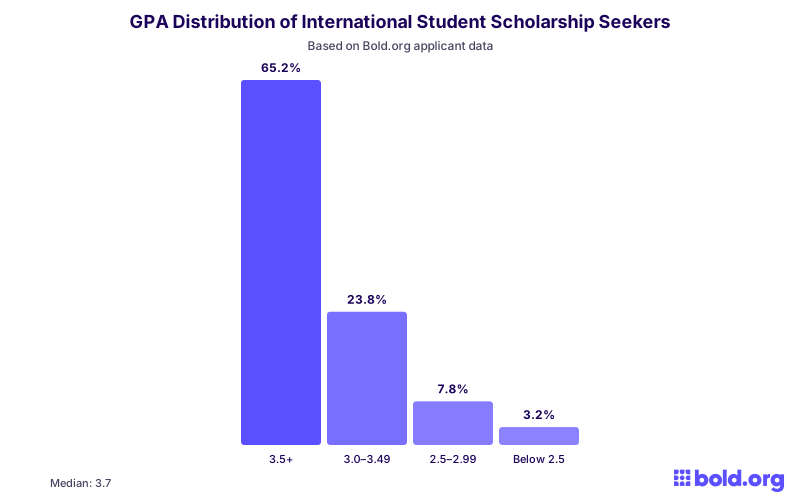
According to the data, 65.2% have GPAs of 3.5 or above. Another 23.8% fall in the 3.0–3.49 range. The 2.5–2.99 bracket holds 7.8%, and 3.2% report GPAs below 2.5.
The median GPA is 3.6. The mean is 3.52. The 25th percentile sits at 3.2 and the 75th at 3.9. These numbers mean the pool skews strong — but they also show that you do not need a perfect GPA to seek or win funding.
Over a third of seekers (34.8%) have GPAs below 3.5. Many awards on this page set no GPA floor. Awards that weigh need, community work, or essay quality alongside grades are open to students at every level. A 3.2 GPA with a strong personal statement and clear need makes a solid profile for many scholarships for international students on the platform.
Where International Scholarship Seekers Study
Bold.org data shows where international student scholarship seekers are based across the United States (methodology):
According to the data, Texas (11.7%) and California (11.1%) together hold nearly a quarter of all seekers. Florida (6.7%), New York (5.3%), and Georgia (3.9%) round out the top five. Illinois, Pennsylvania, Ohio, North Carolina, and New Jersey each hold between 2.9% and 3.9%. This matches IIE data showing California, New York, and Texas host the most international students nationally.
Top schools among seekers include a mix of large campuses and online programs. According to platform data, Grand Canyon University and Southern New Hampshire University (Online) lead at 0.3% each. Liberty University and Western Governors University follow at 0.2%. University of Central Florida and Florida International University — one of the largest international student hosts in the country — each sit at 0.2%. Texas A&M and Arizona State University Online round out the top at 0.1%.
The strong online program presence (SNHU, WGU, ASU Online) among seekers suggests many international students pursue flexible education while managing work, family, or visa rules. Traditional enrollment data from IIE does not capture this pattern — it is unique to the platform's view of the scholarship-seeking population.
Education level split: According to Bold.org data, 57.6% of seekers are high school students, 20.6% are college undergrads, 9.8% are adult learners, 8.2% are in associate programs, and 3.8% are graduate students. The high school majority shows that funding shapes whether international students attend U.S. schools at all — many are deciding during their final year of secondary education whether they can afford to come.
Fields of Study and Career Goals
Bold.org data on the most common majors among international student scholarship seekers shows a pattern that differs from national trends (methodology):
According to platform data, the top five are Nursing and clinical fields (7.9%), Business and management (5.2%), Psychology (5.0%), Health professions (2.9%), and Computer Science (2.6%). Education (2.3%), Biology (2.0%), Biomedical Sciences (1.9%), Business Administration (1.8%), and Sports/Kinesiology (1.7%) fill out the top ten.
This spread is broader than the national picture. IIE data puts STEM at about 55% of international enrollment, led by engineering and computer science. On the platform, health sciences, social sciences, and education all show strong presence next to STEM. The range of fields is wider than national averages suggest, which means the pool of seekers for scholarships for international students is more diverse than you might expect.
Winner career goals from the data echo this pattern. Healthcare and medicine lead at 44%, followed by education (12%) and mental health (11%). The link between top majors (nursing at 7.9%) and top career goals (health care at 20%) shows that health-field students are driven to seek and win funding. This makes sense — healthcare programs run long and cost more than most other paths.
For students in smaller fields: seekers in education, psychology, or the arts face thinner pools for field-specific awards. Groups like the AAAS (American Association for the Advancement of Science) fund international STEM research. Humanities and social science students can target awards from foundations and professional groups where fewer peers compete.
Major Scholarship Programs Every International Student Should Know
The funding landscape stretches well beyond any single platform. Knowing the major programs helps you map where the biggest awards sit — and how scholarships for international students on Bold.org fit alongside them.
Government-Funded Programs
Government scholarships offer some of the largest awards available. The Fulbright Program, run by the U.S. State Department through IIE, covers tuition, living costs, health insurance, and travel for students from 160+ countries. Germany's DAAD (German Academic Exchange Service) funds thousands of scholars each year at every level. The UK's Chevening Scholarships fully fund one-year master's programs. Japan's MEXT Scholarships cover tuition plus a monthly stipend for graduate study.
The Joint Japan/World Bank Graduate Scholarship Program funds graduate work in development fields for mid-career professionals from developing countries. Total value for these programs often runs $30,000 to $80,000.
EducationUSA, a network of 430+ advising centers in 175 countries run by the U.S. State Department, gives free help finding and applying for U.S.-based scholarships. Students outside the U.S. can get in-person advising before they arrive on campus.
Private and Nonprofit Scholarships
Several major nonprofits run long-standing fellowship programs for international students. The AAUW (American Association of University Women) International Fellowships give $20,000–$50,000 for women in U.S. graduate programs. Rotary Peace Fellowships, backed by the Rotary Foundation, cover graduate study in peace and conflict resolution.
The Aga Khan Foundation funds graduate study for students from select developing countries — 50% grant, 50% loan. MPOWER Financing runs a monthly scholarship series for international students in the U.S. and Canada. The World Bank Scholarships Program supports graduate study tied to economic development goals.
Platform-Based Scholarships
Scholarships for international students listed on this page range from $500 to $10,000, with shorter applications and broader eligibility than most institutional programs. The median award of $1,000 makes these an accessible entry point. Many need only a short written response and set no GPA floor, so they work for students at every level. These awards fill the gap between large competitive programs and day-to-day costs.
Visa Eligibility and Scholarship Rules
Visa status shapes which scholarships for international students you can apply to, how you can work, and how award money is taxed.
F-1 visa holders can study full-time at SEVP-certified schools. Most private scholarships do not bar F-1 students, but some school-based awards require enrollment at that school or a certain visa type. Per USCIS, F-1 students can work on campus up to 20 hours a week during the term and full-time on breaks. Off-campus work needs CPT or OPT approval.
J-1 exchange visitors often get funding from their sponsor program — Fulbright is the most common example. J-1 holders may face limits on outside scholarships or jobs. Check with your program sponsor before applying to other awards.
Taxes on scholarship funds. Under IRS Publication 519, award money that goes beyond tuition and required fees — used for room, board, or living costs — counts as taxable income for nonresident aliens. If you win $5,000 and tuition is $3,500, the extra $1,500 may be taxed. Tax treaties between the U.S. and many countries lower or remove this tax. Ask your school's international student office for guidance.
Full-time enrollment. Most scholarships require full-time status, which matches F-1 rules (usually 12 credits for undergrads, 9 for grad students). Dropping below full-time can put both your scholarship and your visa at risk. Know the enrollment terms before you accept any award.
Home-country scholarships. Many governments fund outbound study for their citizens. India's Tata Scholarships, Mexico's CONACYT fellowships, Brazil's CAPES/CNPq programs, and South Korea's KGSP (Korean Government Scholarship Program) are well-known examples. These can often be stacked with U.S.-based awards and platform scholarships, creating a multi-source funding plan.
How to Strengthen Your Application for Scholarships for International Students
The funnel data makes one thing unmistakable: among international student scholarship finalists on Bold.org, the GPA gap between those who win and those who don't is 0.01 points (3.67 vs. 3.66). At the finalist stage, academics aren't the differentiator. Analysis of 200 finalist and 48 winning essays reveals what actually separates winners from the rest (methodology).
Lead with your cultural bridge, not just your cultural background. This is the biggest essay-level differentiator in the data. Winners are 10 percentage points more likely to frame their cross-cultural experience as an active bridge between two worlds — not just mention where they're from. A Ghanaian student connecting her understanding of rural healthcare gaps to her U.S. social work thesis tells a more compelling story than one who mentions being from Ghana and then pivots to standard academic achievements. The bridge narrative says: because I've lived in both places, I see something others don't. Programs like the Fulbright Program and Rotary Peace Fellowships explicitly value cross-cultural perspective — frame your essay around this strength.
Pair adversity with forward momentum. Among finalists who didn't win, adversity-centered narratives actually appeared at a higher rate (55%) than among winners (50%). The difference isn't whether you mention hardship — it's what you pair it with. Every winning adversity essay in the analysis combined the challenge with a concrete project, organization, or measurable outcome. "I struggled financially as an international student" is a finalist essay. "I struggled financially, so I founded a peer tutoring network that now serves 200 students" is a winner essay. The funnel data confirms this: low-income students go from 57.2% of finalists to 62.3% of winners. Financial need is a strength — but demonstrated action on that need is what closes the deal.
Don't over-restrain your voice. This is counterintuitive: winner essays were more likely to use charged, passionate language (25% vs. 15% of non-winning finalists). The risk isn't being too emotional. The risk is being too generic. Several winning essays in the analysis won with distinctive creative voices — a Minecraft memory, a children's book illustration journey, a dance manifesto. If you have a story that breaks the mold of conventional scholarship essay structure, lean into it. The AAUW International Fellowships and Aga Khan Foundation scholarships reward applicants who demonstrate unique perspective.
Language barriers are underused as a differentiator. Only 5% of essays in both the finalist and winner pools meaningfully discussed language challenges or cultural adaptation. For an international student scholarship pool, this is a remarkably untapped angle. If navigating a second language or a new academic system shaped your experience, that story is rare in this pool — and rare is valuable.
The anti-pattern to avoid: The hardship-only essay without a forward thread. Finalist essays that centered entirely on struggle — without connecting it to a specific plan, project, or community outcome — appeared at a higher rate among non-winners. Selection committees for scholarships for international students are looking for what you'll do with the funding, not just why you need it.
Stack smaller awards into a funding strategy. With a median of $1,000 and 56.4% of awards in the $1,000–$4,999 range, a portfolio approach works. Aim for two to three applications per month, mixing no-essay scholarships with essay-based awards. Have your documents ready — I-20, bank statements, and affidavit of support in a shared folder — so you can apply the moment you find a match.
Frequently Asked Questions
How can an international student get a full scholarship?
Full scholarships for international students come from a few main sources. Government programs like Fulbright cover tuition, living costs, and travel for students from 160+ countries. The DAAD, Chevening, and MEXT offer full funding for Germany, the UK, and Japan. Some U.S. schools give full-tuition merit awards to international admits — the #YouAreWelcomeHere initiative covers 50% or more at member schools. For most undergrads, stacking partial awards works better than landing one full ride. The median award on this platform is $1,000, so four to six wins can produce $4,000–$6,000 a year.
Can I get a 100% scholarship to study abroad?
Yes, but they are competitive. Fulbright, DAAD, Chevening, MEXT, and the Joint Japan/World Bank Program all offer full funding. At the graduate level, research and teaching assistantships at U.S. schools often cover tuition plus a stipend. For undergrads, full coverage from one award is rare. A mix of school-based aid, private awards, and platform scholarships is the more common path to covering total costs.
What is the easiest scholarship to get for international students in the US?
Awards with the widest eligibility and shortest applications are the most accessible. On this page, many scholarships for international students need only a short written response — no GPA minimum, no enrollment check, no visa bar. Awards under $1,000 (33.8% of all awards on the platform) tend to draw fewer applicants per dollar. No-essay scholarships cut the writing step entirely and are the fastest to complete.
What GPA do you need for scholarships for international students?
There is no fixed GPA cutoff. The median GPA among scholarship seekers on the platform is 3.6, and 65.2% have GPAs of 3.5 or above. Winners average 3.67 — only 0.1 above the pool average of 3.57. More than a third (34.8%) of seekers have GPAs below 3.5, and many awards set no GPA floor. Scholarships that weigh need, community work, or essay quality welcome students with 3.0 GPAs and above.
Are there scholarships specifically for graduate international students?
Yes. Major programs include AAUW International Fellowships ($20,000–$50,000), Rotary Peace Fellowships, the Aga Khan Foundation, and the Joint Japan/World Bank Scholarship. Funded research and teaching roles at U.S. schools are another path. Graduate student scholarships are listed on this page alongside broader awards. Graduate seekers make up 3.8% of the pool — a smaller group that faces less competition for grad-specific funding.
Do scholarships affect F-1 visa status?
No. Getting a scholarship does not hurt F-1 status. It can actually help your financial standing with your school. But award money spent on costs beyond tuition and required fees (room, board, personal expenses) may be taxed under IRS Publication 519. Awards with enrollment rules — like keeping full-time status or a certain GPA — need attention. Dropping below full-time could risk your F-1 status. Go over the terms with your school's international student advisor before you accept.
How many scholarships should international students apply for?
Volume counts. According to Bold.org data, the median award is $1,000. Three to five wins in a year yields $3,000–$5,000 — a real dent in annual costs. The data shows 56.4% of awards land in the $1,000–$4,999 range, the highest-volume bracket. Aim for two to three applications per month spread across the year rather than batching around a few fixed deadlines.
Methodology {#methodology}
The data in this article comes from Bold.org's database of student profiles, scholarship applications, and award outcomes. The analysis covers international student scholarship seekers and winners — defined as students whose self-reported citizenship status shows they are not U.S. citizens.
Data sources:
- Award data: Scholarship awards to international students on Bold.org, including amounts, winner demographics, academic profiles, and career goals.
- Applicant profiles: Self-reported academic, demographic, and financial data from scholarship seekers on the platform — GPA, school, field of study, state, education level, and finances.
- Application funnel data: Three-tier funnel analysis (applicant → finalist → winner) covering 37,421 international student finalists and 7,816 winners. Funnel metrics include GPA, first-generation status, low-income status, and gender at each stage.
- Essay theme analysis: Aggregate theme analysis of 200 finalist and 48 winning international student scholarship essays. No individual essays are quoted; all themes represent patterns observed across multiple applicants. Essays were analyzed for topic prevalence, narrative structure, and theme differences between finalist and winner stages.
- Winner comparison: GPA and demographic comparisons between winners and the broader applicant pool.
- Industry benchmarks: Institute of International Education (Open Doors Report), NAFSA, College Board (Trends in College Pricing), USCIS, IRS Publication 519, Congressional Research Service, EducationUSA, and AAAS. All external data is cited inline.
Notes:
- GPA data reflects self-reported GPAs with valid entries (above 0.0, at or below 4.0).
- Winner data covers GPA comparison, demographics (first-gen, low-income, gender), and career goals from Bold.org's awardee records.
- Application funnel data compares finalist and winner profiles to identify selection patterns. The 0.01-point GPA gap between finalists and winners is statistically consistent across multiple extraction runs.
- Financial data (tuition, aid, funding split) is self-reported and may not match actual spending.
- State data shows where seekers live, not necessarily where they study.
- Award amounts reflect actual payouts to winners on the platform, not listed or advertised totals.
- External program details (Fulbright, DAAD, AAUW, etc.) come from public sources, not platform data.
- Essay theme analysis compares finalist essays (which include winners) against winner-only essays to identify measurable differentiators. Findings are directional and represent aggregate patterns.
Last updated: March 2026
Frequently Asked Questions
An international student scholarship is a scholarship for an immigrant who is studying in the US. International students are usually admitted on student visas such as the F visa and M visa; these allow them to study and work briefly in the US before returning home.
To get a full scholarship, international students can apply for larger scholarships and financial aid that will cover more of their tuition. You can also apply for many different, smaller scholarships. By applying to as many scholarships as possible, it is more likely that you can get a full scholarship.
Though many colleges do not offer need-based scholarships to international students, Bold.org has plenty of scholarships for students in need. By applying for the many scholarships on Bold.org that are inclusive of international students, you can make the most of your funding opportunities so you can finance your education.