Demonstrated leadership, history of community service or volunteer work, and history of social justice advocacy
Financial Status:
Demonstrated financial need
Education Level:
Graduate-level law student at an accredited law school (those pursuing a certificate or a degree at an unaccredited school are not eligible to apply)
GPA:
Background:
Financial Status:
Education Level:
3.0 GPA or higher
Demonstrated leadership, history of community service or volunteer work, and history of social justice advocacy
Demonstrated financial need
Graduate-level law student at an accredited law school (those pursuing a certificate or a degree at an unaccredited school are not eligible to apply)
The legal field holds incredible power, with lawyers making a direct impact on the lives of their clients each day.
Social justice lawyers, in particular, are crucial in addressing the many forms of discrimination and wrongdoing that occur in our world, providing a voice for the vulnerable and using their skills to wield the power of the law for the benefit of the underserved.
This scholarship aims to support future social justice attorneys so they can complete their educational journeys and succeed in their careers.
Any graduate-level law student at an accredited law school who has at least a 3.0 GPA and financial need may apply for this scholarship opportunity if they show leadership experience, a history of community service or volunteer work, and a history of social justice advocacy. Applicants with a demonstrated dedication to DEI are preferred. Those pursuing a certificate or a degree at an unaccredited school are NOT eligible to apply.
To apply, tell us what social justice issue you plan to address through your legal career and why this cause is important to you.
Selection Criteria:
Ambition, Drive, Impact
$5,000
1 winner$5,000
Awarded
Application Deadline
Jul 28, 2026
Winners Announced
Aug 29, 2026
Education Level
Graduate
Share
Essay Topic
What social justice issue or cause do you plan to use your law degree to improve or address, in what capacity, and why?
400–600 words
Explore All Kinds of Scholarships for All Kinds of Students
While I was working as an accredited representative at an immigration law nonprofit, Sofía, just barely 18 years old, made an appointment. She was about to graduate as valedictorian from my old high school and attend a prestigious university pre-med. Yet she was undocumented, and had many questions about her future. Could she still attend medical school given her status? Was there any way for her to practice medicine as a doctor? Or would she be stuck working under the table at a restaurant like she was doing now, even once she earned a college degree?
100,000 young people in the United States each year are in the same predicament as Sofía: graduating from high school without the work authorization necessary to pursue their professional goals. Through hundreds of conversations with undocumented immigrants, first over three years as a legal caseworker and later over three years as a Ph.D. student at Harvard, I have learned how devastating it can be for my clients and research participants to have their career dreams on indefinite hold. Yet I have also learned that, unlike what many believe, these young people are not entirely limited to under-the-table work in industries willing to skirt employment laws. They can lawfully earn income through entrepreneurship, such as by working as independent contractors, starting C-Corps or LLCs, and founding or joining worker cooperatives, all without work authorization. Moreover, at least twelve states do not require a Social Security Number for professional licenses. Sofía would not be able to complete a medical residency to become a doctor, but she would, for example, be able to graduate from nursing or physician’s assistant school and pursue contracts as a traveling practitioner. Through over 50 interviews with undocumented professionals across the country, I have shown through my Ph.D. research how a variety of such lucrative, dignified, fulfilling entrepreneurial careers are indeed achievable for this population.
Yet over my years doing this work, I have met many immigration and employment attorneys who are unaware of these pathways. Immigration attorneys are trained to do legalization screenings, but too often these screenings yield no legalization options. Then what? Immigration attorneys are rarely informed about how their clients might pursue their goals even if they do not qualify to adjust their status. Similarly, employment attorneys assist undocumented immigrants who have experienced labor exploitation, advising them of their rights and complaints they can make. Yet they rarely tell their clients that alternatives exist to under-the-table employment, making it likely that they will experience similar abuse again.
This is the social justice issue that has motivated me to pursue my J.D. at Harvard Law School. To truly address undocumented labor exploitation and stalled dreams, employment and immigration attorneys must move beyond defending clients after harm is done and telling them to watch the news for immigration law changes. They must begin proactively advising immigrants about ways they can pursue their dreams and provide for their families in a more dignified way, and provide accessible legal guidance on how to do so. Upon completing the joint JD/PhD, my dream is to utilize my and others’ research on undocumented entrepreneurship to inform a university clinic at the intersection of immigration and employment law, and to serve as a clinical professor at such a clinic. This would allow me to bring immigration and employment lawyers together to support undocumented immigrants like Sofía in building their desired careers, even within the constraints imposed by current laws.
I plan on using my law degree to address one major issue: violence against women and children. These issue presses on my conscience greatly and impacts many communities across the country and the globe. In my state, domestic and family violence are unfortunately common place, but by working with the Rape and Domestic Violence Information Center (RDVIC) and a local attorney who focuses on these issues, I have been able to help women and their families navigate the process of getting out of abusive situations and find safe, healthy places to recover and raise their families.
I plan on using my law degree to help expand organizations like RDVIC and improve access to resources such as these to rural areas that are heavily impacted by domestic violence, child abuse, and sexual abuse. These issues are widely spread, yet rarely talked about in the public sphere. Many women and children suffer violence at the hands of family members but lack the resources and support to adequately protect themselves. These individuals need more concerned attorneys to bring attention to their struggles and offer a lending hand. I plan on representing indigent families pro bono in protection order hearings, divorces, and when submitting parenting plans while providing them with emotional support and referring them to organizations that can assist with housing and financial security.
On a larger scale, I hope to carry on the work that my mentor and RDVIC have started in my state by petitioning for the laws to have stricter punishments regarding domestic violence and for the law to provide greater safeguards to victims and their families while they are getting out of an abusive or dangerous situation. Too many lives have been lost and too many children harmed while victims are trying to protect themselves. The laws in my state fail to adequately protect victims and ensure their safety during this critical time.
I wish to help victims of domestic violence with my law degree because I myself am victim of domestic violence, both as a child witness and as an adult. My experience has opened my eyes to how wide spread domestic violence is and how normalized it seems to be. Even though the majority of my community have experienced domestic violence, it is still taboo to talk to someone else to ask for help and protect yourself. This cannot continue in our society. We need greater protections and support systems for victims of domestic violence. I hope to be part of the change to make communities safer for women and children with my law degree.
How it works
Bold.org is Built to Make Scholarships Feel Possible
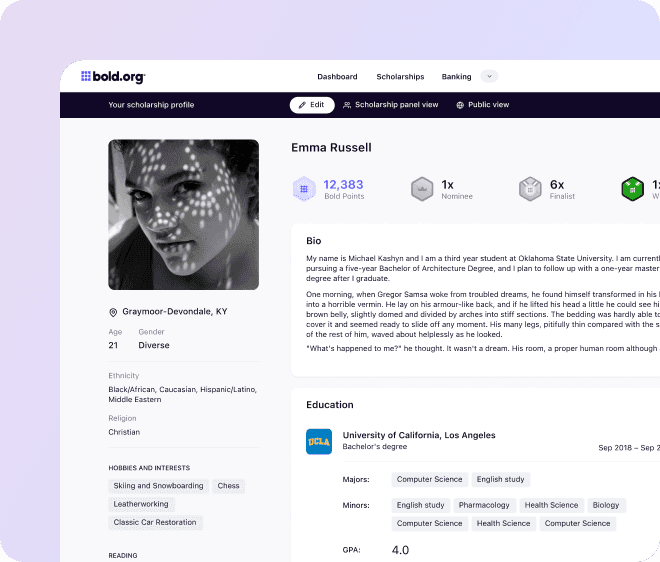
Step 01
Start with your story
Bold.org helps students show donors who they are beyond a transcript.
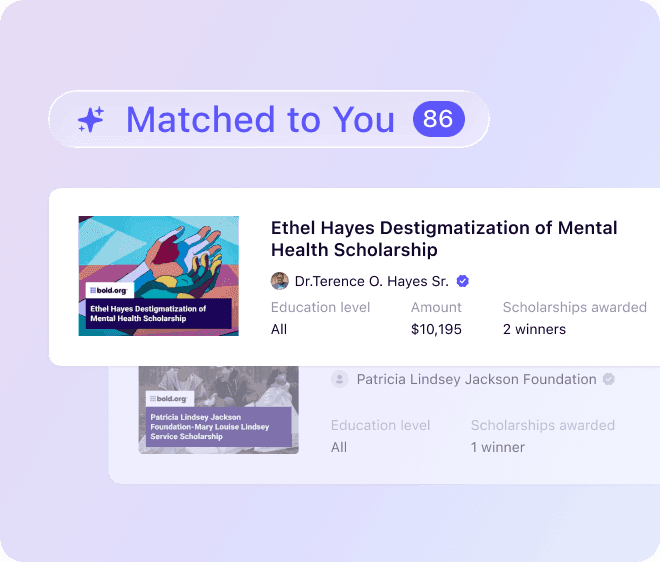
Step 02
Where scholarships are awarded
Every scholarship is funded by donors and managed directly on Bold.org.
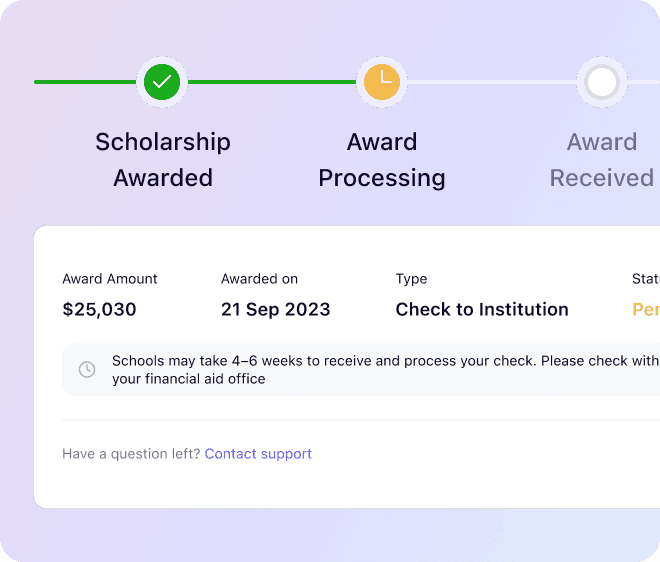
Step 03
Fund your future
Scholarship dollars are disbursed through Bold.org to help students pay for school.
FAQ
When is the scholarship application deadline?
The application deadline is Jul 28, 2026. Winners will be announced on Aug 29, 2026.
How will scholarship application information be used?
Your privacy is a top priority on the Bold.org platform, and you can find our privacy policy in full here. You may opt out of communications from Bold.org at any time, and unless we’ve first notified you and gotten your consent, you’ll never receive communication from any third parties related to personal information you give us.
What is the scholarship award?
Award amounts per winner are designated by the donor. Check the award amount for a detailed breakdown.
When will the scholarship winner be chosen? How will they be notified?
The winner will be publicly announced on Aug 29, 2026. Prior to the announcement date, we may contact finalists with additional questions about their application. We will work with donors to review all applications according to the scholarship criteria. Winners will be chosen based on the merit of their application.
How will the scholarship award be paid?
Award checks will be sent to the financial aid office of the winner's academic institution in their name to be applied to their tuition, and in the name of their institution (depending on the school's requirements). If the award is for a qualified educational non-tuition expense, we will work with the winner directly to distribute the award and make sure it goes towards qualified expenses.
How will my scholarship application be verified?
Before we award the scholarship, the winner will be required to confirm their academic enrollment status. Depending on the circumstances, verification of Student ID and/or their most recent transcript will be required.
How should I get in touch with questions?
If you have any questions about this scholarship or the Bold.org platform, just email contact@bold.org and we’ll get back to you as quickly as we can.
Does the scholarship have terms and conditions?
Yes. The terms and conditions for this scholarship can be found here.
97% of students don't win scholarships. We’re here to change that.