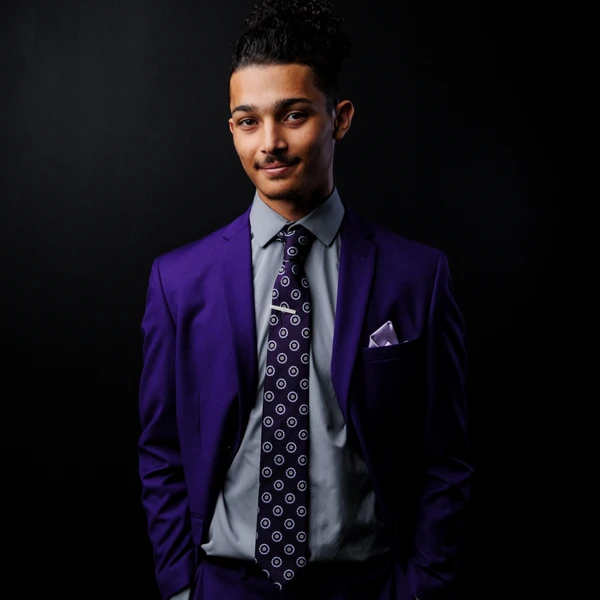
Hobbies and interests
Advocacy And Activism
Classics
Guitar
Snowboarding
Speech and Debate
Community Service And Volunteering
Politics and Political Science
Reading
Classics
Academic
Politics
I read books daily
Isaiah Patterson
1x
Finalist
Isaiah Patterson
1x
FinalistBio
I've played football, run track, and won more than my fair share of debate matches, but what I really love is my job at Ace Hardware. During my four years mixing paint and filling propane tanks, I also earned my grill master certification and bought one of my most prized possessions – my Big Green Egg. (Smoked cream cheese dip, chicken wings, and German chocolate cake are my specialties!)
I invest in a tight knit group of friends who like weekend roadtrips, thrifting, and visiting vintage bookstores almost as much as I do. We've been known to spend a whole day working on a speech about the importance of voting, and then give it at open mic night at the local book co-op. During the winter, my snowboarding gear is always in my car so I'm ready to hit the slopes at a moment's notice.
I was a National Merit Semifinalist, and I recently earned my Certified Nursing Assistant license so that I can spend the summer providing dignified care at a local nursing home. I am a graduate of Rapport Leadership training's teen encounter weekend, one of the best -- and most stretching -- experiences of my life so far. I am about to graduate from high school, and this fall, will adopt Hawkeye gold when I become a biology major at the University of Iowa. My long-term plan is a career in medicine, and while I'm not certain about my exact path, I dream of traveling overseas with Doctors Without Borders one day.
Education
Harrisburg High School - 01
High SchoolMiscellaneous
Desired degree level:
Doctoral degree program (PhD, MD, JD, etc.)
Majors of interest:
- Biological and Physical Sciences
Career
Dream career field:
Medicine
Dream career goals:
Sales associate; certified grill master; certified paintologist; grill, snowblower, and lawn mower assembly; delivery driver; forklift driver
Ace Hardware2022 – Present4 years
Sports
Track & Field
Varsity2022 – 20242 years
Football
Junior Varsity2022 – 20242 years
Arts
Band
Music2018 – 2021
Public services
Volunteering
Suicide Prevention Walk — Chair2022 – 2022Volunteering
Naomi Project — Advocate2023 – Present
Future Interests
Advocacy
Volunteering
Philanthropy
Dan Leahy Scholarship Fund
I was convinced that Mrs. Berg was the worst teacher ever.
But it turns out, she will go down as the best teacher ever. Mrs. Berg was relentless about details in my Advanced Placement (AP) classes. Did you use reputable research studies? Did you cite your sources correctly? Was your grammar precise and correct? Did you take the time for peer review? And don’t forget about the weekly vocabulary list I had to generate myself, populated exclusively with words that were new to me.
A teacher like Mrs. Berg has a way of getting into your head — and I wanted nothing more than to get her out of there as soon as possible. Especially after she called my parents in for a meeting because she believed I wasn’t giving my best to her AP Composition class.
I walked into that meeting prepared to play my role as an angsty, defensive, know-it-all teenager to its fullest. But she stopped me in my tracks when she told my parents, “I have been a teacher for 20 years, and I can count on one hand how many students I’ve had who are truly brilliant. Isaiah is one of those students.”
Well, that was unexpected. And so was my shift from wanting her out of my head to ticking off the things she’d always ask before I turned in my essays for a college course I’m taking this spring. Her teaching was far superior to my college professor’s and feeling so capable and well-equipped for a college course has given me an extra boost of confidence as I head to the University of Iowa this fall.
Learning to prepare, sift, and refine my ideas in Mrs. Berg’s class boosted my performance on my high school debate team. I was first attracted to debate simply because of my love for the back-and-forth exchange of ideas, and debate provided a mutually respectful space to do that. I’m always amazed at how genius the set-up of debate is — having to argue the pro and the con side of an argument leads to people who not only learn to engage with others thoughtfully, but to people who actually know what they think and why. Personally, thanks to debate, I’ve grown more capable of shedding beliefs that no longer make sense and to adjusting my beliefs when better evidence is presented.
As a four-year member of the debate team, I’ve seen the camaraderie that grows among our team members. It’s unlike anything the football or track teams offered me. The opportunity to mentor underclassmen the way I was mentored when I first joined has been one of the greatest accomplishments of my high school career. I started in Public Forum and then moved to Lincoln-Douglas, and in each of those areas, I’ve enjoyed working with my teammates to build better cases — and stronger friendships with others who think differently from me. There’s a special kind of creativity that arises when you’re duking it out mentally, and the effort commands my respect even when I don’t personally agree with my opponent.
I graduate from high school next month, and I plan to write Mrs. Berg a thank you note. She will be shocked given how hard I was on her, but I’ve seen many great educators leave the profession lately, and I’m hoping she won’t be one of them.
My note to Mrs. Berg will says something along the lines of: Thank you for the excellent instruction. You improved my ability to communicate, notice important details, and conquer many of my debate opponents. I am grateful.
Byte into STEM Scholarship
My family is built on adoption and foster care. My older brother and I were adopted through the same agency, and then my parents, brother, and I decided to become a foster family, which we did for about five years. We adopted my younger brother from foster care, and then we went on to welcome a little sister.
It was hard work, and we all had a role to play in being a safe harbor for kids. I learned that my ability to make up stories and songs could help our foster kids calm down when they were anxious (which was most of the time). I learned that I could read to my other siblings when my mom had her hands full with one of our foster babies. I even got good at making macaroni and cheese — we’re all calmer on a full stomach.
Caring for vulnerable children, I began to see myself as a leader who could make life better for those around me.
If I felt like a leader at home, I struggled to find that same footing at school. I am a mix of Black, Hispanic, and White living in South Dakota, a state that offers little diversity. As an adoptee, I even stick out in my own family, which is White. For many of my classmates, I was the first person of color they had ever talked to, sat by at lunch, or invited to a birthday party.
In second grade, I qualified for our school’s advanced program. If there were only a few people of color in the regular classrooms, there was exactly one in the advanced class — me. I excelled, but it never erased the taint that I was there for equity reasons. One day a boy told the group that a wall should be built in our classroom and “that black kid should be put on the other side.” After that, keeping myself unnoticed became my modus operandi; it just felt safer that way.
My sense of being an outlier was also reinforced by my health. I have asthma and allergies, and I was dependent on an inhaler and the school nurse. At that time, I subconsciously assumed all doctors were White until I met Dr. Veloira, a pediatric pulmonologist who looked like me. It was a transformative encounter with representation I didn’t even know I needed.
My experiences with foster care, lack of diversity at school, and meeting Dr. Veloira have galvanized my desire to protect the vulnerable and seeded a dream to care for them through medicine. As a first step, I have earned my Certified Nursing Assistant (CNA) license, and I now provide dignified care to nursing home residents. Whether I am taking blood pressures or dressing a resident who hits and bites, I believe that every patient deserves to be respected.
My next step is to earn a biology degree from the University of Iowa, where I’m enrolled this fall. My experience in AP Biology, where I was the only student to earn a 5 despite my teacher's low expectations, proved that I can succeed in challenging STEM environments. I am not certain what my exact path will be, but I hope to become a physician, potentially with Doctors Without Borders.
By entering the medical field, I intend to uplift my community by advocating for inclusive healthcare and being an example to minority students in South Dakota and beyond that they belong in STEM. My journey from a kid inhaler-dependent kid to a future doctor is fueled by a simple truth: science can be life-saving and life-changing.
Ava Wood Stupendous Love Scholarship
1. Kindness in Action
I am earning my Certified Nursing Assistant (CNA) license. It’s such humbling work that the first time we got to the nursing home where we’d serve our practicum hours, one of my peers burst into tears because she was so overwhelmed. I gave her a pep talk, and we tag teamed caring for our first few residents so she could calm down.
On that first night, we quickly learn that some residents embrace their need for help using the bathroom, dressing, and even feeding themselves by joking and telling stories while I’m tending to them. Others are embarrassed and refuse to talk in spite of my efforts to let them know it’s ok. And the others? They’re tough. One woman hits me repeatedly as I dress her for bed, which actually makes it easier to get her arm in her pajamas. I just guide mine through the hole and she follows it, hitting me the whole way. Another tries to bite me when her dentures are removed.
During some down time, I joined a table of ladies, most of whom don’t speak. Except for Charlie, who spent an hour telling me about her life, family, and her career. She wanted me to get a meal from the kitchen so we could dine together, but I’m not allowed to since all calories are documented to track each resident’s intake. When Charlie finished, she asked me to escort her to her room. When we got there, she instructed me to open a drawer and take my pick. It was filled with candy bars. “Thank you for being so sweet to me,” she said.
And thank you, Charlie, for reminding me that kindness doesn’t require special skills or training. We can all do it — and I, for one, plan to keep at it, even for the hitters and biters.
2. Boldy, Unapologetically Me
I am an ethnic mix of Black, Hispanic, and White living in South Dakota, a state that’s great, but offers little in terms of diversity. As an adoptee, I even stuck out in my own family, which is White. For many of my classmates, I was the first person of color they had ever talked to, sat by at lunch, or invited to a birthday party.
In second grade, I qualified for our school’s advanced program. If there were only a few people of color in the regular classrooms, there was exactly one in the advanced class — me. During the 2016 election cycle, my classmates and I had to recreate our own election ads, campaign stops, and debates. The trouble came when everyone refused to take the Democrat position because it meant speaking against Donald Trump, something notoriously conservative South Dakotans, even kids, couldn’t bring themselves to do. I, however, couldn’t help myself from speaking up to my classmates about my concerns over the Republican presidential candidate. After school, a group of classmates would back me into a bus seat chanting “Trump! Trump! Trump!” in my face.
As it turned out, a few students were listening that day while I shared my concerns. They’d never thought past their own perspectives and had never had to. They were thinking a lot after that, and we became close friends who still discuss politics and current affairs regularly.
Julia Elizabeth Legacy Scholarship
I didn’t even know it mattered until it happened.
When I was a first-grader, I was referred to a pediatric pulmonologist after a severe asthma attack. The day of my consult with the new doctor, my mom and I waited in a sterile exam room like every other time we’d been to a doctor’s office. But everything changed when the door opened and Dr. Veloira walked in. He was the first doctor who had ever looked like me, and while I couldn’t have articulated this at the time, I realized later that I instantly relaxed with him near. I am an ethnic mix of Black, Hispanic, and White, and at eight years old, I was already used to being a minority everywhere I went — we live in South Dakota, a state that’s great, but offers little in terms of diversity. As an adoptee, I even stuck out in my own family, which is White.
Until Dr. Veloira walked through that door, I had subconsciously assumed all doctors were White. Looking at the statistics, I’m not the only one operating on some assumptions. While the importance of diversity in STEM careers holds personal importance to me, it also has worldwide significance. We need:
• Higher quality. STEM careers encompass the professions we rely on for our healthcare, the infrastructure that keeps us safe while flying or driving our cars, the security protocols that protect us from being hacked or attacked, the research that moves cancer treatments forward, the protocols that prevent any number of catastrophes, and on it goes. We expect the highest quality from these things and assume it’s inherent in the way they are developed and applied, but things can’t be truly quality if the methods that developed them only represent a portion of the population. They’re only quality for the population that was represented when they were developed.
• Better outcomes. I’m convinced that being able to talk about my health with Dr. Veloira led to a better plan for managing my asthma and allergies. Admittedly, I wanted to impress him, but I don’t think I’m unique in that, with my increased level of comfort, came an increased level of detail about what I was experiencing. It gave him better insight in how to treat my condition. How much better would the outcomes be if everyone who needed a doctor or a nurse had one who looked like them? How much better would the outcomes be if curriculums were developed with insight into a variety of cultures? What if the technology we use each day was approachable for all?
• Faster innovation. The rate at which science, technology, engineering, and mathematics develops seems fast, but in reality, it takes a long time for a breakthrough to happen. How much faster could we go if we diversified the teams researching the next big thing? More minds with different perspectives to examine a problem could get us to breakthroughs sooner. Accelerating our innovation would be life-saving for the cancer patient enduring rounds of chemotherapy or the parts of the world without access to clean water.
At the end of our appointment, Dr. Veloira kindly told my mom, “Isaiah is very sharp. He’ll be working with me some day.” I’m thinking about his encouragement a lot as I graduate high school and start my new life as a biology major at the University of Iowa this fall. Maybe he’s right — the field of pediatric pulmonology just might need a Black, Hispanic, White guy like me to help shape its future.
Tim Gjoraas Science and Education Scholarship
Lighting the Big Green Egg I bought after I earned my Grill Master certification from the hardware store where I work is a science lesson hidden in my everyday life. The coals, air flow, heat intensity and many other things have to come together for me to produce chicken wings, smoked cream cheese dip, and a German chocolate cake. Science is practical.
In first grade, I went to a birthday party and played with a cat. Instantly, my eyes were nearly swollen shut, and I felt like I was suffocating. Several pokes and prods later, the results were in: I have severe allergies and asthma — the variety that require lifelong maintenance and medications. A kind pediatric pulmonologist helped restore my health. Science is life-saving.
I joined the high school debate team and quickly learned that research is the first rule. At their core, most debate topics are science-related, like the importance of the power grid or the ethics behind nuclear war. We need science knowledge and methods to make sense of the positions we argue and to present accurate data. We educate volunteer judges who had no idea about these topics, but we give them a glimpse into it that will keep them wondering long after the match ends. Science is educational.
My dad and I built a ramp for a wheelchair-bound friend so she can get into our home’s front door. We try, try, try again to get it right. We take several trips to the hardware store, buying different sizes of this and that, experimenting with different angles, and scrapping one plan for a completely new one. We even give up and put the project away for a couple of weeks. We eventually get it right, and it’s satisfying every time she rolls through our front door. Science is triumphant.
I am earning my Certified Nursing Assistant license one blood pressure, catheter cleaning, and dietary plan at a time. Learning to treat people with dignity at a nursing home has been both easier and harder than I imagined. Science is compassionate.
I shared a room with an older brother with developmental delays nearly my whole life. He’s always needed therapies, medical care, and research-backed solutions to meet his unique needs. Science is creative.
Last year, my Advanced Placement teacher warned the class not to expect much success on the AP Biology test. In his years teaching the course, only one or two students have scored a five, and the bunch of us didn’t hold much promise. But one student would earn a five that year — me. On very little sleep (thanks, asthma!) and a half cup of coffee no less. Science is surprising.
I’m passionate about science because it’s practical, life-saving, educational, triumphant, compassionate, creative, and surprising. I don’t have a fully mapped out career path yet (try not to hold that against me), but I know that science and all of the forms it can take — medicine, healthcare, teaching, research, and so much more — feels like a welcoming place of opportunity that the other subjects I study can’t match. Pursuing a career in the field of science means that, if I need to reinvent myself or try something new in 10 or 15 years, I’ll be able to.
I’ve found a home in my science classes, especially as I’ve gotten into patient care through my CNA program, and for the first time in my life, I’m truly excited about what the future holds for me. It begins this fall at the University of Iowa where I’m enrolled as a Biology major.
Christian Fitness Association General Scholarship
I never thought of having asthma and allergies as a challenge until a friend pointed out that my life is “more work than most people’s.”
And I suppose it is. When I was eight years old, I laid on my tummy in an allergist’s office while a nurse poked my back. The first Harry Potter movie played on a small television to my left, and I watched Harry be mistreated by his family while my back got itchier and itchier. It tried not to squirm, but even Harry’s adventures couldn’t distract me from my growing discomfort.
“We can’t continue,” the nurse announced to my mom. “He’s already too reactive to these.”
The doctor later summed up my results this way: “Isaiah is allergic to outdoors and anything with fur or feathers.” (Not sure if you've ever noticed, but the outdoors sure can be hard to avoid…)
We already knew I had asthma; my faulty lungs had sent me to the hospital twice already. Now that allergies were officially in the mix, I was at least grateful to know why my nose was always running and my eyes were always watery and bloodshot. I was the only grade schooler who always carried Kleenex with him, and who needed to send the school nurse a Christmas card.
I’m the kid who skipped birthday parties and sleepovers. Even ten minutes in a house with a pet could set off my asthma and send me back to the hospital.
In middle and high school, I was the only kid at the starting line of the 110-meter hurdles taking a puff of his inhaler, and who ran with one bouncing around in his pocket because I’d need it again at the finish line. If a judge saw me using my inhaler, the race would be halted while they assessed what I was using for compliance with state rules.
I’m the only employee at my hardware store job who may have to sprint to my car or house for quick-acting medicine because a customer came in carrying a cat or dog. (This happens more often than you think.)
I took my last round of Advanced Placement (AP) tests fighting the grogginess of the medication I had to take at 3 a.m. to calm down the suffocation I feel when my asthma and my allergies flare up at the same time.
I love debate, and the bus trips our team takes are some of my favorite memories. But once that bus pulls out of the parking lot, for the next 12 hours, I’m at the mercy of whatever invisible secret agents might attack me and turn a healthy, easy-breathing day into a miserable slog. Debate matches are harder to win when your nose is dripping and your head is pounding because you can’t breathe well. It’s a heavy disappointment when your body lets you down so you’re not at your best when you need it most.
It wouldn’t be true to say that I’ve overcome this obstacle; it will require constant management for the rest of my life. But I have learned to use it for my and others’ good and to live a full life in spite of it. It’s counterintuitive, but regular exercise has strengthened my lungs and tamped down my allergy symptoms. I can definitely tell when I need to get back on my gym routine. I’ve also had to get better at planning ahead and anticipating scenarios, so my medications are refilled on time and are with me wherever I go.
Even better than exercise and planning ahead, the best way to overcome the obstacle of my chronic health challenges, has turned out to be relationships. I've developed a close one with my dad, who suffers from similar challenges. Our mini-support group makes the constant vigilance less irritating and more possible and is worth every inhaler we’ve ever shared. (My dad’s inhaler never seems to go missing the way mine does…) Obviously, allergies and asthma aren't reserved just for me and my dad -- though my pulmonologist claims my level of cat, dog, and horse allergy is astounding -- as lots of people suffer from them. There's a natural comradery that springs up when you meet others wrestling with similar challenges and that too makes the load a little lighter.
My allergic, asthmatic body will study biology at the University of Iowa this fall. I want to pursue a career in medicine, but I’m not positive what path I will take just yet. When I was eight and just learning about my asthma and allergies, I claimed I would become a pediatric pulmonologist because mine was so admirable. That plan isn’t out of the question as I begin to explore my future options in earnest. Wouldn't that be the best way to truly overcome this obstacle?
Gabriel Martin Memorial Annual Scholarship
When I was eight years old, I laid on my tummy in an allergist’s office while a nurse poked my back. The first Harry Potter movie played on a small television to my left, and I watched Harry be mistreated by his family while my back got itchier and itchier. It tried not to squirm, but even Harry’s adventures couldn’t distract me from my growing discomfort.
“We can’t continue,” the nurse announced to my mom. “He’s already too reactive to these.”
The doctor later summed up my results this way: “Isaiah is allergic to outdoors and anything with fur or feathers.” (Not sure if you’ve noticed, but the outdoors can be hard to avoid.)
We already knew I had asthma; my faulty lungs had sent me to the hospital twice already. Now that allergies were officially in the mix, I was grateful to know why my nose was always running and my eyes were always watery and bloodshot. I was the only grade schooler who carried Kleenex with him at all times and who needed to send the school nurse a Christmas card.
I’m the kid who skipped birthday parties and sleepovers. Even ten minutes in a house with a pet could set off my asthma and send me back to the hospital.
In middle and high school, I was the only kid at the starting line of the 110-meter hurdles taking a puff of his inhaler, and who ran with one bouncing around in his pocket because I’d need it again at the finish line. If a judge saw me using my inhaler, the race would be halted while they assessed what I was using for compliance with state rules.
I’m the only employee at my hardware store job who may have to sprint to my car or house for quick-acting medicine because a customer came in carrying a cat or dog. (This happens more often than you think.)
I took my last round of Advanced Placement (AP) tests fighting the grogginess of the medication I had to take at 3 a.m. to calm down the suffocation I feel when my asthma and my allergies flare up at the same time.
I love debate, and the bus trips our team takes are some of my favorite memories. But once that bus pulls out of the parking lot, for the next 12 hours, I’m at the mercy of whatever invisible secret agents might attack me and turn a healthy, easy-breathing day into a miserable slog. Debate matches are harder to win when your nose is dripping and your head is pounding because you can’t breathe well. It’s a heavy disappointment when your body lets you down so you’re not at your best when you need it most.
As exhausting as it is to constantly think ahead and anticipate every scenario, my dad has similar allergies. It’s been a blessing to go on this journey together, to trade life hacks, and share inside jokes about our faulty bodies. My dad has been so encouraging as I learn the ropes of caring for myself — even when I’m waking him from a dead sleep for a trip to the emergency room.
I will study biology at the University of Iowa. I want to pursue a career in medicine, but I’m not positive what path I will take just yet. When I was eight and just learning about my asthma and allergies, I claimed I would become a pediatric pulmonologist because mine was so admirable. That plan isn’t out of the question as I begin to explore my future options in earnest.