
Hobbies and interests
Graphic Design
Journaling
Crocheting
Crafting
Zainab Raza
1x
Finalist
Zainab Raza
1x
FinalistBio
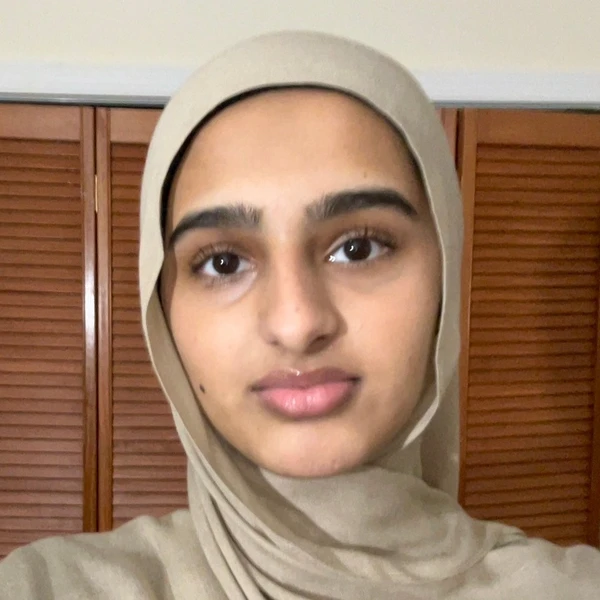
Hi, I'm Zainab, 17 years old with a 3.89 GPA, and passionate about healthcare, neuropsychology, and medicine. I am an active small business owner on Etsy with over 16,000 sales and the founder and president of the online bullet journaling club at my school. Outside of school, I volunteer at a hospital, assist at an Islamic weekend school as a teaching assistant, and am entering a teaching position this fall. I am also dual-enrolled at Northampton Community College, balancing education, entrepreneurship, and service with a focus on making a positive impact in the community. Lastly, I have conducted research on "The Neuropsychological Effects of Screen Time: How Screen Time Impacts Toddlers’ Emotional Regulation and Cognitive Abilities." My authored paper is now under review for publishing and available on Academia.edu.
Education
Muhlenberg College
Bachelor's degree programMajors:
- Medicine
- Psychology, General
Pennsylvania Virtual Cs
High SchoolMiscellaneous
Desired degree level:
Bachelor's degree program
Graduate schools of interest:
Transfer schools of interest:
Majors of interest:
- Neurobiology and Neurosciences
- Psychology, General
Career
Dream career field:
Medicine
Dream career goals:
Humanitarian Work
Owner
Etsy Small Business2022 – Present4 years
Research
Psychology, General
Authored Literature Review2025 – 2025
Public services
Volunteering
St. Lukes Hospital — Patient Advocate2023 – 2026
Gail Lynne Huber S.T.E.M. Scholarship
The chances that you and I exist today are only 1 in 100 million to 300 million, and that is only taking into consideration the time of conception. You and I both won the biological lottery: the sperm race, and our ancestors fought through numerous serious diseases, environmental challenges, and more. We are here today thanks to their resilience and the gradual evolution of complex and capable brains. Our existence means everything; we exist today because of the very intricate brains we have, better than any other living being on this earth and better than the other 25+ human-like species we, the homo sapiens, were competing with millions of years ago. There were some we interbred with, like Neanderthals and Denisovans, but we are still the majority that survived. We were able to develop brains that are tailored for abstract thinking, memory, emotional regulation, complex language, outstanding survival instincts, and long-term planning.
Our brains have led to such great civilizations, inventions, and discoveries, all of which no other human-like species was able to accomplish, even though they lived on earth millions of years longer than us. We are also the living species today that is highly conscious of its own existence and brain, questioning it and studying it. We are special; our brains are special. But living on this earth, we are forced to zoom in. Neuropsychological research proves that each and every human has a different psyche, built with different nature- and nurture-rooted factors. These different biological and environmental experiences shaping our mental health actually physically change the brain's shape and functioning; this is the concept of neuroplasticity.
We each face mental health struggles and disorders and have differing cognitive abilities. People struggle with anxiety, depression, and others start to involuntarily lose their memories as a subject to Alzheimer's, even their most cherished ones. Some of these issues actually trace back to evolution, like anxiety being an accelerated byproduct of survival instincts and being alert to danger. In the past, there were others of us concerned with conquering land, and now people are climbing up the ladder of capitalism, running after paper money that we created ourselves, committing genocide, bombing innocent civilians, holding prejudice and racism, and so much more. The same brain that helped develop inventions, civilization, and beautiful experiences like love, empathy, and creativity is also capable of creating conflict, fear, and sorrow.
All of these different emotions and behaviors all trace back to our one shared organ…the brain. It weighs only 3 pounds, taking up only 2% of bodily weight, but it uses 20% of our bodies' energy. It's powerful enough to develop perplexed civilizations, but it's also complex enough to be subject to endless change and even self-deterioration. This is why I am passionate about studying behavioral neuroscience: to learn about the widely different outcomes of our brain. I want to learn about the human experience, behavior, and the structure of our brains. With the extensive education I gain, I plan on pursuing medicine and become a physician, in order to help people live better, be healthier, and thrive.
Julie Adams Memorial Scholarship – Women in STEM
The chances that you and I exist today are only 1 in 100 million to 300 million, and that is only taking into consideration the time of conception. You and I both won the biological lottery: the sperm race, and our ancestors fought through numerous serious diseases, environmental challenges, and more. We are here today thanks to their resilience and the gradual evolution of complex and capable brains. Our existence means everything; we exist today because of the very intricate brains we have, better than any other living being on this earth and better than the other 25+ human-like species we, the homosapiens, were competing with millions of years ago. There were some we interbred with, like Neanderthals and Denisovans, but we are still the majority that survived. We were able to develop brains that are tailored for abstract thinking, memory, emotional regulation, complex language, outstanding survival instincts, and long-term planning.
Our brains have led to such great civilizations, inventions, and discoveries, all of which no other human-like species was able to accomplish, even though they lived on earth millions of years longer than us. We are also the living species today that is highly conscious of its own existence and brain, questioning it and studying it. We are special; our brains are special. But living on this earth, we are forced to zoom in. Neuropsychological research proves that each and every human has a different psyche, built with different nature- and nurture-rooted factors. These different biological and environmental experiences shaping our mental health actually physically change the brain's shape and functioning; this is the concept of neuroplasticity.
We each face mental health struggles and disorders and have differing cognitive abilities. People struggle with anxiety, depression, and others start to involuntarily lose their memories as a subject to Alzheimer's, even their most cherished ones. Some of these issues actually trace back to evolution, like anxiety being an accelerated byproduct of survival instincts and being alert to danger. In the past, there were others of us concerned with conquering land, and now people are climbing up the ladder of capitalism, running after paper money that we created ourselves, committing genocide, bombing innocent civilians, holding prejudice and racism, and so much more. The same brain that helped develop inventions, civilization, and beautiful experiences like love, empathy, and creativity is also capable of creating conflict, fear, and sorrow.
All of these different emotions and behaviors all trace back to our one shared organ…the brain. It weighs only 3 pounds, taking up only 2% of bodily weight, but it uses 20% of our bodies' energy. It's powerful enough to develop perplexed civilizations, but it's also complex enough to be subject to endless change and even self-deterioration. This is why I am passionate about studying behavioral neuroscience: to learn about the widely different outcomes of our brain. I want to learn about the human experience, behavior, and the structure of our brains. With the extensive education I gain, I plan on helping people live better, be healthier, and thrive.
Nabi Nicole Grant Memorial Scholarship
“So verily, with hardship, there is ease” (Quran 94:6). My faith has taught me that every difficulty in life is a learning experience and a test to build trust and patience in God's plans. There have been times in my life where things didn't go as I planned or where I have faced struggles. In these situations, I have always looked for answers in my belief system, which has always helped me find good in presumably bad situations. I always look back on some of my favorite verses from the Quran, including the verse I quoted at the beginning, as well as the following verse, "And Allah is the best of planners” (Quran 8:30). These verses make me ponder and understand that no matter what happens in life, it will always end with ease and tranquility, and it is part of God's plan. People can find hope and optimism from many different sources, whether that be faith, self-confidence, or community. I share with you a very personal experience where I faced a hardship where my faith helped me in learning perseverance. I have always been the type to stress about school and work, and stress takes a toll on you whether you notice it or not. Whether that be physically or mentally, stress manifests itself in you. One morning in 9th grade, I woke up to find that I was unable to move the left side of my face. At first, I thought I was going crazy. Then my family started to point it out, which is when I thought my life was over. After going to my family doctor, a neurologist, and an ophthalmologist, I found out that I had been diagnosed with Bell's palsy. Weird name, I know, but it's where your nerves on the left side of your face cannot move. This is not prevalent in young teens, but there I was as an already mildly insecure young teenager with a distorted face. They told me that it was due to stress. At this time I decided to not even think about the possibility of this staying but to work towards healing. I knew there was a reason for this test and that I’d have to show patience and optimism to overcome it and find ease. I prayed and started working on my recovery. I attended regular physical therapy and regularly did facial exercises. “You are fully recovered; you don’t have to come to these anymore,” said my physical therapist. In just 2 weeks, I managed to fully recover despite my doctor warning me that I might not be able to recover 100%. After this, I started to take care of my mental and physical health and took action to control my stress levels. I understood that nothing comes before your health. This is just one experience in my life, but there have been countless times, and I'm sure others have also experienced this. The times when your prayers get answered and when the seemingly impossible become reality through patience and trust. I believe that everything that happens is for a reason, and sometimes these hardships come to teach you valuable lessons. Whether you call it optimism or trust in God, this trait has always helped me to overcome small and larger problems in my life, and I know that it will continue to.
Cheryl Johnson-Watts Memorial Scholarship
Hi, I’m Zainab (zayn-ub), and I am currently a senior in high school living in the Lehigh Valley. I would describe myself as someone who has many hobbies; loves creativity and is inspired by other people's creativity; is passionate about humanitarian work; and carries her faith through the ups and downs of life. As for my academic interests, I enjoy learning about neuroscience, psychology, biology, and sociology. All of these subjects stem from my curiosity for learning about humans, nature, and the human experience. I will be majoring in Behavioral Neuroscience B.S. starting in the upcoming fall semester as a first-generation college student. As I mentioned, I enjoy creative hobbies like crocheting, bullet journaling (even started a club for it at my high school), drawing, painting, scrapbooking, and random crafts. One of these crafty activities I do every year is make a vision board showcasing my goals for that year. I also have a separate vision board dedicated to what I want my future to look like, including career and lifestyle. This vision board I made includes a specific image that describes the overarching goal I have for the career path I have chosen, which is medicine and becoming a physician. The image I have placed depicts a doctor on deployment to an underprivileged community, assisting a child with the skills and knowledge they have gained. Whenever I find myself in an opportunity similar to the one that the doctor had, that is when I’ll know that I have reached success in my career. I think many doctors and medical professionals can become blinded by the system that is set up to only profit businesses and organizations, while the Hippocratic Oath doctors take in the beginning of their careers entails working for the patients' benefit and being able to use the knowledge they have worked so incredibly hard for to help others. So what I plan on doing with my future career and academics is to live out the actual purpose of doctors in a society, which is to heal the sick, and do my part in helping underprivileged communities and patients I will encounter, who might not be able to afford the greed of the mainstream healthcare system. How? I want to get involved in making a difference, whether that be through individual humanitarian work and deployments or through advocating for widespread change with activism, working in public health, and health policy. But as of now, I aspire to wear a white coat of dignity with the motto to actually help, not burden; even if it’s just a single deployment mission a year, at least I am aware and doing my part. This is how I’ll bring a difference in the community around me and in other communities around the world: humanitarian work as a healthcare provider.
Mema and Papa Scholarship
Last year, I signed up for a volunteering position as a patient advocate at my local hospital to get hands-on experience in a medical environment because I want to pursue medicine in the future. My role was to provide patients with non-clinical comfort items, assist the nursing staff with supportive duties, discharging patients, etc. While doing these tasks, I was often reminded of how socializing with patients mattered just as much. During training, a senior volunteer put extra emphasis on socializing with patients. He explained that it might not mean much to us, but a lot of these patients are elderly patients who don’t have family visiting often, or they might be feeling lonely, stressed, or worried. Even the small conversations mattered; every patient showed appreciation for us dropping by to have a small chat, and I felt that appreciation with the smiles on their faces and how their energy levels went up while talking to us. I knew I would never forget this experience, and so when I started to volunteer on my own, I made sure that I spent a good portion of my time not only helping the patients and completing my tasks around the floor but also talking and socializing with patients.
I share with you a very personal experience where I faced a hardship that taught me perseverance. I have always been the type to stress about school and work, and stress takes a toll on you whether you notice it or not. Whether that be physically or mentally, stress manifests itself on you. One morning in 9th grade, I woke up to find that I was unable to move the left side of my face. At first, I thought I was going crazy, then my family started to point it out, which is when I thought my life was over. After going to my family doctor, a neurologist, and an optamologist, I found out that I had been diagnosed with Bell's palsy. Weird name, I know, but it's where your nerves on the left side of your face cannot move. This is not prevalent in young teens, but there I was as an already mildly insecure young teenager with a distorted face. They told me that it was due to stress. At this time I decided to not even think about the possibility of this staying, but to work towards healing. I knew there was a reason for this test and that I’d have to show patience and optimism to overcome it and find ease. I prayed and started working on my recovery. I attended regular physical therapy and regularly did facial exercises. “You are fully recovered; you don’t have to come to these anymore,” said my physical therapist. In just 2 weeks, I managed to fully recover despite my doctor warning me that I might not be able to recover 100%. After this, I started to take care of my mental and physical health and took action to control my stress levels. I understood that nothing comes before your health. This is just one experience in my life, but there have been countless times, and I'm sure others have also experienced this. The times where your prayers get answered and when the seemingly impossible become reality through patience and trust. I believe that everything that happens is for a reason, and sometimes these hardships come to teach you valuable lessons. Whether you call it optimism or trust in God, this trait has always helped me to overcome small and larger problems in my life, and I know that it will continue to.