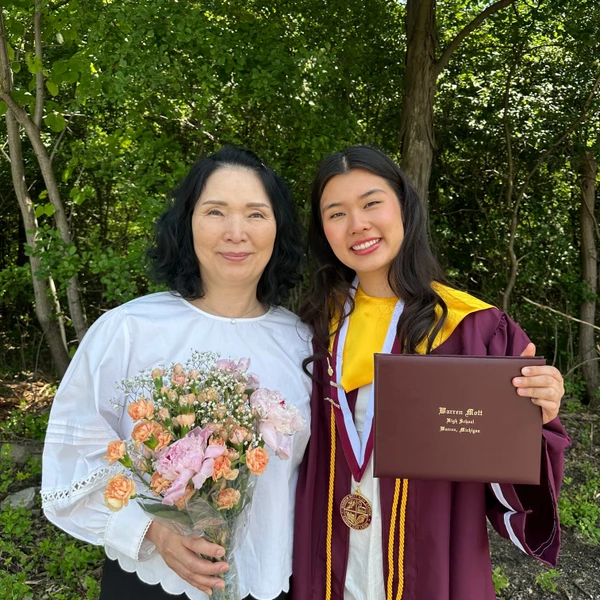
I immigrated from Korea to America when I was 8 months old. My parents took a shot at the American dream, growing up though, it was hard to say I understood what they meant. We are a very low income family, and my parents worked long, hard hours to make a living for us. My dad spends 10-12 hours a day standing in front of a hot stove and my mom juggled raising my sister and I while managing small side jobs to make ends meet. Growing up, education became a major part of my identity as my mom made sure I understood the phrase “Education is my lifeline.” Over the years I grew fond of that phrase and realized that my future was in my own hands.
Growing up, I was always curious about how things worked. I found joy in understanding the deeper mechanics of things. But my fascination with science and technology took on a deeper meaning as I watched my parents struggle with their health. In my situation, we had no access to healthcare or aid, so I experienced firsthand the consequences of the unequal healthcare system. Sparked by my mom’s chronic back pain and heart condition, combined with my dad's deteriorating health from years of hard labor in a hot kitchen, I was painfully aware and saw how the lack of health care can strip away comfort and stability in one's life.
These experiences ignited my passion for change in the healthcare system. Biomedical engineering merges science, technology, and healthcare to develop solutions for unfair medical access. This field excites me because of the technological advancements it continues to make, and because of its real-world impact. I hope to work in research programs focusing on regenerative medicine to help families like mine. Stem cell therapy aligns with my visions and treats spinal cord injuries or heart disease with stem cells to regenerate nerve or heart tissue, challenges similar to those my mom faced. Tissue engineering also creates solutions for burn victims and can create artificial cartilage for joint repair, which can be helpful for those who take part in hard labor like my dad. Beyond regenerative medicine, I hope to develop diagnostic tools, improve herniated disk treatments, and enhance physical therapy options. Through biomedical engineering, I want to bring equitable healthcare to all.
However, pursuing this dream comes with financial barriers. As a first-generation, low-income student, the cost of higher education is a significant challenge. My parents have worked tirelessly to provide for our family, but affording college expenses is beyond our means. This scholarship is not just financial help; it’s an opportunity for me to continue my education and work toward my goal of changing healthcare accessibility. With this support, I can focus on research, gain hands-on experience, and ultimately contribute to a field dedicated to improving lives.
My goal is not just to dream, but to work and actively contribute to make a difference. I am determined to use my education to break down the barriers preventing underrepresented communities from receiving proper medical care. This scholarship will help me take one step closer to that reality, allowing me to focus on my studies and, eventually, use my education to drive meaningful change. With your support, I can turn my passion into action, ensuring that my memories of hesitancy when seeking medical care is not a burden that anyone else has to carry, and rather create a world where healthcare is a right, not a privilege.