Hobbies and interests
4-H
FFA
Student Council or Student Government
Speech and Debate
Agriculture
Education
Reading
Cultural
I read books multiple times per month
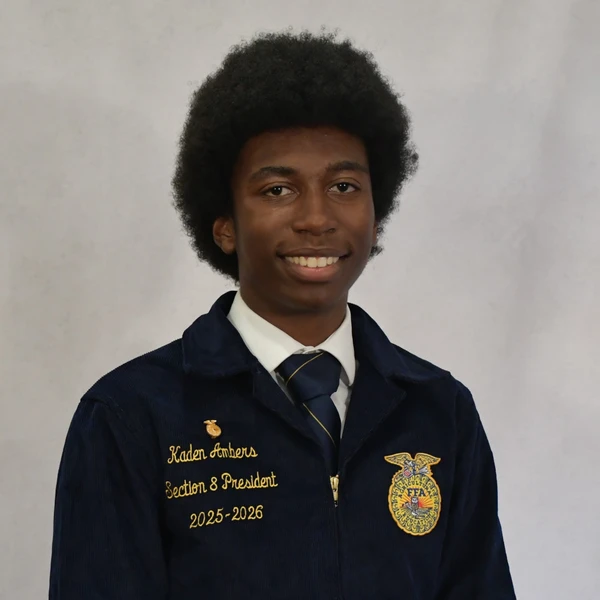
Kaden Ambers
2x
Finalist1x
WinnerKaden Ambers
2x
Finalist1x
WinnerBio
I’m Kaden Ambers, a student deeply passionate about leadership, education, and community impact, especially in the field of agriculture. My goal is to pursue a degree in Agricultural Education at a land-grant university, where I can combine my love for teaching with my desire to strengthen agricultural literacy in diverse communities. I’m driven by the belief that access to education and leadership opportunities can empower young people, especially those from underrepresented areas, to view agriculture as a viable and rewarding career path.
Throughout high school, I’ve served in various roles, including FFA Section 8 President, a 4-H Teen Leader, and a mentor for community youth workshops. These experiences have taught me the value of service, communication, and resilience. I’ve led educational initiatives, spoken at leadership conferences, and worked on community engagement projects, all of which reflect my dedication to making a lasting impact.
I believe I’m a strong candidate for scholarships because I don’t just chase opportunities, I create them for others. I’m committed to personal growth, community service, and using every resource I gain to uplift those around me. Investing in my education means investing in someone who is determined to pay it forward.
Education
Chicago Hs For Agricult Sciences
High SchoolMiscellaneous
Desired degree level:
Bachelor's degree program
Majors of interest:
- Education, Other
- Agricultural/Animal/Plant/Veterinary Science and Related Fields, Other
Career
Dream career field:
Education
Dream career goals:
As a CTE Intern at CHSAS, I helped tend the school farm by tilling soil, harvesting vegetables, and supporting plant restoration while gaining hands on experience in sustainable agriculture.
Chicago High School for Agricultural Sciences2025 – 2025As a GAST Intern, I support agricultural education and youth leadership by helping plan programs, create lessons, and lead workshops. I work with educators and communities to promote inclusion and build accessible pathways in agriculture.
Joliet Junior College2024 – 20251 year
Sports
Track & Field
Junior Varsity2022 – 20231 year
Awards
- n/a
Research
Agricultural and Food Products Processing
National 4-H Organization — As a RYLAT member, I help promote youth leadership and agricultural literacy by collaborating with peers to plan outreach, support inclusive programs, and advocate for community engagement and education.2024 – PresentCommunity Organization and Advocacy
University of Georgia — As a UGA intern, I supported agricultural literacy research, helped develop educational materials, and applied leadership skills to promote youth engagement in ag education and community projects.2023 – 2024
Public services
Volunteering
Illinois 4-H Extension — As a 4-H Food Advocate, my role was to lead discussions, host workshops, and collaborate with peers to raise awareness about food security and nutrition. I helped plan events and encouraged youth to engage in community food initiatives.2024 – Present
Future Interests
Advocacy
Volunteering
Tammurra Hamilton Legacy Scholarship
Mental health has become one of the most important conversations among young people today. Many students face academic pressure, social expectations, family responsibilities, and uncertainty about the future. On the outside it may seem like everyone is managing, but many students struggle quietly with stress, anxiety, or feelings of isolation. Because of this, mental health awareness and suicide prevention are essential topics for my generation. When these conversations are ignored, students can begin to feel alone in their experiences. When they are acknowledged, they create space for understanding, support, and hope.
My perspective on mental health changed as I became more involved in leadership and service within my school community. I noticed that many students were willing to talk about their struggles privately with friends, but very few felt comfortable discussing mental health openly. The silence surrounding these topics often made students feel as if they had to carry their challenges by themselves. Seeing this inspired me to take a more active role in creating conversations that encourage support and understanding.
Today I serve as the president of my school’s Mental Health Awareness Club. In this role, I work with other students to create a space where conversations about emotional wellbeing feel safe and accepted. Our goal is to remind students that mental health is just as important as physical health. Through meetings, school events, and awareness campaigns, we encourage students to talk about stress, seek help when they need it, and support one another through difficult moments.
One moment that deeply shaped my understanding of this work happened during a discussion meeting with our club. We invited students to share what mental health meant to them and what challenges they often faced during the school year. At first the room was quiet. Eventually one student spoke about feeling overwhelmed by expectations and not knowing how to talk about it with anyone. When that student shared their experience, others slowly began to speak as well. What began as silence turned into a conversation where students realized they were not alone in their struggles.
That moment reminded me why awareness matters so much. Sometimes the most powerful support we can offer someone is simply making them feel heard. Many students believe they have to appear strong at all times, but real strength comes from honesty and connection. Mental health awareness encourages people to look out for one another and to understand that asking for help is not a weakness.
My involvement in mental health advocacy has influenced how I approach relationships and leadership. I have learned to listen more carefully, to check in with people when they seem overwhelmed, and to create spaces where others feel comfortable expressing themselves. Leadership is not only about organizing events or speaking in front of a group.
This experience has also shaped my future goals. I hope to pursue a career in education where I can support students not only academically but personally. Teachers often serve as mentors and trusted adults in students’ lives. By promoting mental health awareness in schools, educators can help students develop healthy coping strategies.
Stories like Tammurra Hamilton’s remind us why this work matters. She valued education, family, and connection with others. Honoring her legacy means continuing to build communities where students feel seen.
Mental health awareness is not just about preventing tragedy. It is about building stronger communities where compassion, understanding, and open conversation guide the way we treat one another. As president of my school’s Mental Health Awareness Club, I am committed to continuing that work and helping ensure that no student feels alone in their struggles.
Aserina Hill Memorial Scholarship
Throughout my time in school, I have dedicated myself to programs that focus on education, agriculture, and community engagement. I am actively involved in organizations such as FFA, 4-H, and youth leadership programs that allow me to work with others while learning how to give back to my community. These experiences have shaped my interests in agricultural education, leadership, and communication. After high school, I plan to attend college and pursue a degree in agricultural education.
My passion developed through small moments that slowly changed how I understood the meaning of helping others. One experience that remains in my memory happened during a community service project. I spent the afternoon packing boxes, greeting families, and helping distribute supplies.
At one point, a young student arrived with his parent to pick up a food box. As he looked through the items inside, his face lit up when he recognized a few things he enjoyed eating at school. It was such a small moment, but it left a lasting impression on me. For many of us, groceries are something we rarely think twice about. For that family, the box represented relief and support during a difficult time. That moment helped me understand that community service is not about completing volunteer hours. It is about restoring dignity, showing compassion, and reminding people that they are not alone.
Experiences like that one encouraged me to stay involved in service through school organizations and local volunteer efforts. Agriculture provides the resources that sustain communities, yet many people do not have access to fresh food or opportunities to learn how food is grown. These experiences have strengthened my desire to pursue a career in agricultural education where I can combine teaching and service.
If I were given the opportunity to start my own charity, I would create an organization that focuses on agricultural education and food access for young people in underserved communities. The mission of the charity would be to empower students with the knowledge and tools to grow their own food while also learning leadership and community responsibility. Many students grow up without access to fresh produce or a clear understanding of where their food comes from.
The organization would serve students and families who face food insecurity. One program would focus on building school and community gardens where students could learn how to grow vegetables and maintain sustainable growing systems.
Another part of the charity would include educational workshops that introduce students to nutrition, environmental stewardship, and agricultural careers. Volunteers could mentor students, help lead service projects, and guide young people in using their knowledge to support others in their community.
This vision reflects the legacy of Aserina Hill. She devoted her life to helping others achieve their educational dreams. Her generosity and sacrifice created opportunities for countless people. In many ways, the charity I imagine would continue that same spirit of giving. By providing education, resources, and encouragement to students who may not otherwise have those opportunities.
Aserina Hill’s story reminds me that true impact is often quiet and selfless. She used what she had to lift others up. In my own life, I hope to follow that example by using education, agriculture, and service to create opportunities for people who need them most.
Rev. Ethel K. Grinkley Memorial Scholarship
Faith has always been more than something I say on Sundays. It is something that shapes the way I move through the world and the way I see people. I believe love, faith, and service are not just ideas but responsibilities. They ask a simple question. What will you do for others with the life you have been given?
One moment in my life showed me what that question truly means.
Last year I helped organize a small community service project through a youth group connected to my school and local programs. At first it seemed simple. We planned to collect food and supplies for families in our community who were struggling. I expected the project to be about organizing boxes, counting donations, and completing volunteer hours. Instead it became something much deeper.
While we were distributing supplies, a woman and her young son came to pick up a box of food. The boy could not have been older than seven. As his mother thanked us, he quietly looked into the box and smiled when he saw a few simple things like cereal and fruit snacks. It was a small moment, but it stayed with me. For him, those items were not ordinary groceries. They were relief. They meant his family would have something to eat that week.
That moment changed the way I understood service. Community work is not about checking a box or completing a requirement. It is about recognizing the dignity of people and showing love through action. Faith calls us to notice the quiet needs that often go unseen. Sometimes service looks like leadership. Sometimes it looks like listening. Sometimes it looks like handing a child a box of food and realizing how much it matters.
As I continued volunteering through school organizations, leadership groups, and agricultural programs, I began to understand that service and education belong together. I have been deeply involved in agricultural education programs such as leadership organizations and youth development groups. Through these experiences I have learned that agriculture is not only about growing crops or raising animals. It is also about feeding communities, supporting families, and building stronger connections between people.
My goal is to pursue a career in agricultural education so that I can help students see how agriculture connects to service and leadership. Many young people grow up without understanding where their food comes from or how agriculture shapes their communities. When students learn these lessons, something powerful happens. They begin to see themselves as caretakers of the land and servants to the people around them.
Faith guides that vision. My belief teaches me that love is not passive. It is active. It asks us to care for the hungry, encourage the discouraged, and build communities where people feel valued. I want my career to reflect that belief. As a future educator I hope to create programs that bring students into their communities through service projects, food initiatives, and agricultural learning experiences.
Being a first generation college student also shapes my journey. My family has always believed in hard work and perseverance, even when opportunities were limited. Their sacrifices remind me that education is a gift that carries responsibility. When I step into college, I will not only be pursuing my own dreams.
When I think about the impact I want to make, I return to that small moment with the young boy and the food box. Real change often begins quietly. A single act of kindness can ripple through families, schools, and entire communities.
Jimmie “DC” Sullivan Memorial Scholarship
My name is Kaden Ambers and I am a senior in high school who has discovered through athletics the power of dedication, teamwork, and community engagement. As a sprinter on my school’s track team, specializing in the 100-meter dash and relays, I have learned that success in sport is about more than speed; it is about preparation, focus, and the ability to work seamlessly with others toward a shared goal. Each time I step onto the track, I am reminded that my actions affect not only my performance but the cohesion and morale of the entire team. Relays in particular have taught me the critical importance of trust, communication, and timing. Passing a baton smoothly requires precision, discipline, and an understanding that every member contributes equally to the team’s outcome, lessons I carry far beyond the track.
My experience as a student-athlete has naturally extended into mentorship and leadership within my community. I have served as a youth coach for younger athletes, helping them develop the technical skills required to sprint effectively while instilling values such as perseverance, sportsmanship, and confidence. Coaching has been transformative for me because it provides an opportunity to guide others while reflecting on my own growth. I have learned to balance patience with encouragement, to celebrate small victories, and to model the behaviors I hope to see in my athletes. Witnessing young athletes achieve personal goals, whether shaving a fraction of a second off their time or improving their coordination, has reinforced my belief that sports are a powerful medium for teaching life skills.
Beyond the track, my involvement in athletics has shaped my broader commitment to community service. I understand that being part of a team means contributing to something larger than oneself, and I apply this principle to every area of my life. Through organizing practice sessions, volunteering at local track meets, and assisting in youth sports programs, I strive to create positive experiences that inspire young people to pursue their passions while learning responsibility and cooperation. Athletics has taught me that leadership is not about being the fastest or the most skilled; it is about showing up consistently, offering support, and encouraging others to reach their full potential.
Looking forward, I plan to continue making a difference through sports by combining my athletic experience with community engagement. I aspire to expand youth track programs in my area, providing opportunities for students of all backgrounds to experience the confidence, discipline, and joy that come from participating in athletics. I hope to emphasize inclusivity, teamwork, and character-building alongside physical development, ensuring that every student feels supported and empowered. By fostering an environment where young athletes can thrive, I aim to honor the legacy of Jimmie “DC” Sullivan, who devoted his life to guiding youth and strengthening communities through sports.
In reflecting on my journey as a sprinter, relay team member, and mentor, I recognize that the lessons I have learned, resilience in the face of challenge, collaboration under pressure, and dedication to the growth of others, will continue to guide me as I contribute to my community. Athletics is not merely a pastime; it is a platform for leadership, learning, and service. Through my involvement in track and my commitment to coaching, I strive to make a lasting, positive impact on those around me, carrying forward the spirit of mentorship and community that defines Jimmie “DC” Sullivan’s remarkable legacy.
Hearts on Sleeves, Minds in College Scholarship
There was a moment when my voice caught in my throat, not because I lacked words, but because I questioned whether they would be welcomed. I was standing at a leadership conference, invited to speak about agricultural education and community engagement. I had prepared carefully and knew my material well. Yet as I looked out across the room, I noticed how few people looked like me. The realization did not silence me, but it unsettled me. I wondered whether my voice would be taken seriously or quietly dismissed.
That hesitation did not come from nowhere. As an African American student pursuing leadership and education in agricultural spaces, I am often aware of being an exception. I carry the awareness that when I speak, I am not only representing myself. I am challenging assumptions about who belongs in academic, scientific, and leadership roles. That awareness can feel heavy. In that moment, it nearly stopped me from speaking at all.
Instead of withdrawing, I focused on why I was there. I spoke about how agricultural education can strengthen communities, how access to knowledge changes lives, and how students succeed when they see themselves reflected in leadership. As I continued, the tension eased. I realized that confidence is not the absence of doubt, but the choice to speak despite it. When I finished, people engaged with my ideas. They asked thoughtful questions and shared that my perspective challenged what they thought agriculture and leadership looked like. My voice did not simply fill the room. It shifted it.
That experience reshaped how I understand communication. Growing up, I learned how to measure my words carefully. I learned when to stay quiet, when to blend in, and when to soften my opinions. Communication was not just expression. It was protection. Over time, I understood that silence did not shield me. It limited me. Leadership requires honesty, not invisibility.
There were other moments when using my voice felt difficult. In classrooms and meetings, I sometimes hesitated to ask questions that challenged traditional thinking. I worried about being labeled as disruptive or out of place. Eventually, I recognized that curiosity is not confrontation. It is contribution. When I began to speak with intention rather than apology, my confidence grew. I learned that clarity comes from trusting the value of your perspective before others validate it.
Communication has become central to how I lead. Whether presenting research, facilitating workshops, or advocating for equity in education, I now understand that my voice carries responsibility. I speak to widen conversations, not dominate them. I speak so others listening might feel more confident using their own voices.
This scholarship resonates with me because I know what it means to navigate systems that were not designed to amplify voices like mine. African American communities have long been excluded from decision-making spaces, even when policies directly affect us. Communication is how those barriers are questioned. It is how experiences become visible and change becomes possible.
In the future, I plan to use my voice as an agricultural educator and community leader. I want to create learning environments where students gain both knowledge and confidence. I want them to understand that their ideas are worthy and their voices matter.
The moment when my voice nearly failed me taught me something lasting. Confidence is not given. It is built through choice. Each time I choose to speak, I grow stronger. My voice is not something to manage or minimize. It is something to use. When used with intention, it becomes a tool not only for personal growth, but for lasting impact.
Zedikiah Randolph Memorial Scholarship
I am drawn to agricultural education because it sits at the intersection of science, leadership, and service. I did not arrive at this major by accident. I arrived through curiosity, questioning, and a growing awareness of how education can either distance students from opportunity or invite them into it. Agriculture, when taught well, is not only about food or land. It is about systems, stewardship, and belonging. I chose agricultural education because I want to teach in a way that makes learning relevant, human, and accessible.
My interest began in high school when an agriculture classroom became the first space where learning felt alive. Instead of memorizing facts, I was encouraged to ask why systems function the way they do and how knowledge could be used to solve real problems. Through research projects, leadership roles, and community engagement, I realized that agricultural education allows students to see science in action. It shows them how biology, chemistry, environmental science, and economics connect to daily life. More importantly, it creates a pathway for students who may not see themselves reflected in traditional STEM spaces.
I plan to make an impact on my community by becoming an educator who teaches beyond the textbook. My goal is to build programs that connect classrooms to communities through service learning, urban agriculture, and financial and agricultural literacy. I want students to understand that education is not separate from their lives. It is a tool they can use to improve food access, advocate for sustainability, and become leaders in their own neighborhoods. I also hope to work closely with Extension programs and youth organizations to expand access to agricultural education outside of school hours.
Representation matters deeply in my field. African Americans make up a small percentage of agricultural educators nationwide, often estimated at less than five percent. That number is not just a statistic. It reflects generations of exclusion, lack of access, and misrepresentation of what agriculture truly is. By choosing agricultural education, I am entering a space where my presence challenges assumptions and expands what students believe is possible.
I plan to inspire the next generation by being visible, intentional, and honest. I want students to see someone who looks like them teaching science, leading programs, and engaging with policy and community issues. I will mentor students who are unsure if they belong, just as others once mentored me. I will emphasize that agriculture is not a narrow field, but a broad and evolving one that includes education, research, technology, and advocacy.
Ultimately, I want my career to increase the odds for students who come after me. By creating inclusive classrooms, supporting youth leadership, and connecting education to community impact, I hope to leave the door wider than I found it. Agricultural education gives me the platform to teach, to lead, and to change lives.
Julius Quentin Jackson Scholarship
Throughout my life, I have faced challenges that tested my determination and shaped my drive to succeed. Growing up in a low-income household, financial insecurity was a constant shadow in our lives. My parents worked multiple jobs to make ends meet, and while I admired their resilience, the lack of stability often made it difficult to focus on my education. There were times when I studied by candlelight during power outages or borrowed Wi-Fi from a neighbor to submit assignments on time. These obstacles could have discouraged me, but instead, they strengthened my ambition to create a better future for myself and my family.
One of the greatest challenges I had to overcome was balancing my academic responsibilities with my role at home. As the eldest child, I often helped care for my younger siblings, making sure they completed homework, ate dinner, and felt supported, all while managing my own rigorous coursework. There were nights when I felt overwhelmed, but I gradually learned how to organize my time and develop effective study habits. Through this process, I discovered my capacity for resilience and leadership, qualities that have helped me achieve a 4.0 GPA despite the difficulties I faced.
Financial need has also shaped my perspective and fueled my drive. I know firsthand the stress that comes from wondering if college is financially possible. I have spent my high school years not only excelling academically but also seeking opportunities to contribute to my family and prepare for my educational future. I worked part-time during summers and participated in community programs that offered mentorship and resources for college readiness.
Each step I took reinforced my commitment to overcome the barriers that might otherwise limit my opportunities. Receiving this scholarship would have a profound impact on my educational journey. It would allow me to focus fully on my studies and pursue a degree in Agricultural Education without the constant worry of financial strain. My ultimate goal is to become an educator and use my skills to give back to my community. I believe that education is the key to breaking cycles of hardship, and with this scholarship, I can continue to move forward on a path toward making meaningful change. The challenges I have faced have taught me the value of perseverance, hard work, and hope. They have inspired me to not only reach for my dreams but also to help others who are navigating similar obstacles.
This scholarship would not only relieve a financial burden but also serve as a reminder that my efforts and my story matter. I am ready to embrace the opportunities ahead and use my education to create a future defined by possibility rather than limitation.
Richard Neumann Scholarship
Creativity, to me, is the ability to see problems not as obstacles, but as invitations to design something better. Some of the most meaningful solutions I have created did not come from having perfect conditions or unlimited resources. They came from necessity, observation, and a desire to improve systems that were not working as they should. One of the most impactful creations I have developed was an educational outreach project designed to address the gap in agricultural literacy among younger students.
Through my involvement in agricultural leadership organizations, I noticed that many elementary and middle school students had little understanding of where their food came from or how agriculture connected to their daily lives. This lack of knowledge was especially common in urban and underserved communities. To address this, I helped create a hands-on grow kit program that could be used directly in classrooms. The kits included seeds, soil, containers, and simple instructional materials that allowed students to grow vegetables while learning about plant science, nutrition, and sustainability. The problem was not that students lacked interest. It was that they lacked access to engaging, practical learning experiences.
The grow kit project solved multiple issues at once. It made agricultural education accessible, affordable, and interactive. Teachers did not need extensive training to use the kits, and students were able to see real results from their efforts. The project also encouraged responsibility and patience, as students had to care for their plants over time. Creating this solution taught me that effective problem-solving requires empathy, adaptability, and a willingness to simplify complex ideas without diminishing their importance.
If I had the financial resources and institutional support, I would expand this concept into a larger-scale educational initiative focused on food systems, leadership development, and creative problem-solving. My plan would be to create a mobile agricultural learning program that could travel to schools and community centers. This program would include interactive workshops, demonstration tools, and curriculum-aligned activities designed to engage students who may not thrive in traditional classroom settings.
The first step would be to assemble a multidisciplinary team of educators, agricultural professionals, designers, and students. Together, we would identify the most pressing gaps in agricultural and financial literacy within different communities. The program would then be customized to meet those needs rather than applying a one-size-fits-all approach. This flexibility is essential for supporting unconventional thinkers who learn best through hands-on experience.
Next, I would invest in developing modular learning stations that could be transported easily and adapted for different age groups. These stations would focus on topics such as sustainable farming, food equity, budgeting for small-scale production, and environmental stewardship. Students would be encouraged to ask questions, test ideas, and collaborate on solutions to real-world problems. By framing learning as experimentation rather than memorization, the program would validate creativity as a strength rather than a distraction.
Finally, I would prioritize mentorship and long-term engagement. Students would not only participate in workshops, but also have access to mentors who could guide them toward future opportunities in education, entrepreneurship, and leadership. Measuring success would go beyond test scores. It would focus on confidence, curiosity, and the ability to think critically about systems and solutions.
Richard Neumann believed that problem-solving and creative thinking are forms of art. I share that belief. Creativity is not always loud or dramatic. Sometimes it looks like a simple grow kit that sparks curiosity or a redesigned system that allows students to see themselves as capable innovators. With the right support and resources, I believe creative students can design solutions that make the world more cohesive, sustainable, and visionary.
Resilient Scholar Award
Here is a 600-word essay that addresses the prompt directly, centers your father’s passing with care, and emphasizes resilience, growth, and self-understanding. It is sincere, composed, and grounded in reflection:
⸻
I was raised in a single-parent household shaped by love, responsibility, and resilience. After the passing of my father, my life changed in ways I did not immediately understand. Loss became an early teacher. It taught me that stability is not guaranteed, that strength often arrives quietly, and that growth can come from grief when it is met with purpose. My upbringing required maturity at a young age, and it forced me to look inward and outward at the same time.
My mother became my foundation. Watching her navigate parenthood, work, and grief while still showing up for me reshaped how I understood commitment and perseverance. There were moments when resources were limited and answers were unclear, but there was never a shortage of determination. From her example, I learned that resilience is not about pretending hardship does not exist. It is about continuing forward even when the weight feels heavy. That lesson continues to guide me academically, personally, and as a leader.
One defining realization in my life came through stepping into leadership roles during high school. As I became more involved in organizations focused on service, education, and agriculture, I began to see myself not only as someone shaped by loss, but as someone capable of creating impact. For a long time, I carried the belief that I had to prove myself constantly because of what I lacked. Over time, I learned that my background did not disqualify me from leadership. It prepared me for it.
A moment that shifted my understanding of myself was when Mr. Becker, my 4-H mentor and advisor, acknowledged my ability to communicate thoughtfully and lead with intention at the 2024 Ignite Conference. I realized that resilience is not just endurance, but adaptability. It is the ability to grow into responsibility without losing compassion. It is choosing to engage rather than withdraw. That moment helped me understand that I can lead others notwithstanding my personal and financial burdens.
My father’s passing also reshaped how I view others. I became more observant, more patient, and more aware that everyone carries unseen weight. This awareness influences how I lead and how I listen. I strive to create environments where people feel valued and supported, because I know how transformative that can be. I learned that leadership is not defined by authority, but by presence and accountability.
Academically, my upbringing has motivated me to pursue higher education with intention. Education represents stability, opportunity, and the ability to build something lasting. I see it as a pathway to honor the sacrifices made for me and to create security not only for myself, but for others I hope to serve. Every challenge I have faced reinforces my commitment to continue learning and growing, even when the path feels demanding.
Resilience, to me, is not a single moment of triumph. It is a collection of choices made daily. It is waking up committed to growth despite uncertainty. It is choosing responsibility over resignation. My upbringing taught me that while I cannot control every circumstance, I can control how I respond to them. That understanding has shaped who I am and who I continue to become.
Through resilience, reflection, and responsibility, I have developed a deeper understanding of myself and others. I carry that understanding forward as both a student and a leader, committed to building a future grounded in purpose, compassion, and perseverance.
Let Your Light Shine Scholarship
Creating a legacy, to me, means leaving behind systems, spaces, and people that are stronger because I was present. I do not define legacy as recognition or wealth alone, but as sustained impact. I want my future work to reflect service, integrity, and opportunity, especially for communities that have historically been excluded from leadership, education, and economic power. My goal is to build something that lasts beyond my involvement and continues to uplift others long after I step away.
In the future, I hope to create a business rooted in education, agriculture, and community development. Agriculture has shaped my leadership journey and taught me that growth requires patience, strategy, and responsibility. I am interested in creating an organization that blends agricultural education, financial literacy, and youth leadership development. This business would partner with schools, community organizations, and local farms to provide hands-on learning experiences, mentorship, and access to resources for students who may not otherwise see themselves reflected in agricultural or leadership spaces. I want this business to function not only as a service provider, but as a bridge between education, industry, and community empowerment.
My vision is inspired by my experiences in FFA, 4-H, and leadership roles where I have seen how early exposure and encouragement can change a student’s entire trajectory. I have also witnessed the opposite: how lack of access, guidance, or belief can limit potential. By creating a business that prioritizes education and mentorship, I hope to address these gaps directly. I want to create opportunities where students can gain practical skills, confidence, and a sense of belonging while also learning how to navigate systems such as college preparation, career pathways, and financial responsibility.
The way I shine my light is through communication, advocacy, and presence. I believe that leadership begins with listening and grows through action. I consistently strive to show up prepared, articulate, and intentional in spaces where my voice matters. Whether I am leading meetings, representing organizations, or supporting peers, I aim to bring clarity, encouragement, and accountability. I shine my light by creating environments where others feel seen, heard, and capable of stepping into leadership themselves.
I also shine my light by challenging assumptions. As a young Black leader in agricultural and academic spaces, I understand the importance of visibility and representation. I use my platform to expand the narrative of who belongs in leadership, education, and business. By simply existing authentically and performing with excellence, I hope to open doors for those who come after me. My presence is not just personal; it is purposeful.
Faith and values play a central role in how I approach legacy. I believe that light is meant to be shared, not hidden. Every opportunity I have received has reinforced my responsibility to give back. This belief motivates me to mentor younger students, serve my community, and remain grounded in humility. I want my future business and leadership work to reflect compassion, ethical decision-making, and long-term stewardship rather than short-term gain.
Ultimately, the legacy I hope to create is one of access, education, and empowerment. I want people to say that because I led, taught, or built something, they were able to dream bigger and move forward with confidence. By combining business, leadership, and service, I plan to shine my light in ways that illuminate paths for others. That is the legacy I am committed to creating.
Scorenavigator Financial Literacy Scholarship
My understanding of finances did not begin with a bank account, a debit card, or a formal lesson in money management. It began with observation, responsibility, and necessity. Growing up, I witnessed how financial decisions shaped opportunities, especially in communities where resources were limited and every dollar carried weight. I saw how budgeting was not optional, how sacrifice was often required, and how a lack of financial knowledge could quietly close doors. These early experiences made me curious but also cautious. I learned that money is not simply about spending or saving, but about planning, discipline, and long-term thinking.
As I progressed through school, I realized that financial education was something many people, including students, were expected to figure out on their own. This understanding made my Agricultural Finance and Economics class especially impactful. Through this course, I gained structured knowledge about budgeting, credit, interest rates, investments, and financial risk. More importantly, the class taught me how these concepts operate in real-world systems rather than in isolation. Studying how agricultural businesses manage loans, handle unpredictable markets, and plan for sustainability helped me see finance as a practical tool for stability and growth rather than something abstract or intimidating.
What stood out most in Agricultural Finance and Economics was how deeply finance is connected to leadership and responsibility. Farmers and agricultural leaders must make informed decisions not only for profit, but for the long-term health of their operations and communities. This perspective shifted how I think about money. Financial literacy is not just personal. It affects families, industries, and entire communities. That realization strengthened my commitment to learning how to manage finances responsibly and ethically.
Beyond the classroom, my involvement in organizations such as FFA and 4-H has further shaped my financial awareness. Through leadership roles, travel for conferences, and project-based learning, I have had to manage expenses, plan ahead, and make thoughtful financial choices. These experiences taught me the value of saving in advance, prioritizing needs over wants, and preparing for unexpected costs. Managing my time alongside financial responsibilities also showed me that discipline in one area often supports success in another. Financial education, I learned, is not theoretical. It is lived, tested, and refined through experience.
My commitment to pursuing higher education is rooted in my desire for both personal growth and long-term impact. I view college as an investment in my future and in the communities I hope to serve. I plan to finance my education through a combination of scholarships and working one or two jobs while in college. This approach reflects the values I have developed through my financial education: responsibility, planning, and accountability. I understand the importance of minimizing debt and making informed decisions that will support me beyond graduation.
Looking ahead, I intend to use my degree in a way that blends leadership, education, and community engagement. Whether I pursue a career in agricultural education, community leadership, or public service, I want to advocate for financial literacy as a form of empowerment. Many students lack access to clear and practical financial education, and I hope to help change that. By sharing knowledge and leading by example, I want to contribute to systems that equip people with the tools they need to make informed financial decisions.
Financial education has taught me to ask better questions and lead with responsibility. By continuing my education, I aim not only to improve my own future but also to help create opportunities for others. I believe that when people understand money, they gain more than financial stability. They gain confidence, independence, and the ability to shape their own paths.
Enders Scholarship
Losing my father when I was in middle school was the most profound experience of my life, one that changed the way I see myself and my future. His passing was sudden, and the shock of that loss left me feeling overwhelmed and unmoored. Beyond the grief, there was the reality of how much our lives would change. My mother did not have a job at the time, and suddenly, everything from paying bills to affording school supplies became uncertain. Navigating that emotional and financial weight forced me to mature quickly and develop resilience in ways I had not imagined possible.
At first, I struggled with the void my father left behind. He had always been a source of stability, and his absence made our home feel unfamiliar and heavy. I watched my mother worry about how we would make ends meet, and I felt a responsibility to help, even as a young teenager. This responsibility motivated me to appreciate the value of resources and to take on small jobs, like helping neighbors or tutoring younger students, to contribute in any way I could. Learning to adjust financially was challenging, but it also taught me self-reliance and the importance of planning for the future.
Emotionally, I needed an outlet to cope with the grief and stress. I began journaling each night, writing about my father, my feelings of loss, and the fears I had about our uncertain future. Over time, journaling became a form of meditation for me, a quiet, safe space where I could process my emotions and begin to understand them. This practice helped me recognize that grief does not move in a straight line. There were moments of hope and gratitude mixed with waves of sadness, but through writing, I learned to navigate those emotions without feeling consumed by them.
Through this experience, I discovered a great deal about myself. I learned that resilience is not about being unshakable, it is about showing up for yourself and your loved ones, even when circumstances feel impossible. I watched my mother find the strength to re-enter the workforce, and together we adjusted to a new reality. Our financial struggles taught me the value of education as a path to stability and opportunity. I knew that if I committed to my academics and future goals, I could create a life where our hardships would become stepping stones rather than barriers.
Losing my father also reshaped my perspective on my education and my purpose. His death fueled my determination to work hard, not only for my own success but also as a way to honor his belief in me. I want to pursue higher education to open doors that my family once thought were out of reach and to create a future where financial uncertainty does not define our lives. My father’s passing gave me the motivation to set ambitious goals and the perspective to appreciate every step forward.
The journey through this loss has shaped me into someone who values perseverance, reflection, and empathy. Journaling and quiet self-reflection became my tools for healing, and they continue to guide me through challenges. While I will always miss my father, I carry his influence with me in the way I approach school, support my family, and plan for the future.
Applying for the Enders Scholarship represents more than financial support; it is a step toward fulfilling the promise I made to myself during my most difficult days that I would turn hardship into growth, and I would pursue my dreams with the strength and love my father gave me.
Taylor Swift Fan Scholarship
Among Taylor Swift’s many performances, the one I find most moving is her folklore era performance of “my tears ricochet” at The Long Pond Studio Sessions. It is not her most theatrical moment, nor her most vocally demanding, yet it lingers with a quiet gravity that feels inseparable from the story of her career in the spotlight.
What makes this performance so affecting is its restraint. There are no elaborate costumes, no roaring crowd, no choreography designed to dazzle. Instead, Taylor sits in stillness, surrounded by collaborators rather than spectators, letting the song breathe on its own terms. In a career often defined by spectacle, this performance feels like a deliberate refusal of it. That choice speaks volumes. It suggests an artist confident enough to let silence, space, and vulnerability carry the weight.
“My tears ricochet” is a song about ownership, loss, and the echo of betrayal, themes that mirror Taylor’s long and public struggle to reclaim control over her work and narrative. Watching her perform it live, knowing the context behind the lyrics, transforms the song into something more than metaphor. Each line feels measured, as if she is both revisiting pain and demonstrating that it no longer controls her. The performance becomes an act of quiet reclamation rather than confrontation.
What moves me most is her composure. She does not dramatize the hurt or lean into spectacle to amplify emotion. Instead, she trusts the audience to meet her where she is. Her voice is steady, almost conversational, yet weighted with intention. That balance between emotional exposure and professional control reflects a deeper truth about life in the spotlight. Survival often requires learning how to feel deeply without falling apart publicly.
As someone who values leadership, communication, and authenticity, this performance resonates with me on a personal level. It models a kind of strength that is rarely celebrated: the ability to remain grounded while being observed, to tell your story without oversharing, and to assert your truth without demanding validation. Taylor does not ask the audience to take sides. She simply presents the experience and allows it to stand.
In the context of The Life of A Showgirl, a project that reflects on endurance, reinvention, and visibility, this performance feels especially significant. It captures the paradox of a career spent under constant observation: the need to be seen, and the simultaneous desire to protect what is private. Taylor Swift has mastered the art of navigating that tension, and “my tears ricochet” at Long Pond is one of the clearest expressions of that mastery.
Ultimately, the performance moves me because it reframes what power looks like. It is not loud. It does not demand applause. It exists in control, clarity, and quiet confidence. In a career defined by constant reinvention, this moment reminds me that sometimes the most profound performances are not about becoming something new, but about standing firmly in what you have survived and choosing to speak anyway.
Rev. and Mrs. E B Dunbar Scholarship
The pursuit of higher education, for me, has been less a straight road than a series of thresholds, each demanding proof not only of ability, but of endurance. The most persistent obstacle has been financial uncertainty. College was never assumed or guaranteed. It was something I had to justify, plan for, and defend against practical realities that often whispered restraint rather than ambition. Application fees, testing costs, and the looming price of tuition transformed what should have been a hopeful process into one marked by calculation and restraint. I learned early that desire alone does not fund an education, and that resilience must often substitute for resources.
Layered onto these challenges is my experience as a minority navigating systems not built with people like me in mind. In academic and professional spaces, particularly within agriculture and leadership, I have often been one of the few, or the only one, who looks like me. That reality carries an unspoken pressure: to represent well, to work twice as hard, and to prove that my presence is earned rather than granted. At conferences, classrooms, and leadership events, I have felt the quiet distance of exclusion, the sense of being visible yet unseen. These moments were isolating, but they also sharpened my awareness of inequity and strengthened my resolve to persist.
There were moments when financial strain and underrepresentation converged, when exhaustion and doubt made retreat seem reasonable. Yet each obstacle clarified my purpose. I sought mentors intentionally, leaned into programs like FFA, 4-H, and community leadership initiatives, and committed myself to service not as an extracurricular activity, but as a guiding principle. Where access was limited, I learned to build pathways. Where support was scarce, I learned to ask for help, and eventually, to offer it to others.
These experiences taught me that higher education is not simply a personal milestone, but a communal responsibility. I plan to use my education to give back by expanding access to agricultural education and leadership opportunities for students from underrepresented communities. Through teaching, advocacy, and program development, I aim to create learning environments where diversity is not an afterthought, but a foundation.
My goal is to help ensure that future students do not have to choose between ambition and belonging. By strengthening educational pipelines, fostering inclusive practices, and partnering with community organizations, I hope to make agriculture and education spaces of welcome rather than gatekeeping. What I gain through my studies, I will return with intention, working to widen the path for those who follow and to ensure they do not have to walk it alone.
Rainbow Futures Scholarship
For much of my life, I learned how to belong quietly. As an LGBTQ+ individual, I became skilled at reading rooms before entering them and measuring safety through tone, language, and who was allowed to be visible. In many spaces, especially those tied to tradition and identity, authenticity felt conditional. I showed up, participated, and led, but often with pieces of myself carefully folded away.
One experience remains especially clear. I attended an agricultural leadership event where community and connection were emphasized, yet I felt profoundly alone. Conversations assumed shared identities that did not include mine. Casual remarks, not intentionally cruel but carelessly narrow, reminded me that inclusion is not the same as presence. I remember standing in a crowded room, surrounded by people, feeling unseen. I questioned whether agriculture, an industry I deeply cared about, had space for someone like me to lead openly and honestly.
That moment could have pushed me away. Instead, it clarified my purpose.
The challenges I have faced as an LGBTQ+ individual are not always loud or dramatic. They are often subtle and exhausting. They appear in moments of silence, in deciding when to correct assumptions, and in balancing authenticity with self protection. I learned that resilience is not about hardening oneself, but about choosing visibility with intention. I began to lead more openly, not because it was easy, but because representation matters, especially in spaces where it has been limited.
Higher education represents more than academic advancement for me. It is preparation for systemic change. I aspire to pursue studies that intersect education, leadership, and agriculture, with the goal of expanding access and belonging within institutions that shape our food systems and communities. Agriculture is not only about production. It is about people. Yet too often, LGBTQ+ individuals, especially those from underrepresented backgrounds, feel excluded from agricultural education, leadership pipelines, and professional networks.
My commitment is to change that reality.
Through my personal and professional experiences, I have already begun advocating for more inclusive environments. I prioritize language that affirms identity, leadership practices that center belonging, and programs that recognize diversity as a strength rather than a deviation from tradition. In the agricultural industry, I intend to work toward inclusive leadership development, equitable youth programming, and organizational cultures where LGBTQ+ individuals do not have to choose between passion and authenticity.
I envision creating and supporting initiatives that train educators and leaders to foster inclusive spaces, advocate for policy changes that protect+
individuals in educational and professional settings, and mentor young people who may feel isolated in industries where representation remains limited. My goal is not simply visibility, but structural inclusion, where diversity is reflected in leadership, decision making, and opportunity.
Receiving this scholarship would directly alleviate the financial burdens that accompany pursuing higher education. Like many students from marginalized communities, financial constraints add an additional layer of stress to an already demanding journey. This would allow me to focus more fully on my studies, leadership development, and advocacy work rather than navigating constant financial uncertainty. It would grant me the time and stability needed to invest deeply in the academic and community efforts that align with my long term goals.
Most importantly, this scholarship would affirm that my story, and the stories of LGBTQ+ individuals like me, belong in every industry, including agriculture. I carry forward the lessons of that moment when I felt alone at an event, that inclusion does not happen by accident and leadership requires intention. Through education, advocacy, and service, I am committed to building spaces where no one has to shrink themselves to belong.
Nabi Nicole Grant Memorial Scholarship
There was a time when I was outwardly involved but inwardly uncertain. I occupied classrooms, leadership meetings, and community spaces where opportunity was present, yet belonging felt conditional. As an underrepresented student navigating institutions not designed with my lived experience in mind, I learned how easily doubt can disguise itself as humility. I questioned whether my voice mattered or whether I was simply present, hoping not to disrupt spaces that were never fully built for me.
It was during this season of quiet uncertainty that I relied most deeply on my faith, not as a retreat from challenge, but as a steady anchor within it. Faith became the lens through which I learned to endure, to act, and to serve even when clarity was incomplete.
Through learning about Nabi Nicole’s life and legacy, I recognized a familiar truth: faith is most powerful when it is lived, not spoken. Nabi’s commitment to service, through counseling others, mentoring youth, and sharing her faith reflects a belief that purpose is fulfilled through people. Her life reminds me that leadership is not measured by visibility, but by consistency and care.
One defining moment in my own journey came when I was preparing to step into a leadership role that placed me in front of peers and adults I believed were far more qualified than I was. I considered stepping aside, telling myself that waiting would be wiser. In prayer and reflection, however, I was reminded that faith does not wait for comfort. It calls for obedience before certainty. I accepted the role not because I felt ready, but because I trusted that growth follows faithfulness.
That decision did not eliminate fear, but it prevented fear from becoming the decision-maker. I learned that leadership rooted in faith does not require perfection, it requires presence. Much like Nabi’s approach to guiding others, I learned to lead by listening, encouraging, and showing up consistently. Over time, confidence grew not from praise, but from service.
Faith has also sustained me through financial strain and academic pressure. When resources felt limited and expectations felt heavy, faith reframed my perspective. Rather than measuring success by outcomes alone, I learned to measure it by integrity and effort. This mindset echoes the way Nabi used her professional excellence as a customer service representative not for recognition, but as another avenue for service. Her example affirms that faith can be practiced in every space, not only from a pulpit.
Most importantly, faith has shaped how I engage with my community. It has taught me to create spaces where others feel seen, supported, and encouraged, especially young people who may feel unsure of their place. Like Nabi Nicole, I believe faith is most meaningful when it is shared through mentorship, compassion, and unwavering presence.
Nabi’s life stands as a reminder that faith is not passive optimism, but disciplined resilience. It is choosing to serve even when the path is unclear, to uplift others while still growing yourself, and to trust purpose beyond circumstance. This scholarship honors that legacy, and I am committed to carrying it forward by leading with humility, conviction, and faith in action.
Evangelist Nellie Delores Blount Boyce Scholarship
My name is Kaden Ambers, and I am a student leader shaped by responsibility, service, and an unwavering belief in the power of education to transform both individuals and communities. I have grown up learning that leadership is not loud or effortless—it is often quiet, demanding, and rooted in care for others. That understanding has guided my academic goals and solidified my commitment to pursuing higher education.
A defining moment in my life came when I realized that many young people, especially those from marginalized communities, are rarely shown what is possible for them beyond survival. As a Black student in agricultural education spaces, I often found myself navigating environments where people like me were underrepresented or underestimated. Rather than retreat, I leaned in. I joined organizations such as FFA and 4-H, not simply to participate, but to serve—mentoring younger students, organizing community outreach, and advocating for inclusive agricultural education. Through these experiences, I learned that leadership means showing up even when you feel unsure, and continuing even when recognition is absent.
One afternoon during a chapter visit, I stayed late to help a younger student prepare for a presentation. He admitted he did not think he belonged in the room. I saw myself in his uncertainty. We talked, practiced, and reframed his doubts into confidence. When he presented the following week, he succeeded—not because I gave him answers, but because someone believed he was capable. That moment affirmed my purpose: education changes lives when paired with compassion and access.
I am committed to pursuing higher education because I view college not as an endpoint, but as a responsibility. I plan to study agricultural education, leadership, or communications so I can work at the intersection of education, advocacy, and community development. I want to help design programs that make agriculture and leadership education accessible to students who may never see themselves reflected in these fields. Knowledge should not be gated by background, and opportunity should not be reserved for the few.
After earning my degree, I hope to return to the communities that raised me—working as an educator, program coordinator, or extension professional who empowers youth through experiential learning. I want to build pathways that affirm students’ identities while preparing them to lead with integrity. Like Nellie Delores Blount Boyce, whose life was dedicated to education, faith, and service, I aspire to live a life that uplifts others and creates lasting impact.
Higher education represents preparation, discipline, and possibility. I pursue it not solely for personal advancement, but because I believe my education carries a purpose beyond myself. I want my work to echo in classrooms, community spaces, and futures not yet imagined—proof that when students are supported and believed in, they rise.
Stephen "Mike" Flinders Agriculture and Animal Care Scholarship
Growing up on the South Side of Chicago, agriculture wasn’t something I initially saw around me. There were more buses than barns, more corner stores than greenhouses. But that didn’t stop me from falling in love with agriculture and, more importantly, from realizing how powerful it can be when introduced to people who’ve never been exposed to it. My passion for agriculture began when I joined my local FFA chapter and started participating in urban gardening and livestock care programs. From the very first time I held a baby chick or pulled a carrot from the ground I planted, I knew agriculture was going to be more than a hobby; it was a calling.
What started as curiosity turned into a responsibility. I began volunteering with school garden programs and hosting barn and greenhouse tours for students who had never even seen where food comes from. That experience helped me realize how disconnected many people are from agriculture and how much work there is to be done. Caring for plants and animals isn’t just about watering or feeding; it’s about being present, understanding cycles of growth, and building a relationship with the world around us. Whether I was practicing safety or showing elementary students how to plant tomatoes, I found myself becoming an advocate not just for agriculture, but for agricultural education.
One of my most meaningful experiences was through my Supervised Agricultural Experience (SAE) project, where I served as a research intern focused on agriculture and leadership development. I led a project in partnership with the University of Georgia that explored how experiential learning impacts agricultural literacy in youth. Alongside my research, I mentored first-year students, led community garden activities, and worked with small-scale poultry and greenhouse programs. Every day, I find purpose in showing others, especially young people of color, that agriculture has a place for them.
Animals, especially, have taught me some of the most valuable lessons about leadership and empathy. Whether caring for chickens or helping manage livestock education projects, I’ve learned that animals require patience, attention, and trust. I see these same qualities as necessary in humans, especially as we build stronger communities. Animals don't ask for much, just care, consistency, and respect. I’ve tried to bring those same values into every leadership position I’ve taken on, including serving as Illinois FFA Section 8 President. In that role, I visit chapters, guide officers, and inspire others to get involved in agricultural careers and advocacy.
Agriculture has taught me to slow down and notice the little things to nurture, to educate, and to lead with care. It has shaped who I am, how I think, and what I want to dedicate my life to. I plan to major in agricultural education so I can teach future generations not just how to grow food or raise animals, but how to become responsible stewards of the land and leaders in their communities.
Ultimately, I want to be someone who gives back, who builds bridges between urban and rural communities, and who inspires young people, especially those who didn’t grow up around fields or farms, to see themselves in agriculture. Because agriculture is for everyone, and with compassion and care, it can grow more than crops. It can grow leaders.
Hearts to Serve, Minds to Teach Scholarship
WinnerGrowing up on the South Side of Chicago, I learned early that service is not always flashy — it’s often quiet, consistent, and rooted in community. Whether I was organizing youth gardening days, mentoring younger students, or leading workshops on food equity and wellness, my purpose has always been to leave a place better than I found it. My service work hasn’t just shaped my path; it’s become the foundation for my dream of becoming a teacher, not just to deliver curriculum, but to build confidence, spark curiosity, and model compassion.
One of the most meaningful experiences I’ve had is serving as a mentor and facilitator for our school’s Day of Action. I hosted a workshop on food nutrition for freshmen, where we created grow kits to help students learn about healthy eating and sustainable practices. Watching students become excited about something as simple as planting lettuce reminded me that learning is most powerful when it feels personal and hands-on. As someone who didn’t always see themselves represented in agriculture or education, I know what it means to feel like an outsider. That’s why I’m committed to being the kind of educator who creates a welcoming, inclusive space where all students feel seen and valued.
My role as Section 8 President in Illinois FFA has also deepened my leadership and teaching skills. In this position, I’ve led regional meetings, mentored younger members, and helped plan large-scale events that bring chapters across the district together. These moments have taught me how to communicate across different personalities, adapt when things don’t go as planned, and teach through example. I’ve also interned with the University of Georgia’s Department of Agricultural Leadership, Education, and Communication, where I worked on curriculum development and community-based education projects. That experience helped me understand the importance of research-based strategies in education and how to make learning both effective and engaging.
Throughout high school, I’ve served as a 4-H Food Advocacy Youth Leader, helping plan events that fight food insecurity and educate youth on health and nutrition. I was also selected to represent Illinois at national leadership conferences, where I facilitated conversations around agriculture, leadership, and diversity. My supervised agricultural experience (SAE) has focused on community leadership and agricultural education, blending my passions into projects that serve others. I’ve created lesson plans, led school tours, and presented to younger students on career development events and the importance of agricultural literacy.
Beyond academics, I hope my future students gain a sense of purpose, belonging, and resilience. I want them to walk into my classroom and feel like their voice matters. I want to be the kind of teacher who listens and helps students see potential they didn’t know they had. Education changed my life, not just because of what I learned, but because of the mentors who believed in me before I fully believed in myself.
One teacher in particular, my junior Finance teacher, made a lasting impact. He saw something in me: a writer, a thinker, a leader, and encouraged me to speak up and trust my words. That small push changed the way I saw myself. If I can offer that same push to a student that one moment of belief, then I’ll have done my job well.
Teaching is more than a career for me; it’s a calling. I hope to bring empathy, energy, and creativity into my future classroom. Because when students feel connected, they don’t just succeed academically, they grow into strong, thoughtful citizens ready to lead and uplift others. That’s the kind of impact I hope to leave behind.
Matthew E. Minor Memorial Scholarship
I’ve always believed that leadership starts with serving the people around you, not from a title or a position, but by showing up for your community. Growing up on the South Side of Chicago, I’ve seen firsthand the power of mentorship, community involvement, and education. My neighborhood is full of diverse voices, hardworking families, and young people with endless potential. But like many urban communities, we also face challenges like limited access to resources, food insecurity, and underrepresentation in leadership spaces. That’s why I’ve committed myself to being active in programs that uplift and protect young people.
Throughout high school, I’ve held leadership roles centered on advocacy, education, and creating safe spaces for youth. As Section President for my FFA Section, I connected students from across the Chicagoland area, helping them build confidence and leadership skills through agricultural education. I’ve also mentored students at Leadership Training School, encouraging them to find their voice and work as a team. My involvement with 4-H’s Regional Youth Leadership Advisory Team (RYLAT) gave me the chance to advocate for food security and lead projects that promoted agricultural literacy. Whether it was helping launch a school nutrition initiative or facilitating workshops, I saw how empowering young people helped them make positive change.
One experience that changed me happened during a food literacy workshop I led for younger students at my school. I noticed a quiet student, Laquinn, who seemed hesitant to participate. Instead of letting him fade into the background, I paired him with me for a hands-on grow kit activity. As we planted seeds together, I asked him questions about his favorite foods and his dreams for the future. By the end of the session, Laquinn was leading his group, smiling and sharing what he learned. That moment reminded me why I’m passionate about mentorship and education. Sometimes, all it takes is a little encouragement to help someone grow into themselves.
While I’m proud of the leadership roles I’ve earned, I’m also realistic about my financial needs. As I plan for college, I know scholarships will make a huge difference for me and my family. My goal is to attend a four-year land-grant university and study Agricultural Education, a path that will allow me to continue serving my community. While I’ve worked hard through leadership and academics, the cost of tuition and living expenses makes financial assistance critical. A scholarship would help me achieve my goal of returning to urban communities as an educator and advocate.
Beyond leadership, I believe in protecting young people, especially from bullying and cyberbullying. Whether I’m leading a workshop or mentoring a younger member, I create spaces where students feel safe and respected. I set clear expectations for behavior and foster inclusivity. Online, I speak up for positive communication and remind others of the lasting impact of their words. As part of Bring Change 2 Mind’s Teen Advisory Board, I’ve worked to spread mental health awareness and reduce stigma, making sure youth know they have support.
Everything I do is grounded in the belief that every student deserves a space to learn, lead, and be heard. Whether I’m hosting a workshop, helping a peer, or standing up against negativity, I strive to make my community stronger. As I move forward into higher education, I want to carry this mission with me — to serve, protect, and empower the next generation of leaders.
Marie Humphries Memorial Scholarship
When I first stepped into my high school agriculture class, I thought I was just there to learn about farming tools and soil. I assumed agriculture meant tractors, fields, and livestock — things I thought didn’t apply to a city kid like me. But what I discovered instead was a passion for teaching, leadership, and service, a calling I didn’t expect. As I became more involved in FFA, 4-H, and agricultural education, I realized the most rewarding moments weren’t about winning awards or holding titles. They were about seeing another student light up when they learned something new or gained confidence in themselves.
My sophomore year, I was elected Sophomore Class President in FFA. It was my first leadership role, and I remember feeling both excited and unsure. One of my responsibilities was to help mentor younger members, lead activities, and represent our chapter at events. I wasn’t sure I had what it took to lead or teach others, but with every workshop I facilitated and every conversation I had with a new member, I grew more confident. I learned that teaching isn’t just about passing on information — it’s about planting seeds of confidence and encouraging growth.
One particular experience stands out. During an agriculture literacy day at my school, I worked alongside a group of sophomores to teach elementary students about agriculture. I watched how a simple lesson on food nutrition sparked curiosity in those young learners. That moment taught me that when students are engaged with hands-on learning and real conversations, it opens doors to bigger possibilities. That day solidified my desire to teach — to give students not just knowledge, but belief in themselves.
My FFA advisor played a huge role in shaping my path. They didn’t just teach — they invested in me. When I struggled with public speaking or doubted my leadership abilities, they encouraged me to keep going. They reminded me that great teachers don’t just impart facts; they uplift, empower, and inspire. My advisor saw something in me I hadn’t yet seen in myself. Because of their belief in me, I learned to believe in others. That’s the kind of educator I want to be — one who challenges students, walks beside them, and never gives up on their potential.
Beyond my school, I took my passion for agricultural education even further through experiences like interning with the University of Georgia’s Department of Agricultural Leadership, Education, and Communication. I worked on research promoting community engagement and agricultural literacy, allowing me to see firsthand the impact educators have on shaping both students and communities. Through my internship, I gained skills in leadership development, communication, and youth mentorship — all of which I plan to bring to my future classroom.
Teaching isn’t just a career for me; it’s a lifelong mission. I want to empower students, especially those from underserved and underrepresented communities, to see education and agriculture as a gateway to opportunity. I want to create classrooms where students feel safe, valued, and inspired to lead. My goal is to foster environments where students discover not just academic skills, but confidence, leadership, and the power to change their communities.
Every student deserves a teacher who believes in their future. I hope to be that teacher. Through education, I want to plant seeds of hope, cultivate confidence, and watch young leaders grow. My journey so far has shown me that teaching is more than a profession — it’s a purpose. That’s why I’m committed to becoming an agricultural educator who leads with heart, service, and impact.