
Oakland, CA
Hobbies and interests
Game Design and Development
Community Service And Volunteering
Coding And Computer Science
Gaming
Pickleball
Badminton
Basketball
Reading
Technology
I read books multiple times per week
William Lee
1x
Finalist
William Lee
1x
FinalistBio
I am currently attending a four-year college, where I am pursuing a B.S. degree in Biomedical Engineering. I am passionate about technology and health care because of how much they improve lives around the world. My field allows me to combine my interest in science with practical solutions that can help patients and advance medical care. I believe I am a strong candidate because I am a first-generation, low-income college student who is committed to completing my degree and building a career that aligns with my goals.
Education
California Polytechnic State University-San Luis Obispo
Bachelor's degree programMajors:
- Biomedical/Medical Engineering
Oakland Technical High
High SchoolMiscellaneous
Desired degree level:
Bachelor's degree program
Graduate schools of interest:
Transfer schools of interest:
Majors of interest:
- Computer Engineering
- Engineering-Related Fields
- Biological and Physical Sciences
- Biological/Biosystems Engineering
Career
Dream career field:
Biotechnology
Dream career goals:
Researcher/Lab
Reading Mentor
Community Reading Buddies2023 – 20241 yearKodely Mentor
Kodely2024 – 2024
Sports
Badminton
Intramural2023 – Present3 years
Basketball
Intramural2020 – 20233 years
Swimming
Intramural2017 – 20192 years
Arts
California Polytechnic State University - San Luis Obispo
Photography2025 – 2025AIMS College Prep High School
Music2021 – 2022
Public services
Volunteering
Area Youth Ministry — Volunteer2023 – PresentVolunteering
Area Youth Ministry — Student Mentor2023 – PresentVolunteering
Asian Youth Services Committee — Sergeant At Arms2024 – PresentVolunteering
Asian Youth Services Committee — General Member2021 – 2024Volunteering
Oakland Chinatown Chamber of Commerce — Volunteer2022 – PresentVolunteering
Alameda County Community Food Bank — Volunteer2022 – 2022Volunteering
Oakland Chinatown Blue Angels — Patrol Team Member2022 – PresentVolunteering
Oakland Public Library (Asian Branch) — Team Member2023 – PresentVolunteering
Community Reading Buddies — Mentor2023 – PresentAdvocacy
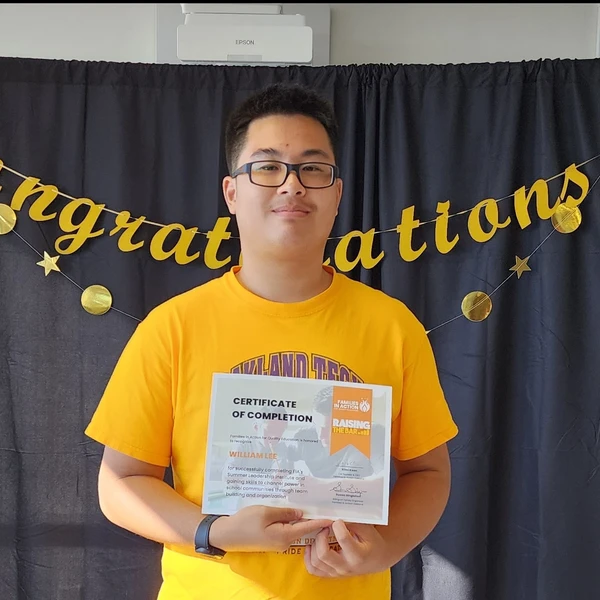
Families In Action — Student Intern2023 – 2023
Future Interests
Advocacy
Volunteering
Entrepreneurship
No Essay Scholarship by Sallie
K-POP Fan No-Essay Scholarship
Finance Your Education No-Essay Scholarship
Linda Kay Monroe Whelan Memorial Education Scholarship
Walking through Oakland Chinatown, with its grocery stores overflowing with mustard greens and daikon, and the aroma of fried rice wafting through the streets, I feel a deep sense of belonging. Growing up near this vibrant community, I always felt safe and accepted, which inspired me to give back in any way I could. For four years, I volunteered at the Oakland Chinatown StreetFest, working at booths filled with colorful merchandise like zodiac-themed t-shirts. What started as a simple way to contribute grew into something much more profound.
As one of the few Cantonese-speaking volunteers, I often found myself bridging the gap between generations. Many of the attendees were elderly, speaking primarily Cantonese, and I became a translator—not just of words, but of emotions and intentions. One moment stands out: an elderly woman approached our booth, looking for a craft she could gift to her grandchildren. My ability to communicate with her in her native language allowed me to help her find the perfect item. Her smile and gratitude showed me the power of connection.
I began volunteering with the hope of giving back to my community, but I soon realized how much I was gaining in return. Each interaction taught me the value of language, culture, and human connection. It inspired me to continue supporting my community’s traditions and pass them on to future generations.
This same sense of purpose carried over when I joined Peer Forward (PF), a program aimed at educating students from low-income communities about post-secondary opportunities. When I started high school, I was shy and unsure of my abilities. However, PF gave me a chance to step out of my comfort zone. During my first meeting, as we brainstormed ideas for initiatives, I felt a spark of excitement. That spark grew into a flame when I became the team’s Data Manager. In this role, I combined my organizational skills with a passion for helping others, tracking event participation, co-leading workshops, and empowering students to envision their futures.
An event I helped organize was a Vision Board workshop for freshmen, encouraging them to think about their goals. Watching students cut out images of college logos and dream jobs, I felt proud, knowing that I had played a role in helping them plan their futures. Another fulfilling moment was leading a presentation on A-G requirements, where my teammate and I broke down complex graduation requirements for underclassmen. Seeing their understanding grow was a reminder of how impactful even small acts of guidance can be.
What began as a way to help others have transformed me. Through volunteering in Chinatown, I learned how to connect across generations and preserve my community’s traditions. Through Peer Forward, I developed leadership skills and learned how to uplift others. These experiences have shown me that helping others helps me grow. Each moment of service has taught me something new about empathy, resilience, and the importance of stepping outside myself to make a difference.
Looking ahead, I want to continue bridging gaps—whether between generations, cultures, or educational opportunities—while learning from every person and community I serve. In giving back, I have found my purpose, and I am excited to carry this passion into the future.
W. Tong and A.C. Wong Legacy Scholarship
Walking around Oakland Chinatown, you would see a lot of grocery stores full of mustard greens and daikon laid out in front and restaurants’ windows displaying delicious trays of fried rice and vegetables. Growing up near here, I always felt safe and accepted. For four years, I volunteered at the Oakland Chinatown Street Fest, working at a booth filled with vibrant merchandise like t-shirts with the zodiac of the year. The festival is something that happens once a year, and it unites the local community, with the attendance leaning more towards the elderly, many of whom speak primarily Cantonese. Being one of the few volunteers fluent in the language, I often find myself translating, not just words but stories and emotions, creating meaningful interactions between the old and new generations. Being able to make that special and emotional connection helps me to really bridge this gap and create meaningful interactions between the old and new generations. One moment that stood out is when an elderly woman approached our booth, looking for a specific craft that she could give to her grandchildren. My ability to communicate with her in Cantonese allowed me to help her find what she was looking for, and her appreciation was seen in her smile. This interaction, being simple, made me notice the power of language and connection. It’s a small way I can give back to a community that gave me so much. When I began volunteering, I thought it meant doing something nice, but my experience was much more than that. I have gotten to know the elders in my community and learned about their life experiences, and now I am increasingly spirited about keeping the traditions alive that define my community. For college, I would like to continue “keeping the traditions alive” by continuing the work I have done in my community by finding more similar opportunities in different community.
Sean Carroll's Mindscape Big Picture Scholarship
Understanding the universe is important because it helps us make sense of the world around us. By studying the nature of our universe, we can unlock many mysteries and improve our lives. There are a few key concepts and ideas that can help us in this quest for knowledge.
First and foremost, the study of the universe allows us to learn about our origins. We humans have always been curious about where we come from and how everything started. By understanding the universe, we can piece together the puzzle of how the cosmos came into being. This knowledge can help us understand our place in the universe and our connection to it.
Another important reason to study the universe is to gain insights into the future. By understanding the laws that govern the cosmos, we can make predictions about the fate of the universe and our own planet. This knowledge can be crucial in preparing for potential cosmic events that could impact our existence. For example, by studying celestial objects, we can learn about the life cycles of stars and predict when a nearby star might go supernova, which could have devastating consequences for Earth.
Studying the universe can also inspire technological advancements. Many of the innovations we use today, such as GPS technology, have their roots in our understanding of space and the positioning of satellites. As we explore the universe, we develop new technologies that can improve our daily lives and drive economic growth.
One of the key concepts employed in understanding the universe is the scientific method. This method involves making observations, forming hypotheses, conducting experiments, and analyzing data to test those hypotheses. It's a systematic approach that has proven effective in unraveling the mysteries of the universe. Without the scientific method, we would be left with only conjecture and superstition.
Additionally, mathematics plays a vital role in our quest to understand the universe. Math is the language of science, and it provides a precise and unambiguous way to describe the fundamental laws of nature. Concepts like algebra, calculus, and geometry help scientists make sense of the complex phenomena observed in the universe. Without mathematics, our understanding of the cosmos would be limited.
In our exploration of the universe, the concept of space-time is of utmost importance. Space-time is a unified framework that combines the three dimensions of space with the dimension of time. It's the fabric of the cosmos, and our understanding of it has led to groundbreaking theories, such as Einstein's theory of relativity. This concept allows us to comprehend the way objects move in the universe and how gravity affects them.
Another crucial idea in the study of the universe is the concept of scale. The universe is vast, with objects ranging from subatomic particles to galaxies and clusters of galaxies. Understanding and appreciating the immense scale of the cosmos can be mind-boggling, but it's essential in comprehending how the universe operates. By studying phenomena at different scales, from the quantum world to the cosmic scale, we can piece together a more comprehensive picture of the universe.
Exploration and observation are fundamental in our quest to understand the universe. Telescopes, satellites, and space probes have enabled us to observe distant celestial objects and collect data that helps answer some of the most profound questions about the cosmos. The Hubble Space Telescope, for example, has provided us with stunning images and valuable information about distant galaxies, stars, and planets.
Furthermore, collaboration and sharing of knowledge are key components of our quest to understand the universe. Scientists from all over the world work together, sharing their findings and expertise. This global collaboration accelerates the pace of discovery and ensures that the scientific community can build upon each other's work.
Another important idea is the concept of cosmic evolution. Just as life on Earth has evolved over billions of years, the universe itself has undergone significant changes. From the Big Bang to the formation of galaxies, stars, and planets, the universe has a history that we can uncover. By studying cosmic evolution, we gain insight into how our universe has transformed over time and how it might continue to change in the future.
The concept of dark matter and dark energy is also pivotal in our understanding of the universe. These mysterious substances make up a significant portion of the cosmos, even though we cannot directly observe them. They have a profound impact on the structure and expansion of the universe. By studying dark matter and dark energy, we aim to shed light on the hidden forces that shape the universe.
Lastly, the concept of the multiverse is a fascinating idea that has gained traction in recent years. It suggests that our universe is just one of many universes in a vast "multiverse." Each universe in the multiverse could have different physical laws and constants, leading to diverse forms of existence. Exploring the concept of the multiverse challenges our understanding of reality and raises profound questions about the nature of the cosmos.
In conclusion, the study of the universe is of paramount importance because it helps us answer fundamental questions about our origins, predict our future, inspire technological advancements, and improve our daily lives. The scientific method, mathematics, space-time, scale, observation, collaboration, cosmic evolution, dark matter, dark energy, and the concept of the multiverse are all crucial in our quest to understand the universe. By employing these ideas and concepts, we can continue to unravel the mysteries of the cosmos and gain a deeper appreciation of our place in the universe.