Hobbies and interests
Biology
Chemistry
Reading
Academic
I read books multiple times per week
Wafaa Altaan Al Hariri
1x
Finalist1x
WinnerWafaa Altaan Al Hariri
1x
Finalist1x
WinnerBio
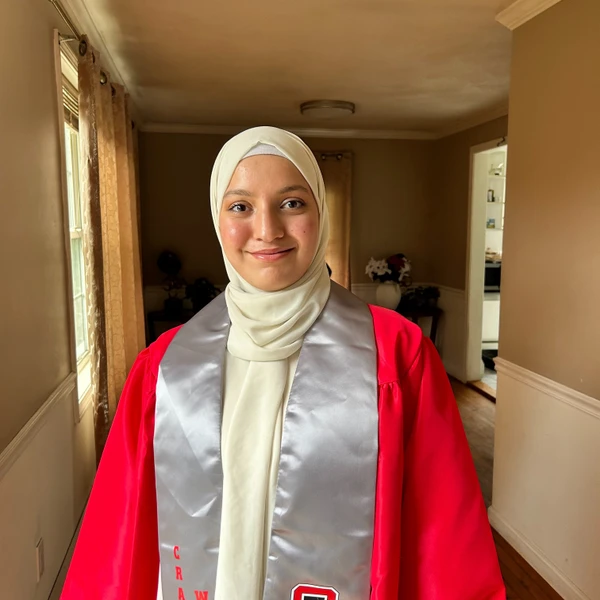
My name is Wafaa, and I am a freshman in the Pharm.D. program at the University of Rhode Island. I am the first in my family to attend college and the first to pursue a STEM field. Neither of my parents graduated or currently work, so I pay $3,000 each semester while balancing school and weekend jobs.
I was four when the Syrian revolution began in Daraa, Syria. My earliest memories are filled with fear, hiding in a basement, hearing airstrikes, and uncertainty. In 2013, my family walked 85 kilometers, nearly 110,000 steps, to reach the Zaatari refugee camp in Jordan. Life in the camp taught me resilience, resourcefulness, and the power of small acts of care in building community.
In 2016, my family resettled in Providence, Rhode Island. I quickly learned English, adapted to a new school system, and balanced academics with work and volunteer activities, including mentoring refugee youth and participating in community programs. These experiences taught me empathy, leadership, and the value of giving back.
I am passionate about pharmacy, healthcare, and helping others. I hope to use my education to improve access to care for underserved communities and advocate for those whose voices are overlooked. Being a Syrian refugee and a first-generation college student has shaped me into a resilient, adaptable, and determined individual. My experiences have shown me that challenges do not define us; how we respond does. I am eager to continue learning, growing, and contributing to my community and beyond.
Education
University of Rhode Island
Bachelor's degree programMajors:
- Pharmacy, Pharmaceutical Sciences, and Administration
Cranston High School West
High SchoolMiscellaneous
Desired degree level:
Doctoral degree program (PhD, MD, JD, etc.)
Graduate schools of interest:
Transfer schools of interest:
Majors of interest:
Career
Dream career field:
Pharmaceuticals
Dream career goals:
I hope to earn a PhD in pharmacy or pharmaceutical sciences to conduct groundbreaking research, mentor future students, and contribute to innovative treatments that improve healthcare access for underserved communities. I want to combine research, teaching, and community impact to make a meaningful difference in the field of medicine.
Sales Associate – Assist customers, manage inventory, and support store operations. Work 15–20 hours per week while balancing full-time Pharm.D. coursework and other responsibilities.
Marshalls2025 – Present1 yearIT Assistant – Provide technical support for students and faculty, troubleshoot software and hardware issues, and maintain computer systems. Work 10 hours per week while balancing full-time Pharm.D. coursework.
University of Rhode Island2025 – Present1 yearJunior Counselor – Led a class of 13 refugee students in math, English, and science, developed engaging activities, facilitated communication using Arabic, and supported newly resettled youth. Contributed 40 hours/week over a five-week summer program.
Refugee Youth Solidarity through Education (RYSE)2021 – 20221 yearIntern – Collaborated on a team to develop a business plan, analyzed financial data, calculated costs and projected income, researched market trends, and proposed strategic recommendations. Completed 150 hours and earned a $15/hour stipend.
PrepareRI Internship – Electric Boat, Providence, RI June - August 20242024 – 2024
Sports
Badminton
Club2025 – Present1 year
Awards
- I play badminton weekly at the University of Rhode Island through a recreational club. It's become an important part of my routine, helping me stay physically active, connect with others on campus, and maintain a healthy balance between academics and personal well-being.
Research
Pharmacy, Pharmaceutical Sciences, and Administration
N/A — As I am a freshman pharmacy student interested in medicine development and why refugees and immigrants may distrust the U.S. healthcare system. Excited to pursue research in these areas.2025 – Present
Public services
Volunteering
Rhode Island Community Khayr (RICK) — Coordinated major community events, assisted with Ramadan meal prep, organized fundraising, and ensured smooth execution of community programs.2022 – PresentAdvocacy
Refugee Youth Power Movement (RYPM) — Participated in an 8-day program with refugee youth, explored societal injustices, learned about career pathways, and strengthened leadership and advocacy skills.2020 – 2021Volunteering
Muslim Youth of Rhode Island — Organized and supported community events, youth programs, and fundraising while maintaining welcoming spaces to engage and empower Muslim teens and young adults in Rhode Island.2022 – Present
Future Interests
Advocacy
Politics
Volunteering
Philanthropy
Entrepreneurship
Henry Respert Alzheimer's and Dementia Awareness Scholarship
Alzheimer’s disease has impacted my family in a deeply personal way. My grandmother, who lives in Syria, is now showing signs of memory loss and confusion. Access to healthcare and support in a post-war region is extremely limited, and I cannot be there to help her in person. Watching her struggle from afar has been painful, but it has also strengthened my determination to pursue a career in healthcare and medical research, specifically focusing on Alzheimer’s disease.
I am currently an undergraduate student pursuing pharmacy, and I hope to dedicate my career to Alzheimer’s research. I want to help families like mine whose loved ones face memory loss with minimal resources by developing better treatments, expanding access to care, and raising awareness about dementia. This ambition is deeply personal. It is rooted in love, experience, and the desire to make a tangible difference in the lives of patients and their families.
At the same time, pursuing my education is a challenge. To afford tuition and living expenses, I work two part time jobs while maintaining a demanding academic schedule. Balancing work, school, and volunteering leaves limited time for research or community initiatives. Yet I remain committed to giving back. I volunteer at my local mosque, help organize educational events through the Muslim Student Association, and mentor refugee youth. These experiences remind me that healthcare is not only about science. It is about empathy, service, and connection.
Receiving this scholarship would have a meaningful impact on my education and future. It would allow me to dedicate more time to studying, participating in research opportunities, and gaining hands-on experience in Alzheimer’s and dementia care. With fewer financial pressures, I could focus fully on developing the skills and knowledge needed to contribute to medical research that can improve the lives of patients and families facing dementia.
My grandmother’s experience has taught me patience, resilience, and the importance of advocacy. It has shown me that memory loss is not just a personal struggle. It affects entire families and communities, especially where resources are scarce. These lessons motivate me every day to pursue research, volunteer, and prepare for a career where I can make a meaningful impact on Alzheimer’s awareness and treatment.
In short, my connection to Alzheimer’s disease is both personal and purposeful. Scholarships like this one would allow me to continue my education without compromise, to focus on research, and to build the skills necessary to make a real difference in the lives of patients and families affected by dementia. I am determined to turn my grandmother’s struggle into a source of inspiration, using it to guide a future in which healthcare is more compassionate, accessible, and informed by research.
Simon Strong Scholarship
Adversity first entered my life before I even understood the word.
At six years old, I fled Daraa, Syria with my family as war consumed our city. We walked nearly 85 kilometers to safety, leaving behind our home, our community, and the only life I had known. I remember the fear in the air, the urgency in my parents’ voices, and the uncertainty of what tomorrow would look like. We eventually found temporary refuge in a camp before resettling in the United States to begin again from nothing.
Starting over in a new country was a different kind of challenge. I did not speak English. I entered classrooms where I could not understand the lessons, and I watched my parents struggle to navigate systems written in a language they could not read. As a child, I often translated documents and interpreted conversations beyond my years. I quickly learned that survival required adaptability.
The adversity was not only external. It was internal. There were moments of isolation, of feeling different, of wondering whether I truly belonged. As a first-generation college student and a woman of color pursuing a degree in pharmacy, I have had to carve my own path without a blueprint. I taught myself how to navigate college applications, financial aid, and academic expectations while balancing work and family responsibilities.
But adversity shaped me in powerful ways.
It taught me resilience. When you rebuild your life once, you learn that obstacles are not endpoints. They are challenges to be solved. It taught me empathy. Having experienced displacement and uncertainty, I am deeply aware of how invisible struggles can be. And it taught me responsibility. I understand that my success is connected to the sacrifices of my family and the support of my community.
Because of this, I have committed myself to service. I volunteer at my local mosque, organize cultural and educational events through the Muslim Student Association, and mentor refugee youth adjusting to new schools and environments. I work to create spaces where others feel understood rather than alone. My experiences have transformed pain into purpose.
If I could give advice to someone facing similar adversity, it would be this: your circumstances do not define your ceiling. They shape your strength. It is easy to feel behind when you are learning a new language, adapting to a new culture, or navigating systems without guidance. But resilience is built in those moments. Ask for help without shame. Seek community. And remember that growth often feels uncomfortable before it feels empowering.
Adversity is not something I would have chosen, but it is something I have chosen to rise from. It pushed me toward healthcare, where I can advocate for underserved communities and ensure patients feel heard and respected. It gave me perspective that cannot be taught in textbooks.
My journey began with displacement, but it continues with determination. The challenges I faced did not weaken my ambition. They strengthened it. And through resilience, service, and leadership, I intend to turn every obstacle into impact.
Kristinspiration Scholarship
Education, to me, is not simply a degree. It is dignity, stability, and transformation.
I am a first-generation college student, a Syrian refugee, and a woman pursuing a degree in pharmacy. My understanding of education was shaped long before I stepped into an American classroom. At six years old, I walked nearly 85 kilometers with my family to escape the war in Daraa, Syria. We rebuilt our lives from nothing in a refugee camp before eventually resettling in the United States. In those uncertain years, one truth remained constant in my household: education was the one thing no one could take from us.
My parents did not have the opportunity to pursue higher education. They sacrificed their own dreams to ensure my siblings and I could chase ours. When we arrived in the United States, I did not speak English. My parents could not guide me through course registration, financial aid forms, or standardized testing. Every step toward college required independent research, long nights, and relentless determination. I learned how to navigate systems that were completely unfamiliar while balancing cultural expectations and financial responsibility.
Being first generation means carrying both pressure and purpose. I carry my family’s hopes with me into every classroom, every exam, and every opportunity. I work two part time jobs to afford living on campus so I can fully participate in my academic program, since commuting from home without reliable transportation would take hours each day. The weight is heavy, but it fuels me rather than discourages me.
Education is important to me because it transforms survival into opportunity. It gives me the tools to serve others in meaningful ways. Through pharmacy, I am preparing to address healthcare inequities that disproportionately affect refugees and underserved communities. I have translated medical forms for my parents and watched capable people struggle to navigate complex systems simply because they lacked language support or guidance. My education allows me to become someone who closes those gaps.
The legacy I hope to leave is one of access and empowerment.
In my family, I am the first to attend college. I do not want to be the last. I want my younger siblings, cousins, and future generations to grow up seeing higher education not as an intimidating mystery, but as an attainable expectation. I want them to inherit confidence instead of uncertainty.
Beyond my family, I hope to leave a legacy of compassionate leadership in healthcare. I want to build clinics and community outreach programs that prioritize cultural understanding and clear communication. I want patients from marginalized backgrounds to see themselves reflected in positions of expertise and authority. Representation matters, and I intend to be part of that change.
Education gave me a path when my life began in displacement. It gave structure to chaos and direction to uncertainty. More than anything, it gave me the power to choose my future rather than be defined by my past.
My legacy will not be measured only by my degree, but by how many doors I open for others along the way.
Harry & Mary Sheaffer Scholarship
College is often described as a time of independence. For me, it is an act of responsibility.
As a first-generation college student, a Syrian refugee, and a woman pursuing pharmacy, I understand that education is not just personal advancement. It is preparation for service. Because both of my parents do not drive, commuting from home would require nearly four hours each day on public transportation. To live on campus and stay fully engaged in my academic program, I work two part time jobs while maintaining a strong GPA. Every hour I spend working is necessary, but it is also time I wish I could invest even more deeply into serving my community.
Service has always been central to who I am. I actively volunteer at my local mosque, helping organize community events, prepare meals, and support youth programming. Through the Muslim Student Association on campus, I help coordinate educational and cultural events that create dialogue and foster understanding among students of different backgrounds. These spaces matter deeply to me because I know what it feels like to search for belonging in a new country.
My greatest strength is my ability to connect across cultures. Growing up as a refugee taught me resilience, but it also taught me empathy. I learned English while helping my parents translate school emails, official documents, and medical forms. I saw firsthand how easily language barriers can create isolation. Those experiences shaped my desire to build bridges between communities that may not always understand one another.
Through pharmacy, I plan to combine science with compassion. Healthcare is one of the most powerful spaces to build trust and understanding. As a future pharmacist, I want to serve diverse and underserved populations, ensuring patients not only receive medications, but also feel heard, respected, and understood. I hope to work in communities where cultural awareness and clear communication can make the difference between confusion and confidence in care.
Beyond my career goals, I am committed to strengthening the global community at a local level. Whether organizing events through MSA, volunteering at the mosque, mentoring refugee youth, or supporting cultural initiatives, I strive to create spaces where people feel valued. Empathy begins with presence. It requires time, energy, and intention.
Receiving this scholarship would ease my financial burden and reduce the number of hours I must dedicate to work. With that time, I would expand my volunteer efforts, take on greater leadership roles in community organizations, and develop outreach initiatives that promote intercultural dialogue and health education. It would allow me to invest more fully in the service that already defines my life.
Being first generation means building opportunities that did not exist before. It means honoring sacrifice with action. My journey from refugee to college student has shaped not only my ambition, but my responsibility to give back.
Through resilience, cultural understanding, and a commitment to service, I will continue working to build a more empathetic and connected global community, one conversation, one patient, and one act of service at a time.
Jeannine Schroeder Women in Public Service Memorial Scholarship
To many, college is a next step. To me, it is a milestone generation in the making.
I am a first-generation college student, a Syrian refugee, and a woman in STEM pursuing a degree in pharmacy. My journey began not in a classroom, but on foot, walking nearly 85 kilometers with my family to escape the war in Daraa, Syria. More than 110,000 steps carried us through airstrikes and shattered streets to the Zaatari refugee camp in Jordan. I was six years old, but I already understood that education would be my path forward.
Today, I am working to address a social issue that deeply affects communities like mine: unequal access to healthcare for refugees and underserved populations. Displaced families often face language barriers, limited health literacy, financial hardship, and distrust of medical systems. I have lived these barriers. I have translated complex forms for my parents, navigated unfamiliar healthcare systems, and watched capable, hardworking people struggle simply because they did not understand the system designed to help them.
When we resettled in the United States, I did not speak English. I learned the language while also learning how to navigate an education system my parents had never experienced. As a first-generation student, I had no blueprint, only determination. I taught myself how to apply for scholarships, enrolled in rigorous coursework, and pursued pharmacy because I saw it as a bridge between science and service.
Beyond academics, I have committed myself to serving refugee and immigrant communities. As a junior counselor in a summer program for newly resettled refugee youth, I helped students adapt to new schools and cultures while preserving pride in their identities. I have organized cultural and educational events, prepared meals for families in need, and supported local initiatives that promote inclusion and youth leadership. Each act of service is rooted in the belief that no one should feel alone in systems that are meant to support them.
Through pharmacy, I aim to confront healthcare inequity at both the individual and systemic levels. Pharmacists are often the most accessible healthcare providers. I hope to serve in communities where language and cultural understanding are barriers to care, ensuring patients understand their medications, feel heard, and receive compassionate guidance. In the long term, I aspire to advocate for policies that expand healthcare access for refugees and marginalized populations.
Jeannine Schroeder believed in building a more beautiful and just world through service. I honor that legacy by combining STEM with public service, by using science not just to build a career, but to build equity.
This scholarship would ease my financial burden, but more importantly, it would affirm that women like me, refugees, first generation students, and future healthcare providers, belong in spaces of leadership and service. My journey began with survival. It continues with purpose.
Being first generation, means being first, but never the last. I am building a path so others can walk it more easily, and I will keep walking until healthcare, education, and opportunity are accessible to all.
Bick First Generation Scholarship
WinnerTo many, college is a next step. To me, it’s a milestone generation in the making.
I am a first-generation college student, a Syrian refugee, and a woman in STEM pursuing a degree in pharmacy. My educational journey began not in a classroom, but on foot, walking nearly 85 kilometers with my family to escape the war in Daraa, Syria. That journey was over 110,000 steps, each one carrying fear, hope, and the determination to survive. We fled airstrikes, walked through shattered streets, and finally reached safety in the Zaatari refugee camp in Jordan. I was only six years old, but I knew that education would be my way forward.
When we resettled in the United States, I didn’t speak English. Every day was a challenge, from learning a new language to navigating unfamiliar school systems with no family history of higher education to guide me. My parents, who never had the opportunity to attend college, could not help with financial aid forms or course selection. I had to learn everything from scratch, what AP classes were, how to write a résumé, and why SATs mattered.
Being a first-generation student means more than being the first to attend college. It means building a future without a blueprint. It means translating school emails for your parents while figuring out how to apply for scholarships late into the night. It means balancing cultural expectations with academic demands and carrying the dreams of your family with every step forward.
But it also means being resilient.
I’ve taken every opportunity to give back to the community that welcomed me. I’ve worked as a junior counselor for a summer program supporting newly resettled refugee youth, helping them adapt to their new environment. I’ve helped organize cultural and educational events, prepared meals for those in need, and supported local organizations that promote inclusion and youth leadership. I currently work as an IT assistant while studying full-time in a demanding academic program. Every job, every volunteer shift, every late night spent studying has been fueled by the belief that my success is not mine alone, it belongs to my family, my community, and every young person who dreams of doing more than just surviving.
This scholarship would ease a financial burden that weighs heavily on my education. But more than that, it would affirm that my journey, and that of so many first-generation students, is seen and valued. It would allow me to focus on becoming a healthcare provider dedicated to community health and health equity. I hope to one day return to refugee communities to serve not just as a pharmacist, but as a source of hope.
Being first-generation means being first, but never the last. It means paving a path so others can walk it more easily. I’m proud to be that person, and with your support, I’ll go even further.
Champions Of A New Path Scholarship
My name is Wafaa Al Hariri. I am a freshman in the Pharm.D. program. I grew up in Syria where war began when I was four years old. In 2013, when I was eight, my family fled on foot to Jordan. We walked over 85 kilometers, and then in 2016 we resettled in the United States. In my family of nine, my father is deaf and mute and my mother is partially deaf. None of my siblings finished high school because they had to work full time to support our family while living in Jordan. I am the first in my family to study college and the first to pursue a STEM field.
These circumstances have been my greatest teacher. Because no one in my family finishes high school, I knew early that the chance to learn meant more than books. It meant hope, and a future. Because my parents cannot hear or speak well, I became their voice early on. I interpreted at doctor’s appointments, helped with forms, and made sure they understood what others could say. Because no one drove, even travel to school or clinic required planning. Because daytime was full of classes, family responsibilities kept me busy in evenings and weekends. These roles taught me patience, responsibility, and resilience. They taught me to manage time and pressure in ways many students never face until later.
What gives me an advantage over others is not perfect grades or less struggle, but that I carry experiences that build character. I know how it feels to be unheard, unseen, and yet still strive. I know what it is to walk toward a goal while carrying weight most don’t have to carry. I know that when I succeed, I carry not just my own dreams, but the hopes of my family, my siblings, and others who look like me.
I want this scholarship because it will allow me to afford tuition without extra panic, to buy the materials I need, to reduce the number of hours I work so I can focus more on learning and helping others. It will give me the chance to continue volunteering, mentoring refugee youth, and being a role model. I will honor this opportunity by excelling in my studies, pushing forward even when obstacles arise, and using every tool I am given to lift others.
I deserve this scholarship because I bring more than academic potential. I bring resilience, lived experience, and a relentless drive to give back. I carry my history as fuel, not as burden. This scholarship will help me build a future that honors where I came from, and serves those who have not yet had the chance to rise.
Women in STEM Scholarship
Growing up during war, displacement, and resettlement shaped not only my life but also my understanding of health and science. My name is Wafaa, and I am a first-year student in the Pharm.D. program at the University of Rhode Island. I grew up in a family of nine children, raised by a deaf and mute father and a partially deaf mother. As the second youngest, I watched my older siblings sacrifice their education to work full-time and support our family after we fled Syria in 2013. We resettled in the United States in 2016, and I became the first in my family to pursue higher education and enter a science-based field.
I chose pharmacy because I have witnessed firsthand how critical healthcare access is, especially for displaced families and underserved communities. When we lived in Jordan as refugees, getting medication and basic care was often impossible. After arriving in the U.S., we were grateful for safety, but cultural and language barriers still made healthcare difficult to navigate. These experiences pushed me toward a career where I can help bridge the gap between science and the real, human needs of people who are often left behind.
As I move through my program, I hope to focus on research that explores how trauma and displacement affect long-term health outcomes. I am especially interested in how conditions like PTSD and chronic stress impact medication adherence and treatment success in refugee and immigrant populations. I also want to investigate how community-based pharmacy programs can increase access to care and improve health education in low-income or non-English-speaking neighborhoods. Ultimately, I want my work to inform policies and programs that are both medically effective and culturally informed.
Outside the classroom, I work two jobs to support myself and my family—one as an IT assistant on campus and another on weekends at a local retail store. Despite this, I remain committed to giving back. I volunteer with organizations such as Refugee Youth Solidarity through Education, where I served as a junior counselor supporting newly resettled students. I also help coordinate community service events through the Muslim Youth of Rhode Island and Rhode Island Community Khayr, focusing on outreach, education, and mutual aid.
For me, pursuing a scientific career is not just about academic achievement. It is about using my knowledge to make healthcare more inclusive, compassionate, and accessible. This scholarship would significantly reduce my financial burden, giving me more time to invest in both my education and service. It would also allow me to take on leadership roles that inspire other young women, especially those from immigrant, first-generation, or low-income backgrounds, to see themselves in scientific spaces.
Representation matters. As a Muslim woman in a pharmacy program, I understand how isolating it can feel to be the only one in the room who looks or sounds like me. I want to change that by not only succeeding in my own path but by creating space for others to follow. Science needs diverse voices, perspectives, and lived experiences to grow and truly serve everyone.
I am driven by the belief that knowledge should heal, not divide. I hope to bring that spirit into every lab I work in, every patient interaction I have, and every community I serve. Thank you for considering my application.
Liz & Wayne Matson Jr. Caregiver Scholarship
My name is Wafaa, and I am a freshman in the Pharm.D. program. Since I was a child, I have taken on responsibilities that most people my age have never experienced. My father is deaf and mute, and my mother is partially deaf. Because of their disabilities and language barriers, I have served as their primary caregiver and communicator. These experiences have shaped my goals, strengthened my character, and influenced how I view my place in the world.
I come from a large family of nine children, and I am the second youngest. None of my older siblings were able to complete high school because they had to work full-time to support our family while we were living in Jordan as refugees. I was born in Syria in 2007, and after the war began in 2011, we fled to Jordan in 2013. We resettled in the United States in 2016. My parents, who never had access to formal education, relied heavily on me to help them navigate life in a completely unfamiliar country. As soon as I learned English, I became their interpreter at medical appointments, school meetings, and government offices. I translated important documents, filled out forms, and made phone calls on their behalf.
My caregiving responsibilities have only grown with time. I manage household tasks, communicate with service providers, and help them understand the systems they must engage with to survive and thrive. While other students focused solely on academics or extracurriculars, I balanced schoolwork with caring for my parents and supporting my family’s needs. These experiences taught me discipline, time management, and empathy. I have learned to remain calm in difficult situations and to be resourceful when facing unfamiliar challenges.
My caregiving journey has inspired my career path. I chose pharmacy because I want to work closely with patients, especially those who face language barriers, disabilities, or limited access to healthcare. I understand what it feels like to not be heard or understood. My goal is to be someone who not only provides medication but also compassion and advocacy for people who are often overlooked.
Receiving this scholarship would ease the financial pressure on my family and allow me to focus more on my studies and continued service to others. I want to give back to the community that welcomed me and help those who are struggling just like we once were. My dream is not just to earn a degree, but to become a healthcare professional who makes a real difference in people’s lives.
Caring for my parents has shaped who I am. It has made me stronger, more compassionate, and more determined to succeed. This scholarship would support my continued growth and help me keep moving forward toward a future where I can care for others with the same love and commitment I have given to my family.
Mikey Taylor Memorial Scholarship
My name is Wafaa, and my experience with mental health has been shaped by growing up in a war zone and becoming a refugee. I was born in 2007, and when the war in Syria started in 2011, I was only four years old. My family fled to Jordan in 2013 and finally arrived in the United States in 2016. During these years, I witnessed violence, loss, and instability that affected me deeply. Although I was diagnosed with post-traumatic stress disorder after resettling, I have not spoken openly about my struggles with my family. Syria is still a difficult subject for us. Instead, I have channeled my pain into a determination to help others who have been displaced or affected by conflict.
My experiences have made me passionate about standing up for refugees and displaced populations. I am an anti-war activist because I believe no child or family should have to endure the hardships I faced. The trauma I carry motivates me to work toward a more just and peaceful world. It has also shaped my beliefs about strength and resilience. Even though I face challenges, I continue to move forward and fight for the rights and dignity of people like me who have been uprooted from their homes.
These struggles have also influenced how I relate to others. I understand what it means to feel isolated and scared. While I do not often talk about my mental health openly, I try to show empathy and kindness to those around me. Volunteering with refugee youth and community groups has taught me the power of listening and supporting others quietly. I want to be a person who provides hope and understanding to those who are struggling.
My career goals are deeply connected to my mental health journey. I am a freshman in a Pharm.D. program because I want to help improve health care for underserved communities, especially refugees and immigrants. I hope to become a healthcare provider who recognizes the importance of mental wellness alongside physical health. My goal is to create a safe and welcoming space where patients feel respected and cared for as whole people, not just as cases or illnesses.
Receiving this scholarship would relieve some of the financial burdens I face and allow me to focus more on my education and community involvement. It would support my continued growth as a student and an advocate. I am committed to using my experiences and education to make a positive impact on the lives of others.
In conclusion, my mental health challenges have shaped my beliefs, strengthened my empathy, and fueled my passion for social justice and healthcare. Through my work and studies, I hope to honor the strength of those who have endured hardship and to contribute to a better future for displaced people everywhere.
Brooks Martin Memorial Scholarship
My name is Wafaa, and my life has been shaped by many losses, but the one that changed me most deeply was losing the childhood I once knew because of war. Born in 2007 in Syria, my family’s world was turned upside down when the civil war started in 2011. Though I was only four years old, I still remember the fear and uncertainty that followed.
The loss I experienced was not the death of a loved one, but the loss of safety, home, and normal childhood experiences. When the fighting intensified in 2013, my family and I fled our home city of Daraa. We walked for days, covering more than 85 kilometers, to reach a refugee camp in Jordan. This journey was full of fear, pain, and hardship. We left behind everything we had ever known; friends, family memories, and the life we had planned for ourselves.
In Jordan, life was difficult. My older siblings had to work full time to help support our family, and they never finished high school. My parents, both with hearing impairments, struggled to find stable jobs and provide for us. Despite these challenges, I was determined to keep learning and growing.
In 2016, we were resettled in the United States. Though we were safe, the loss of my early childhood and the burden of war have stayed with me. I was diagnosed with PTSD after arriving here, and I have had to work hard to heal and find peace.
This experience of loss has shaped who I am today. It has made me resilient and deeply empathetic toward others facing hardship. I have learned that even when everything feels impossible, moving forward takes courage and determination. I carry these lessons with me in my education and daily life.
Losing my childhood to war has influenced my goals profoundly. I am now a freshman in the Pharm.D. program, motivated by a desire to help others who suffer, especially refugees and underserved communities. I want to use my education to improve health care access and outcomes for people who, like me, have faced great challenges.
The loss I endured taught me the value of family, community, and support. It pushed me to become a leader in volunteer programs that assist refugee youth and to advocate for inclusion and understanding. I want my work to bring healing and hope to others who are struggling.
While my journey has been shaped by loss, it has also been defined by resilience and ambition. I strive to honor the strength I have gained by giving back, by helping others find their way forward. Receiving the Brooks Martin Memorial Scholarship would not only ease financial burdens but also be a powerful reminder that even after loss, there is a future worth fighting for.
In memory of Brooks and in honor of all who have experienced profound loss, I commit to living a life of purpose, courage, and compassion.
Equity Elevate Scholarship
My name is Wafaa, and I am the second youngest of nine siblings. My family’s journey has been shaped by incredible challenges and unwavering resilience. My father is deaf and mute, and my mother is partially deaf. None of my family members have had the opportunity to pursue education beyond basic levels, and I am proud to be the first to study STEM and attend college.
Born in Syria in 2007, I was only four years old when the war began. In 2013, when I was eight, my family and I fled our home in Daraa, walking over 85 kilometers to reach the Zaatari refugee camp in Jordan. We lived there under difficult conditions until 2016 when we were finally resettled in the United States.
Life in Jordan was especially hard for my family. Because of the war and economic hardship, my older siblings had to work full time to support us. They never finished high school, sacrificing their education so our family could survive. This reality made me even more determined to pursue my studies and honor their sacrifices.
Adjusting to life in the U.S. has not been easy. None of my family members know how to drive, so transportation has been a constant challenge. I often had to figure out how to get to school, appointments, and volunteer opportunities without reliable rides. This taught me independence, resourcefulness, and responsibility at an early age.
As a first-generation college student and a BIPOC woman, I am deeply motivated to succeed not only for myself but also to uplift my family and community. I am currently pursuing a Pharm.D. degree, driven by a passion to improve health outcomes and provide care for underserved populations like mine.
Being a single mother adds both challenges and strength to my journey. Balancing parenting and rigorous studies demands careful time management and sacrifice. This scholarship would provide critical financial support to help cover tuition and childcare costs, allowing me to focus on my education and community engagement.
My life experiences have shaped my values of perseverance, empathy, and hard work. They have fueled my ambition to become a healthcare professional who understands the unique barriers faced by marginalized communities. I want to be a role model for my siblings, my child, and others who face adversity but refuse to give up.
Receiving the Equity Elevate Scholarship would not only relieve financial burdens but also affirm my dedication to education and service. It would empower me to continue pursuing my dreams and make a lasting impact in my community.
Kalia D. Davis Memorial Scholarship
My name is Wafaa, and I am currently a freshman in the Pharm.D. program. Throughout my life, I have learned the value of hard work, perseverance, and community service. This scholarship would be a tremendous help in allowing me to continue pursuing my educational and career goals while supporting the community that has helped me grow.
Although I have not participated in sports, this was primarily due to time constraints and transportation challenges. No one in my family knew how to drive, which made it difficult to attend practices or events that required a ride. Balancing schoolwork, family responsibilities, and volunteering left little time for extracurricular sports. However, I have remained deeply committed to volunteering and community service, which has been a major part of my life. I served as a junior counselor with Refugee Youth Solidarity through Education, a summer program in Providence that supports newly resettled refugee youth. This role helped me develop empathy, leadership, and the ability to create a welcoming and supportive environment for others.
Additionally, I have volunteered with local organizations such as Muslim Youth of Rhode Island and Rhode Island Community Khayr, helping to organize events, prepare meals for people experiencing homelessness, and raise awareness about health and wellness. These experiences have shown me how small acts of kindness and service can have a powerful and lasting impact on individuals and communities. They have also strengthened my desire to pursue a career in pharmacy, where I can contribute to improving health outcomes and provide care to underserved populations.
This scholarship would ease the financial burden of my studies and allow me to focus more on my education and community involvement. The Pharm.D. program is demanding, but I am passionate about becoming a healthcare professional who serves others with compassion and dedication. Financial support would enable me to take on more leadership roles on campus and participate in volunteer opportunities that will help me grow personally and professionally.
The legacy of Kalia D. Davis inspires me deeply. Like Kalia, I am committed to excellence, kindness, and ambition. I strive to bring positivity and encouragement to those around me, whether in the classroom or in the community. Her example motivates me to keep moving forward despite obstacles and to help others do the same.
In conclusion, this scholarship would not only assist me financially but would also be a meaningful recognition of my efforts and aspirations. I am dedicated to working hard, serving my community, and making a positive impact. I hope to honor Kalia’s legacy by embodying the same work ethic and spirit of giving in my own life.
I Can and I Will Scholarship
I was four years old when the Syrian revolution reached my hometown of Daraa. For the next four years, I lived in a warzone. Bombs falling overhead became part of daily life. Nights were spent hiding in a basement, hoping the airstrikes would pass. By the time I was eight, my family could no longer survive the violence. We fled on foot, walking nearly 85 kilometers to reach the Zaatari refugee camp in Jordan. That journey took more than physical strength. It required emotional resilience that, as a child, I did not fully understand.
In the camp, I watched my parents try to hold our family together with almost nothing. There was no privacy, no stability, and no time to process what we had lost. Life became about survival. We eventually resettled in the United States, but the pain did not disappear just because we had found safety. I was diagnosed with PTSD not long after arriving. For the first time, there was a name for the constant anxiety, the sleepless nights, the overwhelming emotions I could not explain.
Mental health was never something we talked about openly in my culture. When I received my diagnosis, it felt confusing and even shameful at first. I wondered if something was wrong with me. But over time, I realized that surviving trauma does not make someone weak. It makes them human. Therapy, school counselors, and trusted mentors helped me begin healing. They gave me the tools to manage my emotions and the language to speak about what I had gone through.
That process changed everything for me. I began to see mental health not as something separate from who we are, but as a vital part of our well-being. I also saw how often refugees, immigrants, and low-income families struggle in silence because they do not know where to turn or fear judgment. I started volunteering with refugee youth, helping others who had experienced trauma find connection, support, and confidence. These relationships helped me heal further and inspired me to build a career centered around helping others feel seen, heard, and understood.
Today, I am a freshman in the Pharm.D. program at the University of Rhode Island. My goal is to become a pharmacist and researcher who brings a trauma-informed, human-centered approach to healthcare. I want to improve access to medicine and mental health support for underserved communities, especially those like the one I come from. I believe that healthcare should honor the whole person, including their emotional and cultural experiences, not just their physical symptoms.
My experience with mental health has shaped my beliefs about compassion, resilience, and justice. It has taught me to approach every person with empathy, because we do not always see the battles others are fighting. It has also made me more determined to become a healthcare provider who advocates for patients who feel unheard or misunderstood.
Living through war, displacement, and PTSD has not broken me. It has shaped me into someone who refuses to give up. It has given me a clear purpose: to use my story to improve the lives of others. I can, and I will.
Leading Through Humanity & Heart Scholarship
Essay 1
My name is Wafaa Al Hariri, and I am a freshman in the Pharm.D. program at the University of Rhode Island. I am a Syrian refugee and the first in my family to attend college and pursue a career in STEM. Growing up in a war-torn region, I witnessed how fragile health and wellness can be when basic resources and safety are taken away. My family fled Syria on foot, walking over 85 kilometers to reach a refugee camp in Jordan where medical care was scarce and difficult to access. These early hardships taught me the value of resilience, hope, and community support.
After resettling in the United States, I worked hard to adapt to a new language and culture while excelling in school. Volunteering with refugee youth and local organizations helped me realize the importance of compassionate care and the need to support mental health and cultural sensitivity in healthcare. I am passionate about becoming a pharmacist and researcher to improve healthcare access and trust for underserved populations like refugees and immigrants who often face systemic barriers. My experiences have inspired me to use my education to make a meaningful impact by ensuring healthcare respects the dignity and unique needs of every individual.
2. Second Essay
Empathy, to me, is more than simply feeling sympathy or kindness toward others. It is the deep ability to truly understand and share the experiences and emotions of another person. Empathy requires active listening, patience, and an open mind, especially in healthcare where every patient has a unique story that shapes how they experience illness and healing.
In the pharmacy and healthcare fields, empathy is essential. Patients are not just a collection of symptoms or a prescription to be filled. They are individuals with diverse backgrounds, fears, cultural beliefs, and personal challenges that influence their health decisions and outcomes. Without empathy, healthcare risks becoming mechanical and impersonal, which can result in miscommunication, mistrust, and poor treatment adherence.
My personal journey as a Syrian refugee has profoundly shaped my understanding of empathy. I know what it is like to navigate a healthcare system that can feel foreign and unwelcoming. Language barriers, financial struggles, and trauma from my past have created layers of mistrust toward healthcare providers among many in my community. I want to be a pharmacist who not only provides medications but also builds bridges of trust through compassionate care and cultural understanding.
I plan to apply empathy by actively listening to patients’ concerns and learning about their cultural and personal contexts. I will advocate for clear, respectful communication and ensure that patients are well-informed and empowered to participate in their healthcare decisions. Patient education will be a priority, especially for those who face language or literacy challenges.
A human-centered approach in healthcare means designing services and treatments that put people first. It requires working closely with patients, families, and communities to understand and address social determinants of health such as access to care, economic barriers, discrimination, and education. In my future research, I aim to focus on creating medicines and healthcare policies that reduce disparities and improve outcomes for marginalized populations.
Empathy will guide not only how I interact with patients but also how I engage with other healthcare professionals and researchers. It is the foundation for collaboration, innovation, and ethical care. Through empathy, I hope to contribute to transforming healthcare into a more inclusive system that honors the humanity of every person it serves.
Ultimately, empathy turns medicine from a science of curing into an art of healing. It ensures that healthcare is not just about treating diseases but about caring for people as whole, complex beings. This belief motivates me every day as I pursue my education and prepare for a career dedicated to improving lives through both science and compassion.
Christina Taylese Singh Memorial Scholarship
My name is Wafaa Al Hariri, and I am a freshman in the Pharm.D. program at the University of Rhode Island. I’m the first in my family to attend college, the first to pursue a STEM degree, and a proud Syrian refugee who dreams of making healthcare more accessible for those who feel left behind by the system.
My journey into healthcare began long before I stepped into a college classroom. I was only four when the Syrian revolution began in my hometown of Daraa. My earliest memories are not of classrooms or cartoons, but of airstrikes, basements, and fear. In 2013, my family fled Syria on foot, walking 85 kilometers to reach the Zaatari refugee camp in Jordan. We lived in a tent, relying on minimal access to medical care and basic needs. It was there that I first witnessed the impact of healthcare disparity and the kindness of those who worked to close that gap.
In 2016, we resettled in Providence, Rhode Island. I learned English, adapted to a new school system, and support my family. Despite the language barrier and financial hardship, I found ways to give back. I volunteered with the Refugee Youth Solidarity through Education (RYSE), mentoring newly resettled youth. I also worked with Muslim Youth of Rhode Island and Rhode Island Community Khayr (RICK), helping organize community events and fundraisers. These experiences deepened my desire to serve others, especially those like me, who have experienced trauma and disconnection from the healthcare system.
I chose pharmacy because I believe medicine should be both scientifically advanced and human centered. I am fascinated by how medications are developed, how they work, and how access or lack of it can shape a person’s health and future. I am especially interested in understanding why many immigrants and refugees distrust the U.S. healthcare system. As someone who has lived that reality, I want to bridge the cultural, financial, and systemic gaps that prevent equitable care.
Though I am early in my academic journey, my goal is to pursue a PhD in pharmaceutical sciences, conduct research on medicine development, and advocate for underserved populations. I hope to combine research, education, and community outreach to ensure that innovation in healthcare does not leave anyone behind.
Christina Taylese Singh’s story resonates deeply with me. Like Christina, I believe in the power of healthcare not just to heal, but to transform lives. Her dedication to occupational therapy reflects the compassion and drive that every healthcare professional should aspire to. I am honored to apply for a scholarship that carries her name and legacy.
I carry the resilience of my past and the hope for a better future, not just for myself, but for others who face similar challenges. I do not want to just be a pharmacist. I want to be someone who stands in the gap for others, offering knowledge, compassion, and care in equal measure.
Thank you for considering my application. I am committed to honoring Christina’s spirit of service through my education, my work, and my ongoing dedication to making healthcare a more inclusive, just, and compassionate field.