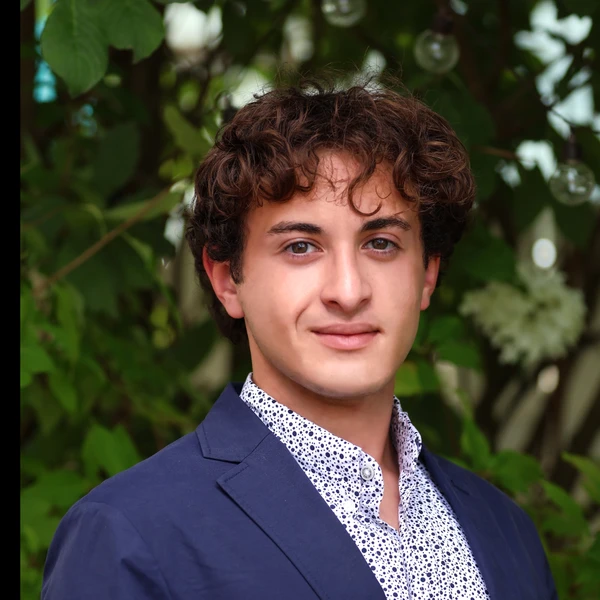
Viktor Kagan
1x
FinalistViktor Kagan
1x
FinalistBio
First-generation Yale College Environmental and Urban Planning graduate currently working in public service, exploring opportunities to grow and sustain my planning, design, and community engagement skillsets through part-time education.
I'm passionate about people, places, and the interactions in-between, inquiring what drives individual and mass movements, the design choices that attract people, and what active and executed plans prioritize societal and environmental health and well-being in urban and suburban settings. Cities are the workshops of ideas, innovation, and creativity. I aspire to analyze and replicate the policy and design that leads to functional, inventive, and sustainable communities.
Education
Yale University
Master's degree programMajors:
- Environmental Design
Yale University
Bachelor's degree programMajors:
- Geography and Environmental Studies
Miscellaneous
Desired degree level:
Master's degree program
Graduate schools of interest:
Transfer schools of interest:
Majors of interest:
- Foreign Languages, Literatures, and Linguistics, Other
- Environmental/Environmental Health Engineering
- Natural Resources and Conservation, Other
- Landscape Architecture
- Sustainability Studies
- Parks, Recreation, and Leisure Studies
- City/Urban, Community, and Regional Planning
- Area, Ethnic, Cultural, Gender, and Group Studies, Other
- Geography and Cartography
- Public Policy Analysis
- Geography and Environmental Studies
- Urban Studies/Affairs
Career
Dream career field:
Architecture & Planning
Dream career goals:
Climate and Jobs Organizer
POWER Interfaith2024 – 20251 yearChief of Staff
PA State House2025 – Present1 year
Research
Environmental Design
Yale Policy Institute — Center Head2021 – 2023
Public services
Public Service (Politics)
Philadelphia City Committee — Committeeperson2022 – Present
Future Interests
Advocacy
Politics
Volunteering
Entrepreneurship
Dr. Samuel Attoh Legacy Scholarship
Entering the gates of my university, I was uncertain about my future – it was a bastion of elitism and wealth, filled with students who had a story, a purpose, and often, a history within a space like Yale. They had, and were called, legacies. To me, legacy quickly became synonymous with privilege – a story of descent from consistent cycles of success. I soon realized that my story, and my family’s “legacy,” was not one of material wealth, nor did we have access to that wealth. It was of struggle, impact, community, and rebuilding, over and over.
Telling my story reminded me that being unlike those with financial wealth doesn’t make me legacy-less. Instead, I am the next iteration of my family’s legacy, building upon and expanding the foundation they too built upon. As I navigate life, I am reminded of legacies built, stories told, collective experiences, and impacts made. Legacy is an ever-evolving story that functions as an individual path, built brick by brick, and as part of a collective experience that imprints itself in varying ways.
Legacy is persistence. Often, I reflect on my name, Viktor, named after my paternal great grandfather who passed away fighting Nazis in WWII. His heroism and passion for freedom played a role in freeing my maternal family, trapped in Nazi-occupied Ukraine, only by happenstance escaping the Babi Yar massacre. These same survivors rebuilt, establishing a life in Soviet states, warding off Antisemitism while cementing themselves as neighborhood doctors, like my paternal grandfather, seamstresses, like my maternal grandmother, and repairmen, like my maternal grandfather. When Soviet pogroms made it impossible to remain, they fled and rebuilt in the US, supported by and then supporting those around them, building new interconnected communities.
Legacy is impact. My maternal grandfather passed away in 2023. Since then, my mother has worked diligently to see his remaining family members, from Connecticut, all the way to Estonia. Each new cousin, second uncle, great aunt, or distantly connected relative spoke of my grandfather’s kindness, his diligent and masterful work, and stories of his prized boat, back in Kiev. They recalled his love for animals and showed me the items he repaired, from TVs to woodwork, out of the kindness in his heart. He remains integral to our family, even as many had last seen him prior to the fall of the USSR. His memory is a blessing and his legacy an inspiring impact.
In my upbringing, I continuously hear stories of my family – lessons from my dad to not drink boiling hot tea the way his grandfather did, or my grandfather dumping a bowl of noodle soup on my mom’s head when she was younger. These stories build legacy, providing deeper context into the experiences that brought me into the very moment I am in, creating my own story. They are interwoven, paint character, and build community. Often, in decision-making, I think of the headstrong, yet goodwill character that remains as part of my grandfather’s legacy, something I believe my siblings and mother do as well. Never having met my paternal grandmother, I too reflect on her benevolent legacy that has been imparted onto those who, regardless of lifetimes, are connected to her. The legacy of those before me, alongside me, and ahead of me push me to build community, so that when my story is to be told, it is a continued story of my namesake, great grandpa Viktor, the story of those I know little of, and the ones who continue to inspire me today, to do good, build camaraderie, and persist to make an impact.
Bick First Generation Scholarship
Entering the gates of Yale, I was uncertain about my future – Yale was a bastion of elitism and wealth, a contrast to my thirteen years at Philadelphia’s public schools. Yet, walking in, I heard a friendly “Hello!” from my soon-to-be friend, Lydia, who I had met on orientation calls. Over the weeks, I met lifelong friends, all inquisitive about my story. A year prior, while applying to colleges, I realized I was first-generation – attending poor public schools lent the belief that everyone came from the same underprivileged experience where families struggled to financially support their children.
That September, I shared my first-generation story, that of my grandparents, Holocaust survivors, who escaped the USSR with my parents, aspiring to build a better life. Arriving in the US with nothing but hope, they built a foundation for me. Poor in wealth, but rich in community, my family ensured that I welcomed others. Building a network of friends at Yale, I observed differences – I taught some classmates how to do laundry, learning their parents owned a $10 million penthouse. Others came from places ravaged by poverty, struggling to find their place in an institution that accepted the likes of Jeff Bezos’ son. I often felt isolated. Weekly dinners out were expensive and exclusive.
Yet, telling my story reminded me that being unlike those with financial wealth doesn’t make me poor. Instead, I’m uniquely prepared to pave my own path and ensure that those who I build community with can build alongside me. I spread that wealth, connecting with first-generation students and multi-generational legacy students. Being first-generation allows me to build community and explore at Yale, as I don’t have a path predefined by those before me.
From day one at Yale, I’ve felt welcome. My openness about my story allows for those around me to comfort and uplift me. I seek to do the same, regardless of experience. I don’t know the root of this aspiration, whether from community at home, or the growing community around me. Yet, as a first-generation student, I aspire to cultivate kinship, to integrate and welcome all into that which supports me.
Sharing my story has made me feel integrated into communities I join, inviting others to welcome me into their story. My urban planning studies lend a hand to storytelling and the bonding that occurs – that of a run-in at a neighborhood park, or connecting while walking dogs. Close-knit communities like at Yale develop through run-ins and conversation, inspiring me to study and build interpersonal urban landscapes where community is natural, regardless of differences. Isolation – whether through Antisemitism in Nazi-occupied Ukraine or language barriers in a new country – plagued by family, but nevertheless led to development of community through storytelling. I refuse to allow my inexperience in elite spaces to deter the construction of new stories. This scholarship will allow for my studies to initiate conversation and research into effective community-building strategies, and design of better, more human and sustainable cities.