user profile avatar

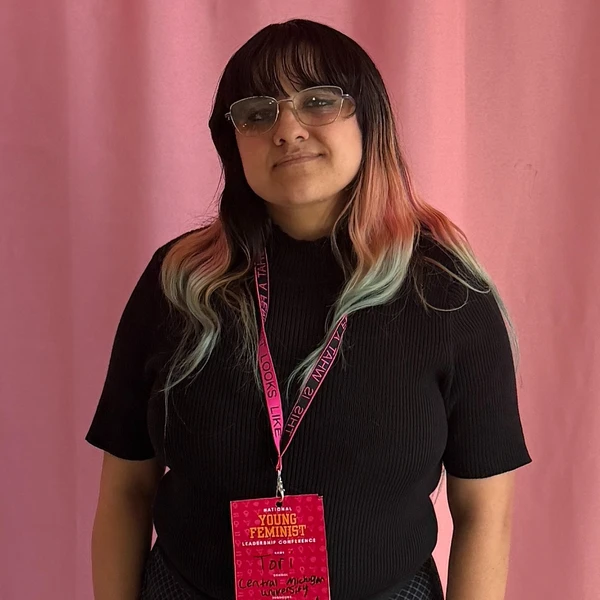
Victoria Zuber

1x

Finalist

Bio

Political Science major with a minor in Women's and Gender Studies and Theatre and Interpretation at Central Michigan University. Secretary for Feminists for Change. As an organization, FFC earned recognition from the Feminist Majority Foundation and won an award at the Young Feminist Leadership Conference in 2025. Vice president and social chair for Spectrum, CMU's oldest LGBTQ organization. Member of the College Democrats at CMU; recipient of an award from the Michigan College Democrats for my work registering students to vote and collecting signatures committing to vote in the 2024 presidential election. First-generation college student, Mexican-American.

Education

Central Michigan University

Bachelor's degree program
2024 - 2028
  • Majors:
    • Political Science and Government
  • Minors:
    • Drama/Theatre Arts and Stagecraft
    • Area, Ethnic, Cultural, Gender, and Group Studies, Other
  • GPA:
    3.5

Muskegon Community College

Associate's degree program
2020 - 2024
  • Majors:
    • Drama/Theatre Arts and Stagecraft

Western Michigan Christian High School

High School
2016 - 2020

Miscellaneous

  • Desired degree level:

    Master's degree program

  • Graduate schools of interest:

  • Transfer schools of interest:

  • Majors of interest:

    • Political Science and Government
    • Law
  • Not planning to go to medical school
  • Career

    • Dream career field:

      Political Organization

    • Dream career goals:

      Campaign Manager, Immigration Lawyer, Nonprofit or Advocacy

    • Costume Shop Assistant

      Central Michigan University Department of Theater and Dance
      2025 – Present1 year
    • Team Lead

      Panera Bread
      2021 – 20254 years

    Research

    • Political Science and Government

      Political Behavior — Researcher
      2025 – 2025
    • Drama/Theatre Arts and Stagecraft

      Musical Theater History — Researcher
      2024 – 2024
    • Area, Ethnic, Cultural, Gender, and Group Studies, Other

      Feminist Theory — Researcher
      2025 – 2025
    • Political Science and Government

      Women and Politics — Researcher
      2026 – Present

    Arts

    • Central Michigan University

      Theatre
      2024 – 2025
    • Muskegon Community College

      Acting
      2023 – 2024

    Public services

    • Advocacy

      Feminist For Change — Executive Board
      2024 – Present
    • Public Service (Politics)

      College Democrats — Executive Board
      2024 – 2024

    Future Interests

    Advocacy

    Politics

    Volunteering

    Philanthropy

    Dylan's Journey Memorial Scholarship
    As a kid growing up with Neurofibromatosis, I felt like such a burden. I remember being in elementary school and not understanding why the lessons just weren't sticking with me like they were with the other kids. After years of doctor's visits and testing, it made sense, one of the symptoms of Neurofibromatosis is learning disabilities and ADHD, and I had both. Math was especially hard for me. I would get really frustrated, sometimes to the point of crying, and I would wish that I didn't have NF, that it would make everything easier. It was hard going through school knowing that no matter what, I would never be as smart as my peers, at least that's what it felt like, especially as I got to high school. It wasn't only the learning disability part of NF that got in the way, but also the chronic pain and headaches often made it difficult to focus while in class or while doing my homework. It would get so bad, and the learning disability didn't make it any better. As high school went on, and the talks of college began, I started to worry about my future and how living with NF would affect it. Based on things I heard from doctors or saw online, it seemed college might not be an option for me, with the NF and learning disability, I already didn't have the best grades, and having chronic pain wasn't helping things. I didn’t get accepted to many schools, my only option was really only community college, so that's what I did, but after a while, I was lacking motivation once again. I ended up taking some time off and got a job. After some time, I started thinking about going back to school, but I was still lacking the motivation. I began seeing a lot of content online about pursing high education while dealing with a learning disability, while also thinking about my future, and where I was in life right now wasn’t really what I wanted for my future. I think that’s what really motivated me to try higher education again. I didn't want to let NF and my learning disability define me anymore; I couldn't let it continue to get in the way, so I didn’t let it. It was a lot of hard work at first; I wanted to give up multiple times. Nevertheless, I persisted, and now I’m in my second year at a four-year university. The NF still makes things difficult, but I don’t let that get to me too much. I know there is more to me than this disorder, and I learned not to let it stop me from accomplishing my goals and following my dreams. I believe I’m a strong candidate for this scholarship because, like Dylan, I didn't let Neurofibromatosis stop me from pursuing my educational dreams despite many hospital visits, learning difficulties, and chronic pain. Through majoring in Political Science, I hope to work in non-profit advocacy. With a priority similar to Dylan's, I want to help other students with Neurofibromatosis or other similar disabilities navigate pursuing higher education and accomplish their own goals.
    Jeannine Schroeder Women in Public Service Memorial Scholarship
    I remember being in elementary school when a teacher would ask for the “strong boys” to help carry things, which always confused me. What about carrying a box required being male? I could do that; the girls around me could too. The world had already begun assigning limits on girls before we knew what it meant. At the time, I did not have the language to explain why that moment stayed with me; I just knew it felt unfair. As I grew older, I began noticing more similar moments. In middle school, we learned about women’s suffrage as if it were the final chapter in the story of the women's rights movement. Women fought; women won the right to vote, they got Roe v. Wade, then the lesson moved on. That was it, the work was done, but the world around me told a different story. By high school, I began to understand that gender inequality was not confined to history books. I saw it all around me, on social media, the news, and in my real life. Gender based violence, reproductive healthcare, wage disparities, and underrepresentation in political leadership were not abstract concepts; they were lived realities. The more I learned, the more I felt a responsibility to bring my awareness into action. That’s why women’s rights, reproductive freedom, and awareness of violence against women are issues I have a huge passion for and have been working to address through awareness and activism. At my university, I serve as an executive board member of Feminist for Change, an organization dedicated to education, advocacy, and direct community support. We have done this through a variety of ways, including Reclaim the Red Zone, a term coined by Dr. David Lisak, which refers to the time of statistically heightened instances of sexual assault during the first semester on college campuses. During our event, we walk together, deliver educational speeches, and distribute resources, sharing what to do during unsafe situations and where to seek help on campus. We have also organized Slut Walk, a movement calling to end rape culture, victim blaming, and slut shaming that stems from an incident in 2011 when a Toronto police officer said that “women should avoid dressing like sluts to not be victimized.” We strive to create a space for survivors to feel believed and empowered by doing this march, as well as hosting a space to share stories through art, like poems and music, after the march. Beyond awareness campaigns, we host period packaging parties where we put together menstrual hygiene kits for students in need and local shelters. We also have our normal weekly meetings where we educate and discusses on a variety of social issues and topics, such as intersectionality, misogyny in the sports industry, crimes against native women, reproductive healthcare, trans women in feminism, Hispanic and black women leaders, and the portrayal of feminism in the media. My academic path also reflects this passion. As a political science major with a minor in women and gender studies, I study structures that shape power, policy, and representation. I’m particularly interested in how legislation and institutional systems either protect or fail women and other marginalized communities. In the future, I hope to work within the non-profit or advocacy sector, continuing my work and focusing on gender equity and survivor support. As I pursue my education and future career, I hope to continue my activism as well as expand resources, strengthen protections, and amplify the voices of women and other minorities. That is the work I’m prepared to dedicate myself to.
    Olivia Rodrigo Fan Scholarship
    When Olivia Rodrigo sings, "Bought a new prescription to try and stay calm 'Cause there's always something missing There's always something in the mirror that I think looks wrong, When pretty isn’t pretty enough, what do you do?" — Its something that I can relate to and feel like reflects that part of adolescence that people don’t often talk about. I’ve struggled with mental health for as long as I can remember, but it wasn’t until my late teens that things got especially difficult. High school was incredibly difficult for me as someone who has severe anxiety and was also dealing with self-image issues, two things to pile onto everything else that came with that time of late teen/early adulthood. I watched everyone else have the kind of social life I longed for—dating, friendships, parties. Meanwhile, I often sat alone at lunch, most of the time sitting on the floor by my locker instead of the lunchroom. I didn’t have close friends besides one who didn’t go to the same school as me, and I constantly questioned what I was doing wrong. That sense of being invisible made me feel like there was something wrong with me—like I was fundamentally unworthy of connection, and I didn’t deserve it anyway. Feeling invisible and the isolation also made me start to have self-image issues. I watched other girls my age get boyfriends and go on dates, while I never had that. They say high school and adolescence are supposed to be the best time of your life, but for me, it was a constant fight against anxiety and feeling like I wasn’t enough. It’s a time filled with uncertainty and the process of trying to find yourself. Olivia puts into words a feeling I’ve carried for most of my life. These lines capture not just the weight of anxiety and insecurity, but the helplessness that can come with growing up in a world where it feels like you’re never quite enough. I think my experience is common among teens, especially teenage girls. There's this societal pressure put on us from a young age that gets worse as we get older. We are expected to look a certain way and act a certain way, and it often feels like no matter what, it's never enough and it's never going to be enough, no matter what we do or try to change about ourselves. That pressure comes from everywhere—our peers, media, family expectations—and now, growing up in the age of social media, it feels impossible to escape. We’re comparing ourselves not just to the people around us, but to strangers online who always seem to have it all together, even if that's not entirely true, but to us, that's how it seems. It creates this unrealistic standard of beauty, happiness, and success that makes so many girls feel like they’re falling short. Olivia’s lyrics hit even harder in this context, especially when you tie them in together to the whole song. It puts a voice to what so many of us are silently feeling: that no matter how much we try, it doesn’t feel like it’s ever enough, that pretty isn't pretty enough.