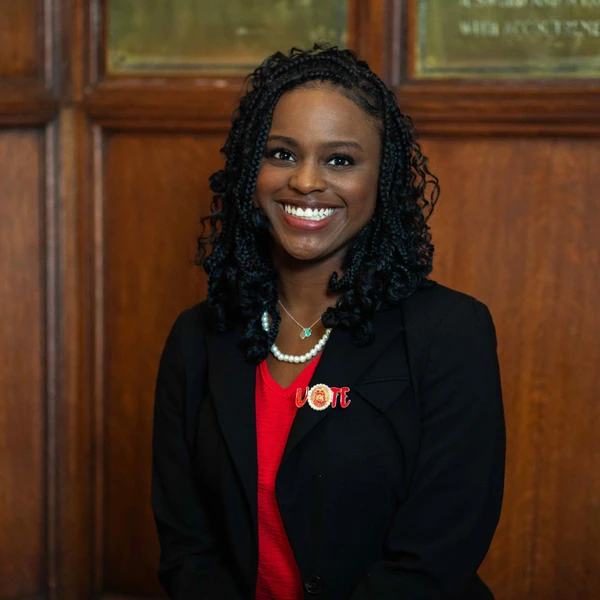
Belonging is more than being accepted—it’s about being understood, valued, and seen in the fullness of who you are. As a Black woman from Memphis, Tennessee, and the first in my family to graduate from college, the journey toward belonging has been a layered one—rooted in pride, marked by resilience, and shaped by the tension between where I come from and the spaces I’ve had to navigate.
Growing up, I understood the power of community and the cost of exclusion. I watched how race, geography, and class determined who had access to opportunity, and I became fluent in code-switching between the world that raised me and the institutions I entered. That duality only deepened when I arrived at the University of Pennsylvania—an elite space that wasn’t built with someone like me in mind. I often felt the pressure to prove I deserved to be there while carrying the weight of representing so many others who didn't get the chance.
But I didn’t just endure those spaces—I transformed them. I found and helped build communities that centered the voices of Black women, first-generation students, and those committed to justice. Through my leadership in student organizations, my service work, and my academic research, I began to realize that belonging wasn’t something I had to earn by shrinking myself. It was something I could cultivate by creating space for myself and others to show up fully.
My study abroad experience in Spain challenged and expanded that understanding. Living in Madrid, I was immersed in a culture and language not my own. While I experienced awe and beauty, I also encountered assumptions about my Blackness and Americanness that forced me to reflect on how identity travels—and what it means to belong in a space that sees you as “other.” At first, I tried to minimize my difference, to blend in. But soon I realized that even thousands of miles away, my roots were not a burden—they were a bridge.
Through conversations with classmates from around the world, late-night reflections with host families, and moments of cultural misunderstanding turned into connection, I began to see belonging as relational, not conditional. It wasn’t about assimilation—it was about authenticity. In journaling, in engaging with the history of the African diaspora in Spain, and in reflecting on how language carries power, I grew more grounded in who I was and more committed to making sure others could do the same.
Belonging, I’ve come to learn, is a practice. It’s checking in on the quiet student after class. It’s advocating for marginalized voices even when it’s uncomfortable. It’s creating space—not just to be seen, but to be safe, to be whole, to be heard. As I move forward, whether in education, cultural exchange, or policy work, I carry this with me: Belonging should never require erasure. It should be an invitation to be more fully human.
Because when we build spaces where people don’t have to leave parts of themselves behind, we don’t just create inclusion—we create transformation.