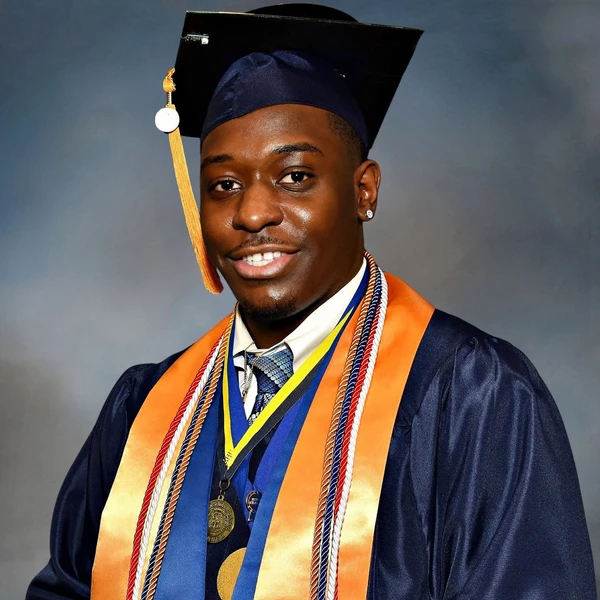
New York, NY
Age
27
Gender
Male
Ethnicity
Black/African
Religion
Christian
Church
Church of God in Christ
Hobbies and interests
DJing
Music Production
Graphic Design
Bible Study
Church
Forensics
Reading
Christianity
Drama
Adult Fiction
Romance
Music
True Story
Design
Cookbooks
I read books multiple times per week
US CITIZENSHIP
US Citizen
LOW INCOME STUDENT
Yes
FIRST GENERATION STUDENT
Yes
Tyler Coleman
1x
Finalist
Tyler Coleman
1x
FinalistBio
I am a first-generation cybersecurity student at Pace University with a 4.0 GPA and six consecutive semesters of academic excellence. After earning my associate degree in cybersecurity from SUNY Westchester Community College, I transferred to Pace to continue developing my skills in cybersecurity, artificial intelligence, digital forensics, and research.
My current research explores bias and fairness in biometric AI systems, including whether improving the balance of training data can produce fairer synthetic biometric data for mental health analysis. Outside of academics, I serve my campus through leadership, volunteering, student organizations, and my work as a university-approved DJ.
My long-term goal is to build a career in cybersecurity where I can protect individuals and communities from cybercrime, reduce the harm experienced by victims of data breaches, and help more underrepresented students find opportunities in technology.
Education
Pace University - Westchester Campus
Bachelor's degree programMajors:
- Computer Science
GPA:
4
SUNY Westchester Community College
Associate's degree programMajors:
- Computer Science
GPA:
4
Miscellaneous
Desired degree level:
Bachelor's degree program
Graduate schools of interest:
- Pace University - Westchester Campus
Transfer schools of interest:
Majors of interest:
- Computer Science
- Computer Systems Networking and Telecommunications
- Education, General
- Criminology
Career
Dream career field:
- Computer & Network Security
Dream career goals:
My goal is to build a career in cybersecurity, digital forensics, or security research. I want to help prevent cyberattacks, support people affected by data breaches, and develop safer and more ethical technology. Over time, I hope to become a cybersecurity leader who also creates opportunities for first-generation and underrepresented students entering the technology field.
Approved Student Vendor/Worker - DJ
Pace University2025 – Present1 yearRetail Merchandiser
Hallmark2019 – 20212 yearsOperations Associate (Seasonal)
JCPenney2016 – 20171 year
Sports
Dancing
Club2013 – Present13 years
Research
Computer and Information Sciences, General
SSUR and UR2PhD — Undergraduate researcher studying bias in biometric AI and whether balancing training data can create fairer synthetic biometric data for mental health analysis.2026 – Present
Arts
Pace University
Music2025 – PresentFreelance
Graphic Art2012 – Present
Public services
Volunteering
Emmaus Bible Chapel — Vacation Bible School Presenter and Youth Volunteer2026 – PresentVolunteering
Pace University Admissions — Volunteer Student/DJ2025 – PresentVolunteering
Pleasantville Garden Club / Pace University Make a Difference Day — Volunteer Student2025 – PresentVolunteering
Make-A-Wish Foundation / Pace University Setters Leadership Program — Volunteer Student2026 – PresentVolunteering
Pace University – Office of Student Engagement, Admissions, Athletics, Career Services, and student clubs — Volunteer DJ / Event Music Coordinator2025 – PresentVolunteering
Pace Setter Leadership Program — Student Leader / SLP Participant — participated in workshops, mentorship, community-service events, and leadership development activities.2025 – PresentAdvocacy
NAACP — General Member — participated in meetings, advocacy campaigns, and supported local NAACP initiatives.2025 – Present
Future Interests
Advocacy
Politics
Volunteering
Philanthropy
Entrepreneurship
Zelaya Creativity Scholarship
At 11:47 p.m., Andre found the pixel.
It sat beneath the event title, where gold lettering met a black background—a single blue square, nearly invisible unless the screen was magnified to eight hundred percent.
Andre leaned closer.
“No.”
The flyer was due at midnight.
His client had approved the design three hours earlier. The hosts were centered. The bottle prices were correct. Every name was spelled properly. Even the glow around the headline had finally stopped looking uneven.
He could have exported the file and gone to sleep.
Instead, Andre zoomed in.
The pixel remained.
He selected the eraser tool and clicked directly over it. Nothing changed. He clicked again. The square disappeared—then reappeared when he zoomed out.
At 11:51, his phone buzzed.
We still good for midnight?
Andre typed, Yes. Deleted it.
He typed, Almost done. Then deleted that too.
Finally, he sent a thumbs-up that felt dishonest.
He reopened every layer. Background. Text. Glow. Shadows. Host photos. None contained the pixel. He hid them one by one until the entire canvas was transparent.
The pixel remained.
“That’s not possible.”
His younger sister appeared in the doorway, holding a bowl of cereal.
“What are you doing?”
“Fixing this.”
She stepped closer. “Fixing what?”
Andre pointed. “That.”
She squinted, then shrugged. “Nobody is going to see that.”
“I see it.”
She paused. “That sounds personal.”
Then she left.
At 11:56, Andre considered sending the flyer as it was. Hundreds of people would scroll past it without noticing. Some would glance just long enough to find the address. Others would immediately ask if they could get in for free.
No one would zoom in and search for a single blue pixel.
But Andre would know.
He opened a new document and began rebuilding the design from scratch. Background first. Then the photos. Then the pricing. Finally, the gold title.
The pixel returned.
11:58.
Andre stared at the screen, then at the title. Slowly, it clicked.
The pixel was not beneath the text.
It was part of the glow.
A fragment left behind from an earlier edit.
He opened the layer mask, brushed carefully over the edge, and watched the square disappear.
Not hide.
Disappear.
At 11:59, he exported the flyer and sent it.
Three dots appeared beneath the message.
Then:
Looks good. Can you move the title down a little?
Andre closed his eyes.
For a moment, he imagined throwing the laptop out the window. Instead, he reopened the file, nudged the title downward, checked the corner, and exported it again.
Approved at 12:04.
The next morning, Andre saw the flyer posted online. No one mentioned the title. No one noticed the clean edges or the corrected glow.
No one knew about the pixel that had nearly ruined his night.
But Andre smiled anyway.
The square was gone.
THE END!
Chris Jackson Computer Science Education Scholarship
My interest in computer science began with a desire to understand how technology works and how it can be used to protect people. The more I learned about cybersecurity, the more I realized that a single vulnerability can affect someone’s finances, privacy, education, or sense of security. I became interested not only in how systems are built, but also in how they can fail and what can be done to make them safer.
I began my college journey at Westchester Community College, where I earned an associate degree in cybersecurity with a 4.0 GPA. I am now pursuing my bachelor’s degree in cybersecurity at Pace University. Throughout both schools, I have maintained a 4.0 GPA for six consecutive semesters while continuing to grow outside the classroom. I helped co-found a cybersecurity club, participated in undergraduate research programs, completed leadership development, and worked on campus as a student DJ. These experiences have taught me how to balance technical learning, leadership, creativity, and service.
After earning my degree, my goal is to build a career in cybersecurity where I can help prevent breaches and reduce the harm experienced by victims. I am especially interested in work involving threat detection, incident response, digital forensics, and the protection of sensitive information. My dream is to become a cybersecurity professional who can solve complex problems while remembering that every security incident affects real people. In the future, I also hope to guide students from underrepresented and first-generation backgrounds who may not initially see themselves represented in technology.
I believe I am a strong candidate for this scholarship because I have shown consistent commitment even when continuing my education has required difficult financial decisions and sacrifices from both me and my family. I have worked hard to take advantage of every opportunity available to me, but the cost of tuition, housing, transportation, and other educational expenses remains a serious challenge. Financial support would allow me to focus more fully on completing my final year and preparing for a successful transition into the technology workforce.
More importantly, this scholarship would be an investment in someone who plans to use his education to serve others. I have already demonstrated my dedication through my academic record, campus involvement, leadership, and willingness to challenge myself. I do not view a computer science education as only a path to a job. I see it as an opportunity to build a meaningful career, protect people, and create opportunities for those who come after me.
Chadwick D. McNab Memorial Scholarship
As a DJ, one of the most important decisions I make is choosing what song should play next. A strong transition is not only about selecting a popular track. I have to consider tempo, energy, genre, and how the crowd may respond in real time. For my Intro to Computer Science term project, I turned that part of my DJ process into a Python program called the DJ Song Selector Assistant.
The program uses a music library that I built myself in a CSV file. I entered each song individually, recording the title, artist, genre, beats per minute, and an energy rating. This process required more than simple data entry. I had to decide how each track should be categorized and how its energy compared to others in the library. Building the dataset taught me that a program is only as reliable as the data behind it, and that careful organization directly affects the accuracy of its results.
After creating the library, I developed a program that allows the user to select the current song and choose whether the energy should increase, decrease, or stay the same. The program analyzes the dataset and recommends five possible songs to play next.
To generate these recommendations, I designed a scoring system that compares each track’s tempo to the current song, evaluates whether its energy aligns with the user’s goal, and adds a bonus when the genres match. Instead of simply listing options, the program explains each recommendation by showing the BPM difference, the energy change, and whether a genre match occurred. This made the output more transparent and allowed me to demonstrate the reasoning behind each suggestion.
Developing this project pushed me beyond simply writing functional code. I had to manage and clean a large dataset, remove duplicate entries, handle missing or inconsistent values, and prevent invalid inputs from crashing the program. One challenge I encountered was that some song titles contained commas, which interfered with how the CSV file was parsed. Solving this required me to rethink how the program read and separated data so that each field remained accurate.
I was especially invested in this project because it connected two major parts of my life: music and technology. DJing has always relied on instinct and experience, but this project showed me that those decisions can also be modeled through data and algorithms. At the same time, I recognized the limits of automation. While the program can suggest songs, it cannot fully replace a DJ’s ability to read a crowd and respond to the moment.
Working on the DJ Song Selector Assistant showed me how technology can transform personal experience into practical tools. It reinforced my interest in building systems that are both functional and reliable, especially when they interact with real users. As I continue studying cybersecurity and technology, I want to develop systems people can trust, whether that means protecting data, improving decision-making, or creating tools that adapt to human needs. This project showed me that meaningful technical work often begins with a simple, personal problem and the willingness to solve it thoughtfully.
Bick New York Scholarship
At one point, my college GPA was 0.83, and I believed that number defined my future.
I grew up in a low-income immigrant household in the Bronx. Although my parents received their education outside the United States, their degrees were not fully recognized here, limiting their employment opportunities and making financial stability difficult. As a first-generation college student, I began higher education without a clear guide for navigating admissions, financial aid, scholarships, or long-term academic planning.
My first attempt at college was shaped by challenges I was not prepared to manage. I experienced housing instability, suffered a dislocated kneecap and a broken dominant hand, and struggled emotionally after losing my aunt. My grades declined, and I eventually withdrew from college. For years, that academic record felt like evidence that I was not capable of succeeding.
Eventually, I decided that my setback would not be the final chapter of my education.
I returned through SUNY Westchester Community College, where I earned an associate degree in cybersecurity with a 4.0 GPA. I joined Phi Theta Kappa and Alpha Beta Gamma, graduated with honors, and was accepted into more than fifteen universities. After transferring to Pace University, I continued my academic progress and have now completed six consecutive semesters with a 4.0 GPA.
My growth has extended beyond the classroom. Through summer undergraduate research, I have studied bias and fairness in biometric artificial intelligence systems used for stress detection. I also serve my campus and church communities through volunteering, student organizations, and creative projects. Most recently, I developed and delivered an interactive Vacation Bible School presentation that helped children understand a lesson in an engaging, age-appropriate way. Their enthusiasm and request for another presentation reminded me how meaningful education and encouragement can be.
I am motivated by the opportunity to turn my experiences into protection and support for others. My goal is to build a career in cybersecurity where I can protect communities from data breaches, reduce the harm victims experience, and help organizations communicate transparently and responsibly after security incidents. I also hope to encourage students from underrepresented backgrounds who may struggle to envision themselves in technology or higher education.
This scholarship would help me continue at Pace University while reducing the pressure of tuition, housing, transportation, books, and technology expenses. It would ease financial strain and allow me to continue the progress I fought hard to rebuild while dedicating more time to research, internships, professional development, and hands-on cybersecurity training.
My educational journey taught me that failure can interrupt a dream without ending it. I am proud of the student I have become, and I am determined to use my education to create opportunities, restore confidence, and help others believe in their ability to move forward.
Let Your Light Shine Scholarship
I do not want my legacy to be only a list of accomplishments. I want it to be proof that someone can come from financial struggle, build something meaningful, and still bring people with them. As a low-income, first-generation student, I understand what it feels like to have ambition bigger than your resources. That is why I want my future to be rooted in ownership, service, and opportunity.
The business I hope to create one day will combine my passions for music, technology, cybersecurity, and community. Right now, I am building myself as DJ Ty Combs, a student DJ and creative entrepreneur who provides music, design, and event experiences. I have DJed campus events, accepted students days, job fairs, and student organization programs. Each event has taught me that music is more than entertainment. It changes the energy of a room, helps people feel comfortable, and gives students a reason to gather, celebrate, and connect.
In the future, I want to expand that into a creative technology company. My vision is to build a business that offers DJ services, event production, media design, and digital safety education for schools, nonprofits, and community organizations. I want to help people host meaningful events while also teaching young creatives and student leaders how to protect their brands, manage their digital presence, and use technology responsibly. As a cybersecurity major, I know how important digital protection is. As a DJ and designer, I also know how powerful creativity can be when people are given tools to express themselves.
My legacy will also come from leadership. At Pace University, I serve as DJ manager on the executive board of the radio club, and I am a founding executive board member of the Cybersecurity Club on the Pleasantville campus. That role matters because Pace has strong technology programs, but many students in computer science and cybersecurity are hesitant to put themselves out there. I want our club to make cybersecurity feel less intimidating and more accessible, not only for students already in the field, but for anyone curious enough to learn. I see myself as a bridge between creative students, technical students, student leaders, faculty, and future professionals.
I shine my light by showing up fully as myself. I am outgoing, honest, creative, and willing to speak in rooms where others may stay quiet. I also shine through service. Through the Setters Leadership Program, I have participated in leadership and service experiences that pushed me to think beyond my own goals. One of the most meaningful was helping fundraise through Make-A-Wish for a child with leukemia so he could go to Disneyland. I also attended the Women’s Leadership Conference, where I learned from alumni, leaders, and students with different backgrounds and perspectives. Those experiences reminded me that leadership is not just about being seen. It is about using your presence to support something bigger than yourself.
People may watch me without ever saying anything. They may see me DJing, organizing a club, attending a cybersecurity conference, or balancing work, school, and leadership while still pushing forward. I hope they see someone who refuses to shrink because of where he came from. My legacy is a business that opens doors, builds confidence, and helps people feel prepared for the future. Success means more when it helps someone else rise too.
Gladys Ruth Legacy “Service“ Memorial Scholarship
For a long time, I thought doing the work would be enough. At Westchester Community College, I was not the student everyone knew. I was not heavily involved in clubs or campus leadership. I showed up, completed my assignments, and earned a 4.0 cumulative GPA. Even then, many people still did not know my name. That taught me that being different is not always about being loud. Sometimes it is about being disciplined when nobody is watching.
But I have never wanted to be invisible. I am different because I refuse to separate the parts of myself that make me whole. I am a first-generation African American student, a cybersecurity major, a DJ, a student leader, and someone who understands financial pressure. I come from a background where every opportunity matters because nothing is guaranteed. Instead of letting that make me feel limited, I use it as fuel to be creative, present, and intentional.
One of the clearest examples of my uniqueness was my graduation cap. Instead of only decorating it, I built a functioning spinning vinyl record into it with a DC motor kit. I also added a sound module so it could play music. That cap represented me perfectly: a student who pays attention in class, a DJ who loves music, and a problem-solver who turns ideas real. It showed that my education was not just something I memorized. It was something I could build with.
Since transferring to Pace University, I have become more intentional about using my presence to serve others. Through the Setters Leadership Program, a service-focused development program, I have participated in experiences that challenged me to think beyond myself. One meaningful example was helping fundraise through Make-A-Wish for a child with leukemia so he could be sent to Disneyland. I also attended the Women’s Leadership Conference, where I networked with alumni, leaders, and students with different perspectives. Those experiences reminded me that leadership is not just a title. It is taking time to support people, learn from others, and show up when no one is forcing you to care.
I also serve on the executive board of my school’s radio club as DJ manager, and I am a founding executive board member of the Cybersecurity Club at Pace’s Pleasantville campus. Pace has a strong technology program through the Seidenberg School of Computer Science and Information Systems, but many students in technical fields are introverted or hesitant to put themselves out there. As someone naturally outgoing, I feel responsible for creating spaces where students can connect, learn, and feel welcome. Cybersecurity should not feel closed off or intimidating. It should be accessible to anyone willing to learn.
If I had to describe myself as an animal, I would choose a chameleon. I can adapt to different rooms without losing myself. I can speak with students, alumni, professors, professionals, artists, and future cybersecurity leaders. As an adult learner, it can be challenging to relate to younger students, but I try not to judge them. Instead, I guide by example. I want them to learn early what I had to learn the hard way.
I know people are watching, even when I do not know their names. They may see me DJing PaceBound for accepted students, helping at campus events, attending cybersecurity conferences, or speaking up in spaces where others stay quiet. I hope what they see is proof that a Black first-generation student can be excellent, creative, outspoken, professional, and service-minded all at once. My uniqueness is not just about standing out. It is about making it easier for the next person to step forward.
Jesus Baez-Santos Memorial Scholarship
I never believed in myself the way I do now, Professor Prezioso did. From the moment I met her at Westchester Community College, she saw potential in me that I did not even know existed, and she pushed me to reach for opportunities I never imagined possible. She not only challenged me academically, but also instilled in me the confidence to pursue goals I had thought were out of reach. Her encouragement transformed the way I viewed my own abilities and the possibilities of what I could accomplish as a first-generation student.
Professor Prezioso did not just teach me, she guided my path. With her mentorship, I earned the 2024 PepsiCo Uplift Scholarship, became keynote speaker at the 2025 ceremony, and gained membership in both Phi Theta Kappa and Alpha Beta Gamma honor societies. She also helped me make the decision to continue my education beyond WCC, showing me that my dreams were bigger than I had allowed myself to imagine. More than accolades, she made me truly believe in my abilities and inspired me to lead and serve others the same way she leads. Her support taught me that success is not measured by awards or recognition alone, but by the impact you make on the people around you.
Her example has shaped how I approach leadership today. She leads by empowering others, creating opportunities, and encouraging people to see their own potential. At Pace University, I strive to carry that forward. I am founding a cybersecurity club to make our campus digitally safe, teaching students how to protect themselves from phishing, scams, and social engineering. I am also a member of the Setters Leadership Program, completing over 30 hours of community service last semester, including volunteering for Pace’s Make a Difference Day. Through music as a DJ and student vendor, I am helping revive campus culture and community engagement after the social isolation caused by the pandemic. Each of these efforts reflects the leadership and resilience Professor Prezioso modeled for me.
Every step of my journey is influenced by her mentorship. Her belief in me inspires me to give back to my peers, my community, and my family. She taught me that leadership is not about titles or recognition, it is about impact, service, and lifting others as you climb. As a first-generation student pursuing a degree in cybersecurity, I hope to leave a legacy rooted in those same values: resilience, service, and empowerment for the next generation of students. Professor Prezioso’s guidance has not only shaped my educational path, but also instilled in me the desire to continue her example of mentorship, helping others believe in themselves as I have learned to believe in myself.
7023 Minority Scholarship
My name is Tyler Coleman, and I am an African American first-generation college student pursuing a career in cybersecurity. I graduated with my associate’s degree in cybersecurity with a 4.0 GPA and am currently continuing my education toward my bachelor’s degree, with plans to eventually earn my master’s. For me, education has never been just about earning a degree—it is about creating opportunities, breaking barriers, and using what I learn to uplift the communities around me.
Growing up in a low-income household taught me early on that access to opportunity is not always equal. Because of that, I have always felt a responsibility to use my education not only to improve my own circumstances, but also to make a meaningful difference in the lives of others. My chosen field, cybersecurity, allows me to do exactly that.
As technology becomes more integrated into everyday life, many people remain vulnerable to cyber threats such as scams, phishing, identity theft, and social engineering. Initially, I believed these threats mainly affected older generations. However, once I arrived at Pace University, I realized that even many students lack awareness of how easily their personal information can be compromised. That realization motivated me to work with my peers to begin forming a cybersecurity club on campus. Our goal is to create a digitally safe environment at Pace by educating students about online security, hosting workshops, and promoting responsible digital habits.
Service and leadership are also central to my life outside the classroom. I am a member of the Setters Leadership Program, where we focus on leadership, initiative, and community engagement. Through the program and other opportunities, I completed over 30 hours of community service in a single semester, including volunteering during Pace’s Make a Difference Day. I plan to continue expanding my service and finding new ways to give back.
I am also a proud member of the NAACP, an organization that has long fought for equality, justice, and opportunity for African Americans. Being part of the NAACP reinforces my belief that progress happens when individuals are willing to stand up, contribute, and work toward meaningful change in their communities.
In addition to my academic and service commitments, I also contribute to campus life through music. As a DJ and student vendor for the university, I volunteer my time to perform at campus events such as open houses and job fairs. After the challenges many campuses faced during and after the COVID-19 pandemic, I have made it a personal goal to help restore a sense of culture, community, and energy on the Pleasantville campus. Music has been a powerful way to bring students together and rebuild that sense of connection.
Through my education, leadership, and service, I hope to continue creating spaces where people feel supported, informed, and empowered. Whether it is helping students protect themselves online, mentoring others, or building stronger communities on campus, I want my work to leave a lasting impact.
GD Sandeford Memorial Scholarship
Growing up, education was never something my family took for granted. I was raised in a home where faith, perseverance, and gratitude mattered more than the circumstances around us. As a first-generation college student, I understood early on that pursuing higher education was not just about personal success—it was about opening doors that had never been opened before in my family and making sure others behind me could walk through them too.
My journey to college has not been without challenges. I grew up in a low-income household where stability was not always guaranteed, and there were times when injuries and personal setbacks made school more difficult than it should have been. Despite these obstacles, I stayed committed to my education and recently graduated from community college with near-perfect attendance, missing only one class. That experience reinforced something important to me: success is not just about talent or opportunity, but about consistency and resilience.
I am currently pursuing a four-year degree in cybersecurity. While technology continues to advance and shape our world, many communities—especially underserved communities—are still left behind when it comes to digital literacy, online safety, and access to technology careers. I want to change that.
My goal is to use my degree not only to build a successful career in cybersecurity, but also to educate and empower people in my community about digital safety. Cybercrime, identity theft, and online scams disproportionately affect people who may not have the resources or knowledge to protect themselves. By using the skills I gain in my program, I hope to host workshops and mentorship programs that teach young people and families how to stay safe online, protect their information, and explore careers in technology.
Beyond cybersecurity, I also believe in giving back through mentorship. As a first-generation student, one of the biggest challenges I faced was simply understanding how to navigate the college process—financial aid, scholarships, internships, and career planning. Because of this, I plan to continue mentoring younger students who come from backgrounds similar to mine. I want them to see that higher education is not out of reach and that their circumstances do not define their potential.
Receiving this scholarship would not only help support my educational journey, but it would also allow me to continue focusing on the work I want to do for my community. My degree represents more than a career path—it represents an opportunity to uplift others, close opportunity gaps, and create pathways for students who will come after me.
As the first in my family to pursue this path, I feel a responsibility to make sure I am not the last.
Kim Moon Bae Underrepresented Students Scholarship
Being a Black student in higher education has never been something I could separate from who I am or how I move through the world. My identity as an African-American undergraduate has shaped my experience in college from day one—sometimes as a challenge, sometimes as motivation, but always as a driving force behind why I refuse to settle for less.
I grew up in a low-income household where stability wasn’t guaranteed and opportunities had to be fought for. College was never presented as an easy or obvious path; it was something I had to believe in for myself before it became real. When I entered higher education, I quickly realized that being underrepresented didn’t just mean being outnumbered—it meant navigating spaces where I often felt unseen, underestimated, or expected to prove I belonged. Financial stress, isolation, and the pressure to succeed without a safety net were realities I carried alongside my coursework.
Instead of allowing those barriers to define me, I let them sharpen me. I approach my education with intention because I know what’s at stake. As an undergraduate Cybersecurity major at Pace University, I’ve earned and maintained a 4.0 GPA while balancing leadership, creative work, and personal responsibility. Every accomplishment feels meaningful because it represents more than academic success—it represents progress against the odds.
My identity has also influenced how I choose to show up outside the classroom. Alongside my STEM studies, I am a DJ, music producer, and graphic designer. Creativity has always been my outlet and my voice, especially in spaces where I might otherwise feel boxed in. It allows me to stay grounded in who I am while proving that technical excellence and cultural expression can coexist. I don’t believe I should have to choose between being analytical and being creative—both are part of my identity.
Looking ahead, being a member of an underrepresented group will continue to shape my path, particularly in the tech industry. Cybersecurity is a field where diversity is still lacking, and I understand the importance of representation. I plan to build a career that not only provides financial stability for myself and my family, but also opens doors for others who may not see people like them reflected in STEM spaces. Whether through mentorship, advocacy, or leadership, I want to be someone others can look at and say, “If he can do it, so can I.”
The Kim Moon Bae Underrepresented Students Scholarship represents encouragement, validation, and opportunity. It affirms that students from marginalized backgrounds are not just capable, but essential to the future of higher education and innovation. I am committed to honoring that belief by continuing to push forward, break cycles of limitation, and create impact that extends beyond my own success.
Dr. Samuel Attoh Legacy Scholarship
Legacy, to me, is not about what you leave behind—it’s about what you set in motion. It’s the quiet, lasting influence of choices that continue shaping lives long after you’ve moved on. A true legacy creates access, opens doors, and makes the path a little clearer for those who follow. That idea resonates deeply with me, especially as I work toward a future in STEM and strive to redefine what success looks like for myself and my family.
I was raised in an environment where resources were limited, stability was never guaranteed, and education often felt like a privilege rather than a given. Growing up in poverty taught me early that nothing would be handed to me, and that survival often came before ambition. Still, those circumstances instilled resilience, gratitude, and an unshakable work ethic. I learned how to adapt, how to make the most of what I had, and how to stay focused even when life felt unpredictable. While those challenges could have limited my expectations, they instead fueled my determination to aim higher.
As an undergraduate Cybersecurity major at Pace University, I’ve carried those lessons with me into my academic journey. Maintaining a 4.0 GPA has required discipline, sacrifice, and consistency—traits that were shaped by my upbringing. I see education not just as personal advancement, but as a responsibility. Pursuing a STEM degree allows me to build financial stability, challenge generational limitations, and enter spaces where people from backgrounds like mine are often underrepresented.
At the same time, I refuse to believe that success must come at the expense of creativity. Alongside my studies, I work as a DJ, music producer, and graphic designer. These creative outlets have helped me stay grounded, express myself, and connect with others in meaningful ways. They remind me that legacy is multidimensional: it’s possible to be both technical and creative, analytical and expressive. In many ways, blending creativity with STEM mirrors how I’ve learned to navigate life—finding balance where others see contradiction.
When I think about continuing or breaking cycles, I see a clear responsibility to do both. I want to continue the cycle of perseverance, faith, and determination that carried me this far. At the same time, I am committed to breaking cycles of financial instability, limited access, and self-doubt. My goal is not only to succeed in cybersecurity, but to create opportunities for others—whether through mentorship, advocacy, or future community-focused initiatives that support students from underserved backgrounds.
Dr. Samuel Attoh’s legacy in academia represents exactly the kind of impact I aspire to have: one rooted in knowledge, service, and empowerment. Receiving this scholarship would not only support my education, but affirm my commitment to building a legacy that uplifts others and proves that where you start does not determine how far you can go.
Michael Valdivia Scholarship
Lyndsey Scott Coding+ Scholarship
I didn’t come to computer science through a traditional path — I came to it through music. DJing taught me how energy moves through people, but coding taught me how systems move behind the scenes. Once I realized I could combine the two, computer science stopped feeling abstract and became something I could actively shape.
My primary goal in computer science is to build a career in software development and cybersecurity, designing systems that are secure, intentional, and centered around real human needs. I’m drawn to computer science because it rewards logic, structure, and problem-solving — skills that have always come naturally to me. In my Intro to Computer Science course, I worked in Visual Studio Code to develop a live song recommendation program specifically for DJs. The idea came from a real problem on my campus: many student DJs struggled to select Caribbean and dancehall songs that matched the energy of the room in real time.
I designed the program using a point-based system where each song starts at 100 points. The user inputs the current song, the desired energy level, and the target genre. The program then evaluates BPM, musical key, and energy compatibility to recommend the next best tracks. This wasn’t a theoretical project — it was designed for live use. When I presented it, the class was impressed by both the technical logic and the cultural relevance of the solution, and I earned a 100% on the project. That experience confirmed that computer science could strengthen my creative work while also solving meaningful problems.
Outside of software, I’ve explored the hardware and engineering side of technology as well. When I graduated from Westchester Community College with a 4.0 GPA and Phi Theta Kappa honors, I wanted my graduation to reflect who I am. I engineered a DC motor kit into my graduation cap, mounting a vinyl record that spun on top. I also embedded a sound module that played a remix I produced in FL Studio at the press of a button. The project gained viral attention on TikTok and Instagram, not because it was flashy, but because it told a story about identity, creativity, and technology working together.
DJing itself mirrors how I think as a computer scientist. It’s built on numbers, timing, pattern recognition, and decision-making under pressure. Every transition is a calculation, and every song choice is a response to real-time feedback. Beyond performance, music has always been a stabilizing force for me. During difficult moments, a good song could reset my focus and shift my energy. That taught me how powerful well-designed systems can be when they’re centered around people — a lesson I now carry into how I approach technology.
I also deepen my technical skills through DJ software customization. Using VirtualDJ’s scripting system, I’ve built custom transitions, tools, and keyboard mappings that allow me to execute complex actions with a single button. I even use a dedicated secondary keyboard for custom commands I designed myself. These experiences pushed me toward computer science long before I formally committed to the major.
Long-term, I want to merge my technical expertise with creative and community-driven work — building secure tools for artists, students, and organizations, while mentoring others who may not see themselves represented in tech. The Lyndsey Scott Coding+ Scholarship represents exactly the kind of technologist I aim to be: multifaceted, innovative, and unafraid to blend logic with creativity. I’m not just studying computer science — I’m using it to create systems that connect, protect, and inspire.
New Jersey New York First Generation Scholarship
Being a first-generation college student means carrying both responsibility and possibility at the same time. I grew up in a household where financial instability was a constant reality, and while my family valued hard work, navigating college was something I had to learn largely on my own. From understanding financial aid to managing academic expectations, every step required persistence, independence, and resilience. As a first-generation student, earning my degree represents breaking a cycle and creating a new foundation for my family.
When I transferred to Pace University, I did so with a 4.0 GPA and a clear goal: to prove that I could excel academically while fully engaging in my campus community. Maintaining a strong GPA—currently around a 3.8–3.9—while managing financial responsibilities has not been easy, but it has shaped me into a disciplined and self-motivated student. As a cybersecurity major, I am pursuing a field that offers both stability and purpose, allowing me to support my family while contributing to the protection of others in an increasingly digital world.
My extracurricular involvement has played a major role in shaping who I’ve become. I am a member of the Setters Leadership Program, which has helped me develop confidence, accountability, and a deeper understanding of leadership through service. I have also been actively involved in community service and campus events, including DJing multiple Pace University functions. Through these experiences, I learned how to bring people together, create inclusive environments, and represent my school with professionalism.
One of my most meaningful moments came when I was invited to deliver a keynote speech for the PepsiCo Uplift Scholarship ceremony at SUNY Westchester Community College—a scholarship I had received the year prior. Standing before students, faculty, and donors as a first-generation student was a powerful reminder of how far I had come and how important representation and mentorship are. It reinforced my commitment to giving back and using my voice to encourage others who may not yet see themselves reflected in academic spaces.
I have also worked with Pace University’s DOIE department, participating in commercials and promotional materials aimed at fostering inclusion and engagement on campus. Being trusted to represent my institution was both an honor and a responsibility, especially as a first-generation, low-income student. These opportunities showed me that my presence and contributions matter—not just academically, but within the broader campus community.
Being a first-generation college graduate would mean transforming struggle into stability and uncertainty into opportunity. It would allow me to support my family, serve as a role model, and continue building a future defined by leadership and impact. This scholarship would ease the financial burden that often challenges students like me and allow me to remain fully focused on my education and service. With your support, I will continue working toward a future grounded in resilience, purpose, and progress.
Sherman S. Howard Legacy Foundation Scholarship
Church is where I grew up. Faith ran through both sides of my family, and Saturday morning devotion was a fixture in our home. We’d all pile onto my parents’ bed, half-asleep, listening as they prayed and read Scripture. I’ll be honest — as a kid, it felt boring. I didn’t grasp the weight of those moments until years later, when I realized they were shaping the roots of my faith.
What truly lit me up back then was VBS — Vacation Bible School. Every summer, Emmaus Bible Chapel transformed into a vibrant, themed center of learning, games, worship, and community. Every child brought friends, and soon our youth group was overflowing. We learned about God in age-specific groups, sang songs, made crafts, and connected with people who spoke to our hearts. There was always a picnic afterward, swimming and fellowshipping — but no matter the activity, we’d be ministered to before the day was done.
Throughout high school, I led Praise and Worship every Sunday. We'd practice weekly. I remember standing on stage, mic in hand, as the youth praise team sang music. My heart pounded — not from fear, but from the shared electricity of voices praising in unison. It wasn’t just about singing; it was about creating an atmosphere where others could feel God’s presence and where we all felt like family.
Then there was Camp Iroquoina every Labor Day weekend. While most Caribbeans were at carnival, we were in Pennsylvania for preaching, worship, and team competitions. We had Bible trivia, sports, and our infamous shaving cream fight. Camp reset my spirit before each school year. Those moments built my closest friendships — people I still call family today.
When I left for college upstate, things changed. Our youth group shrank as my peers also went away, and my own priorities shifted. I poured more time into DJing than into God — even over my studies — chasing the quick financial return. That season taught me hard lessons. Injuries, personal struggles, and COVID’s arrival left our youth ministry withered. I stayed loosely connected, helping with VBS shirts, decorations, and music, but my presence wasn’t the same. Still, I carried Emmaus with me — the lessons, the worship, and the standard of living my faith both inside and outside the building.
When I re-enrolled in school, I did it with focus. No distractions, just discipline — the same kind I learned leading Praise and Worship every Sunday. I graduated with a 4.0 GPA, joined Alpha Beta Gamma and Phi Theta Kappa Honor Societies, earned scholarships, and was accepted into over 15 colleges, including Fordham, Liberty University, St. John’s, and the University of Mount St. Vincent. I chose Pace University for its strong programs and the leadership opportunities it offers, like the 13th Cohort of the Setters Leadership Program.
This time, I’m committed to keeping my faith at the center. At Pace, I plan to join CRU, the Christian club on campus, to rebuild my spiritual discipline and use my gifts to serve others. I don’t want my prayers to only be requests. I want my daily walk to reflect gratitude — for every breath, every opportunity, every moment God has allowed me to rise again.
I thank Sherman S. Howard and all involved in offering this scholarship to African Americans. My foundation in faith has given me resilience through injury, recovery, and academic success. My past taught me the joy of lifting others. My present calls me to be resourceful and creative. My future belongs to God — and I’m determined to honor Him in all I do.
Mireya TJ Manigault Memorial Scholarship
Some kids grow up dreaming about what they want to be. I grew up wondering how we would keep the lights on. In my family of six, love was abundant but financial stability was not. My parents were both college-educated in their home countries, my mother in England for English and fashion, and my father in Jamaica for teaching. They came to the United States with dreams as big as the sky, but their qualifications were not recognized, forcing them into jobs far below their skills. I have seen it happen to others too — a doctor from India driving a cab, a teacher working in retail — but for me, it is not just a story. It is my reality. Watching my parents’ sacrifices instilled in me a fierce determination to make my education count, not only for myself but for my family and community.
I am a first-generation college student, though not the first of my siblings to attend. What I am, however, is the first to reach this point with a 4.0 GPA, near-perfect attendance, and a clear vision for my future. My path has not been without setbacks. Injuries, including a dislocated kneecap and a broken dominant hand, could have derailed my progress, but they did not. I refused to let circumstances define me, and that resilience has shaped who I am today.
Community has always been my foundation. For years, I led praise and worship at my church, welcoming guests, singing with the congregation, and celebrating milestones like birthdays. It was not just music, it was connection, unity, and joy. Outside of church, I DJ for family and friends without ever charging, because bringing people together through music is my way of giving back. My passion for music even inspired my graduation cap project, which featured a custom-built, functioning spinning vinyl integrated into the cap. It was a creative blend of STEM skills and artistry that reflects who I am: a problem solver, an innovator, and someone who sees the beauty in merging worlds.
Looking ahead, I am pursuing a career in cybersecurity, a field I was drawn to after personally experiencing multiple data breaches, many from educational institutions that ironically offer cybersecurity programs. It is alarming to see organizations responsible for shaping the next generation fail to protect their own students’ data. My goal is to educate communities, especially those who are not tech-savvy, about protecting themselves in an era where technology evolves daily. I want to advocate for better cybersecurity policies in schools, nonprofits, and businesses, ensuring safety is prioritized alongside progress.
This scholarship would be a lifeline. Despite earning over half a million dollars in scholarships, the reality is that the school where I know I will thrive, Pace University, comes with a price tag I cannot meet alone. My parents have given everything they can, but we are still struggling to achieve the stability they dreamed of when they came here. Every dollar toward my education is a step closer to changing that narrative, not only for my family but for the communities I will serve.
Mireya TJ Manigault’s legacy of creativity, compassion, and a commitment to equity deeply resonates with me. Like her, I believe in using my talents to uplift others, building systems that endure, and ensuring equal opportunity is not just a promise, but a reality. With your support, I will continue to lead with purpose, blending technology, creativity, and community to make a lasting impact.
Pereira Art & Technology Scholarship
Growing up in a low-income, faith-filled household, we didn’t have much—but we had each other, and we had God. Financial stability was never guaranteed, but spiritual stability was. My mother didn’t cry—she prayed. She reminded us daily that everything happens for a reason and that someone always has it worse. We learned to be grateful for the bare minimum. I truly believe that gratitude shaped my mindset as much as hardship shaped my ambition.
As a first-generation college student, I originally prioritized immediate income over long-term goals. I began working as a DJ, and the money came faster than I expected. I started to see how I could support myself, ease the pressure on my family, and still survive. But I quickly realized I wasn’t truly investing in my future. That realization hit even harder after I suffered two serious injuries—one to my knee, and one to my dominant hand—that required surgery. These weren’t just physical setbacks; they impacted me mentally, emotionally, and spiritually.
But I healed. And I came back stronger.
I just graduated with my associate degree with a 4.0 GPA, and now I’m transferring to Pace University to pursue my bachelor’s. I’ve earned over $550,000 in scholarships as a transfer student, which is extremely rare. Most scholarships are geared toward first-year applicants, and transfer students are often overlooked—even with perfect academic records. But I kept applying, kept believing, and kept proving I’m worth investing in. I didn’t let my financial circumstances define my outcome.
Still, I need more support. Private university costs are real, and federal loans aren’t always accessible for students like me, especially without a creditworthy cosigner. I’m not asking for sympathy. I’m asking for belief—because I know I’m the right candidate for this scholarship.
The Pereira Art and Technology Scholarship is everything I stand for. I’ve spent the last few years learning how to merge art, technology, and business. My DJing is more than just music—it’s branding, design, sound engineering, and digital strategy. I’ve built logos, crafted clothing, gone viral for remix videos, and turned my creativity into income. My graduation cap itself was a literal, working circuit-powered vinyl record—playing one of my own remixes—designed in Photoshop, assembled by hand. It represented who I am: an innovator, a visionary, and a walking example of what happens when art, tech, and hustle meet. You can see the full project in action here: my graduation cap remix circuit on Instagram.
I don’t come from privilege. I don’t have a long list of extracurriculars because I was working, surviving, and healing. But I’ve maximized every opportunity I’ve had—and I’m ready for more. By November, I’ll have even more to show—more designs, more tech projects, more ways I’m using my education to grow my craft and build something real. I’m not hoping to “someday” be a creative force. I already am one.
All I need now is the right support to keep going. I’m not just asking for funding—I’m asking for someone to see what I already know: I’m worth it. I deserve it. And I’m ready.
Thank you for your time and consideration .
I Can and I Will Scholarship
I’ve done everything right these past two years — 4.0 GPA, scholarship awards, multiple honor societies, and I didn’t miss a single class. But right now, I still feel lost. Depressed, even. Not in a way that’s dangerous — just heavy. Quiet. A mental weight that doesn’t lift, no matter how many wins I stack.
I wasn’t always on track. Years ago, I had to step away from school. I was injured in two separate semesters — back-to-back — with no insurance, no family nearby, and no help. I was limping to class, DJing weekends just to survive, taking pills to stay functional, and healing completely alone. That period in my life was dark. I was deeply depressed. But I kept going.
When I came back to school, I came back laser-focused. I told myself I wasn’t there to make friends — I was there to get the degree. And I did. I didn’t join clubs or events, not because I didn’t want to, but because I couldn’t afford to. I live in the Bronx and studied at the Yonkers extension. Everything happened at the main Valhalla campus — clubs, connections — but I didn’t have money to travel back and forth. I stayed in my lane and did the work.
Now, I’m graduating — the first in my family to do it. I was offered valedictorian if I had done a little more tutoring or community service. But the truth is, my community was my family. We’ve been struggling financially. There were times we didn’t know how rent would be paid. And I can’t help but think: If I’d done college right the first time… if I had a job in my field by now… maybe we wouldn’t be struggling like this. That guilt lingers.
I grew up Christian. Every Sunday, we were in church. So we’re used to chalking up pain to God’s will. This is a test. This is a storm. And maybe it is. But when you face one hurdle after another, it gets hard to see the good in it. People call me pessimistic — but I’ve just been through too much to fake a smile through everything. Still, I pray. That’s how I was raised.
Graduation was my moment to show who I really am — not just a student, but a creator. I made a graduation cap that went viral. I wore every stole, medal, pin, and chain I earned: Alpha Beta Gamma, Phi Theta Kappa, perfect attendance, scholarship medallion. I didn’t follow creative rules — I broke them on purpose. Because I’m not invisible. I just didn’t have the access others had. But I made sure people saw me.
Mental health is still ongoing for me. I’m still figuring it out. I’m applying to scholarships all summer because every school I got into is financially out of reach. The one my family loves most? It’s the most expensive. But they love that it’s close to home. They used to do 2- and 3-hour drives to visit me at SUNY Delhi and Schenectady. They’re older now, and I think about what they’ve sacrificed too.
This is where I’m at: I’ve done everything I was supposed to. And it still doesn’t feel like enough. That hurts. But it doesn’t stop me.
Because no matter what I’m going through, I keep going.
Because success isn’t about perfection — it’s about perseverance.
Because I can and I will — even when it feels like the world says otherwise.
Love Island Fan Scholarship
If I had the chance to create a brand new Love Island challenge, I’d call it “Temptation Test.” It’s not about who’s the strongest couple or who can win a silly game — this is where islanders are forced to make real emotional choices that test loyalty, attraction, honesty, and above all… the truth they don’t say out loud.
Here’s how it works:
Each islander is given a private prompt card with three instructions:
1. Choose one islander (who is NOT your current partner) that you would cheat with if nobody would ever find out.
2. List one “pro” and one “con” about your current partner — something that makes you want to stay, and something that makes you want to leave.
3. Read all three answers out loud — in front of the entire villa.
There’s no hiding behind silence, smiles, or safe answers. You have to name a person you’d cheat with, and you have to give a flaw about your current partner — even if you’re in a strong couple. That alone is enough to shift the energy of the entire villa.
To keep it fair and raw, no one can change their answer once written. And to make it even more nerve-wracking? No reactions allowed while answers are being read. Everyone has to hear the full truth before anyone is allowed to speak.
But we’re not done yet.
After all the cards are read, the group votes on which couple seems the most unstable after the challenge and which couple they think is truly strong enough to survive anything. The “strongest couple” gets a private romantic date, while the “most unstable” must switch partners for 24 hours — and yes, that includes sleeping arrangements.
Why this challenge works?
Because it reveals the truths people think about in their heads but never say out loud. You get to see who’s really settled, who’s suppressing temptation, and who’s emotionally checked out but afraid to admit it. It shakes couples without physically hurting anyone — it’s just pure, vulnerable truth under pressure.
“Temptation Test” exposes the emotional cracks in every connection. It’s the moment couples either grow stronger or fall apart completely — and the viewers get a front-row seat to all of it.
Larry Joe Gardner Memorial Scholarship for Public Policy
Growing up in a low-income Caribbean-American household in the Bronx, I’ve always understood how race, income, and access can intersect to limit opportunity. My parents immigrated to the United States with college degrees that weren’t recognized here, and they’ve been unemployed for years. Despite the odds, they instilled in me the importance of education and resilience. I wasn’t always on track—my early college experience was marked by setbacks, including injuries that forced me to withdraw—but I made a comeback. I returned to school with a new sense of purpose, earned a 4.0 GPA in cybersecurity, joined Phi Theta Kappa and Alpha Beta Gamma, and got accepted to over 15 universities. I’ll be continuing my education at Pace University, majoring in Cybersecurity with a strong interest in public policy and digital justice.
There are three key ways I intend to make a positive impact. First, I aim to improve how marginalized communities are supported during cyber crises. After personally experiencing a data breach and poor corporate follow-up, I realized how vital it is for tech professionals to communicate ethically and transparently after incidents. My goal is to work in cybersecurity policy or communication, shaping how companies respond to data breaches—especially for vulnerable populations with limited digital literacy.
Second, I plan to push for greater equity in cybersecurity education and access. At my community college, I saw talented students drop out because of financial pressure or a lack of technical support. I want to develop outreach programs that bring cybersecurity awareness, training, and mentorship to underserved high schools and two-year colleges, particularly in Black and Brown communities.
Third, I want to bridge the gap between government policy and digital inclusion. In a world where public services are increasingly online—from applying for housing to accessing unemployment benefits—those without access to secure digital systems are left behind. By combining cybersecurity expertise with a public policy lens, I hope to advise policymakers on making digital public services more secure, accessible, and equitable.
My volunteer work has kept me grounded in this mission. I’ve helped with community cleanups and food drives through local nonprofits and supported tech-related events at my college. I’m also a proud member of the NAACP, which reflects my long-standing commitment to racial and social justice. Even when I couldn’t afford to travel to the main campus or take unpaid internships, I found ways to contribute, mentor peers, and engage in community-based efforts.
My story isn’t one of overnight success—it’s one of persistence. I’ve seen firsthand how systemic barriers impact students like me, and I’m determined to change that. The Larry Joe Gardner Memorial Scholarship would not only ease the financial strain of continuing my education, but it would also validate the very mission I’m pursuing: to make public policy, technology, and justice accessible for the people who need it most.
Byte into STEM Scholarship
Growing up in a low-income, immigrant household in the Bronx, I learned early that access to opportunity isn’t distributed equally. My parents, both unemployed and facing housing instability, always believed in the power of education, even though their foreign college degrees weren’t recognized here in the U.S. That lesson stuck with me: education isn’t just a way out — it’s a way forward.
I wasn’t always on the path I am now. I began college years ago, but life had other plans. After a series of injuries — a dislocated knee, then a broken dominant hand — my academic confidence was shattered. I withdrew, thinking maybe I wasn’t meant for higher education. But deep down, I knew I couldn’t give up. After healing physically and mentally, I returned to school at SUNY Westchester Community College. With renewed determination, I rebuilt everything — ultimately earning my associate’s degree in Cybersecurity with a 4.0 GPA, membership in both Phi Theta Kappa and Alpha Beta Gamma honor societies, and acceptances to over 15 schools, including top Cybersecurity programs. Ultimately, I committed to Pace University’s Cybersecurity program.
Cybersecurity is more than a field of study for me — it’s a mission. I’m passionate about protecting underrepresented communities from digital threats. As someone who lived through the stress of a personal data breach, I know firsthand how poorly many companies communicate with vulnerable users after such incidents. My goal is to become not just a cybersecurity analyst, but an advocate — helping companies improve post-breach communication and make cybersecurity more accessible to the people who need it most.
Beyond the classroom, I’ve shown leadership through my involvement with the NAACP, supporting advocacy for civil rights and digital equity. I also strive to serve as an example to my siblings and my community — proving that with perseverance, barriers can be broken.
The value I bring as a student is being recognized: so far, I’ve earned over $550,000 in scholarships and awards toward my education. But despite these honors, financing my bachelor’s degree remains an uphill battle. We rely on housing assistance through HRA, and my parents are unable to work without risking this critical support. My own ability to work is also limited, as maintaining a 4.0 GPA in a demanding STEM field leaves little flexibility, and taking on employment could risk my family’s housing support as well.
Winning the Byte into STEM Scholarship would directly help close this financial gap and bring me one step closer to my goal of using cybersecurity to create a more inclusive digital future. I want to uplift others by making sure that when a vulnerable person faces a cyber incident, they feel informed and empowered — not left behind.
In this way, I hope to honor the sacrifices my family has made and contribute to building a more secure, more equitable world. I’m ready to "byte" into STEM — and make an impact that lasts.
West Family Scholarship
One social issue I am passionate about is the lack of clear, accessible communication with the public after data breaches. In today’s world, cybersecurity incidents are common, and yet the way companies respond often leaves many people—especially those in low-income or underserved communities—confused and unprotected. I’ve seen this happen firsthand within my own family and community. When major companies suffer breaches and send out legal notices or emails full of technical jargon, many people don’t know what it means or what steps they should take to safeguard their identity and personal data.
I come from a low-income, immigrant family, so I understand how challenging it can be when you lack the resources or knowledge to respond effectively to a cybersecurity threat. In our household, we once received a data breach notification after a major company mishandled customer information. The email provided free credit monitoring, but no one in my family fully understood what that meant, how to activate it, or what else to do. I had to research it myself and explain it to my parents and siblings in simple terms. That experience stuck with me and became one of the reasons I chose to pursue cybersecurity.
Now, as a cybersecurity student, I am actively working to address this issue. I am pursuing both technical skills and a strong focus on communication and ethics. Too often, cybersecurity is treated as a purely technical field, but I believe that connecting with people—and helping them understand the risks they face—is just as important as stopping the attacks themselves.
Through my studies, I’ve explored how companies can improve their breach response communications by using clearer language, multiple languages when needed, and actionable next steps that make sense to everyday people. I am also pursuing cybersecurity certifications to strengthen my ability to contribute to this space professionally. In addition, I have shared what I’ve learned with classmates, family members, and my broader community, helping others understand how to recognize phishing attempts, protect passwords, and respond to suspicious activity.
Looking ahead, my goal is to work in cybersecurity roles where I can help bridge the gap between technical response teams and the general public. I want to advocate for stronger, clearer communication practices when breaches happen so that no one is left confused or vulnerable simply because they didn’t understand the message they received. This is especially important in underserved communities, where language barriers, limited digital literacy, or lack of access to professional resources make it even harder to respond effectively to cybersecurity threats.
Ultimately, cybersecurity should serve and protect everyone, not just those with technical knowledge or privilege. By continuing to develop both my technical expertise and my communication skills, I aim to contribute to a more inclusive and responsible cybersecurity field—one that helps people, empowers them, and builds trust rather than fear.
Ethel Hayes Destigmatization of Mental Health Scholarship
For a long time, I didn’t know how to talk about mental health, and honestly, I still don’t. In my family and my culture, it wasn’t something we spoke about. I was told to be strong, to pray, to push through it. But when life knocked me down harder than I had ever been hit, those words didn’t feel like enough.
After suffering some serious injuries and facing academic failure in my first two colleges, I fell into a very dark place. I had friends and family who loved me, but no matter how many people were around, I felt alone. Worse, I started to believe that I had nothing left to offer, that I was a disappointment. Even when my friends tried to be there for me, I pulled away, too ashamed to let them see how badly I was struggling.
Being a DJ made this even harder. I am a very public person in that space, the life of the party, the one who brings joy to others. I’ve learned how to keep a smile plastered on my face, even when that smile feels like a mask. The music, in many ways, has been my therapy. DJing gives me moments of peace, moments where I can lose myself in sound instead of sadness. It is one of the few things that has helped me cope through my depression, even if no one in the crowd knows the battle I am fighting inside.
In the Black and Caribbean communities, and especially in my Christian household, the idea of seeking therapy is often dismissed. “Pray about it” was the solution I heard most often. But after so many losses, disappointments, and setbacks piling up one after another, like a snowball gaining size and speed, I found myself losing faith and losing hope. I didn’t know who I was anymore. I didn’t know if I would ever climb out of that place.
And yet, somehow, I did. Before re-enrolling in college in 2023, I took time to rebuild myself, not just academically, but emotionally. It was a hard, lonely process. I had to learn how to believe in myself again, to find value in my own story. I had to give myself permission to feel, to heal, and to let go of the shame I carried from my earlier failures.
With that renewed confidence and focus, I was able to return to school and achieve something I never thought possible: a 4.0 GPA. Now, as I prepare to graduate with my associate’s degree this summer, I am proud not just of my academic success, but of the personal growth it represents.
Creating my graduation cap, a project where I combined my love of DJing, creativity, and resilience, was one of the most healing experiences I have had. It wasn’t just about the ceremony. It was about finally walking across a stage, something I hadn’t done since middle school, and proving to myself that I am not defined by my past. If you would like to see the cap I created, I shared a short video of it here: https://www.instagram.com/reel/DJsaWAaP0a7/?igsh=dGFpdmIwbW8zanIy.
Mental health is a journey I am still on. I still struggle. I still have days where the smile feels heavier than I can carry. But I have learned that healing is not linear, and that every small step matters.
That is why receiving the Ethel Hayes Destigmatization of Mental Health Scholarship would mean so much to me. If I do not receive this scholarship or another like it, I will not be able to attend my dream school. My parents, with the best intentions, have encouraged me to take out loans, believing that the degree will pay off in time. I understand their point of view. But I have never been in a situation where I would be forced into debt just to stay in school, no matter how hard I work or how high my grades are. The financial burden feels overwhelming.
This scholarship would not only allow me to continue my education, but it would also validate the effort and growth that I have fought so hard for. I want to move forward in my education without the weight of debt holding me back. I want to be able to walk across the next stage with pride, knowing that someone believed in my potential enough to help me get there.
This is more than just an application to me. It is a chance to continue the life I have worked so hard to rebuild.
Dr. Soronnadi Nnaji Legacy Scholarship
Growing up in a low-income, first-generation Caribbean family in the Bronx, I’ve always viewed education as both a privilege and a responsibility. My parents immigrated from Jamaica and England, bringing with them values of hard work, sacrifice, and faith in the power of education to open doors they themselves were denied. Their experience has shaped not only my educational path, but also my deep desire to contribute meaningfully to my community.
Though my financial situation limited my ability to participate fully in traditional campus life, I’ve still found ways to give back where I can. As a DJ, I often donate my time and talent to support community events — including DJing free of charge for local street fairs and church outreach events. In fact, I’m DJing one today, as part of an effort to re-engage the youth in our church community, which has struggled to recover after COVID. Music is a powerful tool for connection, and I hope this event will help bring young people back into a supportive environment.
In addition to music, I contribute through my skills in technology and design. I create flyers, logos, and custom clothing for community organizations and small businesses — often for free or minimal cost — helping them promote events and initiatives that serve the local community. For example, at my church, I design and produce custom t-shirts each summer for Vacation Bible School, which reaches dozens of children each year.
I also volunteer my knowledge of cybersecurity to help family, friends, and fellow church members protect themselves online. Phishing and social engineering attacks have become a growing threat, particularly to older, less tech-savvy members of the community. I make time to help them understand safe online habits, improve their password practices, and recognize the signs of potential scams. While I can’t reach everyone, I believe even small steps toward digital literacy can prevent real harm.
Academically, I have maintained a 4.0 GPA while pursuing my associate’s degree in Cybersecurity. I’ve been inducted into Phi Theta Kappa and Alpha Beta Gamma Honor Societies and am also a member of the NAACP. Though my schedule has limited my ability to engage actively in these organizations, I value the sense of academic community they provide. I also encourage younger students — especially through the ZeeMee app — to pursue scholarships early, knowing from experience how limited opportunities can become for transfer students. Over the summer, I plan to write a research paper highlighting this issue and sharing it on LinkedIn to help raise awareness.
Due to financial constraints, I wasn’t able to take classes on my college’s main campus, where most extracurriculars and opportunities were based. I’ve only visited the main campus for award ceremonies and graduation. Despite this, I’ve made the most of every opportunity available to me and have worked to serve my community in ways that fit my circumstances.
Receiving the Dr. Soronnadi Nnaji Legacy Scholarship would have a significant impact on my education and STEM career. Transferring to Pace University this fall, I face a major funding gap despite earning multiple scholarships. This award would allow me to continue my studies in Cybersecurity without the constant stress of financial uncertainty, and help me build the skills I need to give back even more — by making technology safer and more accessible for the communities that need it most.
Gladys Ruth Legacy “Service“ Memorial Scholarship
I wasn’t always the most disciplined student in the room. In fact, I used to be the loudest.
Before attending SUNY Westchester Community College, I was known as the funny one, the loud one, the guy people remembered. As a DJ, I knew how to bring energy, take over a room, and keep the party going. That version of me made real money and built a reputation. But even with all the attention and income, something still felt off. The lifestyle I was living wasn’t leading me toward the kind of success I truly wanted. The environment I kept putting myself in didn’t reflect the future I envisioned. So when I started over at WCC, I made a different choice.
I decided to move quietly, intentionally, and with purpose. I let go of the need to be seen, and focused instead on showing up. I studied when no one was watching. I kept to myself, not because I lost my voice—but because I was learning how to use it differently. That mindset shift changed everything.
At WCC, I held a 4.0 GPA, joined Phi Theta Kappa and Alpha Beta Gamma, and was awarded scholarships including the PepsiCo Uplift Scholarship and the Werlinich Scholarship. I was accepted to over 15 colleges and committed to continue my education at Pace University, where I’ll pursue a degree in cybersecurity. I officially graduated on May 15th and will receive my degree after finishing one final class this summer.
I’ve only missed one class in my entire time at WCC. That consistency wasn’t easy—I still had responsibilities at home, financial struggles, and limited access to some opportunities. But I kept showing up. I didn’t know all the answers, but I kept asking questions. I used my story—my academic comeback—as motivation to push forward, and sometimes quietly inspired others who saw me do it.
One of my proudest moments was building a motorized vinyl record into my graduation cap—a custom, working piece of tech powered by a DC motor and sound module. It combined my DJ roots, my Caribbean background, and my technical growth all in one. People shared it around campus, and some told me it motivated them to embrace their own creative sides. You can see it here: https://www.instagram.com/reel/DJsaWAaP0a7/?igsh=dGFpdmIwbW8zanIy
That’s how I serve. Not by trying to impress people—but by being authentic. By showing that you can change. That you can be loud and still learn when to be quiet. That you can party and still prioritize purpose. And that just because you were known for one thing doesn’t mean you can’t redefine what you’re known for.
I believe I’m the kind of student Gladys Ruth would’ve understood. I’ve embraced my individuality and used it to rebuild myself—not just to be successful, but to be someone worth looking up to. I know there are people watching, even if I don’t see them. And I hope that when they do, they see someone real, someone flawed, and someone proving every day that reinvention is possible.
Chris Jackson Computer Science Education Scholarship
When my identity was stolen, I didn’t even fully understand what a data breach was. I was just a teenager when I got an email offering credit monitoring and a vague apology—but no guidance, no protection, no answers. That experience stuck with me. It opened my eyes to how disconnected cybersecurity systems can feel from the people they’re meant to protect. Years later, that moment would become the spark that led me to pursue a degree in computer science with a focus on cybersecurity.
I’m passionate about technology, but more importantly, I’m passionate about people in tech—making sure that security doesn’t just stop at the code but reaches the human side of the crisis. I want to be the person who not only investigates and resolves breaches but also communicates clearly and responsibly in the aftermath, especially for those who feel powerless when their information is compromised.
Coming from a low-income, immigrant household, I’ve had to build my future piece by piece. My parents’ degrees from overseas weren’t recognized here, so I watched them sacrifice everything to give me and my siblings a chance. I carry that with me in everything I do. I’ve overcome academic setbacks, restarted my college career, and today I hold a 4.0 GPA at SUNY Westchester Community College. I’ve only ever missed one class. I’m a proud member of Phi Theta Kappa and Alpha Beta Gamma, and I’ve been awarded the PepsiCo Uplift Scholarship, the Werlinich Scholarship, and merit awards from multiple institutions. I’ve now been accepted to over 15 colleges and have committed to continuing my education at Pace University to study computer science with a cybersecurity concentration.
One of the projects I’m most proud of is my graduation cap. Instead of going the traditional route, I engineered a spinning vinyl record powered by a DC motor with an independent sound module. I 3D-fitted the components into a compact enclosure and got everything working just in time. It’s a personal blend of my passion for music, my Caribbean roots, and my technical creativity. You can actually see the final project in motion here: https://www.instagram.com/reel/DJsaWAaP0a7/?igsh=dGFpdmIwbW8zanIy
My dream is to become a digital forensics and incident response specialist who leads with empathy and clarity—not just technical skill. I want to change how companies handle crises and how people feel after they’ve been affected.
I believe I’m the best candidate for this scholarship because I’ve lived the struggle Chris Jackson faced. I know what it’s like to question whether you can afford to keep going, even when you’re doing everything right. But I’ve never let go of my goals. I’m building something real, and this scholarship would help me finish what I’ve started—with purpose, passion, and the promise of paying it forward.
Xavier M. Monroe Heart of Gold Memorial Scholarship
I started college with a GPA of 0.83. That wasn’t a typo or a rough semester—that was my reality.
As a first-generation, low-income Black student, I carried more than just books when I walked into campus. I carried pressure to succeed for my family, confusion about how college even worked, and the weight of being “the one who was supposed to make it.” My parents, both immigrants whose degrees weren’t recognized in the U.S., gave up everything to give us a better future. But I had no roadmap. I tried to figure everything out on my own—and I failed.
Academic probation hit hard. I felt embarrassed, ashamed, and stuck. Watching opportunities slip through my fingers because of financial barriers, not knowing how to navigate the system, and trying to juggle everything at once—it felt like too much. I didn’t think I’d come back. But I did.
I made a promise to myself that if I ever got a second chance, I’d treat it like my last. I re-enrolled at SUNY Westchester Community College and started fresh. I showed up early, stayed late, and treated every class like an opportunity. I maintained near-perfect attendance—only missing one class during my entire time there. I stopped pretending I had to do everything alone. I asked questions, used every resource available, and gave my full effort, even when financial limitations kept me from participating in some campus opportunities. I didn’t just want to pass—I wanted to rebuild my future.
Today, I hold a 4.0 GPA, and I’m about to graduate with honors. I’ve been inducted into Phi Theta Kappa and Alpha Beta Gamma, and I’ve received multiple scholarships including the PepsiCo Uplift Scholarship, the Werlinich Scholarship from SUNY Purchase, and other awards from colleges that believed in my comeback story. I’ve been accepted to over 15 schools and committed to Pace University, where I’ll pursue a degree in cybersecurity, focusing on digital forensics and incident response. My ultimate goal is to protect vulnerable communities and improve how companies communicate with people after a data breach—because I’ve been on the other side of that screen, left in the dark after my identity was compromised.
This journey wasn’t easy. I’ve missed out on employment because my family couldn’t risk losing housing assistance. I’ve turned down opportunities I couldn’t afford to commute to. But despite all of that, I’ve stayed focused. My drive doesn’t come from competition—it comes from survival, from purpose, and from knowing that every step forward honors the sacrifices my family made.
The obstacle I faced wasn’t just a GPA. It was isolation. It was silence. It was feeling like I didn’t belong in college. But I learned that belonging isn’t given—it’s built. And I’ve built mine from the ground up.
Thank you for honoring Xavier M. Monroe through this scholarship. If selected, I’ll carry that legacy forward—not just in words, but in the impact I make.
Chadwick D. McNab Memorial Scholarship
When I started designing my graduation cap, I didn’t just want to decorate it—I wanted it to move. I wanted it to reflect my identity, my growth, and my roots. That’s how I ended up building a spinning vinyl record powered by a DC motor and housed inside a plastic enclosure I designed myself. Alongside it, I added an independent sound module that played music—separate from the motor setup. It wasn’t the exact one-switch system I first envisioned, but I still made it work. The end result combined engineering and creativity in a way that felt personal and real.
The vinyl itself wasn’t tied to a specific song or album, but it symbolized something bigger. I added my DJ name across the label because music has always been part of my story—especially growing up in a Jamaican household, where dancehall and reggae played on loop in the background. More than anything, this project represented motion. It was about movement forward, after all the setbacks and stops I’ve had along my academic path.
There were a lot of technical frustrations—finding the right resistor to slow the motor, testing power flow, making sure the sound module played clearly. I learned that even a small circuit demands attention, logic, and patience. But I didn’t quit. I kept tweaking the setup until everything synced. That’s what drew me in. That process, that challenge—it’s the same reason I’m passionate about technology. I like figuring things out. I like protecting systems, people, and information. And I especially want to make cybersecurity more human. After being impacted by a data breach myself, I realized how disconnected most responses are. I want to improve the way companies handle digital crises—technically and emotionally—so people feel seen, not just secured.
Right now, I’m finishing my final course at SUNY Westchester Community College. I’ve maintained a 4.0 GPA, earned membership in both Phi Theta Kappa and Alpha Beta Gamma, and received several scholarships including the PepsiCo Uplift Scholarship, the Werlinich Scholarship from SUNY Purchase, and merit awards from many of the 15 colleges I’ve been accepted to. I’ve committed to transferring to Pace University to continue studying cybersecurity—specifically digital forensics and incident response—but I’m still facing a major financial gap. This scholarship would relieve a huge burden and allow me to focus fully on preparing for a career where I can make a difference.
Thank you for considering me for the Chadwick D. McNab Memorial Scholarship. I’m grateful for the opportunity to share my story—and even more grateful for the chance to keep moving forward.
The link to a video of my project is here:
https://www.instagram.com/reel/DJsaWAaP0a7/?igsh=dGFpdmIwbW8zanIy