
Hobbies and interests
Cooking
Writing
Photography and Photo Editing
Sewing
French
Baking
Advocacy And Activism
Community Service And Volunteering
Volunteering
Art
Art History
Animation
Liberal Arts and Humanities
Sculpture
Graphic Design
Drawing And Illustration
Reading
Thriller
Suspense
Short Stories
Science Fiction
Romance
Realistic Fiction
Novels
Mystery
Humor
Horror
History
Folklore
Folk Tales
Fantasy
Drama
I read books multiple times per month
Awatif Garboua
13x
Nominee2x
Finalist1x
Winner
Awatif Garboua
13x
Nominee2x
Finalist1x
WinnerBio
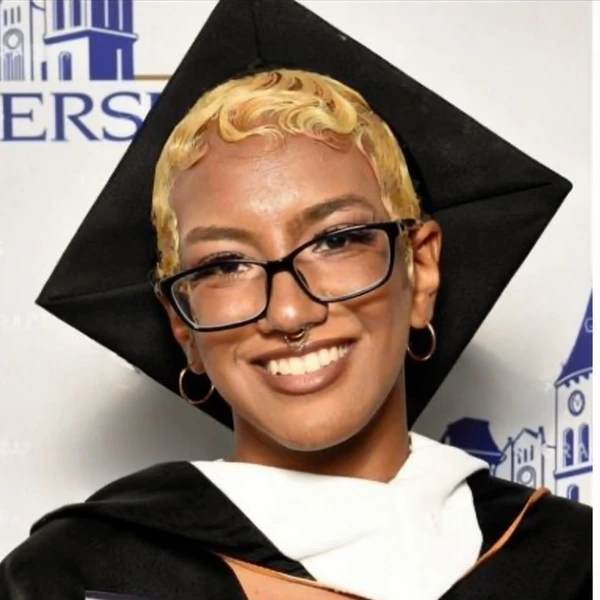
Hi! I'm Awatif Garboua, a 2026 Spring graduate from Converse University with a Bachelor of Arts in Politics. I am looking to attend the Clinton School of Public Service in the fall and receive my Masters in Public Service (MPS). Afterwards, I hope to work in the non-profit sector in legal and personal advocacy.
I have over a year and a half of experience in the non profit sector, including a summer internship with Ten at the Top, an upstate SC based non-profit working in business and community development. I both interned and worked with Project R.E.S.T, an organization serving victims of Intimate Partner Violence (IPV). Most recently, I am interning with Time Served, a non-profit legal aid organization doing pro-bono representation for clients with South Carolina criminal records.
Education
Converse College
Bachelor's degree programMajors:
- Political Science and Government
SC Governor's School For Arts And Humanities
High SchoolEastside High
High SchoolMiscellaneous
Desired degree level:
Master's degree program
Majors of interest:
- Public Administration and Social Service Professions, Other
Career
Dream career field:
Non-Profit Organization Management
Dream career goals:
Intern
Time Served2026 – Present6 monthsShelter Advocate
Project R.E.S.T.2025 – 20261 yearSummer Intern
Ten at the Top2024 – Present2 years
Arts
City of Spartanburg
PaintingMagnified by Viviane Lee Carey2023 – 2023South Carolina Governors School for the Arts and Humanities
Visual ArtsSCGSAH Midyear Student Gallery, SCGSAH End of Year Gallery2021 – Present
Public services
Volunteering
Brown Girls Read — Tutor & Leader2024 – 2026Volunteering
Sigma Gamma Rho Sorority, INC. — Member2024 – PresentAdvocacy
Independent — Organizer and Speaker2023 – 2024Volunteering
SCGSAH- Visual Arts Department — Designed and distributed informational posters about a different Black artist every day of Black History Month2022 – 2023Volunteering
Horizon Church Creative Camp — Taught girls age 9-15 with various experience levels multi-step sewing projects2022 – 2022Volunteering
Arts Advocacy — Create a video for a sticker-making activity while educating about the design process and native South Carolina plants2021 – 2022
Future Interests
Politics
Volunteering
Philanthropy
Michael Rudometkin Memorial Scholarship
“Though I owe allegiance to no one other than myself I clearly understand that my future rests with the black people of the world” George Jackson, Soledad Brother.
The word diaspora, hailing from Greek and defined by the Holocaust, literally means “to scatter” and refers to a population fractured by some seminal tragedy. In the case of Black people, this scattering was the trans-atlantic slave trade, the most horrific atrocity in recorded human history. This was not simply a scattering of people, but a scattering of self; when a people-group is created from tragedy, that trauma embeds itself in the collective racial consciousness. Nowhere is this more evident than in the carceral system, itself a vestige of slavery and modern manifestation of eugenics. Incarceration is the survival of slavery's defining violence; the destruction of the Black person, and the creation of the inmate/slave, a fractal-self who remains long after release.
Incarceration does not create a safer world, a reality evident during my work as a women’s shelter advocate with Project R.E.S.T. Prisons and policing are far more likely to negatively impact victims; at least 70% of incarcerated women have faced Intimate Partner Violence (Bayless et al., 2024). Having a criminal record compounds the harm of IPV and complicates escape from abuse, making it harder to find employment, housing, and other victims’ services. Our program was often forced to deny placement to victims with criminal records in compliance with state law, leaving the most vulnerable without resources. It is this abandonment of victims by the legal system that drives so many to return to their abusers; as a Shelter Advocate I watched many desperate women and families choose stability over safety. This is a systemic, not personal failure; one which could be remedied through restorative justice.
It is this understanding that has driven me to work in the recreation of the justice system as reconciliatory, not retributive. Prisons as they exist serve as a painful reminder of a diasporic existence, one in which “criminality” exists as a moral framework designed to justify the socio-economic subjugation of Black people. I am currently interning with a non-profit legal aid organization called Time Served, which provides pro-bono representation for people with South Carolina criminal records (the only such organization in the state). During my short time with them, I have already witnessed cycles of incarceration and recidivism; specifically how Black people with criminal records are victimized in family policing systems, and how Black children from foster care and DSS often grow up to become incarcerated themselves.
Most recently, I was at a protest held by the family of Cyrus Carmack-Belton, a 14 year old Black boy who was murdered by a man who suspected him of stealing a water bottle. It reminded me of my younger brother, a Black boy of the same age as Belton. Seeing the family and community grieve made me reflect on how the conflation of criminality and Blackness extends far beyond incarceration; anybody can be victimized at the hands of this cruel, anti-Black system, including children as young as my brother. For me, selflessness is not simply a matter of being perceived as a good person. It is ensuring the safety of my family, my community, and generations of Black people to come.