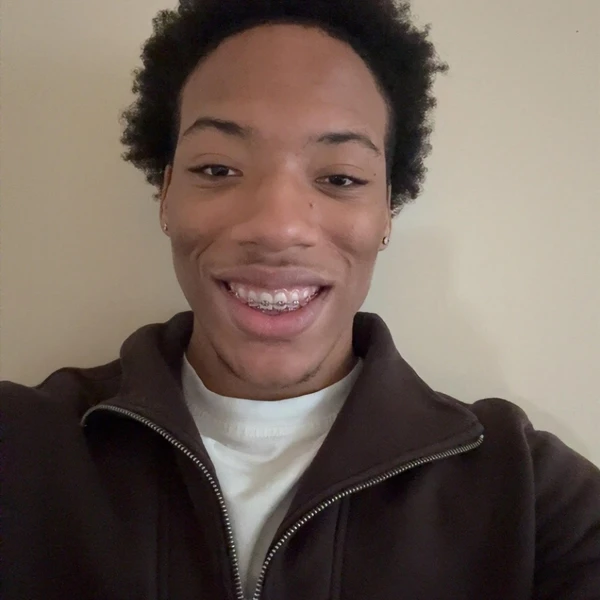
Todd Perkins
1x
Finalist
Todd Perkins
1x
FinalistBio
Todd Perkins is a Computer Science junior at Howard University (Class of 2027) from Detroit, Michigan, building at the intersection of AI, full-stack engineering, and real-world impact. He currently works as an AI Research Assistant at Howard, developing multimodal machine learning pipelines for agricultural crop health classification using hyperspectral imagery. His project portfolio spans a real-time crypto analytics platform processing 44,000+ price updates per minute, an AI-powered research agent deployed on Cloudflare Workers, and a full-stack AI code review platform supporting multiple LLM providers.
A member of the National Society of Black Engineers and a Handshake AI Fellow, Todd is passionate about using technology to solve problems that matter — from financial access to environmental health. Outside of coding, he's equally at home watching anime, grinding video games, or keeping up with whatever sport is in season.
Education
Howard University
Bachelor's degree programMajors:
- Computer Science
University of Detroit Jesuit High School
High SchoolMiscellaneous
Desired degree level:
Master's degree program
Graduate schools of interest:
Transfer schools of interest:
Majors of interest:
Career
Dream career field:
software engineer
Dream career goals:
Lyndsey Scott Coding+ Scholarship
The moment I realized computer science was my calling was not in a classroom — it was watching people in my Detroit community navigate a financial system that was never designed for them. They were locked out of wealth-building opportunities not because of a lack of intelligence or ambition, but because of a lack of access. That observation became the driving force behind everything I build.
My computer science goal is to become an AI Engineer building intelligent systems that democratize access to financial technology. At Howard University, I am already living that goal. As a junior maintaining a 3.34 GPA, I serve as an AI Research Assistant building machine learning pipelines, have deployed three production AI systems processing over 44,000 data events per minute, and founded ChainRisk — an AI-powered crypto risk intelligence platform. The crypto market is one of the most profitable markets in the world, yet its complexity and opacity make it inaccessible to the communities that could benefit most from it. ChainRisk exists to change that by making sophisticated financial risk analysis affordable and understandable for organizations that have historically been excluded from these opportunities.
My non-computer science goal is digital equity. The inaccessibility of tech resources in underserved communities — particularly the lack of affordable high-speed internet, device access, and digital literacy training — is a crisis that compounds every other form of inequality. A student without reliable internet cannot compete. A small business owner without digital tools cannot scale. A community without tech infrastructure cannot build generational wealth. I am deeply committed to addressing this gap through advocacy, mentorship, and community investment. Through NSBE at Howard, I mentor younger Black CS students navigating their first internship applications and research opportunities, ensuring the knowledge I have access to flows back to the people who need it.
The intersection of these two goals is where my most meaningful work happens. ChainRisk is not just a startup — it is a proof of concept that AI can make complex financial systems legible and accessible to people who have been deliberately excluded from them. The same architecture that powers ChainRisk's risk intelligence engine can be applied to help underserved communities understand credit systems, investment opportunities, and financial risk in plain language. I am already designing educational components of ChainRisk that explain AI-generated risk signals in accessible terms rather than financial jargon.
This summer I will join Lenovo as an AI Application Developer Full Stack intern, building LLM systems for enterprise users. That experience will sharpen the technical skills I bring back to ChainRisk and to my community work. Every production system I build teaches me something I can translate into accessible tools for people who deserve the same sophistication that Wall Street takes for granted.
I am a BIPOC computer scientist from Detroit who refused to accept that technology and financial empowerment belong only to the privileged. My computer science work and my equity mission are not separate pursuits — they are the same pursuit, expressed in code.
Ben Brock Memorial Scholarship
My grandfather served in the United States Navy for over 30 years. Growing up, I watched him carry himself with discipline, precision, and a commitment to excellence that shaped how I approach challenges. His service didn't just define our family — it defined my standard.
My path to computer science started unexpectedly through video games. As a kid in Detroit, I spent hours not just playing games, but wondering how they worked. What made characters move? How did the physics engine know when objects collided? How could a screen create an entire world? That curiosity stayed with me as I grew to learn more about the world of technology.
By my senior year of high school, I enrolled in AP Computer Science and finally got my answers. Learning JavaScript for the first time felt like discovering a language I had always been meant to speak. For the first time, I could build something from nothing — logic turning into a functioning program on a screen. The problem-solving, the creativity, and the precision required to write clean code all reminded me of the discipline I had watched my grandfather model throughout my life.
That connection between his service and my pursuit of computer science is not accidental. My grandfather served his country by showing up every day with excellence, regardless of how difficult the work was. I carry that same commitment into my computer science studies at Howard University, where I am currently a junior maintaining a 3.34 GPA while building production AI systems, conducting machine learning research, and founding an AI-powered startup called ChainRisk.
Just as my grandfather never stopped learning and improving throughout his 30 years of service, I approach computer science as a lifelong learner. Every project teaches me something new — every system I build reveals a limitation I need to overcome. The field of computer science changes faster than almost any other, meaning the commitment to continuous learning my grandfather modeled in uniform is the same one I need at my keyboard.
Ben Brock's legacy of lifelong learning and mentorship resonates deeply with me. I have already begun paying forward the mentorship I received — supporting younger NSBE members at Howard in navigating their first internship applications and research opportunities. The same way my grandfather made others better through his service, I want to make others better through technology and mentorship. This scholarship honors someone who never stopped growing. That is exactly the man I want to become, not just for my family, but to prove that, regardless of area or skill level, you can achieve anything you put your mind to.
Grand Oaks Enterprises LLC Scholarship
I am Todd Perkins, a Computer Science junior at Howard University from Detroit, Michigan. My journey to where I am today was shaped less by a straight path and more by a persistent refusal to stop building. Growing up in Detroit — a city that has faced decades of economic hardship, environmental neglect, and systemic disinvestment — I learned early that if you wanted something better, you had to create it yourself. That instinct led me to computer science. I taught myself to build, started with small projects, and kept going. Today I work as an AI Research Assistant at Howard University, developing multimodal machine learning pipelines for agricultural crop health classification using hyperspectral imagery. I have built a real-time cryptocurrency analytics platform processing 44,000+ price updates per minute, an AI-powered research agent deployed on Cloudflare, and a full-stack AI code review platform supporting multiple LLM providers. I am a member of the National Society of Black Engineers, a Handshake AI Fellow, and a Dean's List student maintaining a 3.34 GPA. But the resume only tells part of the story. I have volunteered with Focus: HOPE serving senior citizens in Detroit, contributed to The People's Voice supporting community outreach and reparations advocacy, and served at local food banks feeding families in my neighborhood. Every experience — technical and human — has brought me to this point: a student who understands that knowledge without service is incomplete.
Attending Howard University means carrying something larger than myself. HBCUs were built during a time when Black students were actively denied access to education — they exist as a direct act of defiance against a system designed to exclude us. Walking those halls every day is a reminder that my presence in this field is not accidental. It was fought for. What Howard gives me that no other institution could is a environment where my excellence is expected, not exceptional. I am not a diversity statistic or a first-generation novelty. I am a student among students, held to a high standard by professors who look like me and have walked roads similar to mine. That normalcy — being seen fully — changes how you carry yourself professionally and academically. Howard also connects me to a legacy of Black leadership in technology, law, medicine, and public service that grounds my ambitions in something real. I am not just getting a degree. I am joining a lineage.
Detroit shaped me, and I intend to give that back. My family has sacrificed significantly to support my education, and the most meaningful thing I can do with that investment is build a career that creates real opportunity — not just for myself, but for the people and places that raised me. In the immediate term, that means becoming the first in my family to build a career in technology at scale — demonstrating to younger cousins, neighbors, and kids in my community that this path is possible and accessible. Representation in technical fields matters, and showing up visibly in spaces like NSBE, research labs, and internships at companies like Visa sends a message that Detroit produces engineers too. In the longer term, I want to build technology that solves problems my community actually faces. Detroit residents have lived through contaminated water, food deserts, and limited access to financial services. My work in AI and machine learning is not disconnected from those realities — it is pointed directly at them. Whether that means building tools that improve agricultural sustainability and reduce environmental harm, or creating platforms that give everyday people better access to financial data and literacy, I am committed to ensuring that the technology I build serves people who have historically been last in line to benefit from it. My community gave me the drive to get here. My education at Howard is giving me the tools. The combination of the two is what I intend to spend my career putting to work.