Hobbies and interests
Business And Entrepreneurship
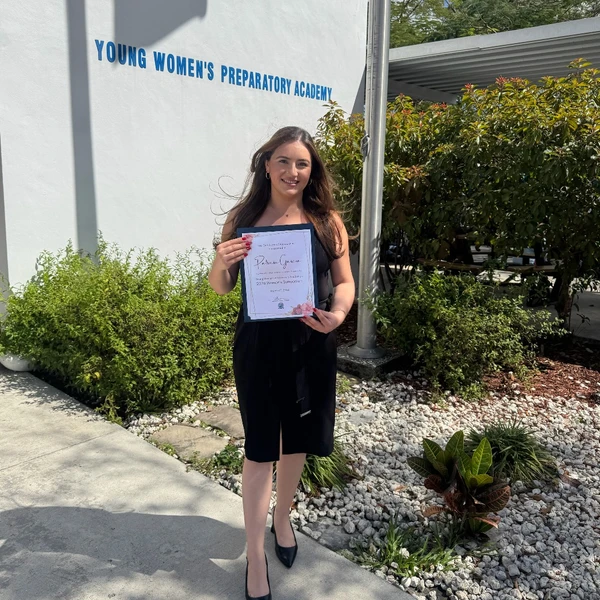
Patricia Garcia
1x
Finalist
Patricia Garcia
1x
FinalistBio
Patricia is a Miami native, product leader, and community advocate with graduate degrees from USC and University College London. A Fulbright Entrepreneurship Award recipient and FIU alumna, she channels her engineering and entrepreneurship background into building inclusive communities through products, grassroots advocacy, and civic initiatives that have reached over 1.3 million South Florida residents. This fall, she begins her JD at the University of Miami School of Law, where she'll continue bridging technology, law, and community impact.
Education
University of Miami
Doctoral degree program (PhD, MD, JD, etc.)Majors:
- Law
University of Southern California
Master's degree programMajors:
- Industrial Engineering
Florida International University
Bachelor's degree programMajors:
- Mechanical Engineering
Miscellaneous
Desired degree level:
Doctoral degree program (PhD, MD, JD, etc.)
Graduate schools of interest:
Transfer schools of interest:
Majors of interest:
- Law
Career
Dream career field:
Law Practice
Dream career goals:
Founder
Unithrifts2020 – 20255 yearsProduct Manager
American Express2025 – Present1 year
Research
Biomedical/Medical Engineering
University of California Berkeley — Researcher2019 – 2019Mechanical Engineering
Massachusetts Institute of Technology — Researcher2018 – 2018Biomedical/Medical Engineering
Worcester Polytechnic Institute — Researcher2017 – 2017Neurobiology and Neurosciences
University of Miami — Researcher2016 – 2016
Public services
Advocacy
Patricia4Miami — Founder2023 – Present
Jeffrey J. Douglas First Amendment Scholarship
My interest in First Amendment applications in the digital age is not academic. It is personal.
What started as a small Instagram account documenting the conditions in my own neighborhood turned into a civic journalism platform that has reached over 1.3 million Miami residents in just 90 days. I documented downed utility cables, deteriorating storm drains, and construction barricades blocking accessible pathways. The work is built on one conviction: communities cannot fight for what they are not allowed to name out loud.
Calling these things out by name upset a sitting commissioner. He responded by deleting constituent comments from his official government account and blocking critics from engaging with it altogether. That is not a social media dispute. That is a First Amendment violation. I took it seriously enough to read constitutional law on my own, trace the doctrine through Lindke v. Freed, and contact the Knight First Amendment Institute at Columbia University. The gap between what I understood and what I was equipped to do is exactly why I am going to law school.
But the commissioner's actions changed something for me. Reading case law at midnight after my 9-5 to understand what had been done to my neighbors, and myself, I kept running into the same wall: I could explain the violation. I could not litigate it. I could write the thread. I could not file the brief.
Free expression is the condition under which every other form of advocacy becomes possible. Without it, the sidewalk photo disappears. The comment gets deleted. I have spent years building tools and platforms to protect that condition at the community level. I am going to law school to protect it at every level. The First Amendment radicalized me in real time. Now I intend to use it.
I did not come to this work as a lawyer. I came as an engineer, trained at the University of Southern California, who learned to build systems that solve problems other people had stopped trying to fix. Then I became the first Latina recipient of the Fulbright Entrepreneurship Award to the United Kingdom, which taught me that the problems worth solving rarely stay inside one discipline. Free expression is an engineering problem as much as a legal one. I have spent years on the engineering side.
As an incoming 1L, I am going to law school to cover the rest.
My goal is to litigate the boundaries of the First Amendment in the digital age, starting with the question that started all of this: when a public official silences a constituent online, what does the Constitution owe that constituent?
Margot Pickering Aspiring Attorney Scholarship
"As a disabled vet that has lived in this community for over 30 years, thank you, I'm very grateful for your advocacy. I always have to walk on the street because I can't walk on the grass or uneven surfaces even with my equipment. Your advocacy for sidewalks helps immensely and encourages me to become more independent, knowing our infrastructure is reliable and available. Thank you."
I did not have a law degree when I received that message. What I had was a choice, and I made it the same way every weekend, every lunch break, every spare hour I could find. I gave a platform to people who had already tried every official channel and been met with silence, and built a civic reporting platform from scratch that reached over 1.3 million Miami residents. Not because it was expected of me but because I could not walk past these problems and do nothing.
And somewhere along the way, my spare time stopped looking like free time and started looking like a second vocation. I was reading the ADA on lunch breaks, studying EEOC guidance on weekends, trying to understand what Section 1983 actually required and when it applied, not because anyone assigned it to me but because I could not show up for my neighbors without understanding the legal ground they were standing on.
There is a saying that you never have to work a day in your life if you love what you do. I think about that often, because nothing I have done in this space has ever felt like work. It has felt like the thing I was supposed to be doing. So when that veteran's message came through, I was not prepared for how much it would reframe everything.
He had lived in the same Miami neighborhood for thirty years. He had rights guaranteed by federal law for just as long. And he was thanking me, a neighbor with a phone and a voice, for making him feel like those rights might actually be real. What broke me open was not the infrastructure failure, I had documented hundreds of those. It was the gratitude. The fact that a man who was legally entitled to an accessible sidewalk felt moved to send a thank you message because someone had noticed. The gap between what the law promised him and what his daily life looked like was not a documentation problem. It was an enforcement problem, and no platform, no matter how many people it reaches, can close that gap alone.
That is when I understood what I was missing. I had the conviction, the knowledge, the community trust, and the track record. What I did not have was the credential that converts advocacy into obligation, that takes a well-documented grievance and makes it a legally enforceable claim. A law degree is not a pivot away from this work. It is the only way to take it further.
As an incoming 1L at the University of Miami School of Law, I am exactly where that message pointed me. I have spent my career learning how to design systems and build things that work as an engineer. A Fulbright took me across the world to do it and civic advocacy brought me back to my own neighborhood to do it again. What I have never had is the legal background to make any of it stick but I am now about to embark on this journey into law school.
Civil rights and municipal law are not abstract interests to me. They are the last tool I need to make the work I have already spent years doing actually stick. I have loved this work long before I had the credentials to formalize it, and now I finally get to do it right.