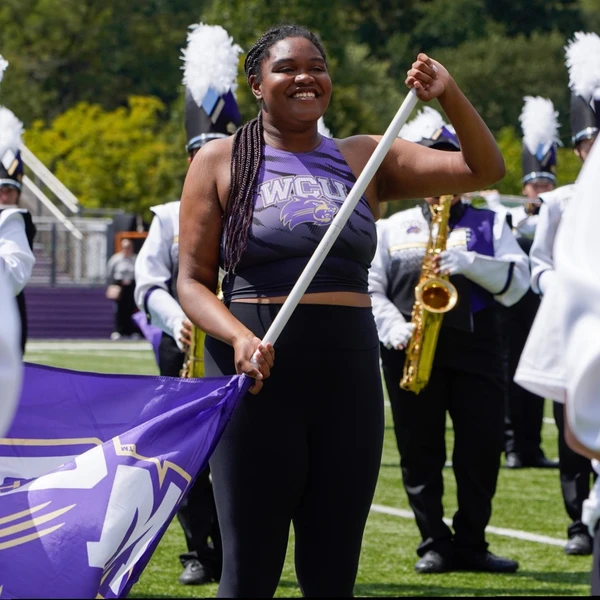
Hobbies and interests
Writing
Journaling
Video Editing and Production
Videography
Photography and Photo Editing
Streaming
Reading
Action
Fantasy
Realistic Fiction
Adventure
Education
Environment
Novels
I read books daily
US CITIZENSHIP
US Citizen
Terinee Dozier
1x
Finalist
Terinee Dozier
1x
FinalistBio
I'm Terinee, and I am an aspiring author, journalist, and streamer. Some of my hobbies include marching band/colorguard, graphic design, and journaling my experiences.
I currently attend Western Carolina University, studying my undergraduate degree in communications with a concentration in journalism. I am also minoring in creative writing and publishing. I have experience with community service in the area by participating in clubs such as the rotaract club and I also enjoy campus activities. My favorite group to be apart of is the Pride of the Mountains Marching Band.
For the past three years, I have been working on a fantasy novel and have finished writing the first couple drafts! I am editing and looking for beta readers so that I may one day find an agent and publisher to publish the book traditionally. I plan to include multiple novels in a series and create realistic fiction novels for young adults later down the line.
Education
Western Carolina University
Bachelor's degree programMajors:
- Journalism
Minors:
- Rhetoric and Composition/Writing Studies
GPA:
3.9
Blythewood High
High SchoolGPA:
3.9
Miscellaneous
Desired degree level:
Bachelor's degree program
Graduate schools of interest:
Transfer schools of interest:
Majors of interest:
- Communication, Journalism, and Related Programs, Other
- English Language and Literature, General
Career
Dream career field:
Media Production
Dream career goals:
To work as a journalistic writer and writing full-fledged novels.
FOH worker
Chick-Fil-A2025 – Present1 year
Sports
Bowling
Varsity2021 – 20254 years
Research
Communication, Journalism, and Related Programs, Other
Personal Journalism Article — Writer2025 – 2025Teacher Education and Professional Development, Specific Levels and Methods
Teacher Cadet Program — Student2023 – 2024Rhetoric and Composition/Writing Studies
English Class — Student2023 – 2024Communication, Journalism, and Related Programs, Other
BHS Media — Opinion Editiorial writer2021 – 2021
Arts
BHS Media
Videography2021 – 2025Blythewood High School Marching Band and Winterguard
Performance Art2022 – 2024
Public services
Volunteering
Richland County Sheriff's Department — Bowler/Participant2022 – 2025Advocacy
No Place For Hate — Member2022 – 2025Volunteering
Rotaract Club — Member2025 – PresentVolunteering
Town Events — Member2021 – 2025Volunteering
AVID — Member2018 – 2022
Future Interests
Advocacy
Volunteering
Philanthropy
Entrepreneurship
WCEJ Thornton Foundation Low-Income Scholarship
I am an undergraduate student attending a 4-year university in the western part of North Carolina. While the school I attend is in a tight-knit community, there is a much bigger world out there than what I am used to. I write a lot, and with my knowledge of writing comes my increase in awareness of what goes on around me and how I feel about what goes on. Since starting college, I have taken great care in checking the news frequently, and while it keeps me informed, I also feel a strange sense of hopelessness fueling me.
I am studying communications with a concentration in journalism to educate myself. I wish to educate myself in the ways in which our communicative industries fuel the fire in a world that seems to operate purely on chaos. However, I also wish to one day share what I have learned with others and provide solid fact-checked information so that people do not have to be skeptical of the news all the time. Trust is important, and it must go both ways. I will build trust within my community, wherever I decide to live, and fulfill my duty of giving the people the choice to accept the truth.
It is easy to see how quickly the world seems to be falling apart and how there always seems to be conflict going on in different parts of our country. As it stands now, I have felt useless as a citizen and powerless as people suffer around me. Sometimes, I suffer myself. However, I believe that journalists have a special role in what people see every day. It's no secret that not all journalists are good, and not all journalism outlets are aimed at spreading correct, unbiased information. It's extremely hard to be unbiased, yes, but it is equally easy to let biases get in the way of what is true and what is not true. Due to this, some outlets favor one side, and when people tend to favor one side, they will consistently absorb information from sources that most align with their beliefs. There is nothing wrong with this in general, but when one refuses to see the other side and face the truth, it can be detrimental to the integrity of our society. Journalists have a job to relay information to the public, and that information should not come in the form of misinformation or disinformation.
Not everyone will accept truth, and that's okay. As long as they were given the information that I know is correct and I do not mislead them intentionally, I will be satisfied with my job as a journalist. Continuing my studies at my university of choice will give me more opportunities to learn how to be a journalist that holds good ethics, leadership skills, and a voice to advocate for myself and others. It's a gift to be able to provide information that normal citizens may not have access to unless they look deep enough, but many people do not have the time or motivation to do so. Knowledge is power in many cases, and I firmly believe in my ability to at least make information more available to audiences that may be exhausted and dissatisfied, even if there are outside factors that may encourage me to do the opposite.
I often measure my success based on how I am able to reach others with my words. Even if there are disagreements, progress has to start somewhere. In journalism, progress comes from courage, integrity, and honesty.
Finance Your Education No-Essay Scholarship
Alexandra Rowan Resilience in Writing Scholarship
I have experienced blood clots in my left leg, and the experience itself has shaped me into who I am today. I did marching band in high school, and during my junior year, I had developed a blood clot that made it extremely difficult to get through that marching band season. I was always the type of person to feel like I was falling behind because I wasn't participating, so not being able to rehearse due to the clots made me feel discouraged and weak. Before the end of the season, when the swelling and pain weren't as bad, I managed to get caught up with the help of my peers, instructors, and personal time. If there is one thing I must admit, it is that it taught me when to take breaks and show resilience mentally and physically.
A moment when writing has helped me see myself or the world differently is definitely the period of time when I was working on my first novel called "A New Era." I was always a daydreamer, and I would frequently dream about story elements in which I desperately wanted to come to life through writing but never thought I had the skills or time to do so. Around four years ago (sophomore year of high school), I decided it was time for me to try and write my first novel. I wrote a lot throughout those four years, even during class, and I found that writing transported me into a place where I could finally put my daydreams down onto paper and mold a story that represented my ideals.
Writing comes with deep thought and changes to the story itself. There had been times when I reached around 40,000 words before I decided I wanted to erase entire characters and change the plot entirely because I thought it would fit my narrative better. The work I had put in was difficult to navigate through, and I wanted to give up so much that I had begun to think that what I wrote would provide nothing valuable to society or myself. My dreams of becoming an established writer and author wavered throughout my journey, but I told myself to "keep going," even if it meant writing 200 more words. Eventually, I finished the first draft, and my finishing the writing portion of my novel changed my outlook on a few things about myself and my environment.
When it comes to me, I knew I had struggled with anxiety and the feeling that I was never enough as a person and I never did enough to contribute to my community. I frequently questioned what skills I had to offer, but when I finished writing my novel, I realized that my skills are incorporated in areas of my life that I don't even recognize. Being proactive and flexible are some parts of my skill that have been influenced by writing, as I needed to be willing to make changes to my draft to improve the story.
When it comes to the world, I have achieved a greater understanding of what it means to struggle through one's passion. I love to write, but the truth is that it is not always easy. Though, if I truly love something and I wish to do more with it, I cannot allow society to push me down and tell me that I can't do it. I pave my own path and use my best judgment to claim personal responsibility and hold myself accountable. The world doesn't owe me a dime, so I will make one for myself.
Robert F. Lawson Fund for Careers that Care
I'm Terinee, and I am studying for my undergraduate degree in communications with a concentration in journalism. I have always been a writer, and while I mostly convey my thoughts and emotions through creative forms of literature, I have always known how important it is for literature, language, and knowledge to be used with the care and integrity to inform others. Journalism is no exception when it comes to its importance in our society and how people view and perceive different cultures, races, ethnicities, and more. Although there are many different fields in which influence society, for better or worse, I believe that some important questions to think about are:
"What is actually going on in our local/regional/national/international communities?"
"How are people reacting to what's going on in our communities?"
"How can I get involved in my community and make the world a better place?"
Journalism involves a lot of skills in order for one to be successful in the field. Trust is arguably the biggest trait a good journalist has. Lately, large news outlets, reporters, and those that work in the field of communication involving news have attained bad reputations. People criticize journalists for having bias towards certain groups of people, whether it be due to their race, class, or influence on society. These criticisms, admittedly, are valid, and it is the right of the people to hold both the press and government accountable.
While these criticisms are valid, I believe that it is the press's duty to address these problems and actually practice integrity, accountability, and tenacity when they present information to the public. The field has lost trust, but if those that are in the field truly care, they know that trust can be built back up over time. It just takes effort and resisting the urge to tell stories that may not be true for the "drama."
I am only a first-year in college, so I have not had the experience to truly work effectively in my field of study. However, I have been slowly getting involved with student-run publications that print out physical newspapers to share with the school and the nearby towns. Researching and verifying information before writing out a story is one of the most important things a journalist must do. Although it is a timely, often frustrating process, it holds people accountable. Information should not be exclusive, as it is important for the public to understand what is going on locally, nationally, and internationally. Knowledge is power, and I have seen the ways that misinformation and disinformation cause conflict between groups.
Becoming more educated on the ethics of journalism and the handling of information meant to be seen by the public, I believe that I can be useful to those who wish to know more in the future. Being aware and knowing what is going on is not being "political," as many people do not like to be engaged in politics, but it is important to stand up for what one believes will benefit society as a whole.
We live on a continuum of goodness and suffering, but knowing what is true and what is not allows us to decipher how we can benefit ourselves without harming others. I aim to continue my studies in informing others while maintaining trustworthy morals to ensure knowledge is accessible for everyone, not just those who are powerful. I want to educate people on what it means to be aware of what is going on in our world and show that the news does not always need to be doom and gloom.
Change is always possible.
Valorena Publishing & Cocoa Kids Collection International Scholarship
I am Terinee, and I am studying for my undergraduate degree in communications with a concentration in journalism. Writing has always been a passion of mine, and my head is constantly filled with thoughts about characters, plots, and settings that I wish to incorporate in future works. During class, while I hang out with friends and family, and even before I go to bed, I dream about what stories I want to share with the public. However, the stories I wanted to tell were ones that were interwoven between fantasy and my personal struggles relating to who I am.
All throughout my life, my anxiety had stopped me from feeling confident with most of my feelings, many of which were feelings needed to set healthy boundaries and protect myself from those that wish to hurt me. I believed that saying "no" would make me come across as rude or create a negative interpretation of my character. I never liked confrontation and made an effort to please as many people as possible to avoid upsetting others. My father had high standards and expectations when it came to my academics, personal growth, and contributions to society. However, the pressures he placed on me made me fear mistakes. I disapproved of any sign of weakness I showed and berated myself if I got anything below exemplary in school.
One way I would deal with these emotions would be through writing and reading. Most of my emotions and frustrations came out in poetry, where I would write about certain concepts I found interesting. Nature, humanity, failure, fear, sorrow, and so much more would be incorporated in lines that felt right. They may not have rhymed, but they conveyed how I truly felt in those times of self-loathing. Short stories would behave the same way, but I would plan out characters that represent my criticisms of society and the type of personalities I get along with or have conflict with. Then, there are novels.
I have never published a book, but I have always dreamed about it. For the past three years, I have been working on a fantasy novel, which includes a main character who I have developed, changed, and closely related to since my freshman year of high school. Over the course of the series, I wish to transform him into what I wish to be when I grow older and gain experience. Confident in my abilities to lead, unafraid to ask for help, and resilient in whatever the cruel world sends my way. Picture books, in particular, have impacted my life by matching the words I read with images of the world I envisioned. I remember reading the Geronimo Stilton books, and I competed with a fellow classmate to see who could read the most books. Yet, thinking about it now, there was something special about the Geronimo Stilton books that made me realize that children's literature is just as important as that intended for older audiences. The "magic" we see and read truly feels like it comes to life, and it continues to affect me now, as my love for literature has not waned.
With my endeavors, I hope to publish various forms of literature for all audiences, from children to adults. My financial situation has not always been the best, and so having the opportunity to fund my career in both communications and creative writing would give me more confidence and security in what I intend to accomplish for the future. Literature is precious and special, and everyone should have the resources to find magic within pictures and words.
Strong Leaders of Tomorrow Scholarship
Being a leader isn’t about dominating a conversation or overseeing those working under or with you like an invisible entity. In an ideal world, leadership involves taking charge and pulling those who struggle up to your platform so that one day they may be able to lead as well. I stand by this idea, especially when it comes to literature and journalism. As a writer, I am particular about the details and how a story is set up; this bleeds into the journalism courses I have taken in high school and the ones that I take now in college.
I am an upcoming sophomore attending Western Carolina University as a communications major with a concentration in journalism. Journalism is a highly collaborative venture, and I have experienced this in many different projects, activities, and events. As someone who has worked on my high school news show in the past, I was placed in a leadership role along with two juniors to help people adjust and learn how the news show is supposed to work. We’ve made many changes the past year, and yet everyone seemed to pick it up rather quickly. Naturally, at the beginning of the year, only a few people knew each other, but I was determined to make the atmosphere positive and welcoming. We played a “get to know you” game and I smiled while trying to learn everyone’s name while introducing myself. I encouraged people to stand up, participate, and put their personality out there to try and build our new community for the year. Luckily, the efforts seemed to work as the group grew closer and closer together and we were all able to joke and laugh without feeling much animosity towards each other. I never liked drama, so if there ever was a problem, I wanted people to tell me if something felt unfair. Everyone’s voice was important to me and even though I had a lot to learn and teach them, I knew that they could teach me many things too.
That experience from high school has transferred to leadership opportunities I am presented in college. Even if the opportunities are not big, I aim to be respectful and as kind to people in my group as possible. When it comes to group projects, while I am often delegated as the "leader," I encourage others to speak up, use their voice, and contribute to project ideas that may benefit our group. Instead of demanding or ordering people to complete certain tasks, I give gentle reminders and let them know that I not only care about the progress of our assignment, but also their well-being. One of the most important things I have learned about being a leader, is understanding that life happens, and people can get caught up in incidents that were not planned. Being able to navigate when people are struggling and still getting the work done is important, and for most of my group projects in college so far, I have been successful in this skill.
Leadership is a trait anyone can achieve, but the effectiveness of one's leadership heavily depends on how they care for those that are not "leaders." Being able to guide people in the right direction to give them confidence and hope is a part of a leader's job. This highlights that compassion, efficiency, and productivity are interconnected and it takes a team to keep our dreams alive.
Tawkify Meaningful Connections Scholarship
Relationships & Impact
My father works as a school resource officer (SRO) at the high school I attended and has always played a big role in my goals to pursue a higher education. Despite people becoming successful with or without attending college, my father saw value in the opportunities that college presented on a regular basis. He encouraged me to do well in school and follow what dreams I had in mind while ALSO having a plan B in case things inevitably do not go exactly as I planned. What I really aspired to be was an author, but I also had a passion for journalism and decided to make that my main career goal. I believed that if I played my cards right and got a little bit of luck, then my dream of becoming an established author could come true.
Despite the right path my father put me on, he did put a lot of pressure on me about my academics at a young age. My earliest recollection of feeling stress in school came in 4th grade. Through the previous years, I had gotten all A's, and my family mentioned how smart I was and how I was more intelligent than they were. While I believed they meant well, this inadvertently made me feel nervous about failing or disappointing them. My 4th grade history class was rough, and while I got through the semester well, when I received my report card, I was unpleasantly surprised.
All of my grades were A's, except for my history class, in which I had an 89. I was just ONE point away from getting all A's, and at that moment an unbearable stress came over me. For the rest of the day, I found myself crying silently and fearing the disappointment on my father's face. I was right to be nervous, as he visibly and audibly voices his displeasure at my "failure," and after that point, the pressure was not only from my father but from my subconscious, too.
Before I left for college, I had a mental breakdown. My father had finally realized the pain I was going through and what his pressure had done to my self-esteem after all of these years. I told him, "Dad, I feel so worthless. I feel like I'm never good enough, and it hurts. It hurts so much; I don't want to disappoint you." For once, I used my voice to actually tell my dad that it hurt. My tears and the way I covered my face out of shame proved it. We talked for an hour after that, and he apologized for what he had done. He explained that he did not mean to hurt me, and the next day while he was at work, he sent an extensive message telling me that he was proud of me. He loved me, and he was taking accountability for the pain he had created.
Now that I am in college and I have had a taste of what it feels like to do things on my own, I am grateful for my dad and what he has done for me thus far. He has always told me stories about children who come from a background full of struggle, whether it be financially, mentally, socially, or familially. Even now, many people I know, such as my roommates, struggle when it comes to relating to their parents. My father has long since broken a generational cycle of divorce by having been married to my mother for 35 years since they met in college. He has taught me the values of having compassion for those that struggle, because I never truly know what someone is going through unless I experience it for myself.
While he has made mistakes, and the mental consequences I received from his pressure still affect me to this day, my dad (and my mother) has given me a life that I cherish. I want to help others and make them feel as though someone truly cares about their well-being. While I can't help everyone, I can attempt to bring the most amount of good to the greatest amount of people. There are always opportunities for improvement, and while I mostly wish to improve myself so I can help others, I will always make time for the people I care about the most.
Christian Fitness Association General Scholarship
Throughout my K-12 years in school, I had always been on either the All A's Honor Roll or the A&B Honor Roll. I have taken and successfully passed all AP courses I have taken in high school, which include Human Geography, European History, U.S. History, Chemistry, English Language & Composition, and English Literature & Composition. I had always been taught the values of hard work, asking for help/tutoring, and being proactive rather than reactive to stay on top of my work. Along with my studies, I joined many school activities and clubs in high school. For instance, I was a part of my school's marching band for three years (sophomore -> senior year), was included in the Black Student Union events during pep rallies, and participated in events meant to improve students' mental health and school experience (such as No Place For Hate). These school activities made me feel like I was included in my community, especially when I was able to see people smile and laugh during these events. Marching band, by far, was the activity I participated in the most, as I had to dedicate three days of the week (and Saturdays for competitions) to practicing the art. While it was fun and made me feel like I was part of a time, it was very time-consuming, and I struggled to manage my time effectively. However, when I became more disciplined with my time and priorities, I got better.
Currently, I am an upcoming sophomore in college. I attend Western Carolina University (WCU) and still involve myself with clubs and extracurricular activities that keep me active. This past fall semester, I participated in the Pride of the Mountains Marching Band, and I managed to make many friends and connect with people who enjoyed the activity as much as I did. We started auditions during the last few months of my senior year of high school, and the experience went on until mid-November, excluding events like the Christmas parade. Again, marching band is a time-consuming activity, but it was worth it considering the band was able to travel to different states and perform for thousands of high schoolers and general audience members. Hearing people cheer, clap, and smile at our performances was worth the blood, sweat, and tears that made our show what it was. Marching band has been a very influential part of my life, but naturally, it is an expensive activity.
Some other clubs I have joined since coming to WCU are the Creative Writing Club and the Rotaract Club. I am a writer at heart, and it's always been one of my favorite activities. I write many kinds of stories, whether they be a different genre or format. Poetry, short stories, and even novels come naturally to me. I have been writing more poetry, as I find it easier to use when I wish to convey my grievances and joys of modern society. However, when I want to escape reality, I will work on my novels. I am working on three, but I have already finished writing one of the three. I dream that, one day, I am able to publish the books that I have been working on for years and share stories that people can use to escape the harshness of life and find entertainment in the little things. The Creative Writing Club has given me more opportunities to work on my writing by presenting me with prompts to use and connecting me with like-minded individuals who also find value in literature.
The Rotaract Club has also been a helpful resource to look into when I want to get involved with my community. The club presents opportunities for me to do things such as assist with on-campus blood drives by handing out snacks and drinks, write letters for elders and veterans, and even help with mental health check-ins. The mental health volunteer opportunities really hit home for me, as I have and still struggle with mental health, so being able to assist others by doing small things for them makes me feel good.
I have met amazing people, students and staff alike, and I believe I have found a great place to call home for the next few years of my college experience. However, a recent reality has made me feel concerned about my near future. As an out-of-state student, paying tuition has become increasingly more difficult, and my parents and I are struggling to come up with the funds. Taking out loans is risky and may compromise parts of my future financially. My mother, unfortunately, mentioned that I may not be able to come back to Western next year due to the financial difficulties of paying tuition. I was with my roommates during that call, and I cried for the rest of the day, for around 5 to 6 hours. The next week was rough, as I scrambled to find ways to help me stay, but the hopelessness filled my heart, and I felt empty. I believed that everything I did now wouldn't matter, and I feared creating more memories with my friends because if I had to leave them, it would be even more difficult for me to do so.
Financial hardship is a reality for me and for many others. However, I have been using this time to look for opportunities that may help me overcome this circumstance. I aim to improve myself physically by going to the gym and working on my nutrition and mentally by talking to professionals and being honest with my friends. I figured that it is best to focus on the here and now rather than constantly worry about the future. Life presents me with problems, and I must find solutions. There is still hope, and I'm going to enjoy every second that I am here because nothing in life is guaranteed. To me, though, this fact makes success sweeter when it happens.
Dream BIG, Rise HIGHER Scholarship
My father worked as a school-resource officer (SRO) at the high school I attended, and had always played a big role in my goals to pursue a higher education. Despite people becoming successful with or without attending college, my father saw value in the opportunities that college presented on a regular basis. He encouraged me to do well in school, and follow what dreams I had in mind while ALSO having a plan B in case things inevitably do not go exactly as I planned. What I really aspired to be was an author, but I also had a passion for journalism and decided to make that my main career goal. I believed that if I play my cards right and get a little bit of luck, then my dream of becoming an established author could come true.
Despite the right path my father put me on, he did put a lot of pressure on me about my academics at a young age. My earliest recollection of feeling stress in school came in 4th grade. Through the previous years, I had gotten all A's, and my family mentioned how smart I was, and how I was more intelligent than they were. While I believed they meant well, this inadvertently made me feel nervous about failing or disappointing them. My 4th grade history class was rough, and while I got through the semester well, when I received my report card, I was unpleasantly surprised.
All of my grades were A's, except for my history class in which I had an 89. I was just ONE point away from getting all A's, and at that moment an unbearable stress came over me. For the rest of the day, I found myself crying silently and fearing the disappointment on my father's face. I was right to be nervous as he visibly and audibly voices his displeasure at my "failure," and after that point, the pressure was not only from my father but from my subconscious, too.
Before I left for college, I had a mental breakdown. My father had finally realized the pain I was going through, and what his pressure had done to my self-esteem after all of these years. I told him: "Dad, I feel so worthless. I feel like I'm never good enough, and it hurts. It hurts so much, I don't want to disappoint you." For once, I used my voice to actually tell my dad that it hurt. My tears and the way I covered my face out of shame proved it. We talked for an hour after that, and he apologized for what he had done. He explained that he did not mean to hurt me, and the next day while he was at work sent an extensive message telling me that he was proud of me. He loved me, and he was taking accountability for the pain he had created.
In regards to challenges I have faced, tuition is a big one. I pay out-of-state tuition to go to Western Carolina University, and for a long time, I hadn't realized how much of a burden it was becoming to my parents. My mother had gotten a spinal surgery in December 2025, and the medical bills are expensive. While I recognized this, I figured that we still had enough to be able to pay off the remaining tuition balance that my financial aid and loans would be able to cover it. I was wrong. My mother sent me a text stating that I may not be able to come back to the school that had changed me for the better. I was in denial, and I called her, begging her to tell me that she was not serious. In just one, single semester, I had made so many friends and felt at peace with where I was. I was in marching band, found a few clubs to engage in, and had a roommate who cherished me as much as I cherished her.
When that text came through, it was like my world was falling apart. I feared that I would eventually have to go back home to schools in-state, which did not make me feel as much wonder and excitement as WCU does. For the next couple of days, I found myself in a depressive state, trying to accept the reality that my parents did not have the money to keep me there unless I could find other ways to pay for school. Though, after talking with a few friends, I decided that sitting down and wallowing in pity would get me no where.
I have a gift to write, and I wish to use that power in both my professional and personal life. This scholarship would assist me in staying at the school I believe values my intended profession and the people I have grown to love. Change is difficult, but just like the characters in my story, I must find a way to overcome the obstacles that I cannot control, whether it be money or family. Embracing change is the first step to this journey of self-reflection, accountability, and responsibility on my end.
I want to show people that truth is always around the corner, and while it is unfortunate that it is not readily handed to us, it is there. Journalism plays a big role in what people see and hear about what goes on in our world, and integrity is very important to the trust people have with media. Giving people the choice to choose what they believe instead of spoon-feeding them ideas I want them to believe for personal gratification is a moral I hold to my heart. People should be skeptical about certain things, and I aim to encourage others to do their own research and becoming their own person who can back up their beliefs. It may take a while to manage this change, but it is worth the effort in the end.
Kalia D. Davis Memorial Scholarship
I'm Terinee, and I am an aspiring writer and journalist! I have been better at communicating through writing rather than verbal speech, and greatly value my ability to tell engaging stories. Most of these stories are told through poetry, with me personifying certain concepts so that I can convey how I feel about different things.
From Life and Death to Nature and Butterflies, I find value in all things that wander my mind. I have been working of a few novels, and finally finished writing one after three or four years during my high school career. Although it was messy, I felt proud of myself for getting through months upon months of writer's block. I had changed so much, and my story had changed with me. I remember deleting old characters and replacing them with new ones, or changing the plot to better suit what I thought should be the overarching message of the fantasy. Change is inevitable.
Despite this message, I am not good at "change." I believe many people are not very good at changing because it is natural for us to want consistency and familiarity which whatever we experience. When change does come, and inevitably so, the positive changes brings confidence, while the negative ones make us feel vulnerable and scared. A major change occurred during the 2nd week of my second semester of college, and the implication was devastating.
I pay out-of-state tuition to go to Western Carolina University, and for a long time, I hadn't realized how much of a burden it was becoming to my parents. My mother had gotten a spinal surgery in December 2025, and the medical bills are expensive. While I recognized this, I figured that we still had enough to be able to pay off the remaining tuition balance that my financial aid and loans would be able to cover it. I was wrong. My mother sent me a text stating that I may not be able to come back to the school that had changed me for the better. I was in denial, and I called her, begging her to tell me that she was not serious. In just one, single semester, I had made so many friends and felt at peace with where I was. I was in marching band, found a few clubs to engage in, and had a roommate who cherished me as much as I cherished her.
When that text came through, it was like my world was falling apart. I feared that I would eventually have to go back home to schools in-state, which did not make me feel as much wonder and excitement as WCU does. For the next couple of days, I found myself in a depressive state, trying to accept the reality that my parents did not have the money to keep me there unless I could find other ways to pay for school. Though, after talking with a few friends, I decided that sitting down and wallowing in pity would get me no where.
I have a gift to write, and I wish to use that power in both my professional and personal life. This scholarship would assist me in staying at the school I believe values my intended profession and the people I have grown to love. Change is difficult, but just like the characters in my story, I must find a way to overcome the obstacles that I cannot control, whether it be money or family. Embracing change is the first step to this journey of self-reflection, accountability, and responsibility on my end.
Elijah's Helping Hand Scholarship Award
Envy. I have had many conversation with friends and family, and something that I could always relate to when we would have discussions about how we feel about our place in society was the curse of envy. Throughout my life, I had asked questions brought upon events that seemed to mistreat certain people, whether it be because of race, class, or bias.
"Why can't I be wealthy like...?"
"Why can't I be famous like...?"
"Why can't I be as talented as...?"
These questions run through my mind whenever I realize that I do not have the gifts that are in others. I doubt myself and compare myself to them, thinking about all of the things that I don't have, rather than the things that I do. I firmly believe that Theodore Roosevelt's quote, "comparison is the thief of joy" holds much merit, and goes hand-in-hand with envy. They both have stolen a lot of joy from me, and have worsened my mental health by making me feel anxious about who I was and what I did not have compared to those around me.
The issue started out, simply enough, with school. My parents made it known to me that I was smarter than my sisters (my sisters even admit it themselves that it is true to this day) and the pressure was suddenly placed onto me when I realized that my father was not pleased with anything but A's. "If so-and-so's child can do it, so can you." That was the phrase my father used whenever I mentioned that math was giving me trouble (math had always been a weakness of mine), and while it taught me that I should not make excused for myself, I began to feel bad about my academic ability. Whenever my grade was below what I thought my father saw as "satisfactory," I panicked and looked at those around me. Surely, if they did as bad as I, then it wasn't my fault, right?
Yet, this competitive nature was detrimental to my health, and me and my father only realized that just before I left for college. We had a long discussion about the negative impact he had on me, and how I believed that I was never good enough even when reality spoke otherwise. We cried, but I cried harder as I felt the pressure suddenly lift off my shoulders. It was not completely gone, but the anxiety and feelings of doubt eased a little and I thought back to other friends of mine who were worried about disappointing those that they lived, too.
As a student currently in college, I understand that everyone was not cut from the same cloth. Fairness and equality does not shine for all, and there are people they have more advantages than others. These advantages come in the form of money, while others come from a good-loving family or support system. Whatever the situation may be, we all have semblance of feeling and emotion. When hard times are upon us, we may show cracks within the image we want to portray to outside world. But because this world is cruel, we want to hide our struggles and keep pushing forward like it does not bother us.
I believe that everyone should be able to express their emotions freely, and feel comfortable asking for help. There are people that feel broken, but they should not have to feel this way. For those I come across, I let them know that their feelings are valid and valued. Everyone needs someone to talk to, and I am a someone.
Jeannine Schroeder Women in Public Service Memorial Scholarship
To me, writing and literature is the embodiment of human expression, culture, and perspectives that can be painted by a communication skill only humans have mastered. No other animal, no other organism, has the capacity to create and string together concise languages of all kinds into a cohesive story that most, if not all, other individuals of our species can understand. From the paper and quill to the printing press to typewriters to computers, communication through writing maintains the same principles: using effective language to persuade, entertain, inform, or criticize the world around us.
I am studying my undergraduate degree in communications with a concentration in journalism. Of course, Journalism involves a lot of skills in order for one to be successful in the field. Trust is arguably the biggest trait a good journalist has. Lately, large news outlets, reporters, and those that work in the field of communication involving news have attained bad reputations. People criticize journalists for having bias towards certain groups of people, whether it be due to their race, class, or influence on society. These criticisms, admittedly, are valid and it is the right of the people to hold both the press and government accountable.
While these criticisms are valid, I believe that it is the press' duty to address these problems and actually practice integrity, accountability, and tenacity when they present information to the public. The field has lost trust, but if the those that are in the field truly care, they know that trust can be built back up overtime. It just takes effort and resisting the urge to tell stories that may not be true for the "drama."
I am only a first-year in college, so I have not had the experience to truly work effectively in my field of study. However, I have been slowly getting involved with student-run publications that print out physical newspapers to share with the school and the nearby towns. Researching and verifying information before writing out a story is one the most important things a journalist must do. Although it is a timely, often frustrating process, it holds people accountable. Information should not be exclusive, as it is important for the public to understand what is going on locally, nationally, and internationally. Knowledge is power, and I have seen the ways that misinformation and disinformation cause conflict between groups.
Becoming more educated on the ethics of journalism and the handling of information meant to be seen by the public, I believe that I can be useful to those who wish to know more in the future. Being aware and knowing what is going on is not being "political" as many people do not like to be engaged in politics, but it is important to stand up for what one believes will benefit society as a whole. We live on a continuum of goodness and suffering, but knowing what is true and what is not allows us to decipher how we can benefit ourselves without harming others. I aim to continue my studies in informing others, while maintaining trustworthy morals to ensure knowledge is accessible for everyone, not just those who are powerful.
Hearts on Sleeves, Minds in College Scholarship
Thankfully, I grew up in a stable household with two happily married parents and two older sisters whose wisdom I still admire to this day. I lived a comfortable life, and I frequently think on how grateful I am to have been born into a family in which my father wished to end the cycle of divorce that ran in his family. While it was not a genetic curse, consequences of a broken family affected my father through his teenage years into adulthood. A consequence was my father struggling to do well in school. Of course, he did not want me or my sisters to go through those moments like he did. He did not want us to face a life of disorder.
My father put a lot of pressure on me about my academics at a young age, but my earliest recollection of feeling stress in school came in 4th grade. Through the previous years, I had gotten all A's, and my family mentioned how smart I was, and how I was more intelligent than they were. While I believed they meant well, this inadvertently made me feel nervous about failing or disappointing them. My 4th grade history class was rough, and while I got through the semester well, when I received my report card, I was unpleasantly surprised.
All of my grades were A's, except for my history class in which I had an 89. I was just ONE point away from getting all A's, and at that moment an unbearable stress came over me. For the rest of the day, I found myself crying silently and fearing the disappointment on my father's face. I was right to be nervous as he visibly and audibly voices his displeasure at my "failure," and after that point, the pressure was not only from my father but from my subconscious, too.
Before I left for college, I had a mental breakdown. My father had finally realized the pain I was going through, and what his pressure had done to my self-esteem after all of these years. I told him: "Dad, I feel so worthless. I feel like I'm never good enough, and it hurts. It hurts so much, I don't want to disappoint you." For once, I used my voice to actually tell my dad that it hurt. My tears and the way I covered my face out of shame proved it. We talked for an hour after that, and he apologized for what he had done. He explained that he did not mean to hurt me, and the next day while he was at work sent an extensive message telling me that he was proud of me. He loved me, and he was taking accountability for the pain he had created.
I realized that my voice had power to change the way my family saw me. I was not perfect, and I was not always effortlessly completing my academics. I struggled like any other person, and I was finally able to let my feelings out verbally. I felt relieved knowing that my father was finally listening. People should not have to feel as though they cannot voice their feelings, especially when they are feeling pressured to do or be something they are not. My friends experienced the same things I have, and I know that I am not alone. Even if I am not able to make a societal impact with my voice, I at least want to make those within my community feel safe to communicate their displeasure if I make them uncomfortable or put pressure on them.
RonranGlee Literary Scholarship
Socrates: "So this is how things stand, my friend. If you will design a life for intended rulers that is better than the life of a mere ruler, you will be able to have a well-managed state. For only in such a state will those rule who are truly rich, not in gold but in virtue and wisdom, the sort of things that a truly blessed person should be rich in. However, if those who crave only after their own private advantage take on the administration of public affairs, thinking this is how they grab at the greatest good, the state will never be managed well. A struggle for power will result, and this internal domestic war will destroy both themselves and the rest of the state." - Plato's "The Allegory of the Cave" (from Republic, Book Seven)
Plato was a student of Socrates and a valued philosopher whom we study even to this day. He wrote "The Allegory of the Cave" as commentary meant to illustrate the road from ignorance to enlightenment. In the story, there are people trapped in a cave, and are only allowed to stare at the wall and the shadows that appear on that wall. It essentially commentates on human perception and the battle between believing what we perceive to be true and what we actually see is true with our own eyes. In the passage above, Socrates is in dialogue to Glaucon (Plato's brother) and reflects Plato's belief that those that rule should do so out of a sense of duty. Furthermore, the consequence of indulging in constant self-interest leads to power struggles and disharmony.
A major principle Plato highlights in his book, "Republic," includes the effectiveness of a society's prosperity comes from the relationship between the rulers and those that are ruled. If that connection is tainted by the ruler's self-interest, then that prosperity is null. The line "if those who crave only after their own private advantage take on the administration of public affairs, thinking this is how they grab at the greatest good, the state will never be managed well," suggests that a ruler's narrow perspective of what will collect the "greatest good" is not a reliable source of progress for a civilized group of people. Humans are naturally selfish, that is simply how our instincts work. If we are in charge of a group of people as leaders, those instincts do not suddenly go away. Our biases and craving of fulfilling our own desires remain, and may very well be heightened in the position of power we find ourselves in. However, the management of people and the environment we govern may not align with our desires, and leaders have the option to either indulge in self-gratification or fulfill in the people that are less fortunate. Plato advocates that the leaders choose the ladder, so that a state can achieve that "greatest good."
Another point that Plato mentions is the struggle of handling power and the effect that has on political leadership. When Socrates mentions that the struggle for power will "result," he speaks with certainty. This result ends up being the "internal domestic war will destroy both [the rulers] and the rest of the state." History does not repeat itself exactly, but it does reflect humanity's flaw in making the same mistakes and blaming it on ignorance outside forces rather than claim accountability. Entire worldviews and societies have been broken and rebuilt due to war, both internal and external (take the U.S. Civil War for domestic and both World Wars for international conflicts as examples). While one can make the argument that conflict and war is necessary for the progression of society, there are net-positive ways for society to progress instead. From Plato's perspective, accountability, and responsibility upon the ruler's end is a way for positive progress to occur. However, power is an unfortunate obstacle that can change good people into worse people. The feeling of being above others and having an advantage fulfills the competitive part of our instinct that is difficult to let go. However, the best leaders are capable of using this competitiveness to create a better state now than it was before.
The world is constantly changing, and time stops for no one no matter what decisions we make. The chances of morphing humanity into a perfect entity is slim to none, but that should not stop individuals from promoting positive leadership that enables the "greatest good." Plato suggests that our sense of good, especially as leaders, should not come from the material possessions such as money or pleasantries. Rather, we should be "rich" in the non-material valuables such as wisdom and virtue. These values, for the most part, are not capable of being taken away. What we as a species experience is something that sticks with us forever, and what we do with our knowledge largely determines where we may end up in society. If we end up as leaders, it is not only our civic duty to benefit those below us, but it also a moral and righteous one.
Most of us will stay along the lower spectrum of power-wielding, but that does not mean we are powerless. As much as it is the leader's responsibility to assist those in need, it is also a citizen's responsibility to hold those in power accountable. From Plato's commentary, he understands that not all leaders have the interests of the people in mind, and are prone to making decisions that are selfish and unwarranted. However, being knowledgeable and having non-material motivations are gifts that empathetic, open-minded individuals have can bring about change itself. It may take more convincing, effort, and careful planning, but being able to effectively demonstrate one's worldview can be a step in the right direction.
The "Allegory of the Cave" does a decent job at portraying humanity's flaws. What people perceive may not necessarily be what is true, and this is especially so when it comes to leadership and our role in society. We may perceive our desires to align with the greatest good, but our desires may promote the exact opposite in reality. Both options may exist simultaneously as well, but being aware of our perceptions and having the capacity to change or accept change is valuable. It takes a group of people to make a village, but it also takes accountability and responsibility on both ends to maintain the wellness of that village.
Simon Strong Scholarship
I am studying my undergraduate degree in communications with a concentration in journalism. I look into the news daily and feel a sense of hopelessness as I witness a society where people who are financially set for life proceed to earn more while those who struggle daily proceed to earn less. Although I have empathized with people who struggle financially, I hadn't felt the hopelessness of actually being in that type of situation until my second semester of college.
My mother, who works at a disciplinary school in South Carolina, recently had a spinal surgery in December, and she had been unable to work. My father, a school-resource officer (SRO), also works in the same district, but at a regular public high school. I attend a 4-year public university in western North Carolina and ultimately have to pay out-of-state tuition. My university is a part of the NC Promise program for the state. I figured that with the aid of that program and the FAFSA, my parents and I would be able to afford the remaining tuition that was uncovered by loans and scholarships. I was naive.
When I mentioned to my mother about the continuing student housing deposit, which was $150, she sent me a text an hour after my last class had ended to let me know that I may not be able to attend WCU next year. I was in denial at first, and proceeded to call my mother asking her over and over again: "What do you mean?" Our conversation was rough, and my roommate and her girlfriend were with me, holding my hand as I cried and argued with my mother. When I explained to her that I did not want to leave the community and friends that I loved so much, she proceeded to say that I "didn't know" my friends and questioned what WCU had that other universities don't. I knew she and my father were financially stressed, but at the moment, I had felt as though my whole world was crashing, falling into an abyss of mental strain and an agony I never felt before.
The rest of the day was spent with me laying on the floor, floating. I was trying to figure out any way that I could stay. Jobs on campus were hard to come by, and I did not have a car to drive to a job in the neighboring town. All work-study funds had been distributed, and I missed the priority deadline to become an RA for the next school year. I alternated between a state of sorrow and depression, and I suddenly envied those who did not need to worry about financial struggle. I felt awful for those who have to scavenge for necessities because they simply did not have enough money. I was angry.
This adversity made me realize that I have to fight for the things that I want. I have to problem-solve, and that life is really just a series of problems, and we all get through it by coming up with solutions. My solution to my financial issues is to find ways to pay for my tuition, whether it be through grants or applying to scholarships or finding a job on campus. It gives me a sense of accountability and responsibility, even it comes from uncomfortable situations. My advice to those that are in the same position as me is to not give up. There are opportunities out there, and even if most of them aren't successful, another door is always open for you. Just don't give up, keep looking.
Get Up and Go Scholarship
Kim Moon Bae Underrepresented Students Scholarship
As a writer, I have always been curious about the various human concepts we have created to gain a better understanding of our world. If there is one thing that is common between all people, no matter their race, class, gender, or sex, is that fairness does not exist for all. Unfortunately, I have become more aquatinted with this reality and I still struggle to accept it. My high school was fairly diverse in its population, but mostly consisted of black and white students. Though, there were more white student than black ones as the school I attended was considered the "smarter" school in the district.
Even though I was in a school that valued my academics, I felt a little "out of place." Despite being a person of color, I struggled to communicate with other black students. This was not because I did not see myself in them, but I understood that I did not have the same mannerism or confidence as some of them had. There were many other black students I was able to get along with, but since I struggled with social anxiety, I also did not engage with other groups in our school. Some of my black friends would make comments that made me self-conscious, such as "you act white" or "you write so fancily." My own sisters even made such comments.
I did not know what it meant to "act white," but my guess would be that I was a little on the quieter, more socially awkward side when it came to interacting with other people of color. I do not know if it is because I grew up in mostly suburban communities or attended schools that was home to a majority white population (or both), however, when I got to college, the discrepancy in what others had compared to me made itself very clear.
Western Carolina University has its own diverse population, but it is majority white students and teachers. This is not a problem, of course, because I chose the campus due to its merited communications program, beautiful environment, and academic credibility. However, when I joined the marching band, I realized that there were only a few black people on the team other than myself. I realized that most of the others on the team had a good amount of money. They were so well off, that they (and their family) could fund them joining DCI (Drum Corps International) and Independent winter guard groups, which usually costs thousands of dollars.
My family hadn't done band, really, especially ones that were not HBCU-based. So, it was difficult for them to wrap their head around the concept and the cost, at that. I funded my membership for my college's marching band season for 2025, and I was envious of my peers whose family didn't seem to mind spitting out thousands for them to continue the hobby they love. I found myself unable to relate to when they talked about these independent groups, and they suggested that I did them myself despite me telling them multiple times that I did not have the money.
It's been difficult conveying how I feel about my disadvantages. However, I know that I am valuable in my own ways, I just have to navigate the financial struggles that others do not have to face and value myself before I find other groups of people who value me just as much. Writing has helped me articulate my feelings about these topics, and I cherish that gift. I do not "act white," I simply act like myself, and that's that.
Ella's Gift
I had only been diagnosed with moderate to severe anxiety and moderate depression at the beginning of the year. However, I have always felt uneasy about my mental struggles and how I would cope with them. Breaking down was easy, and feeling my throat close up due to the overwhelming agony of mental strain made the recovery after difficult and draining. Some days, these feelings came deep within to where I could not pinpoint the root of my exhaustion. Yet, I would move through the days feeling sluggish, hopeless, and useless.
I believe many of these mental strains were caused by the pressure my father would place on me to do well in school. I remember how in 4th grade, I had gotten my first B on my report card. It was not a low B, either, it was an 89. Just one point off from an A. Yet, I also remember how I sat in my math class, feeling the panic flow from my heart all the way to my brain. I cried, I know I did, but I also had to hide my cry from the rest of my class and my teacher. I didn't think, at that age, I would be able to explain why I was so frightened. I had always been successful in my report cards, but I knew my father held high expectations. Disappointing him was the last thing I wished to do at that age, but I felt the impending reality of my imperfection in that exact moment. My father was not happy, though, and he made that very clear. From then on, I effectively tied my self-worth to my grades, and based my success on how well I did on tests.
When I finally got to high school, my dad had mellowed out. I was getting older, and he understood that I should have the skills to hold myself accountable. So, he backed off a little. Since my father worked as an SRO at my high school, he still kept an eye on my grades and would ask me questions if assignments were missing, but for the most part, I had more control. Yet, even with the control I had felt I did not deserve, I tied my self-worth to my grades. Anything below a 90 made me panic, and the combination of my social anxiety and low self-esteem urged me to do certain things that I regret.
To escape the mental pain, which became too much to deal with in certain times of the school year, I would pinch or slap myself to escape that burden. Physical pain, I felt, served as a worthy distraction from thoughts that I did not accept were mine. I hated the way my mind worked, and I would chastise it as if it were a separate entity from the rest of my body. A disease. A parasite. I hated it, and I wanted to escape it. However, I soon realized that the physical pain did nothing for me in the long run but make me feel worse about myself.
Before moving to college, away from my parents, my dad and I had a very difficult discussion. All of the emotions I had harboring for years came out. Parents are not perfect beings, and I realized that night that my father hadn't even realized that I felt this way. He did not know that most of my self-esteem issues came from that pressure he placed on me during my elementary school years. He did not realize that saying "if so-and-so's child can get an A in the class, so can you" made me compare myself to others constantly. He did not realize that I hated myself for feeling like I was never good enough.
I had always struggled being honest to my father about these things, as I knew he had been through stuff when he was a child. He did not do as well in school as he wished he did, and he wanted to avoid having his children make the same mistakes he did. After that talk, though, he sent me a message while he was at work, telling me that he was proud of me. He apologized for making me feel scared to talk to him and my mother. He let me know that I was valued and loved.
Now that I am away from my parents, I have gotten better at dealing with my anxiety. I talk to professionals about my worries and journal constantly to take my mind off the things that trigger me. I have a great support system, with a roommate and friends who constantly make it known that they love me. I still have a long way to go, but I know I deserve some grace from myself.
Redefining Victory Scholarship
Alexandra Rowan Voices of Tomorrow Scholarship
**This is a fictional short story.**
“Do not think that you can beg to ride along with me, just so you can bury your thick skull into your poetry. Why don't you enjoy the moment?”
I smiled. “I am enjoying this moment. Don’t you feel the steady bumps on the road? The silence being abruptly cut off due to your heavy tone? If anything, the only one not enjoying the moment is you.”
Hicks, my "brother" in another universe, gave me a side glance before placing his eyes back onto the road. His lips curled into an unwilling, amused smile. He liked it when he lost to my wit, it was a guilty pleasure, just as much as I enjoyed making him smile. He solemnly did so in any other circumstance as he found himself occupied with the worries of other people.
He would tell me about his stress-inducing ulcers and the gray hairs coming in at his ripe ol’ age of twenty-five, and I would simply smile. I knew I would conjure a new poem to help me understand his experience, and maybe he knew it too.
Some of my thoughts would come in the form of short bursts of sentences, while others came in faint syllables. They came and went like a gentle breeze, and I would find myself disheartened when a thought I enjoyed suddenly left me.
Literature, to me, is like a colony to an ant. It’s something I can’t live without. It’s something that makes me feel as though I have a purpose in a world so small that it matters so little to the universe. I feel bigger and stronger when it is near.
The words on the page never rejected me. They would accept me, love me, worship me, and fill me with overwhelming sensation. The words would even heed my every command, if I so desired. I was the master of the art, and I, for small moments of my existence, could feel in control.
“I do not understand how you write so much, doesn’t your hand hurt?”
I jerked my head up slightly, mouth agape as words ended up catching inside my throat. I had every intention to tell him that if he loved to do something so much, he would fight back the pain to reach it. Though, I doubted that the answer would make much sense to him no matter how much I explained it. I know this because this is likely the seventh time he’s mentioned this.
“Well, sometimes,” I shrugged. “But I can’t help but keep doing it. It’s fun. Kind of like how you like playing your co-op video games. It maddens you, but it’s addicting.”
“Hey, don’t come at me like that,” Hicks sighed playfully. “But when you put it that way, I suppose it makes sense. I guess I just…”
“Just what?” I questioned, looking directly into the side of his face. I could see his jaw clench as he swallowed.
“I just want to make sure you’re okay.”
My eyes widened at his words, and while my looks parted to speak, I cringed. I was not used to someone caring so much about me, but I should have know. Hicks was different. He was someone I learned to trust a long time ago. He was no poet, but he understood me completely.
[The narrator often loses herself in writing, forgetting that there is a human being that cherishes her. However, through the quietness in privacy, she is able to ground herself in the moment again, and realize that her "brother" is there.]
Selective Mutism Step Forward Scholarship
I have been diagnosed with severe anxiety a few months ago, and although I did not have a diagnosis before, I was aware of how my throat would seem to close up when I was in an unfamiliar social setting. Even when I wanted to talk and put myself "out there," it was like an invisible force was strangling me. In college, this is a large part of my character that I am trying to overcome, but it has been a hard journey when I believe that everyone I come across secretly hate talking to me. It seems ridiculous to believe from an outsider's perspective, but as someone who wishes to please people and avoid conflict, I am deathly afraid of saying or doing something that could be interpreted as "weird."
Due to my anxiety in these settings, I will often sit away from people or silently observe from a distance. Sometimes, I do this because I am genuinely curious about a person's behaviors, while other times I am simply too nervous to go up to them. The mix between curiosity and fear of confrontation frequently clash, causing my anxiety to get worse and me berating myself for being flawed in these ways. Most of my family are outgoing, confident, and willing to put themselves out there to benefit themselves and each other. I admire how they hold their heads up high and solve problems despite the world being cruel. When it came to me, though, I would frequently curl up and let my anxiety take control over me. It was difficult to get anything done in this state of mind, but I was too worried about burdening others to get help.
Over time, though, I have gotten better with improving my mental health and learning how to speak my mind in a healthy manner. I have made friends in college and joined a few clubs that really spoke to me. Unfortunately, due with the tuition costs, my parents are looking to send me to another university even with how happy I am with the one I attend currently. I sincerely wish to feel more comfortable in my own skin, especially when it relates to me speaking honestly about how I feel about certain things. It's been a long journey for me thus far, but there's still a lot of work I need to do.
I believe I am better at expressing myself through writing rather than verbal communication. This is mostly due to the ability to think before I say things, and I want to avoid causing miscommunication because of tone through written words. However, I want to get better at communicating verbally, and speak with confidence so that I do not have to feel oppressed, unheard, and brushed aside. I am stubborn and when I set my mind aside to do something, I do it. Changing myself for the better is no exception to this rule.
Justin Burnell Memorial Scholarship
Writing has always been a passion of mine, and my head is constantly filled with thoughts about characters, plots, and settings that I wish to incorporate in future works. During class, while I hang out with friends and family, and even before I go to bed, I dream about what stories I want to share with the public. However, the stories I wanted to tell were ones that were interwoven between fantasy and my personal struggles relating to who I am.
All throughout my life, my anxiety had stopped me from feeling confident with most of my feelings, many of which were feelings needed to set healthy boundaries and protect myself from those that wish to hurt me. I believed that saying "no" would make me come across as rude or create a negative interpretation of my character. I never liked confrontation and made an effort to please as many people to avoid upsetting others. My father is a very religious man, and I understood that he had high standards and expectations when it came to my academics, personal growth, and contributions to society. However, the pressures he placed on me made me fear mistakes. I disapproved of any sign of weakness I showed and berated myself if I got anything below exemplary in school.
One way I would deal with these emotions would be through writing. Most of my emotions and frustrations came out in poetry, where I would write about certain concepts, I found interesting. Nature, humanity, failure, fear, sorrow, and so much more would be incorporated in lines that felt right. They may not have rhymed, but they conveyed how I truly felt in those times of self-loathing. Short stories would behave the same way, but I would plan out characters that represent my criticisms of society and the type of personalities I get along with or have conflict with. Then, there are novels.
I have never published a book, but I have always dreamed about it. For the past three years, I have been working on a fantasy novel, which includes a main character who I have developed, changed, and closely relate to since my freshman year of high school. Over the course of the series, I wish to transform him into what I wish to be when I grow older and gain experience. Confident in my abilities to lead, unafraid to ask for help, and resilient in whatever the cruel world sends my way.
Writing is a gift that I believe I can share with others. I wish to feel comfortable in my own body, and through literature, I want to show others that they are not alone in their struggles. All of us are dissatisfied with something, but I believe that if we understand what we want to accomplish and set up goals for ourselves, we will eventually feel content with who we are. I am grateful for my ability and drive to write. I understand that not everyone has that same passion, but if I can reach even just a small community and inspire them, I will do all that I can to make that possibility a reality.
Sowing Season Scholarship
I am studying my undergraduate degree in communications with a concentration in journalism. I look into the news daily, and feel a sense of hopelessness as I witness a society where people who are financially set for life proceed to earn more while those who struggle daily proceed to earn less. Although I have empathized with people who struggle financially, I hadn't felt the hopelessness of actually being in that type of situation until my second semester of college.
My mother, who works at a disciplinary school in South Carolina, recently had a spinal surgery in December, and she had been unable to work. My father, a school-resource officer (SRO), also works in the same district, but at a regular public high school. I attend a 4-year public university in western North Carolina, and ultimately have to pay out-of-state tuition. My university is apart of the NC Promise program for the state, and I figured that with the aid of that program and the FAFSA, my parents and I would be able to afford the remaining tuition that was uncovered by loans and scholarships. I was naive.
When I mentioned to my mother about the continuing student housing deposit, which was $150, she sent me a text an hour after my last class had ended to let me know that I may not be able to attend WCU next year. I was in denial at first, and proceeded to call my mother asking her over and over again: "What do you mean?" Our conversation was rough, and my roommate and her girlfriend were with me, holding my hand as I cried and argued with my mother. When I explained to her that I did not want to leave the community and friends that I loved so much, she proceeded to say that I "didn't know" my friends and questioned what WCU had that other universities don't. I knew she and my father were financially stressed, but in the moment, I had felt as though my whole world was crashing, falling into an abyss of mental strain and an agony I never felt before.
The rest of the day was spent with me laying on the floor, floating. I was trying to figure out any way that I could stay. Jobs on campus were hard to come by and I did not have a car to drive to a job in the neighboring town. All work-study funds had been distributed and I missed the priority deadline to become an RA for the next school year. I alternated between a state of sorrow and depression and I suddenly envied those who did not need to worry about financial struggle and felt awful for those who have to scavenge for basic necessities because they simply did not have enough money. I was angry, very angry.
The pain trembles throughout your body, from the tenderness to your toes to the constricting pressure in your chest. I craved nothing more than to have the financial peace to just get through another year of college. Sometimes I wonder if I actually had enough money to fund generations, if I would actually use it for that purpose? Knowing how it feels to not have enough, I wish I did have the funds to help others. No one should have to question if they will be able to get through college, or have enough to eat, or keep a roof over their heads. Once I finish my studies, I want to educate people on the pain of financial burden, and help those in need as well.
Wicked Fan Scholarship
I was always a fan of musicals, and while I hadn't seen the movie in theaters, I remember watching the movie in the dark with my father and sister. The movie hit a couple of themes that I believed to be relevant to our current society, such as racism and classism. Naturally, these ideas cause conflict between people that reside on different spectrums of these problems, and Elphaba and Glinda were the examples of these differences.
Glinda was very open about her privlidge and knew that she had everything handed to her. She was aware that she could and SHOULD receive everything she wants because that is how she was raised. The glamorous, bright pinks of her outfits convey an innocence in the way that she did not have to feel discriminated against or worry about others thinking negatively of her. In contrast, Elphaba was seen as an abomination by her own parents and was the outcast in whatever group she found herself in. Her green skin is a symbol in and of itself, as the "green" she is very similar to the "sickly green" color that we think of when we are disgusted with something. Her skin is disgusting, thus she is disgusting, and that is why she was tossed aside and given strange looks when she is forced to make sure her sister, Nessarose, was safe in school.
I admit, I was very satisfied when Glinda was dismissed by Madame Morrible. It scratched an itch where the privileged, spoiled character is not given what she wants for the first time and you can clearly see Glinda's confusion as Madame Morrible seemed intrigued by Elphaba's potential. She gave the outcast a chance, and Glinda was in denial. Overtime though, it was equally satisfying to see Glinda and Elphaba become friends and finally understand each other through their differences. Even though Glinda maintained her posh, privileged attitude, she showed it off with more empathy and care.
I have not had the chance to watch the second film, but I greatly enjoyed the first. The music compositon, story, and knowledge that there was more to the story because of the beginning sequence made my imagination go wild. I truly agree with the statement "everyone deserves the chance to fly," because deep down, we are all human and we all deserve a fair chance to become successful. The way that we look should no determine how hard life will be, because like Elphaba, our potential lies deep within. We can choose to do right or wrong, and we may face consequences and make sacrifices. Yet, we all have potential to become something greater than what people initially thought.
I believe that is the beauty that this film conveys.
Ethel Hayes Destigmatization of Mental Health Scholarship
During my first semester of college, I watched a good friend of mine walk out of my dorm room. She didn't come back for a while, but didn't think of it since it wasn't her room. I thought: "Maybe she had gone back to her room to study" or "maybe she went to get lunch." I did not expect to see her come through the door, begging me to call EMS. I was in my bed when I saw her covering her arm with a bloody paper towel, and suddenly I wanted to pass out.
My friend went to the hospital and got help, but that moment still lingers in my mind due to my own experiences with mental health. Middle and high school had been a great struggle for me, but when I see how people deal with their own struggles, I only feel empathy. This world is fast. It moves fast, time does not stop or slow down for anyone, and society screams at us to "go, go, go." In my own experiences, I have noticed how people will judge me for taking breaks or falling behind on schoolwork, or taking time off on my job. The looks of contempt and disgust made my spine shiver, but I knew that my mind needed breaks.
Since entering college, I have done a few things to ease myself and prepare myself to help others with their struggles.
1.) Journal - As a writer, I am better at communicating my emotions and thoughts through literature or written work. These come in many forms, but the most common is poetry. Additionally, I keep diaries that I attempt to visit multiple times throughout the week. Not only is it a tool to manage my stress, but it also feels like an extension of my own body. I hardly leave it in my dorm, and keep it in my backpack to take to class. I value my diaries, not only for the information but for the memories that I keep track in there. Often times, I read back and reflect on what made me upset on some days. A lot of times I can not remember.
2.) Check on People - It's easy to lose track of time when we are all consumed with our own lives. However, I believe it is important to make time for others if we can afford to. A simple text asking how someone's day was may not seem like a big deal, but may actually work wonders. I know many of my friends stress about their classes, and so I enjoy checking on them or asking them if they need anything (like food from the dining hall or anything from the convenience store). It does not take long to check on others, and it shows them that you care for their wellbeing. A little empathy goes a long way in a world that can be cruel.
3.) Talk it Out - I have found a support system in both my family and friend circles. I used to struggle asking for help or telling people about my struggles. However, I found it more taxing to hold in my burdens. I feared disappointing those that I loved or making people think differently of me, but after breaking down in front of my roommate and her girlfriend about my financial struggles with college, I realized that there are people here to help me. They stayed with me for the next few hours, hugging me and reassuring me that things would be alright. Humility is not a weakness, but an emotion that let's others see us for who we are.
I know that reality is harsh. This world is unforgiving, forever-moving, and forgetful. We make the same mistakes, say the wrong things, and take many things for granted. However, there is always time to check on ourselves and those that we value. If we care enough, we will make time if there is no time readily available. The human will is strong, and if we can foster a strong will within ourselves, we may strengthen the mental health of others and serve as a beacon of light midst a desolate Earth.
Harvest Scholarship for Women Dreamers
My "Pie in the Sky" would definitely be the novels I am writing and intend to publish. I am a die-hard writer, and always have been since elementary school. While I didn't know it at the time, I would daydream the same characters, plot, and setting and write short blurbs about them. These "short blurbs" eventually became a spark in me to write a complete story around, and develop an entire world that excited me. Over the course of a few weeks of thinking, anxiousness, and mindless planning, I would start on the series: Virtue Signal.
I started writing the first novel in the series, "A New Era," and developed a draft that was, admittedly, lackluster, unpolished, and certainly not fit for anyone to read. It took me around three years until the end of my senior year of high school to finish the draft, but I was proud. I was proud because I got through months of deleting characters and replacing them with new ones, changing the plot, editing dialogue from characters I had deleted five minutes ago, and getting through months upon months of writer's block. I was satisfied with myself and what I had done, but I understood it was not good enough to share with others just yet.
During the entirety of my first semester of college, including Thanksgiving and Winter Break, I would take the time to fix the entire layout of the document. I had put extra spaces in between paragraphs, and after researching the traditional layout of published books, I changed the composition and got rid of the extra spaces. I indented properly, looking up videos on the "proper" way to do so, and I downloaded grammar extensions to help catch mistakes I made while writing. Everything I did was intentional, as my intention was to create a story and world that others may enjoy reading one day.
Balancing school and my dream of becoming a great writer was difficult, especially when the reality of how difficult it can be to be successful in the publishing industry is hit me. It would cost a lot, and my parents already struggle to help me pay for my tuition. Being an out-of-state student with limited financial aid, I thought about giving up my dream. It would be too costly, and if I focused all my attention on school, then maybe my parents would not have to worry any longer. If they could not pay for my tuition, I would have to move schools.
The threat continues to linger over my head, but I've decided that writing is my passion. It is one of the few things I believe I am truly gifted at. One day, I will publish the novel and the other novels that will be part of the series. Perhaps with my dream, I can support myself and my parents and finally satisfy the hunger that those past daydreams fostered. I just need to keep writing, editing, and find others that are just as excited about the new era just as I am.
Monroe Justice and Equality Memorial Scholarship
My father has been an SRO (School Resource Officer) at the high school I attended for all years I've been there, and a few years before I came. Many people have asked me: "Isn't it embarrassing to have your dad working at your school?" or "Aren't you worried about your dad watching your every move?" At first, I was, but overtime, I've come to appreciate his dedication to assisting students and acting as a mentor to those who need it. Sure, there are counselors and administrators to help, but watching him welcome people into his office and building relationships with students regardless of their background, is inspiring to watch.
I firmly believe that law enforcement has the capability to build connections with the African American population, and more, with the right amount of time and effort. People are scared and nervous, due to past and present incidents. And while there is a larger population of those who mean to do good, those who have the safety of people in the back of their minds leave a permanent stain on society. Those stains can't be wiped away completely, but an effort can be made to look at those stains and avoid making the same mistakes over again. Law enforcement may not be able to stop people, because people who wish to do bad will find a way to do it, but holding people accountable for the mistakes they've made is good. Favoritism and enabling shouldn't influence decision-making.
Most people who go into law enforcement join to make the world a better place, and so I also believe it's good for our community to try and trust the people who are meant to protect us, not just blindly hate because of those few bad apples among the bunch. Societal development requires effective communication, and I've seen my father use communication to improve the lives of those he comes into contact with. Law enforcement agencies should be transparent and avoid covering the truth, even if it is an act of reducing irritation among the community. The truth will always come out, even if it takes a long time, and sometimes hiding the truth is a worse crime than admitting to it.
Our African American communities in America, and any other community who feel nervous about law enforcement, have a duty to support each other in times of conflict. Communication is the key to human success, and no one can solve the world's problems on their own. As student interested in journalism and the representation of truth, I hope to encourage different classes of our society to help each other, and have compassion when suffering inevitably comes knocking at our doors. Everyone has a story to tell, and through sharing those stories and listening to the stories of others, relationships will mend over time. All it takes is some effort, accountability, and integrity.
TTOG Scholarship
My parents have always pushed me to work hard early so that I may have an easier life later down the line. So, they've encouraged me to take AP classes since my freshman year, telling me that I can do anything if I ask and follow the “Three Pillars.” Did you study? Did you ask for help/tutoring? And did you try your best? Sometimes, I'd tell them no and other times, I'd tell them yes. These pillars taught me accountability and responsibility from the start, and it especially applies to the advanced classes I've had to take.
I've taken around 6 AP courses and 1 Dual Enrollment course for Teacher Cadet, and while they are similar in difficulty, I was more comfortable in certain classes. For instance, I've always been better at English courses compared to any other core class, and I've understood my strengths and weaknesses better because I felt more confident. However, I couldn't simply focus on what I was good at, or else I would fall behind my other courses. I had to take responsibility and accountability, and maintain a balance of what I need to study and when it mattered. It can be hard to focus solely on school, especially with personal struggles and other classes that begged for attention. Though, overtime, I've learned and got used to dealing with a heavy workload, and I have also begun to understand the importance of communicating with my teachers if I'm struggling.
Teachers are there to help, and with the difficulty level spiking with AP and Dual Enrollment courses, I was in desperate need of assistance, despite how much I hated asking for it. My teachers would understand, as long as I showed that I was capable of completing my work effectively and with effort that matched the course's standard. I would work hard to show my teachers that I was trustworthy, and that I'm willing to do anything and help anyone I can in order to achieve my goals.
I will be going to a college out-of-state, thus I won't be granted any state-based scholarships. My parents have been concerned with the cost of tuition. So, in order to minimize the stress of debt I'd have to pay off later, I search for scholarships that may provide me the opportunity to fund the college I'm interested in. Being a journalist and author has been my dream for years, and I plan to give back to my parents by pursuing a career that can sustain myself and those I care for. Taking the opportunity to apply for scholarships that can help is a massive part of my plan, and I'm determined to take the steps needed to prove that I mean what I say.
Gregory Chase Carter Memorial Scholarship
One of my favorite local community events that I’ve participated in was our town’s Christmas parade celebration. Every year, many groups from the surrounding schools come down to the main town in order to show off, produce, and instill the holiday spirit in people who are interested. I was apart of my school’s marching band, and since it was canceled the previous two years, I was never able to experience it. However, this previous year was, in short, incredible. The weather was perfect. The sun was out, but it wasn’t too cold, and all of us wore Christmas hats while the guard wore our ugly Christmas sweaters.
We waited for what felt like hours, but it definitely worth it. We watched as many of the floats came by and many people of all ages were participating in the parade. Singers, dancers, and even our own school’s JROTC group was participating! I had honestly never seen so many people gather in one place for our town, and I felt excited the entire time. While going through the parade, I saw so many children and parents smiling and waving as they listened to the band play Christmas songs and all of the colorful floats that passed (there was even a guy dressed up in a dinosaur costume with a santa hat, which was pretty funny to see). Even when I started feeling tired, I couldn’t stop smiling because of how much fun I was having. I saw many friends from school waving at me, and it was nice to see people be able to take time out of their day to come and enjoy the event.
The Christmas parade was very meaningful, especially in the sense that it brought our community closer together. People brought chairs, blankets, and candy to give out to people in the parade and I didn’t see a single person looking sad or upset as they watched everyone pass by. On a road that usually doesn’t see many people walking along the sidewalk, I could actually see what the town looks like when people huddle together like one giant family. It made me realize how big our area actually is. Even some of the workers from the Wendy’s next to the road came out to watch. No matter if the person was young or old, it seemed like everyone shared the same smile.
I would love to come back in the future and see the parade again. I know our school’s marching band will evolve and grow bigger over time, so hopefully the sound grows larger as well. I want people to feel inspired to participate in the parade themselves and join a group that dances or sings for the fun of it all. Christmas is meant to be a time of bringing people together and enjoying the present, it would be amazing to see the town grow bigger and show outsiders that they are welcome in town as well. I haven’t had much fun like that in a while, and I’m very grateful that we were able to participate in the parade this year.
Ryan Stripling “Words Create Worlds” Scholarship for Young Writers
To me, writing and literature is the embodiment of human expression, culture, and perspectives that can be painted by a communication skill only humans have mastered. No other animal, no other organism, has the capacity to create and string together concise languages of all kinds into a cohesive story that most, if not all, other individuals of our species can understand. From the paper and quill to the printing press to typewriters to computers, communication through writing maintains the same principles: using effective language to persuade, entertain, inform, or criticize the world around us.
Just the thought of imagining hundreds of worlds in my head makes my hands shake with untamable excitement and wonder. The ability to create endless possibilities with words of varied complexity is the most special thing about writing and is purely the reason why I love it so much. I daydream, and the only way I can prevent myself from rambling on about what adventures my characters go on is to write it down. I connect the pieces over time and flesh them out to the point where when I see the words, I can imagine the world as if I truly live in it. Creativity and expression go hand in hand, and one cannot survive without the other.
Within me is an unbridled passion and appreciation for the art of writing. Through writing, people can express the happiest, darkest, most mysterious, and most whimsical parts of their minds; meanwhile, the interpretation of certain concepts that seem bigger than what our minds can comprehend can differ. Of course, with such diversity in expression comes conflict. While some writers criticize the world around them, they may also disagree with other writers on topics they feel they specialize in. Not all criticism has to be taken personally, and one of the best parts about writing is that one can always try to change their perspective. One may practice a writing style they once hated, while another may write genres they are weaker with. In order to write and to become a better writer, one must learn and write with what they disagree with. We write, we share, we criticize, and we change to improve ourselves. And we do it every single day.
In college, while I plan on majoring in communications and journalism, I wish to study English as my minor and dabble in various styles of writing that will strengthen my abilities while acknowledging my weaknesses. To become a journalist while training myself to be an author on the side has been my dream for years now. So, I aim to put my energy into writing scripts for the college newspaper and podcast, work on my novel ideas, and learn from other writers on the most effective ways to influence others with my work. While I have learned so much in previous years of schooling, college will give me a more diverse group of people to work with, and perhaps I can include them in the stories I wish to tell too.
I shall continue to write for myself and learn how to write for others. Writing is an art meant for everyone, whether we are sharing or consuming.