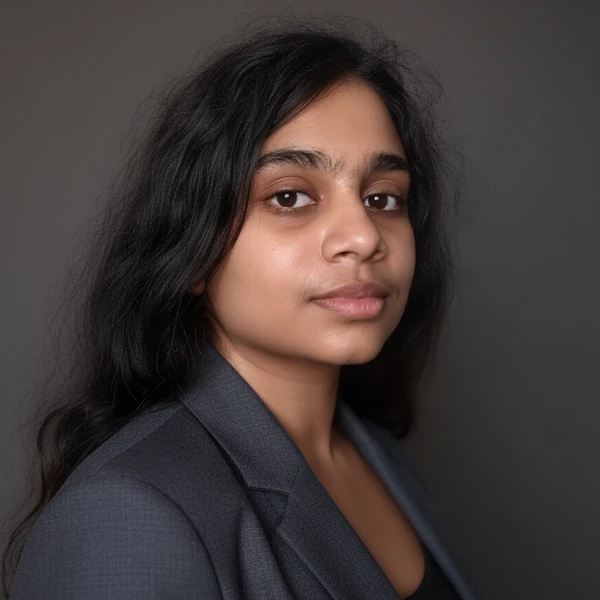
Soumya Vatti
2x
Finalist1x
WinnerSoumya Vatti
2x
Finalist1x
WinnerBio
Soumya Vatti is a finance student at Seminole State College with a 4.0 GPA and a track record of building things that work under conditions where most people would not expect them to.
She lost her mother to stage IV stomach cancer at age three and grew up in a single-parent household where stability was not a given. She was diagnosed with bipolar disorder in high school, failed an entire year, and later faced homelessness during college. She leads with those facts because they explain the urgency behind everything she has built since.
She currently interns at Accenture in capital projects and infrastructure consulting. Previously at Siemens Energy, she authored a lean methodology guide now adopted across North American operations. She is also the founder of Melo AI, a mental health app that adapts to a user's emotional state in real time, built from personal experience managing a condition without consistent support. Melo attracted over 700 waitlisted users, early-stage venture interest from two firms, and recognition from LvlUpVentures, the F(Lux) Fellowship, and the Telora Fellowship, which accepts fewer than 1% of applicants.
Her goal is to work as a Business Analyst, applying data interpretation and process thinking to decisions that affect how organizations operate. Every role she has held and every product she has built points in the same direction: making complex information useful to the people who need to act on it.
Education
Seminole State College of Florida
Associate's degree programMajors:
- Finance and Financial Management Services
- Business, Management, Marketing, and Related Support Services, Other
Minors:
- Data Analytics
Winter Springs High School
High SchoolMiscellaneous
Desired degree level:
Bachelor's degree program
Graduate schools of interest:
Transfer schools of interest:
Majors of interest:
Career
Dream career field:
Financial Services
Dream career goals:
Business Analyst
Founder and CEO
Melo AI2025 – Present1 yearExited Founder and Strategic Advisor
Flow-fi2025 – 2025Identity Verification Specialist
Alorica2024 – 2024Capital Markets and Infrastructure Intern
Accenture2026 – Present3 monthsBusiness Development Intern
Siemens Energy2025 – 2025
Students Impacted by Incarceration Scholarship
I was not arrested. I was held. During a manic episode, a friend called in because they were scared for me. I was not sleeping, my thoughts were moving too fast, and by the time I realized I was losing control, other people had already decided I was not safe to be alone. I was taken to a facility and kept there for three days against my will. I was not charged with anything. I have bipolar I disorder, and my mind took me somewhere I never agreed to go.
The room was small, white, and cold in a way that made everything feel more real than I wanted it to be. Time moved strangely. There was no privacy, no real sense of choice, no way to leave and get air. Even small things felt humiliating: being watched, being told where to sit, what I could have, when I could use things. I was trapped in two ways at once. Physically, I could not leave. Mentally, my brain still would not slow down enough for me to explain myself clearly. I knew I was upset. I could not make anyone understand what it felt like from the inside.
It lasted three days. It felt longer. Not because every moment was dramatic, but because every hour was heavy and I had no control over when it ended.
Afterward, there was a strange grief in realizing that my own mind could put me somewhere like that. I was not just processing what happened. I was processing the fact that people I knew had seen me at my most unrecognizable. But it changed me in ways I now depend on. It forced me to stop treating my condition as something I could outwork or push through. It made my family take treatment, medication, and stability seriously in a way they had been resisting.
It also changed my career ambitions permanently. That experience is the reason I founded Melo AI, a mental health app that adapts to a user's emotional state in real time. I built it because I learned, in that room, how much it matters to be treated like a human being when your life feels like it has slipped out of your hands. People in crisis are still people. They still notice tone, silence, fear, kindness. The systems meant to support them should reflect that. Melo AI is my attempt to build something that does.
I have a 4.0 GPA now. I intern at Accenture. I am building toward a career where data and analytical thinking serve people inside the systems that are supposed to help them. That direction did not come from a textbook. It came from three days in a room where I had no control, no voice, and no choice, and from the decision I made afterward to turn what I learned inside that room into something that could reach people before they ever end up there.
Ethel Hayes Destigmatization of Mental Health Scholarship
Bipolar I disorder did not feel dramatic from the inside. It felt persuasive. During mania, thoughts stopped arriving one at a time and started landing all at once, each one carrying the same absolute certainty. Sleep felt optional. Caution felt insulting. Every instinct started to masquerade as insight. The frightening part was never feeling out of control. It was feeling unusually clear while the people around me could already see the edge I was moving toward.
I was diagnosed in high school. Before I had language for what was happening, I had already failed an entire year. Mania made every day feel like the last one worth living, and I lived accordingly, and then I woke up the next morning inside the wreckage of yesterday's clarity. That cycle repeated until the damage was structural. I dropped out of college on my first attempt. I experienced homelessness during my second. I managed all of it inside a single-parent household where my father, still carrying grief from my mother's death when I was three, did not have the tools to recognize what was happening to me, let alone intervene.
I say all of this not to catalog pain but to explain what it taught me. Because bipolar I did not just shape my mood. It shaped how I understand the world.
The biggest thing it changed is how I see systems. When you spend years inside a mental health condition without adequate support, you start to notice exactly where the support was supposed to arrive and did not. You see the gaps. Not in the abstract way someone reads about them in a textbook. In the specific, lived way of someone who fell through them. I know what it feels like to sit in a room where everyone can tell something is wrong but no one has the framework to name it. I know what it looks like when a system that was built to help people stops short of actually reaching them. That understanding did not come from research. It came from being the person the system missed.
That is what led me to found Melo AI, a mental health app that adapts to a user's emotional state in real time. I did not build it because I read a market report about mental health trends. I built it because I spent years needing something that did not exist. I surveyed over 1,000 people and found an 84% positive response rate. I grew a waitlist of more than 700 users. I coordinated a development team of engineers and navigated early-stage venture interest from two firms. The F(Lux) Fellowship gave it an Honorable Mention for social impact. LvlUpVentures called it one of their most exciting early-stage brands. All of that matters, but what matters most to me is that the product exists because I understood, from the inside, where the current system fails.
That same lens shapes my broader goals. I am pursuing a degree in finance at Seminole State College with a 4.0 GPA and interning at Accenture in water infrastructure consulting. The connection between mental health and water management might seem distant, but the underlying pattern is the same: a system that is supposed to serve people, a gap between what is measured and what actually reaches them, and a need for someone who can see the gap clearly enough to close it. I want to spend my career sitting at that intersection. Whether the system is mental health support or water conservation or something I have not encountered yet, the work is the same: identify where the support breaks down, measure it honestly, and build something that actually reaches the person on the other end.
Mental health also reshaped my relationships in ways I am still learning to navigate. Bipolar I made me more selective about who I let close. During an episode, the people near me see a version of myself I cannot always control, and that requires a kind of trust I do not offer easily. It also made me more empathetic than I would have been otherwise. When someone tells me they are struggling, I do not have to imagine what that means. I know what it costs to hold yourself together when your own mind is the thing working against you. But I would not be honest if I did not also say that episodes have cost me people. Not because they stopped caring, but because the version of me that surfaces during mania is difficult to be near, and not everyone has the capacity to stay through it. I have learned that rebuilding trust after those moments is its own kind of ongoing work, and I do not always get it right.
What bipolar I ultimately gave me is a way of seeing that I do not think I would have developed without it. I see where confidence is real and where it is performing. I see where systems claim to help and where they actually do. I see where people are holding more than they show. None of that makes the condition worth having. I would not choose it. But I am not going to pretend it did not sharpen something in me that I now rely on every day, in my work, in my relationships, and in the way I move through a world that is full of systems that almost reach people but stop just short.
Patricia Lindsey Jackson Foundation - Eva Mae Jackson Scholarship of Education
I am an atheist. I say that respectfully and without apology, because the question asks what role faith plays in my life, and the honest answer is that religious faith does not. I did not lose it. I did not reject it in anger. It simply was never the framework that made sense of my experience. When my mother died of stomach cancer at the age of three, no one in my household turned to God for comfort. We just lived inside the loss and kept going.
But I do not think the absence of religious faith means the absence of faith entirely. I believe something. I believe it strongly enough that it has shaped my education, my career, and the way I spend my time. What I believe is that systems can be made better for the people inside them. That is not a spiritual conviction. It is a practical one, and I have staked most of my decisions on it.
That belief is what led me to found Melo AI, a mental health app that adapts to a user's emotional state in real time. I built it because I have bipolar I disorder and I spent years managing it without adequate support. The mental health system I encountered was not designed to meet people where they actually were. I believed it could be, and I built toward that. Over 1,000 people surveyed, 84% positive response, 700 on the waitlist. That is not faith in the religious sense. But it is faith in the sense that I committed to something I could not yet prove and worked until the evidence started arriving.
That same belief is what drives my work at Accenture, where I intern in water infrastructure consulting. I cleaned and organized billing data for a water utility and made high-consumption patterns visible to executives for the first time. The data already existed. No one had laid it out in a way that changed the conversation. I believe that kind of work matters. I believe that when you make a system more transparent, you make it more fixable. That is the version of faith I operate on.
The person who pushed me toward higher education is someone I never got to know. My mother was preparing for the LSAT when she was diagnosed with cancer. She read parenting books obsessively. She was a model who had been featured in newspaper ads and competitions. She put my sister in the playpen while she cooked because my sister ran around the house, and even in that image you can see someone holding everything together with intention. She was building a life that included both her children's futures and her own. She did not get to finish.
I think about that often. Not in a spiritual way. Not as if she is watching over me or guiding me from somewhere else. I think about it practically: she was building something, and the momentum of that did not disappear when she died. It transferred. I am in college because she was going to be. I pursue education with urgency because she ran out of time to pursue hers. The drive I carry is not divine. It is inherited.
I do not pray. I do not attend services. I do not find meaning in scripture. What I find meaning in is the work of making things less broken than I found them. Mental health systems that actually respond to the person using them. Water conservation programs that measure real outcomes instead of reporting effort. Education that gives someone from a homeless shelter the analytical tools to sit across from an executive and show them something they had not seen before.
That is my faith. It is not traditional. But it is mine, and I have built my life around it.
Strong Leaders of Tomorrow Scholarship
I have bipolar I disorder, and it has made me a specific kind of leader. Not the kind who stands at the front of a room and commands attention. The kind who rebuilds from the ground when the ground disappears, builds things other people told her were too early, and produces work that outlasts the room she made it in. Bipolar I did not teach me leadership in any clean, instructional sense. It taught me that if I did not learn to lead my own life first, no one else was going to do it for me.
The first kind of leadership I learned was self-directed. I was diagnosed in high school and failed an entire year. I dropped out of college on my first attempt. I experienced homelessness during my second. Each time, there was no mentor standing by with a recovery plan. There was just the wreckage and the question of whether I was going to sit in it or start building again. I built again. I came back to college, earned a 4.0 GPA at Seminole State College, and started interning at Accenture in capital projects and infrastructure consulting. None of that happened because someone cleared the path. It happened because I learned to move forward inside conditions that were actively working against me. That is leadership, even if it does not look like the version most people describe.
The second kind showed up when I started building for others. I founded Melo AI, a mental health app that adapts to a user's emotional state in real time. I built it because I spent years managing bipolar I without the kind of support that should have been available. I surveyed over 1,000 people, validated the concept with an 84% positive response rate, grew a waitlist of more than 700 users, and coordinated a development team of AI and machine learning engineers through agile sprints. That work earned recognition from LvlUpVentures, an Honorable Mention from the F(Lux) Fellowship, and consideration for the Telora Fellowship, which accepts fewer than 1% of applicants. Leading a team while managing a disability that affects mood, energy, and cognitive rhythm is not something I would recommend learning the hard way. But I did, and the product exists because of it.
The third kind of leadership is quieter but just as real. At Siemens Energy, I authored a guide on lean methodology that connected process efficiency to customer-focused strategy. That guide was adopted across their North American operations and is cited internally as a reference for efficiency projects. I was an intern. The work outlived my role because it was built to be useful, not to impress.
Bipolar I has shaped every version of leadership I practice. It taught me to build systems that hold up on my worst days, not just my best ones. It taught me to plan for instability instead of pretending it will not come. It taught me that the most honest form of leadership is not performing confidence. It is seeing clearly, building carefully, and producing work that is still standing after you leave the room.
Brent Gordon Foundation Scholarship
My mother was a model who had been featured in newspaper ads and modeling competitions. She was preparing for the LSAT. She read parenting books the way some people read novels, constantly, carefully, like raising children was a discipline she intended to master. She would put my sister in the playpen while she cooked because my sister used to run around the house, and even in that small detail you can see who she was: someone who figured out how to keep everything moving at once. She called me Fatso. I was the child she spent the longest with before she died, and family has told me I was the one she was most fond of. I do not remember any of this. I was three years old when stage IV stomach cancer took her.
What I know about my mother, I know secondhand. But secondhand is enough to understand what kind of person she was. She was proactive, beautiful, ambitious, and deeply focused on her children. She was building a life that held both her own aspirations and ours at the same time. Even after her diagnosis, she masked her symptoms to keep doing what she cared about most: being present for us, preparing for her own future, refusing to let the illness become the only thing in the room. By the end, her body made that impossible. She could only hold my sister. Only my dad could hold both of us at the same time. But she stayed focused on us until she physically could not.
Her death removed a kind of support from my life that I have never been able to replace. My father raised me alone. He did not remarry. His grief did not ease over time. It hardened, and the home I grew up in reflected that. Love was there, but it was unpredictable, and emotional safety was something I had to learn to create for myself. I do not think my father failed me. I think he lost the person who balanced him, and without her, the weight fell differently on everyone.
The impact on my journey has been structural, not just emotional. Without my mother, I grew up without a model for the kind of steady, intentional guidance she was building herself to provide. By high school, I was diagnosed with bipolar I disorder and failed an entire year. I dropped out of college on my first attempt. I experienced homelessness during my second. Each of those moments, I have thought about what might have been different if she had been there. Not to rescue me. But to see what was happening early, to name it, to know what to do. She was that kind of person. She would have known.
I carry a 4.0 GPA now. I intern at Accenture and once did at Siemens Energy, all as a second year undergraduate student. I founded a mental health app called Melo AI because I wanted to build the kind of attentive, responsive support I lost when I lost her. None of that erases the loss. But all of it came from the space she left behind.
I am still becoming the person my mother was preparing me to be. The difference is that I am doing it without her, using the fragments she left and the instincts I had to build on my own. I think she would recognize what I am building, and I think she would understand why.
Dream BIG, Rise HIGHER Scholarship
For most of my life, education was something that happened around me, not something I had a relationship with. I went to school because that is what you do. I did well enough when things were stable, and badly when they were not. It was not until I came back to college for the second time, after failing, after dropping out, after losing my housing, that education became something I actually chose. And once I chose it, everything changed.
I need to explain what came before that choice, because without the context, the choice itself sounds simple.
My mother died of stomach cancer when I was three. She was the parent who read parenting books like they were important literature, who was preparing for the LSAT while raising two children, who called me Fatso because that was the kind of warmth she carried. She was building herself into someone who could guide me. And then she was gone. My father raised me alone after that. He did not remarry. Grief changed him in ways that made our home tense and emotionally unpredictable. I grew up learning to read the room before I walked into it, and learning that the kind of support I needed was not going to come from inside the house.
By high school, I was diagnosed with bipolar I disorder. I failed an entire year. Mania does not announce itself as destruction. It feels persuasive. Every instinct masquerades as insight, sleep feels optional, and caution feels like cowardice. The crash that follows is where the damage becomes visible, and by then you are already behind. I lost a year of my education to that cycle before I understood what was happening.
I graduated and enrolled in college, and then I dropped out. Not because I could not do the work. Because everything around the work was collapsing. I was dealing with housing instability, untreated symptoms, and the accumulated weight of years spent surviving without adequate support. College at that point was not a foundation. It was one more thing I could not hold up.
When I came back the second time, I was living in a shelter. Then low-income housing. I was attending classes under a homeless tuition voucher and working part-time to cover everything the voucher did not. The difference between the first attempt and the second was not intelligence or motivation. It was that by the second time, I had stopped waiting for the conditions to be right and started building inside the conditions I had.
That is when education started to mean something to me. Not as a credential. As a structure. I needed somewhere to put my thinking that would hold it accountable, sharpen it, and connect it to something beyond my own survival. College gave me that. Finance gave me a framework for understanding systems, risk, and decision-making. Data analysis gave me a way to see patterns clearly instead of guessing at them. Every class I took started answering questions I had been carrying for years without knowing how to ask them.
I carry a 4.0 GPA at Seminole State College now. That number matters to me not because it proves I am smart. I already knew that. It matters because it proves that under the worst possible conditions, I can still do rigorous work. That proof changed how I saw myself. Not as someone who had overcome something, past tense, but as someone who could keep building in real time, even when things were still hard.
Education also gave me direction I did not have before. My internship at Accenture in water infrastructure consulting came directly from what I learned in the classroom. I work on data analysis and sustainability research for water management districts, and every week I see how the analytical tools I am learning translate into decisions that affect public resources. That connection between the classroom and the real world is not something I take for granted. For someone who almost lost access to education entirely, seeing it work is not abstract. It is personal.
But the part of this I care about most is not what education does for me. It is what it lets me do for other people. I founded Melo AI, a mental health app that adapts to a user's emotional state in real time, because I spent years managing a condition without the support I needed. I built it because I know what that gap feels like, and I know it does not have to be that wide. Education gave me the technical knowledge, the analytical framework, and the credibility to turn that understanding into something real. Without college, Melo AI would still be a feeling I had about what was missing. With college, it became a product with over 700 people waiting to use it.
My goal is to become a sustainability consultant who uses data and finance to make systems work better for the people inside them. Whether that means making water conservation programs more accountable or making mental health support more accessible, the result is the same: using what I have learned to close gaps that should not exist.
Education did not rescue me. I rescued myself, and then I used education as the tool to build something from it. The difference matters. I am not here because school saved me. I am here because I came back, chose it, and made it work under conditions that should have made it impossible. What I plan to do with that is make sure the systems I touch are better for the people who come after me, especially the ones who are still building inside the hardest version of their lives.
Brooks Martin Memorial Scholarship
My mother was diagnosed with stage IV stomach cancer and died when I was three years old. I do not remember her being sick, or the treatment, or the day she passed. What I have are fragments other people gave me. I know she used to call me Fatso. I know she read parenting books obsessively, like raising children was something she wanted to understand all the way through, not just manage. I know she was preparing for the LSAT at the same time, which tells me she was building something for herself too. I know that by the end, she could only hold my sister. Only my dad could hold both of us at the same time. I know I was the child she spent the longest with before she died, and that she was most fond of me. I do not remember any of it. But I have spent my whole life feeling the shape of what is missing.
Her death changed my father. He never remarried. The grief he carried did not soften. It hardened into something that made our household tense, unpredictable, and at times emotionally unsafe. I do not say this to reduce him to that. He raised me alone and he kept going. But growing up in that home meant learning very early that emotional stability was something I would have to build for myself, because it was not going to be provided.
By high school I was diagnosed with bipolar I disorder. I failed an entire year. I dropped out of college on my first attempt. When I came back for a second try, I was homeless, living in a shelter, then transitioning to low-income housing. Each time, the same pattern: the floor is gone, no one is coming to rebuild it, so either I figure it out or I stop moving. I figured it out. Not gracefully. Not quickly. But I figured it out.
I carry a 4.0 GPA now at Seminole State College. I intern at Accenture in water infrastructure consulting. I founded Melo AI, a mental health app that adapts to a user's emotional state in real time using AI, because I wanted to build the kind of support that did not exist for me when I needed it most. Every part of that came from the loss. Not as inspiration in some clean, narrative sense, but as pressure. The absence of my mother pressed on everything. It pressed on my father, on our home, on my mental health, on my ability to feel safe. And eventually it pressed hard enough that I started building in the direction of the pressure instead of away from it.
My goal is to work as a Business Analyst, using data and analytical thinking to make complex systems more honest and more useful. My outlook is simpler than that: I do not assume stability. I build it. Every day, deliberately, knowing it is not guaranteed.
Losing my mother before I could know her taught me that absence shapes a life just as powerfully as presence. I did not get her guidance, her warmth, her perspective. But the space where those things should have been taught me to pay close attention to what is missing, in systems, in people, in myself, and to build toward it instead of pretending it is not there.
Candi L. Oree Leadership Scholarship
I have bipolar I disorder. I was diagnosed in high school, and it cost me a full year of academic progress before I understood what was happening. It has since cost me a first attempt at college, stable housing, and relationships I did not know how to protect at the time. It is a disability I manage every day, and it has shaped almost every part of how I think, relate to people, and approach my work.
I will start with what it taught me to believe. Bipolar I forced me to stop trusting my own certainty at face value. During a manic episode, everything feels clear, urgent, and correct. Decisions that are reckless feel logical. Instincts that are destructive feel inspired. Learning to live with that means building a relationship with self-doubt that is not paralyzing but protective. I believe now that honesty about your own limits is not weakness. It is the most practical skill a person can develop. And I believe that most people who look like they have everything under control are probably managing more than they show.
That belief changed my relationships. Bipolar I made me more selective about who I let close, because the people around me during an episode see a version of me I cannot always control, and that requires trust I do not give easily. It also made me more empathetic. When someone is struggling, I do not have to guess at what that feels like. I know what it costs to hold yourself together when your own mind is working against you. But I would not be honest if I did not say it has also strained relationships. Episodes have cost me people. Not because they stopped caring, but because the version of me that shows up during mania is difficult to be near, and not everyone can stay through that. Learning to rebuild trust after those moments is ongoing work.
My career aspirations come directly from this experience. I am pursuing a degree in finance at Seminole State College with a 4.0 GPA and working toward becoming a Business Analyst. What draws me to that work is the same instinct bipolar I sharpened in me: the need to see clearly, to verify what is real, to make decisions based on evidence rather than impulse. Data analysis is, for me, a professional extension of the skill I had to develop personally just to function.
The prompt asks about leadership, and the example I am most proud of came from my time as a Business Development Intern at Siemens Energy. I authored a comprehensive guide on lean methodology that connected process efficiency to customer-focused product development. That guide has since been adopted across Siemens Energy's North American operations. What I brought to that project was not expertise I arrived with. It was a way of thinking I had to learn through managing a disability: break the system into parts, figure out what is actually working, and build something that holds up under pressure.
Bipolar I did not give me my ambition. But it gave me a specific kind of discipline, the kind that comes from knowing that your baseline is not guaranteed and that everything you build has to be built to survive your worst days, not just your best ones.
Lotus Scholarship
Growing up in a single-parent household taught me one thing earlier than most people learn it: no one is coming to build the foundation for you. My mother died of stomach cancer when I was three. My father raised me alone, and love did not always translate into stability. By high school, I was diagnosed with bipolar disorder and failed an entire year. I dropped out of college on my first attempt. When I came back, I was living in a shelter.
Perseverance, for me, was not a mindset I adopted. It was the only option that did not end in staying exactly where I was. Every time the floor dropped out, I had to rebuild without a model for what rebuilding was supposed to look like. No blueprint, no second income, no safety net. Just the knowledge that I could think clearly when things were stable, and the stubbornness to keep engineering my way back to stable.
That is what I am doing now. I carry a 4.0 GPA at Seminole State College. I intern at Accenture in water infrastructure consulting, working on data analysis and conservation strategy for public utilities. I founded Melo AI, a mental health app that adapts to a user's emotional state in real time, because I wanted to build the kind of support I never had consistent access to. Each of those exists because I refused to let a single-parent background be the ceiling.
The positive impact I want to make is practical, not symbolic. I want to use data and analytical thinking to improve systems that affect real people, whether that means making water conservation programs more accountable or making mental health support more accessible. I am not planning to make an impact someday; I am already building toward it.
Future Green Leaders Scholarship
Sustainability in water management has an accountability problem. Most programs measure effort: devices distributed, workshops held, outreach emails sent. Fewer measure what actually matters: verified gallons saved, whether peak demand dropped, and whether savings persisted six months later. The field talks about conservation constantly but does not always track whether conservation is happening. That gap between intention and evidence is where I want to work.
I came to this through an unexpected path. I am a finance student at Seminole State College, not an environmental science major. But my internship at Accenture in capital projects and infrastructure consulting put me inside the water utility sector, and once I started working with the data, I realized that finance and sustainability are not separate disciplines. They run on the same logic: what is the baseline, what changed, by how much, for whom, and at what cost. The questions that make a financial analysis useful are the same ones that make a conservation program honest.
The moment it clicked for me was a project involving billing data from a water utility's payment processor. I was asked to clean and organize the data so executives could identify high-consumption users. When I built the analysis, what stood out was the sheer concentration at the top. A relatively small group of accounts was driving a disproportionate share of total consumption, and the gap between them and everyone else was not small. That pattern had always existed in the data. But no one had laid it out in a way that made the scale visible. Once it was visible, the conversation changed. It moved from general assumptions about usage to specific, targeted questions about where conservation efforts would actually have the most impact.
That experience shaped how I think about sustainability in this field. The problem is not that utilities do not care about reducing environmental impact. Most of them do. The problem is that without clear data, clean analysis, and honest measurement, good intentions stay abstract. A program can run for years, report participation numbers, and still not answer the basic question: did consumption actually go down, and if so, for whom and by how much?
I see my future as a sustainability consultant who brings financial and analytical value to environmental work. Not replacing the scientists and engineers who understand water systems, but sitting alongside them and asking the questions that make their work measurable, fundable, and accountable. Grant writing taught me how to make a case for funding. Data analysis taught me how to make a case for action. I want to spend my career doing both: helping organizations understand not just what they should do for the environment, but whether what they are doing is actually working.
Sustainability should be a priority in every field that touches public resources. But priority without measurement is just rhetoric. The work I want to do is making sure the numbers hold up.
Ruthie Brown Scholarship
I do not have student loan debt. That sounds like a comfortable position until you understand how I got here and what it costs to maintain it.
I attend Seminole State College under a homeless tuition voucher. That voucher exists because I qualified for it, which means I met the threshold for housing instability that the program was designed to address. It covers tuition. It does not cover textbooks, course materials, transportation, food, or the rest of what it actually takes to stay enrolled full-time. Last semester, my bank account went negative trying to buy the textbooks I needed. The tuition line reads zero. The lived experience of affording college does not.
Choosing community college was deliberate. I could have taken on debt to attend a four-year university. Instead, I chose the path that let me build a strong academic foundation without borrowing against a future I was still stabilizing. Seminole State gave me the structure to carry a 4.0 GPA, complete an internship at Accenture in capital projects and infrastructure consulting, and build the analytical skill set I need for the career I am working toward, all without a loan balance accumulating in the background. That was not a compromise. It was a calculation.
The other piece of my strategy is scholarships. Over the past year, I have applied to every scholarship I qualified for and won several, including the Jared Monroe Foundation Scholarship, the Macy's Scholarship Fund, the Dr. John Gyllin Endowed Scholarship, and the Sue and James Wong Memorial Scholarship. Each one closed a specific gap: a semester of textbooks, a month of expenses, the difference between stable and precarious. I did not win those by accident. Each required a written essay, and I treated every application as a case I had to make with evidence, clarity, and honesty about where I was and what the funding would change.
My plan going forward follows the same logic. I intend to complete my Associate of Arts in Finance at Seminole State, then transfer to a four-year institution to finish my degree. When I transfer, I will apply the same approach: minimize borrowing through merit-based aid, maintain the GPA that makes that aid possible, and keep working so that whatever gap remains between scholarships and cost is covered without debt. My goal is to enter the workforce as a Business Analyst with a clean financial foundation, not because debt is unacceptable in principle, but because I have already seen what financial instability does to a person's ability to focus, perform, and build. I do not want to begin my career recovering from the cost of preparing for it.
I am not avoiding student loans out of fear. I am avoiding them because I understand, from direct experience, what it means to operate without a financial margin. Every dollar I do not owe is a degree of freedom I keep. That is not an abstraction for me. Rather, it is the difference between a semester where I can think clearly and one where I cannot.
Elijah's Helping Hand Scholarship Award
Bipolar I did not feel dramatic from the inside. It felt persuasive. During mania, thoughts stopped arriving one at a time and started landing all at once, each one charged with the same absolute certainty. Sleep felt optional. Caution felt insulting. Every instinct started to masquerade as insight. The frightening part was not feeling out of control. It was feeling unusually clear while everyone around me could already see the edge I was moving toward.
That is what it was like in high school, when I was first diagnosed. I failed an entire year. Not because I stopped caring, but because the version of me that showed up during an episode was living every day like it was the last one, and then waking up the next morning to do it again. Mania does not announce itself as destruction. It feels like living at full volume. The wreckage only becomes visible after.
What made it harder is that the person who would have known how to reach me was already gone. My mother died of stomach cancer when I was three. She used to call me Fatso. She read parenting books the way other people read novels, constantly, carefully, like raising children was something she wanted to understand all the way through. She was preparing for the LSAT at the same time. Of her children, I was the one she spent the longest with before she passed, and family has told me I was the one she was most fond of. I do not remember any of this directly. But I know that whoever she was, she was building herself into the kind of parent who would have seen what was happening to me and known what to do about it.
My father did not have those tools. He loved me in the ways he knew how, but emotional support was not something he could offer with any consistency. Grief had changed him, and the household I grew up in reflected that. When bipolar disorder arrived, there was no one in the house equipped to recognize it, name it, or help me navigate it. I had to learn what was happening to me largely on my own, and that learning came slow and expensive. It cost me a year of high school, a first attempt at college, and eventually stable housing.
I have rebuilt from that. I carry a 4.0 GPA at Seminole State College. I intern at Accenture and formerly Siemens Energy. I founded Melo AI, a mental health app that adapts to a user's emotional state in real time using artificial intelligence, because I wanted to build the kind of support I did not have access to when I needed it most. That project came directly from this experience. Not from reading about mental health in the abstract, but from knowing what it costs when the right support is not there.
Bipolar I is not behind me. It is something I manage every day, and I expect to manage it for the rest of my life. What has changed is that I no longer navigate it without understanding, without structure, and without the ability to name what is happening when it starts. That took years. It should not have to take that long for anyone and where I hope to create change.
Sharra Rainbolt Memorial Scholarship
My mother was diagnosed with stage four stomach cancer and died when I was three years old. Frankly, I do not remember her being sick, or the treatment, or the day she died. What I know about that period comes from family, from fragments, from things pieced together after the fact. I know that by the end, my mother could only hold my sister. Only my dad could hold both of us at the same time. That is the kind of detail that tells you everything about what cancer was doing to our family without anyone having to explain it. I grew up not with the memory of losing her, but with the shape of her absence already in place. By the time I was old enough to understand what had happened, it had already happened. That is a strange kind of grief. You do not process it in real time. You just discover, slowly, the ways it has already changed everything around you.
Cancer did not just take my mother. It restructured my entire family. My father never remarried. He raised me alone, and the grief he carried did not soften over time. It hardened. Our household became a place where tension was more constant than warmth, where emotional safety was something I learned to build for myself because it was not being provided. I do not say this to blame him. Grief without support does what it does. But I grew up learning very early that stability was not something I could count on receiving. It was something I would have to construct.
That lesson followed me everywhere. When I was diagnosed with bipolar disorder in high school and failed an entire year, I had to figure out how to rebuild without a model for what rebuilding looked like. When I dropped out of college and came back a second time while facing homelessness, I had to build structure around myself again, from the ground. Each time, the pattern was the same: the foundation is not here, so either I make one or I do not move forward.
I think the deepest thing I learned from losing my mother to cancer is that absence shapes you just as much as presence does. I did not grow up with her influence, her guidance, her perspective. But the space where those things should have been still pressed on everything. It pressed on my father. It pressed on our home. It pressed on me. You can lose someone before you are old enough to know them and still spend years feeling the weight of what is missing.
That understanding is also what led me to build Melo AI, a mental health app that tailors support to a user's emotional state in real time using journaling and artificial intelligence combined with Ted Talks videos for self help advice. I built it because I know what unprocessed pain does to a household, to a person, to a child who does not yet have the language to name what is wrong. I wanted to create something that meets people where they actually are, not where a system assumes they should be.
Cancer took my mother before I could know her. What it left behind taught me to pay attention to the things that go unspoken, to build what is not given, and to take the pain I understand personally and turn it into something that might reach someone else before the weight settles in too deep.
Ella's Gift
My journey with mental health has shaped every part of who I am; how I learn, lead, and live. I didn’t discover my strength in moments of success, but in moments when I was certain I wouldn’t make it through. Living with bipolar disorder has been both my greatest challenge and my most powerful teacher.
When I was three years old, my mother passed away from stage IV stomach cancer. My father never remarried, and grief filled our home. I grew up in an environment marked by emotional volatility, learning to stay quiet and composed in order to survive. That silence eventually became my definition of strength, until it began to break me.
By high school, I was experiencing dramatic mood swings: weeks of intense energy followed by deep depression. I failed a year of high school and later dropped out of college during my first attempt. I blamed myself, not knowing I was living with an undiagnosed mental health condition.
When I tried again, I faced an even deeper setback, homelessness. I lived in a shelter while attending college classes, using borrowed Wi-Fi at night to complete assignments. It was one of the hardest times of my life, but it was also where I made a promise to myself: if I made it through, I would use my pain to help others feel less alone in theirs.
That promise became the foundation of my recovery and my purpose. When I finally received an accurate diagnosis of bipolar disorder, I began treatment, therapy, and structured self-management. I learned to work with my mind instead of against it, developing habits that grounded me, consistent routines, mindfulness, exercise, and community support.
I returned to college determined to build a new story. I maintained a 4.0 GPA, earned a Business Development Internship with Siemens Energy, and discovered a passion for using data and strategy to solve complex human problems. Out of this passion, and my lived experience; I founded Melo, an AI-powered mental health and productivity app that helps people manage their emotional and cognitive well-being. Melo adapts to users’ moods and needs in real time, providing structure, empathy, and motivation. What began as a personal coping tool has grown into a broader mission: Melo now has over 700 users on its waitlist and has been recognized by LvlUpVentures, the F(Lux) Fellowship, and the Telora Fellowship for its innovation and social impact.
Through this journey, I’ve learned that recovery isn’t about eliminating struggle, it’s about cultivating balance, resilience, and self-compassion. My plan for continued recovery is rooted in consistency and community: ongoing therapy, medication management, healthy routines, and mentorship. I make space for self-reflection, creative expression, and service to others; because healing deepens when shared.
Today, I’m pursuing a degree in Finance and Data Analytics to expand my ability to build data-driven mental health systems that are accessible, sustainable, and inclusive. My goal is to scale Melo into a global platform and to develop frameworks that integrate wellness into education and workspaces, especially for underserved populations.
I no longer view my mental health condition as a limitation; it’s a lens through which I understand compassion and innovation. I’ve learned that strength isn’t found in perfection but in persistence, and that even from the hardest places, something beautiful can grow. My education, recovery, and mission are all connected by one truth: what once felt like a breakdown has become the blueprint for helping others rise.
Eden Alaine Memorial Scholarship
The most significant loss I have ever experienced happened before I was old enough to understand what loss truly meant. When I was three years old, my mother passed away from stage IV stomach cancer. I don’t remember the sound of her voice or the warmth of her hands, but I’ve always felt the hollow space her absence left behind. Her death shaped not only my childhood but the course of my life; it changed how I understood love, resilience, and purpose.
After her passing, my father became my sole parent. He never remarried, and grief settled into our home like a heavy fog that never lifted. My father struggled to cope, and that struggle often turned into anger and emotional volatility. Love existed, but it was fragile and unpredictable. I learned to navigate that instability quietly, trying not to make waves. From a young age, I became hyperaware of others’ emotions, trying to maintain balance in an environment that rarely offered any.
For a long time, I thought strength meant silence. I believed I had to keep everything inside; to stay composed, to achieve, to endure. But as I grew older, that suppression became unbearable. By my teenage years, I began to experience extreme mood swings; periods of euphoric energy followed by crushing depression. I didn’t yet know I was living with bipolar disorder; I only knew my emotions felt bigger than I could control.
Without support or understanding, I internalized my struggles as personal failure. I failed a year of high school, dropped out of college during my first attempt, and eventually experienced homelessness while trying to rebuild my education. During that time, I often thought about my mother. I imagined what she might say if she were still alive. I liked to think she’d remind me that loss, no matter how painful, can be a teacher; that even heartbreak can give birth to strength.
That thought kept me going.
Living in a shelter, attending classes during the day and studying at night using borrowed Wi-Fi, I promised myself that if I made it through, I would use my pain to help others feel less alone.
When I finally received a diagnosis of bipolar disorder, everything began to change. Through therapy, medication, and structure, I learned to work with my mind rather than against it. Slowly, I began to rise.
I returned to college with renewed purpose, maintaining a 4.0 GPA and earning a Business Development Internship with Siemens Energy. Most importantly, I founded Melo, an AI-powered mental health app designed to support people like me; those who struggle with consistency or emotional regulation. Melo now has over 700 users on its waitlist and has been recognized by LvlUpVentures, the F(Lux) Fellowship, and considered for the Telora Fellowship which historically less than 1% of applicants are considered for.
Losing my mother taught me that love and grief are two sides of the same coin; that to lose deeply is to have loved deeply. Her absence gave me empathy, resilience, and purpose. It shaped my dream to build mental health systems that bridge the gap between awareness and access, ensuring that well-being is treated as a foundation for success.
Melo is how I honor my mother’s memory: by turning loss into leadership and pain into purpose. Her death taught me that even the deepest grief can plant the seeds of transformation, and that by nurturing what loss leaves behind, we can grow something enduring and good.