Hobbies and interests
Art
Advocacy And Activism
Business And Entrepreneurship
Community Service And Volunteering
Drawing And Illustration
English
Ethics
Human Rights
Journalism
Liberal Arts and Humanities
Marketing
Music
Painting and Studio Art
Politics and Political Science
Public Speaking
Research
Reading
Running
Social Justice
Social Sciences
Sociology
Sports
Writing
Volunteering
Reading
Social Science
Academic
Philosophy
Art
I read books daily
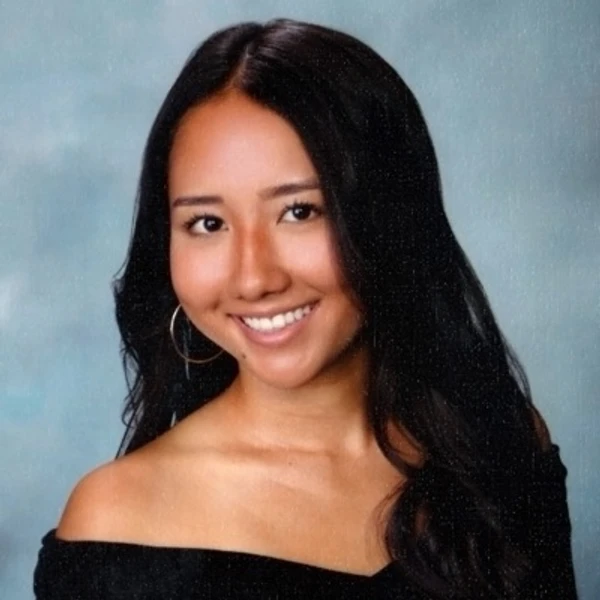
Sophia Battle
1x
Finalist1x
Winner
Sophia Battle
1x
Finalist1x
WinnerBio
Hi, my name is Sophia Battle and I'm a senior from Granada Hills Charter High School! As a student with a deep passion for advocacy and politics, I seek to major in Political Science and Public Policy with a minor in Art. By bridging art and social change, I plan to improve inclusive foreign policy through a creative and innovative approach.
My civic engagement can be marked by my many community service initiatives and social justice projects and internships within my local L.A. community.
I am also an AP Capstone Diploma recipient and was honored by the College Board for their National Recognition Award for my high rigor in academics. Along with being an Advanced Placement (AP) and International Baccalaureate (IB) student, I am also a 4-year varsity athlete, ASB Team Representative, and Team Captain for my Cross-Country and Track & Field teams.
Education
Granada Hills Charter High Sch
High SchoolMiscellaneous
Desired degree level:
Doctoral degree program (PhD, MD, JD, etc.)
Majors of interest:
- Political Science and Government
- Public Policy Analysis
- History and Political Science
- Social Sciences, General
- Communication, Journalism, and Related Programs, Other
- Business, Management, Marketing, and Related Support Services, Other
- Business/Managerial Economics
- Philosophy, Politics, and Economics
- English Language and Literature, General
- Education, General
- Fine and Studio Arts
- Community/Environmental/Socially-Engaged Art
Career
Dream career field:
Arts
Dream career goals:
Cohort Member
District 12 Office of Councilman John Lee2025 – Present1 yearYouth Public Affairs Intern
Los Angeles Mayor's Office2025 – Present1 year
Sports
Track & Field
Varsity2022 – Present4 years
Awards
- 3x 1st-Team League Champions
- 3x 2nd-Team City
- All-City
- All-League
- 1st-Team City Champions
Cross-Country Running
Varsity2022 – Present4 years
Awards
- 2x 1st-Team City Champions
- 3x 1st-Team League Champions
- All-City
- All-League
- 2022 League Champion
- 2024 Most Valuable Player
Research
Social Sciences, General
College Board AP Research Capstone Program — Principal Investigator2024 – 2025
Arts
College Board AP 2-D Art and Design
Visual ArtsSelected Works, Sustained Investigation2024 – 2025College Board AP Drawing
Visual ArtsSelected Works, Sustained Investigation2023 – 2024
Public services
Volunteering
Bee The Hope Non-Profit Organization — Project Manager, Volunteer/Student2022 – PresentVolunteering
ImaginACTION — Founder, Executive Director2025 – PresentVolunteering
Race2Rebuild 5K Fundraising Event: Bee The Hope Non-Profit Organization — Project Manager2025 – 2025Public Service (Politics)
District 12 Office of Councilman John Lee — Cohort Member2025 – PresentPublic Service (Politics)
Los Angeles Mayor's Office — Youth Public Affairs Intern2025 – PresentVolunteering
Kizuna — Camp Counselor2023 – 2023
Future Interests
Advocacy
Volunteering
Philanthropy
Entrepreneurship
200 Bold Points No-Essay Scholarship
ScholarshipOwl No-Essay Scholarship
Peter and Nan Liubenov Student Scholarship
I captured my first glimpse into the captivating chaos of art as I peeked inside his sloppy, splotchy mess of a room. Stumbling into his studio, surrounded by scattered paint and papers, I found my father hunched over his sketches—hard at work. As he invites me to draw alongside him, our shared joy in drawing silly cartoons together becomes my first memory of how art fosters human connection.
Growing older, as papers dissipated and colors faded, I began to notice an emptiness in my father’s studio. Confused at first, I soon realized that he lost his job to artificial intelligence and how something non-human took over the most human aspect of my life. Witnessing parts of myself slipping from technology, I found myself asking, "How could humans choose regurgitated code over soul to produce art?"
Exasperated, for a junior-research capstone, I spent months interviewing local artists to explain this curiosity. Discussing themes of automation and homogenization with like-minded creatives, I realized that the displacement of artists like my father mirrored power imbalances in society. My project identified a problem, but I wanted solutions.
Taking these principles to my district office, I voiced artists’ concerns directly to the City Council. Here, I actively sought political action against generative AI-usage in the art industry—a preservation of workers’ rights. For all 90 anxiety-inducing minutes, facing skepticism and doubt, convincing the cohort felt impossible. Many still deemed art as ‘unimportant,’ and easily saw a machine replacing it. Eventually, I shared stories of the displaced artists I spoke with, emphasizing a need to protect human creativity and jobs. As eyes widened and minds opened, they agreed to consider AI regulations in the art industry—achieving the impossible.
As my hopelessness dissolved, I recognized my ability to actualize my vision for a world driven to preserve human creativity. So, I created ImaginACTION, an organization empowering youth creatives by driving art towards social change. Holding workshops and donation drives, while publishing artist interviews from my research paper, presents new ways to represent art’s vital role in society and politics to a larger audience.
My favorite moments, though, come from bonding with like-minded creatives, centered around conversations of “Art brings people together” and “Art is the greatest form of protest,” reminding me that the human stories explored through art are the same ones shaping political realities. My experience with ImaginACTION has shaped me to be altruistic through powerful storytelling, and I love that I get to inspire future changemakers by transforming creative vision into lasting impact.
With this epiphany, what initially began as an indignation of automation led me to dig deeper towards intersecting humanities and policy, where my fear of speaking out transformed into an act of going all-in. With 2.9k+ youth impacted and continuing to reshape political values through grassrooting and canvassing, I’m committed to accomplishing my dream: helping society be more in touch with humanity. In doing so, I developed an impassioned voice for my art community and became a tool for real advocacy.
There’s something human, emotional, even discomforting in a good way about art. While they helped me express myself and form a deeper bond with my father, their power to bridge others together is beyond my example alone. In my future in public policy, both local and global voices will call for me to step into using my voice to support underrepresented communities like those I connected with in my ‘artivist’ community. And by listening to each person's story, I'll be reminded that the stories I've explored through the arts are the ones shaping political realities—because human understanding is what shapes successful policy.
“I Matter” Scholarship
I belong to a community of distance runners. Growing up in ‘the valley,’ I spent countless hours exploring every running trail available. With every daring adventure, simple “hellos” became a daily routine when running past fellow runners, building unexpected bonds.
But when flames engulfed over 57,000 acres of my LA community, every trail became an empty vessel. In the midst of the 2025 Los Angeles wildfire crisis, the destruction of over 16,000 homes, businesses, and schools caused deep division within my community--the impact of the fires shifted towards blame rather than uplifting Angelenos and LA citizens.
I could no longer weave running by building bonds with runners. Determined to rebuild my community, I brainstormed fundraising initiatives to restore underprivileged, impacted schools. As a project manager for nonprofit Bee The Hope (BTH), I proposed Race2Rebuild--a 5K race and festival fundraiser dedicated to wildfire relief. To make this idea become a reality, my team needed funds through grants, sponsorships, and donations--a daunting task I was willing to dedicate my efforts towards.
But one question almost deterred the entire project: "Are you a 501(c)(3)?" Because of BTH's unverified status, corporate sponsors were reluctant to support our mission, leading to multiple declined emails. Consequently, I realized that support didn't always come from big names but from neighbors--those with shared experience and understanding. So, I began shifting the focus to contacting smaller, local businesses. In fact, the neighborhood shops we visited door-to-door were the first to say yes, willing to contribute to our effort--because they cared for the same city we did.
Through this approach, BTH collaborated with twenty-two sponsors, expanding the project by producing funds for the actualization of Race2Rebuild. Beyond this, I also designed the race course, reached out to locals, secured a city permit, and grew the social media strategy to over 86,000 impressions. As a result, Race2Rebuild gathered over 400 participants, vendors, and city representatives in support, raising $11,000 towards our cause.
But the most significant moments came from forming relationships with strangers through shared stories of evacuations and large gaps in education. These interactions with impacted individuals allowed me to not only unify my city but also give others a space to contribute to a larger initiative. Through my work with Race2Rebuild, I've come to discover that community will always make service more impactful, instilling my commitment to continue building bridges that collectively uplift others while making a lasting impact.
Palette & Purpose Scholarship
WinnerI captured my first glimpse into the captivating chaos of art as I peeked inside his sloppy, splotchy mess of a room. Stumbling into his studio, surrounded by scattered paint and papers, I found my father hunched over his sketches—hard at work. As he invites me to draw alongside him, our shared joy in drawing silly cartoons together becomes my first memory of how art fosters human connection.
Growing older, as papers dissipated and colors faded, I began to notice an emptiness in my father’s studio. Confused at first, I soon realized that he lost his job to artificial intelligence and how something non-human took over the most human aspect of my life. Witnessing parts of myself slipping from technology, I found myself asking, "How could humans choose regurgitated code over soul to produce art?"
Exasperated, for a junior-research capstone, I spent months interviewing local artists to explain this curiosity. Discussing themes of automation and homogenization with like-minded creatives, I realized that the displacement of artists like my father mirrored power imbalances in society. And through multiple global politics readings, these interviews affirmed my interest in how social structures like laws and norms shape the principles of humanity. My project identified a problem, but I wanted solutions.
Taking these principles to my district office, I voiced artists’ concerns directly to the City Council. For all 90 anxiety-inducing minutes, facing skepticism and doubt, convincing the cohort felt impossible. Eventually, I shared stories of the displaced artists I spoke with, emphasizing a need to protect human creativity and jobs. As eyes widened and minds opened, they agreed to consider AI regulations in the art industry—achieving the impossible.
As my hopelessness dissolved, I recognized my ability to actualize my vision for a world driven to preserve human creativity. So, I created ImaginACTION, an organization empowering youth creatives by driving art towards social change. Holding workshops and donation drives, while publishing artist interviews from my research paper, presents new ways to represent art’s vital role in society and politics to a larger audience.
My favorite moments, though, come from bonding with like-minded creatives, centered around conversations of “Art brings people together” and “Art is the greatest form of protest,” reminding me that the human stories explored through art are the same ones shaping political realities. My experience with ImaginACTION has shaped me to be altruistic through powerful storytelling, and I love that I get to inspire future changemakers by transforming creative vision into lasting impact.
With this epiphany, what initially began as an indignation of automation led me to dig deeper towards intersecting humanities and policy. With 2.9k+ youth impacted and continuing to reshape political values through grassrooting and canvassing, I’m committed to accomplishing my dream: helping society be more in touch with humanity. In doing so, I developed an impassioned voice for my art community and became a tool for real advocacy.
There’s something human, emotional, even discomforting in a good way about art. While they helped me express myself and form a deeper bond with my father, their power to bridge others together is beyond my example alone. In my future in art, both local and global voices will call for me to step into using my voice to support underrepresented communities like those I connected with in my ‘artivist’ community. And by listening to each person's story, I'll be reminded that the human stories I've explored through the arts are the ones shaping political realities—because human understanding is what shapes successful policy.
My passion for art ultimately taught me one thing: when you truly love something, you'll always fight for it.