Hobbies and interests
Tennis
Guitar
Piano
Singing
Photography and Photo Editing
Sharla Plier
1x
Finalist1x
Winner
Sharla Plier
1x
Finalist1x
WinnerBio
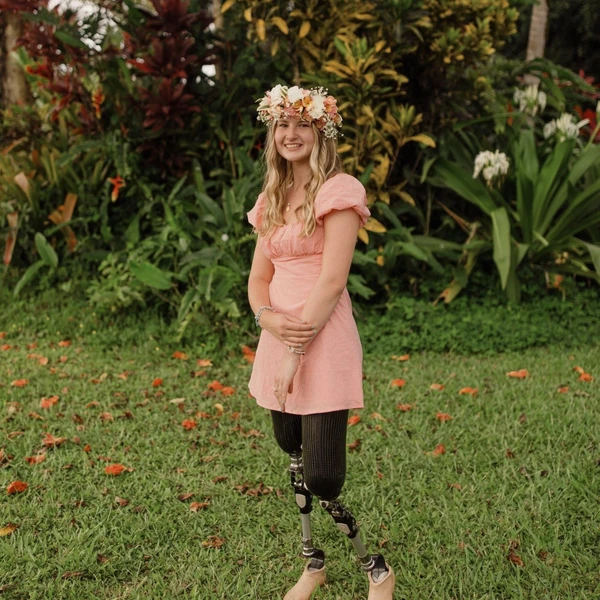
Future hairdresser, love to play guitar, travel, and thriving through the world as a bilateral AK amputee!
Education
Port Washington High School
High SchoolMiscellaneous
Desired degree level:
Trade School
Majors of interest:
- Cosmetology and Related Personal Grooming Services
Career
Dream career field:
Cosmetics
Dream career goals:
Sports
Ice Hockey
Club2020 – 20211 year
Swimming
Varsity2018 – 20235 years
Awards
- Went to junior nationals
- came home with 6 gold metals
Tennis
Varsity2023 – Present3 years
Nicholas Hamlin Tennis Memorial Scholarship
Most tennis players live for the squeak of rubber on the hardcourt, but my game has a different soundtrack. It’s the sharp click of carbon fiber and hydraulics as I load up for a serve. Being an above-the-knee amputee in a sport defined by "explosive" lateral movement and split-second pivots is a challenge. But as a senior in high school, looking back on four years, I’ve realized my leg wasn't a deficit, it was a forge. While my opponents were busy training their muscles, I was busy training my defiance.
The truth is, the court can be a lonely place when you’re "different." There were afternoons when the sun didn't just feel hot; it felt like a spotlight on my imbalance. I’ve felt the stinging heat of a raw socket rubbing against my skin and the even sharper sting of a missed drop shot because my prosthetic didn't hinge quite fast enough. I’ve seen the looks from the bleachers, the tilted heads, the whispers of "good for her." At first, those looks felt like weights. I didn't want to be an inspiration; I just wanted to be fast.
But as the seasons passed, something shifted. I stopped trying to play like a girl with two legs and started playing like a strategist with a weapon. Because I couldn't outrun everyone, I had to out-think them. I learned to read the slight flare of an opponent’s elbow or the height of their ball toss to predict a shot before it even crossed the net. My "limitation" forced me to develop a tennis IQ that my peers didn't even know existed. The mechanical click of my leg became my metronome, a steady, iron reminder that while I might move differently, I was the one controlling the tempo of the match.
The real reward of this journey isn't found in a trophy case; it’s found in the way I now view a challenge. Tennis taught me that "impossible" is just a lack of imagination. If a door is closed, I don't just knock; I find a new way to hinge the frame. This sport has rewired my brain for a future in advocacy and motivation, fueled by the desire to show the next kid that their body isn't a "broken" machine, it’s a masterpiece of engineering and willpower.
As I play my final matches of senior year, I don’t look at the other side of the net and see an enemy. I see a mirror. I see someone who has to work for every point, just like I do. The only difference is that when I walk off that court, I’m carrying the weight of a resilience they haven't had to build yet. I’m leaving this sport with more than a varsity letter; I’m leaving with the knowledge that I don't need a "perfect" body to play a perfect game. I have the courage to keep swinging when the world expects me to sit down.
York Trade Scholarship for the Disabled
WinnerSince the day I was born, my mom and dad knew I was special, not because my life would be easy, but because it would be extraordinary. I learned early that the world is quick to make assumptions. Before people knew my name, they noticed my legs. Before they heard my story, they formed their own. I was born missing both of my tibia bones in my legs, and had them amputated through both of my knees, meaning I grew up learning to walk, run, and stand tall in ways different from most people. What others around me saw as a limitation became the starting point of the strength I have today. I learned a lesson that no one can teach in the classroom, which is that strength is not measured by what you are given, but by how you use it to rise above.
Growing up, words hurt more than obstacles ever could. I experienced stares, whispers, and questions meant to make me feel small. Some spoke out of curiosity, others out of cruelty, but all of them left a lasting mark. For years, it felt exhausting, even painful, to navigate through a world that saw me as “different” before seeing me as capable. But what was even more hurtful was letting the world get to me, so I transformed the pain into beauty. I turned doubt into determination, cruelty into confidence, and fear into courage. All of the hurt I experienced from others turned into motivation to prove, first to myself, then the world, that I am stronger than any judgment.
This is why I am drawn to cosmetology. To me, cosmetology is more than creating hairstyles; it is a way to give people confidence and to help them see the beauty in themselves that the world might overlook. I want to take what others see as flaws and turn them into something empowering, just as I have learned to do with my own experiences. Through cosmetology, I can give others the gift of self-love while pursuing a career that allows me to express my creativity, empathy, and resilience.
My legs are not symbols of limitation; they are symbols of survival, perseverance, and courage. They remind me every moment how I chose hope over fear. Every painful word I've faced has been transformed into something powerful. Receiving a scholarship would enable me to continue turning challenges into opportunities, helping others find their confidence, and creating a future that proves that strength can transform even the most daunting obstacles into something truly extraordinary.
Katie's Alcove Scholarship
Growing up as a girl with prosthetic legs has meant that my "normal" has always looked a little different than everyone else’s. But rather than letting that distance me from the world, it has drawn me toward a career where I can help others see their own strength: cosmetology. I’ve worn prosthetics since I was a toddler, it has affected the way that I viewed myself growing up. However, I discovered early on that the mirror didn't have to be an enemy. Through the artistry of hair, makeup, and skin care, I found a way to take control of my own narrative. I am choosing cosmetology school because I want to turn my lifelong journey of adaptation into a career of empowerment. I’ve spent my life mastering balance, both literally and figuratively. I know what it’s like to feel invisible or "broken," and that gives me a level of empathy that you just can't teach in a classroom. When a client sits in my chair, I want them to see me, standing tall on legs I wasn't born with, and realize that their own "flaws" are just parts of a bigger, more beautiful story. Cosmetology became my bridge to confidence. It allowed me to express my personality and creativity in a way that had nothing to do with being a bilateral AK amputee. My dream is to take this lifelong perspective into my professional schooling and career. I don’t just want to be a stylist; I want to be a source of inspiration and joy. I want my clients to sit in my chair and feel an immediate sense of ease. When they see me, a girl who has been an amputee since she was a baby, standing tall and doing what she loves, I want them to realize that their own "flaws" or challenges don't define their worth.I believe the beauty industry needs more people who understand that resilience is beautiful. In my career, I plan to advocate for inclusivity, showing that someone with a physical disability belongs in the high-energy, high-style world of cosmetology. My hands are steady, my eye for detail is sharp, and my heart is full of the empathy that only comes from a life of overcoming obstacles.By following this path, I am proving that my journey, which began with a surgery at 14 months old, has led to a life of purpose. I am ready to use my shears and brushes to spread a message of hope; that we are all capable of creating beauty, no matter how we stand.