Hobbies and interests
Baking
Tennis
Running
Reading
Research
Health Sciences
Teaching
Tutoring
Reading
dystopian
Science Fiction
Action
Adult Fiction
Economics
Young Adult
I read books daily
Shannon Barton
1x
FinalistShannon Barton
1x
FinalistBio
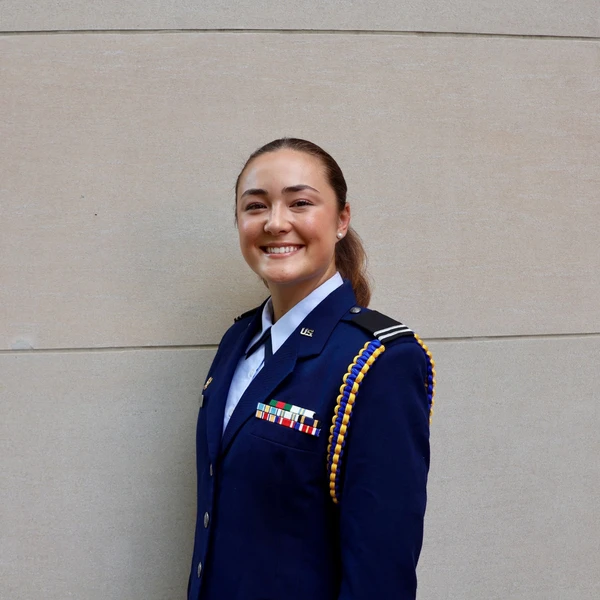
I am a junior at Baylor University and an AFROTC cadet driven by a clear and personal mission: to serve those who have served.
Inspired by my family's legacy of military service (Air Force and war veterans), my passion is to improve healthcare for our nation's veterans. To achieve this, I am pursuing a demanding, multidisciplinary degree in Biology, Neuroscience, and Aerospace Studies, focusing on the complex challenges of Traumatic Brain Injury (TBI) and PTSD.
My commitment is not just academic. I am a certified EMT, gaining hands-on patient care experience to complement my research goals. I also volunteer extensively at the Doris Miller VA Center in Waco, where I assist with the Blind Rehabilitation Service and, most importantly, serve as a listening ear for veterans. This experience grounds my technical studies in real-world compassion and strengthens my resolve.
My goal is to earn my commission as an officer in the Air Force Medical Service. I plan to use my unique background in neuroscience and aerospace to research, innovate, and provide the high-quality, empathetic care our veterans deserve. Scholarships are a direct investment in this mission, allowing me to focus on my rigorous training and community service as I prepare for a lifetime of commitment.
Education
Baylor University
Bachelor's degree programMajors:
- Biological and Biomedical Sciences, Other
Minors:
- Health Professions and Related Clinical Sciences, Other
Rouse H S
High SchoolMiscellaneous
Desired degree level:
Doctoral degree program (PhD, MD, JD, etc.)
Graduate schools of interest:
Transfer schools of interest:
Majors of interest:
- Biology, General
Career
Dream career field:
Hospital & Health Care
Dream career goals:
Surgeon
Tennis Coach
Private business2022 – Present4 years
Sports
Tennis
Club2012 – Present14 years
Awards
- Mixed Doubles District Finalist
- Mixed Doubles District Champions
- Mixed Doubles State Qualifiers
Research
Neurobiology and Neurosciences
DukeTIP — Student2017 – 2018
Arts
Palace Theater
Acting2014 – 2017
Public services
Public Service (Politics)
Austin EMS — EMT2023 – PresentVolunteering
Children's Association for Maximum Potential — Counselor2021 – PresentVolunteering
Texas Humane Heroes — Veterinary Technician2020 – PresentVolunteering
Gateway Church — Visual productions assistant2021 – Present
Future Interests
Advocacy
Volunteering
Entrepreneurship
Leading Through Humanity & Heart Scholarship
1. I am a junior at Baylor University and an AFROTC cadet, but my core identity is shaped by a family legacy of service—my grandfather served in the Air Force and my great-uncle in the Korean War. This instilled in me a profound respect for our military. My passion for human health was solidified through this value of service, specifically during my volunteer work at the Doris Miller VA Center. Assisting with the Blind Rehabilitation Service and, most importantly, acting as a "listening ear" for veterans, I saw firsthand the gaps in their care. These experiences shaped my defining value: to serve those who have served, not just with technical skill, but with the dignity they deserve. This passion isn't just academic; it's a personal mission to heal and support a community that has given so much.
2. To me, empathy is not simply feeling for someone; it is the active and disciplined practice of feeling with them. It is the commitment to understand a person's experience from their perspective, validating their story as a critical piece of data. I learned this most clearly at the Doris Miller VA Center. As a "listening ear," I realized that empathy is a powerful diagnostic and therapeutic tool. It’s the difference between a patient feeling like a case file and a patient feeling truly heard.
This quality is non-negotiable in my specific career goal: becoming an officer in the Air Force Medical Service to research and treat Traumatic Brain Injury (TBI) and PTSD. These are often "invisible wounds." A TBI may not show up on a standard scan, and the symptoms of PTSD can be mistaken for other issues. Without empathy, a healthcare provider will fail these patients. Empathy is what allows a provider to build the trust necessary for a veteran to share their story—a story that is just as critical as any lab result. In this field, empathy is not a "soft skill"; it is the key to an accurate diagnosis and an effective, trusting therapeutic alliance. A veteran who feels dismissed will not seek or comply with treatment. Empathy is the bridge that ensures our scientific advancements actually reach the patient.
I will ensure my work is done through a "human-centered lens" by building my entire approach on this foundation of active listening. My multidisciplinary major in biology, neuroscience, and aerospace studies provides the "science," but my volunteer experience provides the "how." A human-centered lens means designing systems, research, and treatment protocols with veterans, not just for them. For example, it means creating intake processes for TBI research that are not just a series of clinical tests, but that begin with an unhurried, narrative-based history. It means ensuring that any new technology I help develop is implemented in a way that reduces patient frustration, not adds to it. My work will be human-centered because it will always start and end with the person, their story, and their dignity—treating the whole human, not just the injury.
Boatswain’s Mate Third Class Antonie Bernard Thomas Memorial Scholarship
The legacy of Antonie "Tony" Bernard Thomas, as a Navy veteran, a police officer, and a selfless listener, is a powerful reminder that a life of service impacts everyone it touches. As the granddaughter and great-niece of Air Force and Army veterans, I was raised with a deep respect for this kind of commitment. The values he embodied—leadership, resilience, selflessness, determination, and a strong work ethic—are the same values I strive to live by in my academic, military, and personal life.
My focus and determination are the driving forces behind my education. My reason for pursuing a degree is not simply to get a diploma, but to build a highly specific toolkit for a complex mission. I am pursuing a multidisciplinary program in biology, neuroscience, and aerospace studies. This demanding and non-traditional path is necessary to achieve my future goal: to become an officer in the Air Force Medical Service, where I can research and treat the complex wounds of service, such as Traumatic Brain Injury (TBI) and PTSD. My strong work ethic is demonstrated daily in the discipline required to manage this rigorous STEAM courseload while also meeting my obligations as an AFROTC cadet. I am determined to master these subjects because I know they are the keys to developing better treatments for the veteran community I plan to serve.
I practice selflessness and resilience through my community service at the Doris Miller VA Center in Waco. Mr. Thomas was described as a "selfless listener," a role I have come to understand deeply. While I assist with practical needs like the Blind Rehabilitation Service, the most selfless act I can offer is my time as a listening ear for veterans. Hearing their stories of service, and also their deep frustrations with a system that can feel impersonal, requires resilience. It is emotionally challenging to absorb this, but resilience is not about hardening yourself; it’s about channeling that empathy into a stronger determination to make a difference.
Finally, I develop my leadership and communication skills every day in AFROTC. Here, leadership is not a theory; it is a practice. It's about clear communication to accomplish a task, but it's also about accountability for my fellow cadets. To me, leadership means taking on the responsibility of service. It's not about rank or a title; it is the selfless act of putting the mission and your team first. It’s about listening to those you lead to understand their needs—a trait I learned from veterans at the VA and see honored in Mr. Thomas's memory.
My entire life is structured around becoming a leader who serves. I am pursuing my degree to gain the knowledge, honing my character in AFROTC to gain the skills, and grounding my mission in my volunteer work to ensure I never lose my "why." I am honored to apply for a scholarship that celebrates this path.
Kayla Nicole Monk Memorial Scholarship
Kayla Nicole Monk’s story is a powerful testament to ambition, resilience, and a profound passion for helping people. Her life, though faced with immense medical challenges, was defined by her vision and her drive to achieve her goals. As a minority woman in STEAM, her legacy resonates with me deeply. I chose my own area of study not simply as a career path, but as a focused mission to help a community that I believe deserves our very best.
My "why" is rooted in my family and my community. With a great uncle who served in the Korean War and a grandfather in the Air Force, I grew up with a deep respect for our military. This respect, however, turned into a call to action through my community service at the Doris Miller VA Center in Waco. While assisting with the Blind Rehabilitation Service or simply being a listening ear for veterans, I saw the true cost of service. I heard stories of resilience, but also of deep frustration—frustration with a healthcare system that can feel impersonal, and with life-altering conditions like Traumatic Brain Injury (TBI) and PTSD that are often invisible and misunderstood. It was in those moments, listening to their stories, that I found my purpose. I chose my STEAM field to address the gaps in care that these veterans experience every day.
My area of study is a unique, multidisciplinary program of biology, neuroscience, and aerospace studies, chosen specifically to build a toolkit for this mission. This program is not a traditional path, but a necessary one to tackle the complex problems of veteran health. My biology and neuroscience studies are the foundation for understanding the brain at a cellular and chemical level, which is essential for researching and developing better treatments for TBI and PTSD. My aerospace studies, combined with my AFROTC commitment, provide a critical understanding of the specific physiological stressors that airmen and women face. I am not just studying science; I am learning how to solve the specific, high-stakes medical challenges that arise from military service. My ambition and drive, like Kayla's, are focused on a clear vision: a future where our veterans receive care that is as advanced as the technology they operated and as compassionate as the service they gave.
This scholarship will be a direct and powerful investment in that mission. The financial assistance from the Kayla Nicole Monk Legacy Scholarship is not just a line on a ledger; it is a lifeline that helps me protect my most valuable resources: my time and my focus. As a student in a demanding, multidisciplinary STEAM program, and as an AFROTC cadet, my schedule is rigorous. This scholarship would alleviate the financial burden of books, lab fees, and transportation, reducing the need to choose between a part-time job and an extra hour volunteering at the VA center. It would allow me to dedicate myself more fully to my complex studies and my community service.
By investing in my education, you are helping me achieve my goal of becoming an officer in the Air Force Medical Service, where I can directly impact the lives of service members. This scholarship is an opportunity to carry on Kayla’s passionate legacy of helping others, and I would be honored to do so.
Sabrina Carpenter Superfan Scholarship
Why am I a fan of Sabrina Carpenter? It’s not just for her catchy songs or her captivating stage presence, but because her entire career is a masterclass in evolution, versatility, and authenticity. For a student like me, whose own path is proudly unconventional, her journey is a powerful source of inspiration.
I was first a fan during her Girl Meets World days. I always related more to her character, Maya Hart. Maya was the "different" one, the fiercely loyal friend from a tough background who used her wit and art to navigate a world that didn't always understand her. As a young Korean-American woman, I understood what it felt like to be on the outside, and I deeply admired Maya's (and Sabrina's) ability to "embrace her true self" without apology. That character was a testament to the fact that you don't have to fit into a perfect mold to be a good person with a strong moral compass.
That early lesson is at the heart of why Sabrina’s career continues to impact me. The scholarship prompt mentions her "versatility," and that is what I admire most. She refused to be "just" a Disney star, evolving into a dynamic musician and actress who redefines her own brand on her own terms. This inspires my "ambition" and "drive" to defy being put in a single box. My own educational path is multidisciplinary, combining biology, neuroscience, and aerospace studies. I am not just a scientist, or just an AFROTC cadet, or just a community volunteer. I am all of them. Sabrina’s career is a blueprint for how to successfully blend different passions and skills to create a unique and powerful identity.
Sabrina uses her platform to connect with millions, inspiring them to dream big. My dream is to use my own platform for a different, but equally focused, "impact." My goal is to serve in the Air Force Medical Service, researching Traumatic Brain Injury (TBI) and PTSD and providing compassionate care to our nation's veterans. This mission is inspired by my family's service and my hands-on volunteer work at the Doris Miller VA Center. Sabrina’s authenticity and the way her heartfelt lyrics resonate with fans remind me that no matter how technical my work in neuroscience becomes, it must always be grounded in that same human-centered authenticity. My goal is to combine the precision of science with the "art" of compassionate, human connection.
Sabrina Carpenter’s journey has shown me that you can evolve without losing your core. She inspires my ambition to pursue a complex, multifaceted career and fuels my drive to make a tangible, positive impact on my community.
Wicked Fan Scholarship
To me, Wicked is far more than a musical; it’s a manual for anyone who has ever felt "othered" while trying to stand up for what is right. While I love the iconic music and the magic of Oz, I am a fan of Wicked because I see my own story in Elphaba’s. Her journey of courage, identity, and standing tall against adversity is a powerful parallel to my own ambitions as a Korean-American woman in STEM and a future officer in the Air Force.
Elphaba’s story begins with her being an outcast, judged for her appearance and misunderstood by those around her. Yet, it is this very "differentness" that gives her a unique perspective and a fierce moral compass. As a Korean-American woman pursuing a complex, multidisciplinary degree in biology, neuroscience, and aerospace studies, I am often one of the few people who share my background. Like Elphaba, I’ve learned to turn that feeling of isolation into a motivator. It has instilled in me a drive to succeed not just for myself, but to become a visible representative for others and to use my unique perspective to solve problems others might not see.
The musical's central theme of "standing up for what you believe in" is the core of my connection to the show. Elphaba’s "Defying Gravity" moment is not just a song; it's the definitive choice to abandon the "Popular" path to pursue a greater, more difficult calling—protecting the Animals who are being silenced and oppressed. I see this in my own life. My passion is for military and veteran health, a community that includes my great uncle who served in the Korean War and my grandfather who served in the Air Force. My volunteer work at the Doris Miller VA Center in Waco, especially as a "listening ear" for veterans, has shown me a community that is often overlooked and struggling to be heard within a complex system. My choice to join the AFROTC and dedicate my career to researching TBI and PTSD is my "Defying Gravity" moment. It is not the easiest path, but it is the one I believe in.
Finally, the musical’s message of impact, captured in the song "For Good," is something I’ve experienced firsthand. My time with the veterans at the VA center has changed me. Hearing their stories and understanding their struggles has solidified my commitment. Because I have known them, I have been changed for good. Wicked is an inspiration because it champions the idea that your greatest challenges can become your greatest strengths, and that one person, by staying true to their identity and their morals, can make a profound difference. That is a message that inspires my ambition, fuels my drive, and defines the impact I hope to have in my own community.
Kim Moon Bae Underrepresented Students Scholarship
My identity as a Korean-American woman isn't just a box I check; it’s the lens through which I see the world and the foundation of my commitment to service. This scholarship speaks of the "unique set of barriers" faced by minority students. I have faced these barriers, but my identity has also given me a unique perspective, a resilience I’ve had to learn, and a clear sense of purpose that guides my ambitions.
Growing up as a Korean-American, I learned to navigate spaces where I was often one of the few who looked like me. While challenging, that experience taught me to be observant, empathetic, and tenacious. Now, as a woman of color pursuing a complex, multidisciplinary STEM degree in biology, neuroscience, and aerospace studies, I’m keenly aware of the isolation the prompt mentions. I am still often one of the few people who shares my background in advanced classes. Instead of being a deterrent, this has become a powerful motivator. It has instilled in me a drive to not only succeed for myself, but to become a visible representative for others who will follow. This impact is a core part of my "why."
My identity also deeply informs my passion for military and veteran health. My family’s history, with my great uncle Harvey serving in the Korean War and my grandfather in the Air Force, is a story of Korean-Americans serving this country, even when it didn't fully serve them in return. That legacy gives my commitment real weight. My volunteer work at the Doris Miller VA Center in Waco is a direct result of this. When I serve as a "listening ear," I hear stories from veterans of all backgrounds. My own background gives me an immediate empathy, allowing me to connect with minority veterans who may feel overlooked by the system and to understand that "compassionate care" means something different for every community.
In the future, my identity will continue to be one of my greatest assets as a leader. As a future officer in the Air Force Medical Service, I will not just be a scientist; I will be a Korean-American woman in a position of leadership. That's not a small detail. It will shape everything from my research questions to my patient interactions. My goal is to work on TBI and PTSD research, and my identity will ensure I ask questions that others might not—questions about how these conditions uniquely impact different demographics and how we can create treatment protocols that are not one-size-fits-all, but are equitable and accessible to all.
My identity isn't a barrier to my education; it’s the reason my education is so critical. It has provided me with a unique perspective, a resilient spirit, and a focused mission. I am pursuing my dream not in spite of my background, but because of it, and I am determined to use my education to build a more equitable world for the community I plan to serve.
Ward Green Scholarship for the Arts & Sciences
The prompt for this scholarship wisely observes that the arts and sciences are "naturally intertwined," yet students are often pressured to choose one distinct path. In our education system, this pressure often forces the false choice to be analytical or to be empathetic, to be a scientist or to be an artist. My academic and personal journey is built on the belief that to truly solve complex problems and serve a community, these two paths must be one. In no field is this more evident than in medicine, where a purely scientific approach can miss the human element, and a purely empathetic approach lacks the technical tools to cure.
I am currently studying a multidisciplinary program of biology, neuroscience, and aerospace studies. This unique combination is the "science" of my mission, providing the specific, technical foundation for my career. It is directly aligned with my Air Force ROTC commitment and my goal of joining the Air Force Medical Service. My "community at large" is one I am already a part of and deeply committed to—our nation's military service members and veterans. My plan is to use this scientific education to research and treat the complex health challenges they face. This includes using my aerospace studies to understand the specific physiological stressors on airmen, like the cardiovascular effects of high-G forces or the neurological impacts of altered circadian rhythms, while my biology and neuroscience background will allow me to investigate the cellular-level damage of Traumatic Brain Injury (TBI) and the neurochemical basis of PTSD. This is the science: the rigorous pursuit of answers that can lead to better diagnoses and treatments.
However, science alone cannot solve these critical community issues. The "art" is just as crucial, and I learned this not in a lab, but through my volunteer work at the Doris Miller VA Center in Waco. My most important role there was not technical; it was being a "listening ear" for veterans, especially those in the Blind Rehabilitation Service. I quickly learned that a veteran's story is a vital part of their medical history, often holding clues that a diagnostic scan cannot reveal. I saw firsthand that healing is not just about diagnostics and protocols; it is about empathy, building trust, and restoring dignity. I came to understand that a veteran’s frustration with an impersonal system is its own kind of wound. This wound manifests as missed appointments, distrust of providers, and a resignation to pain, barriers that no amount of technical skill can overcome alone. This is the art of healing, the ability to connect with a patient as a whole person, not just a set of symptoms.
I foresee myself using my education to bridge this exact gap between art and science. As a future officer in the Air Force, I will not only rely on my knowledge of biology and neuroscience to implement better treatment protocols, but also on my understanding of compassionate care to ensure those treatments are delivered with the dignity our veterans deserve. For example, while my scientific training helps me understand what a new TBI rehabilitation protocol should be, my experience in "artful" service will inform how it should be implemented, with patient-intake processes that are compassionate, unhurried, and story-centered. My goal is to foster innovation that is not just technological, but human-centered, meaning solutions are co-designed with veterans, not just for them. My education is not a choice between science and art, but a preparation to use the precision of one and the compassion of the other to serve and uplift my community.
Women in STEM and Community Service Scholarship
The prompt for this scholarship states that education is a pathway to a "better, more equitable world." For me, that mission is deeply rooted and focused: to build a world where our nation's commitment to its veterans is reflected in the quality, accessibility, and compassion of their healthcare. My passion for military medicine and veteran health goes back to my family’s history of service. Hearing stories of my great uncle Harvey, who served in the Korean War, and my grandfather, who served in the Air Force, gave me a profound respect for the sacrifices made by our service members. I have seen firsthand the gaps that exist between their immense service and the care they often receive, gaps that I believe technology, data, and dedicated STEM professionals can bridge.
This passion is a call to service that I have already tried to answer. My commitment to my community's veterans led me to volunteer at the Doris Miller VA Center in Waco. In this work, particularly while assisting with their Blind Rehabilitation Service and helping at seasonal events, I’ve encountered the unique challenges veterans with disabilities face in navigating not just physical spaces, but also complex care systems. This experience moved me beyond just sympathy and into action. My role often involves direct support, from setting up for events to pushing wheelchairs, but the most impactful part of my service has been simply being a listening ear. Hearing their stories, I've come to understand that their frustrations often lie not just with their health, but with a system that can feel impersonal and difficult to access. This direct, hands-on service affirmed my belief that practical solutions—grounded in compassion—are necessary and possible.
My goal is to take this hands-on service to a systemic level. A degree in a multidisciplinary program of biology, neuroscience, and aerospace studies is not just a career path, but the bridge to make a large-scale difference. This program aligns directly with my AFROTC commitment and future in the Air Force Medical Service. The challenges in veteran healthcare are often problems of data, logistics, and technology, but they are also deeply biological and psychological. We face issues of interoperability, where a service member's medical history from the Department of Defense does not transfer seamlessly to the Veterans Administration, let alone to civilian providers. This creates dangerous information silos, frustrates patients, and delays critical care for issues like Traumatic Brain Injury (TBI) and PTSD.
With my education, I plan to pursue a career in the medical and research field. This unique combination of majors will allow me to tackle veteran health from multiple angles, using neuroscience and biology to better understand the physiological and psychological impacts of service, particularly TBIs and PTSD, while my background in aerospace studies will provide insight into the specific health challenges faced by airmen. My goal is to work on the front lines of military medicine, helping to develop and implement better diagnostic and treatment protocols that can be standardized from active duty through to veteran life, directly addressing the care and information gaps I've observed. I want to be one of the women in STEM who doesn't just innovate, but who does so with compassion, ensuring my patient, our veterans, are always the priority.
I am dedicated to using my STEM education to solve this critical community issue. I believe I embody the spirit of “heart for community service”, and I am ready to build a more equitable world for those who have given so much to protect ours.
Maverick Grill and Saloon Scholarship
Contradictory to many who make up today's youthful generation, I have always strived to live in the moment, staying present and away from the overpowering aura of social media. While this medium can provide opportunities for socialization, education, and entertainment, it can also have detrimental effects on mental health, relationships, and development. These negatives have convinced me to value the importance of real, true human connections and to resonate with the beauty of tangible interaction.
Community service and volunteering are two of the paths I have resorted to as an outlet for developing these genuine relationships. Specifically, I volunteer with an organization called Camp CAMP (Children’s Association for Maximum Potential), a refuge for disability awareness and respite. During the summer, this organization offers stay-away weeks where volunteers are paired with a camper who may have a host of complications, whether it be Down syndrome, autism, cerebral palsy, or epilepsy. In the week that the counselor and camper spend together, they participate in engaging activities, such a horseback riding, arts and crafts, kayaking, and swimming. During every session that I attend, I find that leaving my camper is the most difficult process, having to sever a developing bond. However, with the knowledge that my camper has gained skills in friendship-making and independence, I feel fulfilled and prepared to make a larger impact.
Another element of service that sets me apart from my peers is my interest in pursuing a life in the military. As a prospective student at Baylor University, I will be in the Air Force ROTC program on the pre-medical route. After graduating and attending medical school, I wish to serve in the Air Force Medical Corps as a surgeon, and eventually, Mercy Ships. This organization operates the largest non-governmental hospital ships in the world, in an effort to provide cost-free humanitarian aid, for the good of all people. Alike my passion for helping those with disabilities, partaking on this mission will enable me to fulfill my purpose of connecting with others. Using my knowledge as a future physician, it is my dream to cure others and reinvigorate their outlook on life, sparking new passions in the dulled eyes of ailing individuals around the world.
By giving back to my community through the means of volunteering and service to the country and society, I hope to continue living in the present and prioritizing the connections that matter—the bonds formed between people.