
Hobbies and interests
Music
Travel And Tourism
Reading
Gaming
Swimming
Acting And Theater
Theater
Directing
Reading
Adult Fiction
Academic
Art
Cultural
Drama
Young Adult
Travel
Plays
Music
Food and Drink
Design
Education
I read books multiple times per week
US CITIZENSHIP
US Citizen
LOW INCOME STUDENT
Yes
FIRST GENERATION STUDENT
Yes
Shadoe Valentin
1x
Finalist
Shadoe Valentin
1x
FinalistBio
Shadoe Valentin is a theatre artist, educator, and arts administrator based in Mobile, Alabama, where he serves in the Alabama School of the Arts at the University of Mobile. A proud UM alum, Shadoe holds both a Bachelor’s and Master’s degree from the University of Mobile and has worked full-time at the university since 2014, supporting students through production leadership, recruitment, mentorship, and classroom instruction.
In addition to his administrative work, Shadoe is an active director, adjudicator, and performer whose work spans theatre, music, and live entertainment across 12 states. He regularly collaborates with schools, churches, and community organizations, offering workshops and creative guidance to help students and artists grow in confidence and craft.
Shadoe is passionate about building bridges between the arts, education, and faith communities, with a deep commitment to reconciliation, representation, and compassionate leadership.
Currently seeking low-residency MFA and terminal degree programs in Theatre Direction, Shadoe’s long-term goal is to teach full-time in higher education while also working as a professional artist in the greater theatre community. He is committed to funding his graduate education without taking on student loan debt and is actively seeking scholarship and grant support as he takes this next step.
Education
University of Mobile
Master's degree programMajors:
- Visual and Performing Arts, General
- Drama/Theatre Arts and Stagecraft
- Music
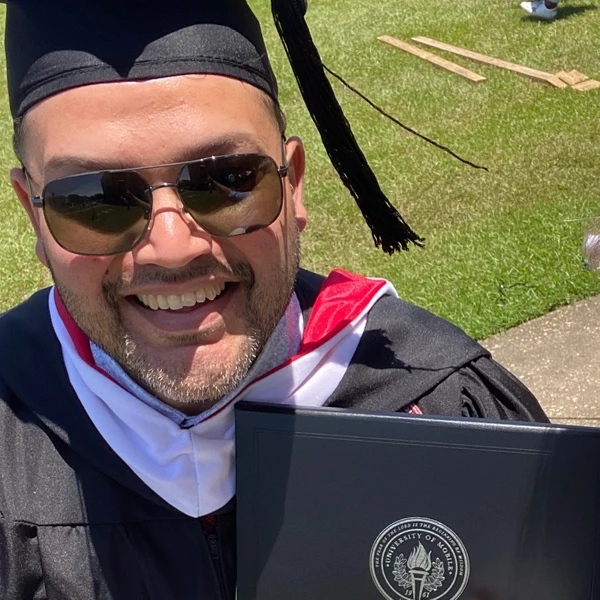
University of Mobile
Bachelor's degree programMajors:
- Music
Minors:
- Drama/Theatre Arts and Stagecraft
Florida SouthWestern State College
Associate's degree programMajors:
- Education, General
Minors:
- Music
Miscellaneous
Desired degree level:
Master's degree program
Graduate schools of interest:
Transfer schools of interest:
Majors of interest:
- Arts, Entertainment, and Media Management
- Drama/Theatre Arts and Stagecraft
- Design and Applied Arts
- Fine and Studio Arts
Career
Dream career field:
Performing Arts
Dream career goals:
Singing, arts administration, arts management, fine arts, higher education, theatre, direction
Coordinator of Performing Arts
University of Mobile2018 – 20246 yearsDirector of Production & Administration
University of Mobile2024 – Present2 yearsSinger Actor
Seward Studios2023 – 2023Vocalist
RWS Entertainment2021 – 2021Costuming
Walt Disney World Theme Parks & Resorts2006 – 20104 yearsAdjunct Music
University of Mobile2022 – Present4 yearsAdjunct Theatre
University of Mobile2021 – Present5 years
Sports
Baseball
Intramural2010 – 20111 year
Arts
University of Mobile
ActingMusicals, Plays, Shakespeare, Concert, Dinner Theatre2010 – 2021
Public services
Volunteering
Chickasaw Civic Theatre — Board Member at Large2023 – PresentVolunteering
3Circle Church — Worship Artist2021 – Present
Future Interests
Advocacy
Philanthropy
Entrepreneurship
Julie Holloway Bryant Memorial Scholarship
I am a theatre artist, educator, and first-generation college graduate pursuing a terminal degree in Theatre Direction. My long-term goal is to teach full-time in higher education while continuing to work professionally in the theatre community. I want to build programs that cultivate strong collaboration, creative excellence, and access for students who may not see themselves represented in leadership.
English is my first language. My parents’ first language is Spanish. Growing up, they intentionally spoke English to me so they could practice and strengthen their fluency. As a result, I developed confidence in English early, but I grew up with a complicated relationship to Spanish. I understood it conversationally, but I did not feel fully confident speaking it.
As I grew older, I became more aware of what that meant. I was connected to my culture, but not always confident in expressing it linguistically. I had moments of insecurity when speaking Spanish with extended family or in community settings. I worried about grammar, accent, and vocabulary. At times, I felt caught between fluency and heritage.
Instead of allowing that gap to define me, I began teaching myself more intentionally. I practiced speaking more frequently with family members. I listened closely. I read and absorbed vocabulary. Reclaiming confidence in Spanish became less about perfection and more about connection.
One challenge of being bilingual in my experience has been navigating identity. Because English is my first language, some assume I am not “Spanish enough.” Because Spanish is spoken in my home and community, others assume full fluency. Living between those expectations can feel isolating. I have learned that language is not only about fluency; it is about belonging.
The benefits, however, have shaped my leadership deeply. Being bilingual allows me to move between communities with greater empathy. I understand cultural nuance. I understand the effort required to communicate across linguistic differences. I recognize how language can either include or exclude.
In my work in higher education and the arts, that awareness matters. I approach students with sensitivity to how they may be navigating language and identity in academic spaces. I value clarity in communication and make intentional efforts to create environments where people feel understood, not judged.
Post-graduation, as I pursue a terminal degree and continue teaching and directing, I hope to expand access to the arts for multilingual and first-generation students. Language shapes how stories are told and who feels invited to participate. My bilingual experience reminds me that representation is not just visual. It is linguistic and cultural as well.
Being bilingual has taught me humility, patience, and adaptability. It has required me to grow intentionally rather than rely on ease. Most importantly, it has strengthened my connection to my family and heritage while expanding my ability to connect with others.
Language, for me, is not simply a skill. It is a bridge.
Ruthie Brown Scholarship
I approach student loan debt with the same mindset I approach leadership: steady, disciplined, and long-term.
After completing my undergraduate degree, I carried both federal and private student loans. Over time, I paid off my federal loans entirely. That process required consistency more than anything else. I budgeted carefully, limited discretionary spending, and prioritized repayment even when it was inconvenient. Paying off those loans was not glamorous, but it was freeing.
I am still repaying private Sallie Mae loans, which carry higher interest rates and less flexibility than federal loans. Addressing this remaining debt is a priority. I maintain a structured repayment plan and regularly review opportunities to refinance at a lower interest rate when feasible. I also allocate additional payments toward principal when my budget allows in order to reduce long-term interest accumulation.
As a full-time professional in higher education, I have learned to build financial strategy into my career decisions. I track expenses closely, maintain a modest lifestyle, and avoid taking on new debt whenever possible. My goal is not simply to manage debt, but to eliminate it responsibly.
Looking ahead, I am pursuing a terminal degree in Theatre Direction through a low-residency model that allows me to continue working full-time. This structure is intentional. By maintaining stable employment while studying, I reduce reliance on additional loans. I am actively applying for scholarships and grants, building a financial plan before enrolling, and refusing to repeat the cycle of borrowing that extended my repayment timeline in the past.
As a BIPOC adult learner and first-generation college graduate, I am acutely aware of how long-term debt can limit professional flexibility and generational mobility. I have seen peers delay homeownership, family planning, and career transitions because of loan burdens. My approach is grounded in discipline and foresight. I prioritize financial literacy, consult with financial advisors when necessary, and make career decisions that align with long-term stability rather than short-term convenience.
Addressing student loan debt, for me, is not about urgency alone. It is about stewardship. I view education as an investment, but one that requires intentional management. By working full-time, seeking scholarship support, aggressively repaying existing loans, and avoiding unnecessary borrowing, I am actively working to ensure that my educational advancement does not compromise my financial future.
My goal is to complete my remaining private loan repayment while pursuing my terminal degree with minimal additional debt. Through careful planning, continued employment, and scholarship support, I am building a path that balances ambition with responsibility.
Debt does not define my education, but how I manage it reflects my values. I am committed to finishing what I started and doing so in a way that creates long-term freedom rather than prolonged burden.
Tawkify Meaningful Connections Scholarship
Option 3: Purpose & Connection
Relationships are not separate from my goals. They are the reason for them.
As a theatre artist and educator, every meaningful professional aspiration I hold is rooted in connection. Theatre is inherently relational. It requires trust between actors, collaboration between designers, vulnerability within rehearsal rooms, and presence between performers and audiences. Without relationship, there is no story.
My long-term goal is to teach full-time in higher education while continuing to work as a professional theatre director. On paper, that sounds like a career ambition. In reality, it is a commitment to community.
In the classroom, relationships shape how students grow. I have seen students flourish not because they were the most technically skilled, but because they felt seen. A student who believes their voice matters takes creative risks. A student who feels safe will ask better questions. A student who experiences trust becomes more generous in collaboration.
Those outcomes do not happen accidentally. They are built through intentional relationship.
In rehearsal rooms, I have learned that leadership is relational before it is artistic. A director can have a clear vision, but without trust, that vision collapses. I have led productions where the most important work happened not in staging, but in conversation. Listening to an actor process grief. Adjusting rehearsal schedules when someone felt overwhelmed. Bridging differences between creative personalities. Those moments shape both the art and the people creating it.
My faith has also shaped how I view relationships. I believe calling is expressed through service. That perspective has taught me that people are never obstacles to productivity; they are the purpose of the work. Whether in church communities or secular theatre spaces, I have tried to lead in a way that values dignity over efficiency and empathy over ego.
Even my pursuit of a terminal degree is relational. I am not seeking advanced study for status. I am seeking it so that I can better serve students, strengthen the programs I am part of, and expand opportunities for those who may not see themselves represented in leadership.
Relationships inform that pursuit. Mentors who invested in me, colleagues who encouraged me, and students who trusted me with their growth have all shaped the direction of my goals.
Relationships also require perseverance. As a first-generation college graduate, I learned early that community does not simply appear; it must be cultivated. I sought mentors when none were readily available. I built networks intentionally. I asked questions even when I felt unsure. Those relational risks opened doors that technical skill alone could not.
In a world that often prioritizes productivity, visibility, and individual achievement, I am convinced that sustainable impact is relational. Careers evolve. Titles change. Programs shift. But the way we treat people endures.
My long-term professional vision is not centered on prestige. It is centered on cultivating environments where students and artists feel connected, challenged, and supported. I want to direct productions that bring communities together. I want to teach in a way that empowers students to collaborate generously. I want to build bridges between faith communities and artistic spaces that have historically misunderstood one another.
All of that work begins and ends with relationships.
If human connection is what changes lives, then investing in leaders who prioritize it is essential. My goals are inseparable from the communities I serve. Relationships are not a complement to my work. They are the foundation of it.
Nabi Nicole Grant Memorial Scholarship
One of the clearest examples of relying on my faith to overcome a challenge has been my entire educational journey.
As a first-generation college student, I did not grow up with a roadmap for higher education. There were no family members who could explain the FAFSA process, graduate applications, or what a terminal degree even meant. Each step required learning in real time. At times, it felt overwhelming. There were financial pressures, academic expectations, and the quiet weight of being the first to do something that felt unfamiliar and uncertain.
I often found myself asking, “Am I capable of this?”
In those moments, my faith became more than belief. It became steadiness.
Scripture reminds me that my words and thoughts should be anchored in something deeper than circumstance. It also reminds me that calling often requires obedience before clarity. When I began my undergraduate degree, I did not know how every bill would be paid or how every opportunity would unfold. The same was true when I pursued my master’s degree. And now, as I seek a terminal degree in Theatre Direction, that tension remains.
Faith has not meant that obstacles disappeared. It has meant that I kept moving forward despite uncertainty.
There were seasons when finances were tight and the pressure to choose stability over growth felt strong. There were moments when imposter syndrome crept in, especially as a Latino student navigating spaces where I did not see many leaders who looked like me. There were times when exhaustion tempted me to settle instead of stretch.
In each of those seasons, prayer grounded me. Community strengthened me. Scripture reminded me that faithfulness is not about immediate results, but about perseverance. I learned that obedience sometimes looks like filling out one more application, preparing one more audition, submitting one more form, even when doubt is present.
My faith has also shaped how I lead. Working in both church and secular theatre spaces, I have relied on faith to approach others with compassion rather than comparison. I believe that calling is not about platform, but about service. That perspective has carried me through challenges that felt larger than my own capacity.
Being first-generation means that my pursuit of education has never been just about me. It represents expanded possibility for my family and my community. Faith has helped me see my journey not as self-promotion, but as stewardship.
If I have learned anything through this process, it is that faith does not eliminate fear. It gives you the courage to move anyway.
From undergraduate studies to a master’s degree and now toward a terminal degree, every step has required trust before confirmation. My faith has sustained me through uncertainty, strengthened me in adversity, and reminded me that calling is rarely convenient.
It has taught me to walk forward even when the full path is not visible.
Learner Mental Health Empowerment for Health Students Scholarship
Mental health matters to me because I have seen how quietly it can shape a person’s life.
As a student and now as an educator in higher education, I have experienced seasons of anxiety and emotional exhaustion that were easy to hide but difficult to carry. For a long time, I equated strength with productivity. If I was meeting deadlines, directing productions, mentoring students, and maintaining responsibilities, I assumed I was fine. It took time to realize that high performance does not always mean healthy balance.
College environments can intensify pressure. Academic expectations, financial strain, identity development, and social comparison often collide at once. I have seen students struggle privately while presenting confidence publicly. I recognize that pattern because I have lived it.
Mental health is important to me because it directly impacts how students learn, create, and lead. In the arts especially, students are asked to access vulnerable emotional spaces. Without support and understanding, that vulnerability can feel overwhelming rather than empowering.
I advocate for mental health first by modeling openness. In classroom and rehearsal settings, I speak honestly about boundaries, rest, and the importance of seeking support. I normalize conversations about stress rather than treating them as weakness. When students express anxiety or burnout, I respond with curiosity and compassion instead of dismissal.
I also advocate by building environments where students feel safe to communicate. In rehearsal rooms, we discuss expectations clearly and encourage collaborative problem-solving. I check in regularly with students who seem withdrawn or overwhelmed. Sometimes advocacy is not a formal initiative. Sometimes it is noticing a shift in someone’s demeanor and asking if they are okay.
As someone who moves between faith communities and secular artistic spaces, I also work to reduce stigma in both. In some environments, mental health is minimized. In others, it is treated as purely clinical. I believe support can include professional care, community, and honest dialogue. I encourage students to utilize campus counseling services when needed and to view mental health care as responsible stewardship rather than failure.
Pursuing advanced study in Theatre Direction is part of this commitment. I want to teach full-time in higher education while continuing to work as a professional artist, and I believe emotionally healthy creative spaces produce stronger art and stronger leaders. Mental health advocacy is not separate from my academic goals. It informs how I teach, direct, and mentor.
Mental health is important to me because I understand how easy it is to carry struggle silently. Advocacy, to me, is not loud. It is consistent. It is choosing empathy over assumption. It is creating spaces where students can pursue excellence without sacrificing their well-being.
When students feel supported emotionally, they are more likely to thrive academically and creatively. I want to be part of that kind of community, one where strength includes vulnerability and where success does not require silence.
Lotus Scholarship
Growing up in a low-income household shaped the way I view opportunity. Education was never assumed. It was something to work toward carefully and responsibly. I learned early that resources were limited, so decisions mattered. If I wanted something, I had to plan for it, earn it, and sometimes go without other things to make it possible.
When I entered college, I quickly realized that tuition was only part of the cost. Textbooks, technology, travel for performances, and production expenses added up. I worked while studying and learned how to budget intentionally. After graduation, I carried student loan debt that required years of steady discipline to repay. Paying it off was not dramatic. It was consistent sacrifice and careful planning. That experience strengthened my resolve to pursue further education without repeating the same cycle.
Coming from a low-income background has made me attentive to others. I now work in higher education and regularly encounter students who are balancing school with financial strain. I recognize the pressure they carry because I have felt it myself. I approach them with patience and look for ways to reduce barriers where I can.
I am currently seeking a terminal degree in Theatre Direction so that I can teach full-time in higher education while continuing to work as a professional artist. I am actively applying for scholarships and building a financial plan that allows me to advance responsibly.
Growing up without financial abundance taught me resilience, discipline, and empathy. I intend to use those lessons to expand access and create supportive spaces for students navigating similar challenges.
Simon Strong Scholarship
One of the most defining adversities in my life has not been a single moment, but a sustained tension: learning how to belong in spaces that were not built with me in mind.
As a Latino student and later as a professional in higher education and the arts, I have often found myself navigating predominantly white institutions where representation in leadership was limited. There were moments when I questioned whether my voice carried weight, whether my cultural background would be misunderstood, or whether I needed to minimize parts of myself in order to advance.
Early in my career, I learned to adapt quickly. I worked hard. I stayed prepared. I became dependable. I took on responsibility without complaint. I believed that excellence alone would secure belonging.
But excellence does not erase isolation.
There were seasons when I carried pressure quietly. I felt financial pressure from student loans, professional pressure to prove myself, and cultural pressure to represent my community well. I did not always have mentors who shared my background. I had to learn how to advocate for myself while remaining respectful, how to disagree without being dismissed, and how to build trust across differences.
Over time, I realized that adversity was not something to outwork. It was something to grow through.
Instead of shrinking parts of my identity, I began to lean into them. I allowed my cultural perspective to inform my leadership style. I brought empathy into rehearsal rooms. I became intentional about mentoring students who felt unseen. I sought collaboration rather than competition. I worked to build bridges between communities, between church and theatre spaces, between local artists and the university, and between students and faculty.
Financial adversity also shaped me. After completing my undergraduate degree, I carried student loan debt that required discipline and long-term commitment to repay. Rather than allowing that burden to stall my goals, I developed careful financial habits, prioritized stability, and paid off my loans. That experience strengthened my resolve to pursue future education responsibly and without repeating the same cycle of debt.
Adversity has taught me resilience, but it has also taught me compassion. I no longer measure success solely by achievement. I measure it by impact. I understand that many students from underrepresented communities carry invisible weight, including family expectations, financial responsibility, and cultural translation. Because I have felt that weight myself, I approach others with greater patience and advocacy.
If I could offer advice to someone facing similar circumstances, it would be this: do not interpret difficulty as disqualification. Feeling out of place does not mean you do not belong. Seek mentors, even if they do not look like you. Build community intentionally. Protect your integrity. Remember that growth often happens in the very spaces that feel uncomfortable.
Adversity did not diminish my aspirations. It refined them. It shaped me into a leader who values representation, financial responsibility, and service. It strengthened my commitment to higher education and the arts as pathways for access and empowerment. And it continues to remind me that perseverance is not loud. It is steady.
Pamela Branchini Memorial Scholarship
For me, collaboration in theatre is not simply a creative strategy. It is the work itself.
Theatre direction is often misunderstood as authority or control, but in reality, it is the art of listening. A production only succeeds when actors, designers, musicians, technicians, administrators, and audience all feel seen in the process. Collaboration means creating a space where every contributor understands that their work matters, not as decoration, but as essential storytelling.
In my field, collaboration begins long before opening night. It begins in the first table read when actors cautiously test their voices. It continues in design meetings where lighting, costume, and scenic ideas collide and evolve. It deepens when a pianist adjusts tempo to support a singer’s breath, or when a choreographer reshapes movement because a character’s emotional arc has shifted. Each adjustment is relational.
Some of the most formative collaborative experiences in my life have taken place in rehearsal rooms where trust had to be built from scratch. I have directed productions that brought together students with different training backgrounds, belief systems, and life experiences. I have worked in secular theatre spaces while remaining grounded in my faith, and I have collaborated within church communities learning how to approach art with greater technical excellence. In both contexts, the process required humility.
One experience that deeply shaped me was leading a production where the cast included students navigating personal grief and mental health challenges. The rehearsals became more than preparation for performance; they became a space of mutual support. Designers adjusted timelines to accommodate emotional needs. Actors advocated for one another. Conversations about character motivations turned into conversations about resilience and identity. What could have been a stressful production instead became a shared investment in one another’s well-being.
That experience clarified something for me: collaboration is not efficiency; it is empathy in action.
As an educator and theatre artist, I have also experienced collaboration across disciplines. Working alongside musicians, choreographers, and production teams has shown me how art is strengthened when no single voice dominates. The best productions I have been part of were not those where the director’s vision was imposed, but where the vision emerged from collective trust.
Pamela Branchini’s life reminds us that concerts and performances are not only about the event itself, but about the relationships formed in preparation. I resonate deeply with that perspective. The most meaningful artistic experiences in my career have been those where the rehearsal room became a community—where artists learned to rely on one another, challenge one another, and celebrate one another.
As I pursue advanced study in Theatre Direction, my goal is not simply to refine craft but to cultivate collaborative spaces that shape people as much as they shape productions. In theatre, collaboration is not a step in the process. It is the process. It is the practice of building something none of us could build alone.
Ethel Hayes Destigmatization of Mental Health Scholarship
Mental health became real to me long before I had language for it.
For much of my life, I learned to equate strength with silence. Productivity meant I was fine. Achievement meant I was coping. Faith meant I should be grateful, not struggling. So when I experienced seasons of anxiety, emotional exhaustion, and internal pressure, I did what many people do: I kept moving. I showed up for work. I led rehearsals. I mentored students. I met deadlines. I carried responsibility well.
But suppression has consequences.
Working in higher education and the arts has placed me in close proximity to college-aged students navigating depression, burnout, family trauma, and identity struggles. Suicide is one of the leading causes of death among this age group, and that statistic is no longer abstract when you sit across from a student who feels overwhelmed or unseen. Over time, I began to recognize in them the same quiet tension I had carried: the pressure to appear capable, the fear of disappointing others, and the belief that vulnerability equals weakness.
My journey with mental health has reshaped my understanding of strength. I now believe strength is not the absence of struggle; it is the courage to name it.
As a Latino educator and theatre artist, I often move between secular artistic spaces and faith-based communities. In both environments, mental health can be misunderstood. In some spaces, it is minimized as a lack of discipline. In others, it is overly spiritualized, as though prayer alone should erase complex emotional realities. Navigating these worlds has taught me that compassion must come before correction, and listening must come before advice.
This has profoundly shaped my relationships. I approach students, colleagues, and collaborators with greater empathy. I assume less about what people are carrying. I try to create rehearsal rooms and classrooms where honesty is welcomed and where asking for help is not seen as failure. I have learned to model boundaries, rest, and openness instead of perfection.
It has also shaped my aspirations.
I am currently seeking low-residency MFA and terminal degree programs in Theatre Direction because I want to teach full-time in higher education while remaining active as a professional artist. Theatre is uniquely positioned to address mental health. It allows us to externalize what is internal, to embody grief, fear, hope, and resilience in ways that feel communal rather than isolating. When students step into a character, they often access parts of themselves they have not yet found words for.
I have witnessed how storytelling can gently open conversations about anxiety, trauma, and identity. I have also seen how silence can deepen isolation. My experiences with mental health have convinced me that leadership in the arts must include emotional awareness. Artistic excellence without emotional safety is incomplete.
My understanding of the world has shifted from asking, “What is wrong with this person?” to asking, “What have they survived?”
Mental health has taught me that faith and therapy are not opposites. That success does not immunize someone from depression. That high-functioning individuals can still be struggling internally. And that bringing darkness into the light, while uncomfortable, is often the first step toward healing.
I no longer believe that suppressing pain protects others. I believe honest dialogue protects lives.
The Ethel Hayes Destigmatization of Mental Health Scholarship exists to bring darkness into the light. That mission resonates deeply with me. My work as an educator and artist places me in daily contact with young adults who are navigating enormous internal pressures. I feel a responsibility not only to teach them craft, but to model emotional integrity and compassion.
My journey with mental health has not made me fragile; it has made me attentive. It has shaped my goals, strengthened my relationships, and expanded my understanding of what it means to lead. I want to build classrooms and creative spaces where students feel seen as whole people, not just performers or producers.
If we are going to reduce stigma, we must start by telling the truth about our shared humanity. I am committed to doing that—in rehearsal halls, in classrooms, and in every space where art and education intersect.