Hobbies and interests
Singing
Animals
Tennis
Reading
Academic
Adult Fiction
Science Fiction
dystopian
I read books daily
Sejal Rose Sundaram
1x
Finalist
Sejal Rose Sundaram
1x
FinalistBio
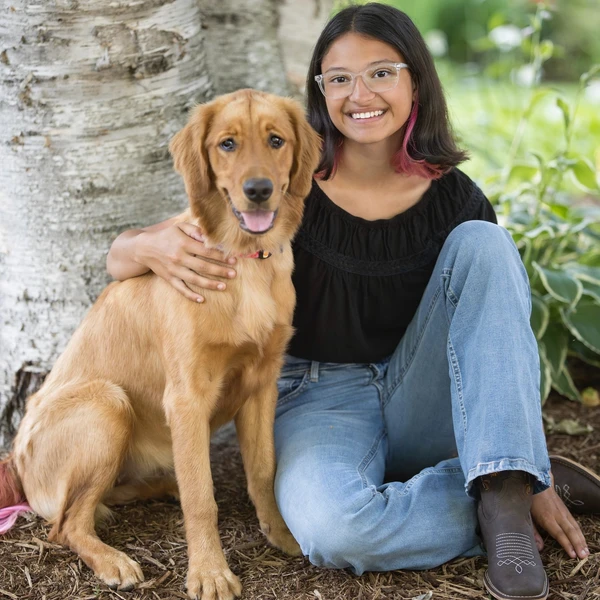
I have always wanted to be a veterinarian. Literally, my kindergarten file says, "Sejal Rose wants to be a rodentologist." Currently, I have spoiled rescue ferrets, guinea pigs, hamsters, gerbils and will do pet sitting for anything with gills, scales, feathers or fur! I am currently training a psychiatric service dog, Sunny, a 67 lb golden retriever.
I am an accomplished gymnast, competing both for my private club and my HS team. I competed Varsity tennis as a doubles player. I've made State trap for the past 3 years, and can't wait for this season to being.
I'm a dual enrollment student, taking all my classes for my junior and senior year at Madison Area Technical College. I love the rigor of advanced science classes
I'm a lead singer and have a band that plays gigs at local VFWs. My rendition of Patsy Cline's "Crazy" usually turns heads. But I also just got paid for a classical showcase doing 2 Italian arias.
During school I have worked at a doggie daycare, accumulating over 1500 hours of direct animal experience , and earning 3 advanced Dog Handling certificates.
I am honored to have been selected a Purdue VetUp! Champion - a highly competitive pre-vet program which I completed over my Sophomore year. FFA has also allowed me great opportunities to learn Vet Science and compete state-wide competitions.
I have a long academic road ahead for undergraduate Vet Science followed by Veterinary School and would be very grateful any scholarship opportunity.
Education
Sun Prairie West High
High SchoolMiscellaneous
Desired degree level:
Doctoral degree program (PhD, MD, JD, etc.)
Majors of interest:
- Agriculture/Veterinary Preparatory Programs
Career
Dream career field:
Veterinary
Dream career goals:
Dog Handler
Paradise Paws2024 – Present2 years
Sports
Sports shooting/Marksmanship
Varsity2022 – Present4 years
Tennis
Varsity2021 – Present5 years
Artistic Gymnastics
Varsity2017 – 20258 years
Research
Veterinary Biomedical and Clinical Sciences
Provandas — assistant2025 – Present
Arts
My own Band
MusicI play at VFW2020 – Present
Public services
Volunteering
Flip City Gymnastics — coach2020 – Present
Future Interests
Advocacy
Volunteering
Philanthropy
Entrepreneurship
Women in STEM Scholarship
I chose to pursue STEM not because it was easy, but because it was meaningful. From a young age, I was drawn to veterinary medicine - not only out of love for animals, but because it sits at the intersection of science, problem-solving, and service. Over time, that interest evolved into a commitment. I sought out rigorous coursework through the Madison Area Technical College STEM Academy, completing college-level classes in calculus, chemistry, biology, statistics, and anatomy and physiology while still in high school. I paired that academic preparation with hands-on experience, working more than 1,500 hours in animal care and participating in Purdue’s Vet Up! Champions program. Each step reinforced that STEM is not just a field of study - it is a way to make informed, meaningful decisions that impact lives.
As a woman entering STEM, I am also aware that representation alone does not guarantee equity. In veterinary medicine, women now make up nearly 80% of students and about half of practitioners, yet disparities persist in leadership roles, pay, and decision-making authority. Women are often concentrated in positions with less influence, while structural barriers continue to shape who advances and who leads.
Understanding this has shaped how I define my role in STEM.
I do not want to simply be part of the statistics. I want to contribute to changing what those statistics mean.
My goal is to become a veterinarian who not only practices medicine, but also advocates for equitable systems within the profession. This includes supporting access to leadership opportunities, promoting data-driven decision-making, and helping ensure that the future of veterinary medicine reflects both the diversity and the full potential of its workforce. I am especially interested in how data can be used to identify gaps in access, workforce distribution, and outcomes, and how that information can drive meaningful change.
At the same time, I believe that impact begins at a smaller scale. As a woman in STEM, I aim to lead through competence, collaboration, and consistency. Whether in a lab, a clinic, or a classroom, I want to create environments where others feel supported, capable, and included.
STEM has given me the tools to understand complex systems. Now, I want to use those tools to improve them.
Thank you for considering my scholarship application.
If allowed: Photo Documentation of Resume Activities: https://tinyurl.com/PhotoDocumentationSejal
Citation: World Organisation for Animal Health (WOAH). (2026, February 11). Veterinary services are increasingly female, but the gender gap is not fully closed yet. https://www.woah.org/en/article/veterinary-services-are-increasingly-female-but-the-gender-gap-is-not-fully-closed-yet/
Learner Math Lover Scholarship
In middle school, math was something I did, not something I understood. I was a reluctant math student - willing to work hard, but never fully convinced it mattered beyond the classroom.
Still, I stuck with it.
I worked my way through algebra, then pre-calculus, and eventually all the way through calculus and statistics. Along the way, my mom tried to keep things light with sayings like “math is mirth,” and every year we celebrated Pi Day with enthusiasm. I even learned a song that lets me sing over 100 digits of pi - proof that sometimes math sticks in ways you don’t expect.
But it wasn’t until I read "Humble Pi: A Comedy of Math Errors" by Matt Parker that something shifted. The book is filled with real-world examples of what happens when math goes wrong - bridges that don’t quite line up, software glitches that cost millions, and everyday mistakes that quietly ripple into larger consequences. It made me realize that math is not just about getting the right answer; it is about understanding the world well enough to avoid getting it wrong.
That realization changed how I see math.
Math helps people because it builds judgment. It teaches you to question numbers, check assumptions, and recognize when something doesn’t make sense. It gives you the ability to pause and think, “Is this reasonable?” - a skill that matters far beyond solving equations. Whether it is understanding financial decisions, interpreting data, or making choices under uncertainty, math provides a framework for thinking clearly.
For me, math also taught persistence. There were moments in calculus and statistics when I didn’t understand something immediately, and I sat with the discomfort of not knowing. I learned to break problems down, try different approaches, and keep going. That process, more than any formula, is what I will carry forward.
As someone pursuing a career in veterinary medicine, I now see math as essential. Dosing medication, interpreting lab results, and making clinical decisions all rely on quantitative reasoning. In those moments, math is not abstract. It directly impacts outcomes, accuracy, and trust.
I still might not be a "math lover," but I have become someone who respects what math does. It sharpens thinking, prevents costly mistakes, and supports better decisions.
And sometimes, it even brings a little mirth.
Julie Adams Memorial Scholarship – Women in STEM
When I held up my kindergarten “What I want to be” sign, it read: Veterinarian. I didn’t know then how unusual that was for a child like me. As a mixed heritage Indian-American, I come from a culture where pets are often viewed as impractical. A generation ago, a guard dog might have been acceptable, but animals weren’t companions. And they certainly weren’t patients.
So when I asked for ferrets in 4th grade, my parents were hesitant. But they said yes. Over time, they said yes again and again to six rescues, Suprelorin implants, and hospice-level cancer care for my most fragile one. By middle school, I had completed every season of Dr. K’s Exotic Animal ER, The Incredible Dr. Pol, Dr. T Lone Star Vet, and Dr. Oakley Yukon Vet. I wasn’t just watching; I was learning. I paused the screen, Googled pathologies, and began building a vocabulary in veterinary science that no one else in my family even recognized.
But as I watched these shows, something gnawed at me: no one looked like me. Not the vets. Not the staff. Not even the clients. I began researching and learned that fewer than 5% of U.S. veterinarians are Asian. That realization wasn’t discouraging. It was clarifying. I don’t want to be the exception. I want to be part of a change. I found the Association of Asian Veterinary Medical Professionals. They weren’t just advocating for representation - they were building the community I didn’t know I needed.
Today, I’m proud to have been selected for and completed the Purdue Vet Up! Champions program, a year-long intensive for aspiring veterinarians which connected me to faculty, provided weekly lectures and brought me to campus for a hands-on immersive veterinarian experience. At the same time, I attended Madison College’s STEM Academy, taking college-level science courses for the entirety of my junior and senior year in high school. I have successfully completed 12+ college credits a semester, earning a 4.0, all while participating in high school athletics as a 3 sport athlete. These aren’t just accomplishments to list, they are mile markers on the road I’ve been traveling since that kindergarten photo.
Outside the classroom, I live my passion every day. I am training my Golden Retriever Sunny to be a service dog. I’ve cared for rescue guinea pigs, ferrets, gerbils, and hamsters - not as a hobby, but as a practice in empathy and commitment. I even work 10+ hours a week at Paradise Paws Camp & Resort. And I’ve completed self-study to earn a Udemy certificate in Pet First Aid and a Coursera EDIVET certification.
Still, my identity isn’t just about being a future vet. It’s about being a future veterinarian who sings with a 60-piece VFW band, competes in varsity tennis, gymnastics and trap shooting, and volunteers coaching Kindergym at my gymnastics club. It’s about holding the #1 academic rank at my high school while pursuing honors in everything from FFA veterinary science competitions to musical theater. It’s about being a mixed-heritage student who finds community in service to others, especially veterans.
Veterinary medicine has always been my dream, but for years I thought I didn’t look the part. Now I know there’s a growing community of Asian American animal lovers who need students like me to redefine what this profession can look like and who it can serve.
So when people ask me why I want to be a vet, I could give them a list: the rescues, the science, the passion... But really, I just point to that old kindergarten photo and then show them every choice since then has been a step toward making that dream real.
If allowed: Photo Documentation of Resume Activities: https://tinyurl.com/PhotoDocumentationSejal
Ava Wood Stupendous Love Scholarship
Creating Connection
My junior year of high school tennis could have been defined by division. There was tension across levels - varsity, JV, and JV2 - and it would have been easy to stay within my own circle. Instead, I chose to step forward.
I was not the strongest player on the team, but I believed I could offer something just as important: connection. I put myself in the race to become varsity captain because I saw the role not as a title, but as a responsibility to bring our team together.
My teammates did elect me captain, and I knew what I had to do. I made it a point to speak to every teammate at practice, not just those in my lineup. I attended JV and JV2 matches to support players who often felt overlooked, learning their names, their goals, and what mattered to them. I wanted every athlete to feel seen. To create a sense of unity, I hand-made hair ties so we could share a small, visible symbol of being one team. Before conference championships, I organized a movie night on the courts and a team potluck, giving us time to connect beyond competition.
On the court, I led by example - playing with integrity, effort, and respect. Off the court, I focused on building relationships.
By the end of the season, we were no longer separate groups. We were a team.
I learned that creating connection is not about control or recognition -it is about consistency, intention, and showing people they belong.
Kindness in Action
For years, singing was something I did for myself - a skill I practiced, a performance I refined. But that changed when I was invited to sing with a group of veterans in a VFW band.
They asked me to learn songs from their era - music filled with memories I had never lived, but they carried deeply. I began performing at VFW posts and nursing homes, unsure at first what my role would be. But after each performance, people came up to me - veterans, spouses, families - thanking me for bringing something back to them: a memory, a feeling, a moment they thought was gone.
One performance stands out. I was invited to sing at the State Veterans Day ceremony at the State Capitol with the Governor in attendance. Standing in that space, surrounded by those who had served, I sang “The Veteran’s Hallelujah.” When I finished, the applause mattered less than what came after. Veterans and their families approached me, some emotional, some quiet, all grateful. They told me I had honored them.
That moment changed how I understand kindness.
Kindness is not always loud or dramatic. Sometimes, it is offering your time, your voice, or your presence in a way that meets others where they are. Through singing, I realized I could give something meaningful without expecting anything in return.
In giving that to others, I found that it transformed me too.
If allowed: Photo Documentation of Resume Activities: https://tinyurl.com/PhotoDocumentationSejal
Pet Pals Pack Compassion Award
When I held up my kindergarten “What I want to be” sign, it read: Veterinarian. I didn’t know then how unusual that was for a child like me. As a mixed heritage Indian-American, I come from a culture where pets are often viewed as impractical. A generation ago, a guard dog might have been acceptable, but animals weren’t companions. And they certainly weren’t patients.
So when I asked for ferrets in 4th grade, my parents were hesitant. But they said yes. Over time, they said yes to 6 rescues and hospice-level cancer care for my most fragile one. By middle school, I had completed every season of Dr. K’s Exotic Animal ER, The Incredible Dr. Pol, Dr. T Lone Star Vet, and Dr. Oakley Yukon Vet. I wasn’t just watching; I was learning. I paused the screen, Googled pathologies, and began building a vocabulary in veterinary science that no one else in my family recognized.
But as I watched these shows, something gnawed at me: no one looked like me. Not the vets. Not the staff. Not even the clients. I began researching and learned that fewer than 5% of U.S. veterinarians are Asian. That realization wasn’t discouraging. It was clarifying. I don’t want to be the exception. I want to be part of a change. I found the Association of Asian Veterinary Medical Professionals. They weren’t just advocating for representation - they were building the community I didn’t know I needed.
Today, I’m proud to have been selected for the Purdue Vet Up! Champions program, a year-long intensive for aspiring veterinarians which connected me to faculty, provided weekly lectures and brought me to campus for a hands-on immersive veterinarian experience. At the same time, I attended Madison College’s STEM Academy, taking college-level science courses for the entirety of my junior and senior year in high school. I have successfully completed 12+ college credits a semester, all while participating in high school athletics as a 3 sport athlete. These aren’t just accomplishments to list, they are mile markers on the road I’ve been traveling since kindergarten.
Outside the classroom, I live my passion every day. I am training my Golden Retriever Sunny to be a service dog. I’ve cared for rescue guinea pigs, ferrets, gerbils, and hamsters - not as a hobby, but as a practice in empathy and commitment. I even work 15+ hours a week at Paradise Paws Camp & Resort. And I’ve completed self-study to earn a Udemy certificate in Pet First Aid and a Coursera EDIVET certification.
Still, my identity isn’t just about being a future vet. It’s about being a future veterinarian who sings with a 60-piece VFW band, competes in varsity tennis, gymnastics and trap shooting, and volunteers coaching Kindergym at my gymnastics club. It’s pursuing honors in everything from FFA veterinary science competitions to musical theater. It’s about being a mixed-heritage student who finds community in service to others, especially veterans.
Veterinary medicine has always been my dream, but for years I thought I didn’t look the part. Now I know there’s a growing community of Asian American animal lovers who need students like me to redefine what this profession can look like and who it can serve.
So when people ask me why I want to be a vet, I could give them a list: the rescues, the science, the passion... But really, I just point to that old kindergarten photo and then show them every choice since then has been a step toward making that dream real.
Let me show you here in my Photo Essay: http://bit.ly/4ludQHT
Nicholas Hamlin Tennis Memorial Scholarship
My 4 years of high school tennis were spent learning how to build success with someone else and sharing the spotlight - I was a doubles player.
Doubles demands communication, trust, and emotional steadiness. Each season, lineups shifted and partnerships changed. I had to quickly understand my new partner’s strengths and rhythms. Some partners thrived on energy and vocal encouragement. Others needed calm reassurance. Success in doubles is not about individual brilliance: it is about synchronization. If one player unravels, the pair unravels. That reality taught me how to reset after mistakes and support someone else through theirs.
As a Junior, my teammates selected me as Varsity captain. That honor meant more to me than any match result because it reflected something deeper: I was trusted to protect the culture of our team.
Leadership in tennis is subtle. It is arriving at practice prepared. It is modeling effort when drills feel repetitive. It is encouraging teammates after tough losses and celebrating their wins without comparison. Even when I was injured (Achilles), I showed up - attending postseason matches, helping with drills, and reinforcing that presence matters. I learned that leadership is not about dominating the court, it is about showing up consistently for others.
Tennis also taught me resilience. Matches swing quickly. A missed volley or double fault can shift momentum in seconds. I learned to treat mistakes as information rather than identity. The ability to recover is a skill I carry into every area of my life.
Most importantly, tennis shaped my understanding of partnership. In doubles, you win together and lose together. There is no isolation. That lesson has influenced how I approach teamwork in academics, leadership roles, and my future career. As someone pursuing veterinary medicine, I know I will work alongside technicians, clients, and fellow doctors. Success will depend not just on knowledge, but on communication and trust: the same qualities that define strong doubles play.
Tennis has shaped my future by teaching me that achievement is rarely solitary. Progress is built through shared effort, emotional steadiness, and a commitment to the team’s success over personal recognition. The court showed me that leadership is a service activity, resilience is practiced daily, and partnership is powerful.
I know I’ll play tennis for the rest of my life. I’ve already looked at what each of my college options has to offer in terms of fun leagues. I was never in the tennis spotlight. I worked hard to earn and keep my V3Doubles position. I’m that tennis player who led quietly, supported others, made a positive impact on team culture, and played her best but often still got outplayed. Thank you for considering me for the Nicholas Hamlin Tennis Memorial Scholarship.
Wisconsin Gymnastics Scholarship
The greatest lesson I have learned as a leader in high school sports is that leadership is not about standing out - it is about standing in where your team needs you most.
In gymnastics, that often meant flipping back and forth between JV and Varsity. I learned that team success depends on flexibility and trust that my role may be to complete a lineup or fill a gap the TEAM needed. It was not always glamorous, but it was necessary. As a Junior, I earned second place All-Around at our JV Conference meet. Sadly my Senior season ended before it began due to an Achilles tear, but I still showed up to meets and was a score flipper for the team.
Gymnastics is unique because it blends individual performance with team scoring. I competed in all four disciplines — bars, vault, beam, and floor — even though I was stronger in some than others. I chose to stretch myself rather than specialize because contributing to the team meant being dependable across all events. That choice taught me that growth often comes from leaning into discomfort. Leadership in gymnastics requires emotional dependability as much as physical skill.
As a three-sport athlete, I have carried that lesson into tennis and trap shooting. In doubles tennis, success depends entirely on partnership. Over four years, I adapted to shifting lineups and learned to communicate clearly and build trust quickly. When my teammates selected me as Varsity captain my Junior year, it was because I led without drama and prioritized team culture over individual recognition. Even when injured, I showed up, encouraged teammates, attended their postseason matches, and contributed however I could.
In trap shooting, earning Most Improved Shooter honors as both a Freshman and Junior reinforced another truth: improvement is built through consistent effort, not overnight success. Qualifying for State each year was meaningful, but what mattered more was the discipline of showing up to practice, refining technique, and encouraging my squad along the way.
Across all 3 sports, the lesson is the same: keep striving and keep showing up both for yourself and for others. Leadership is not defined by the spotlight, but by reliability. It is competing on JV when that is what strengthens the team. It is taking on all four events because your team needs the points. It is calming nerves before a serve, resetting after a missed shot, and encouraging the athlete next in rotation.
Sports have taught me that leadership is service. When you commit to your role, whatever it may be, and give it everything you have, the entire team rises. That is the standard I carry with me on the mat, on the court, on the range, and beyond.
Elevate Mental Health Awareness Scholarship
Mental Health and Beliefs
School is NOT safe. Well, school is not safe for me.
When I was in 2nd grade, my school in NYC had a real lockdown. Not a drill. Real.
A suspicious package was left on the steps outside the school's front door. So, my school went into lockdown mode.
For most students, they were with their classes. For me, I was between classes and was literally thrown into a computer/janitor closet with a motley lot of upper and lower graders and a staff member. I spent the 2+ hours inconsolable.
From that point on, I knew school was not safe.
I'm a 9th grader now, and I'm still working on my school anxiety. I have been in talk therapy with a psychologist since that time. I have worked on breathing and tapping and guided imagery. I have taken medication managed by a psychiatrist and pediatrician. But it still wasn't enough.
In 8th grade, I missed 12+ full days of school due to severe school anxiety and panic. Every time our school went on "administrative hold" for any reason, such as fighting in the lunch room or hallways, I would have to suffer in a locked room, then leave school for the rest of the day to recover. Yet, I still maintained a 4.0 GPA because I love education and learning. But the school district still sent me and my parents a “truancy-risk letter.”
*Note "Administrative hold" is our district code word for lockdown. Students are locked into rooms with staff. But the term hold sounds better to parents, so principals use this word in email communication. Honestly - it's a lockdown.
Additionally, I cannot participate in fire drills, the alarms terrify me. I haven't been able to ride a school bus for school trips for years as the enclosed space with other children reminds me. Obviously, I must be notified ahead of time and be absent during the 2 ALICE drills every year.
Sorry to paint such a dire picture. But this is my reality. School is not safe. For thousands of students in 2023, school has not been safe - fighting, gunmen, drugs, stealing, bullying and more - that is what we face. For me, I worry about safety for every student and staff member every single day.
On to the overcoming part:
In December 2022, I started doing EMDR (Eye Movement Desensitization and Reprocessing) with a therapist. Honestly, it is a rare unicorn to find a therapist who does EMDR, who treats adolescents, who has room in her practice and who takes my insurance... But my Mom found that unicorn.
I have to miss school a half day every week to make this work (which will again result in a “truancy-risk” letter, even though I’m going to therapy to be able to attend school…), but I am 100% dedicated to this therapy. And I still maintain a 4.0 GPA now as a 9th grader.
After just a month of reprocessing therapy, in January 2023, I was able to travel with my high school gymnastics team on the school bus to and from 1 meet. AMAZING!
Clearly, I am a work in progress. I would not dare say I've actually "overcome" my school anxiety. So maybe that disqualifies me for this scholarship.
But I want others to know:
1) To school district administration and staff - school is not safe for many of your students. School violence is real and on the rise.
2) To parents - believe in your child, we're really trying.
3) To my Mom - Thank you for believing in me and supporting this journey.
4) To students - be kind to one another and know that resources are available for school anxiety.
I’m struggling, but starting to overcome my school safety anxiety. It feels like an uphill battle when the school safety situation keeps getting worse. It’s like being told you’re going to climb a 3 foot ladder, but when you get there it’s 4 feet tall. But I’m learning techniques to address and overcome, to survive and eventually succeed.