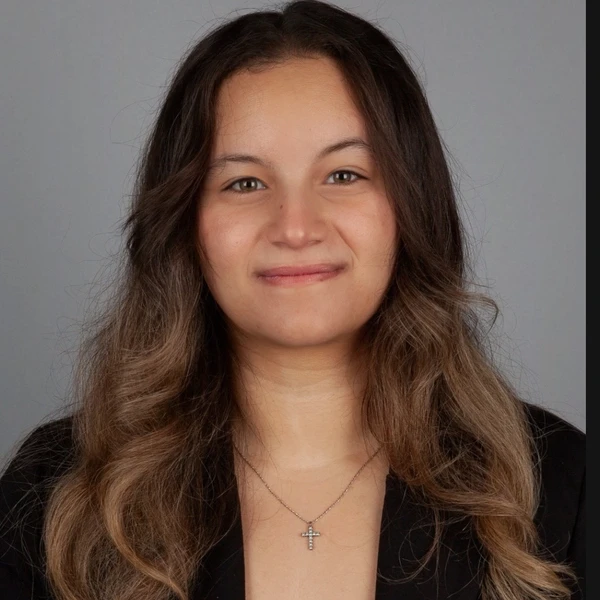
user profile avatar

Sarah Sarofim

1x

Finalist

Bio

As a Graduate Student Researcher at Eastern Michigan University, I focus on molecular signalling pathways in non-small cell lung cancer (NSCLC), investigating mechanisms that influence tumour survival, proliferation, and angiogenesis. My work contributes to understanding how receptor-mediated processes impact cancer progression, with a commitment to advancing biochemical research to improve healthcare outcomes. Building on my Bachelor of Science in Neuroscience from Eastern Michigan University, I am pursuing a Master's in Chemistry with a concentration in Pre-Medicine. My dedication to health equity also extends to community advocacy through ReachOut.MiddleEast, which I founded to connect individuals with mental health resources. My academic and professional journey reflects a strong emphasis on research, education, and service to bridge gaps in healthcare access.

Education

Eastern Michigan University

Bachelor's degree program
2021 - 2025
  • Majors:
    • Neurobiology and Neurosciences
  • GPA:
    3.5

Eastern Michigan University

Master's degree program
2021 - 2026
  • Majors:
    • Chemistry
  • GPA:
    3.8

Miscellaneous

  • Desired degree level:

    Doctoral degree program (PhD, MD, JD, etc.)

  • Graduate schools of interest:

    • Johns Hopkins University
  • Transfer schools of interest:

  • Majors of interest:

  • Planning to go to medical school
  • Career

    • Dream career field:

      • Medicine
    • Dream career goals:

    • Front Desk Assistant

      College of Health & Human Services
      2021 – 20221 year
    • Student Teacher

      Children’s Institute
      2022 – 20242 years
    • Medical Assistant

      Trinity Health
      2023 – 20252 years

    Sports

    Squash

    Club
    2017 – 20214 years

    Research

    • Biochemistry, Biophysics and Molecular Biology

      Eastern Michigan University — Student Researcher
      2025 – Present
    • Genetics

      Eastern Michigan University — Sole Student Researcher
      2021 – 2025

    Public services

    • Volunteering

      UPchieve — Tutor
      2025 – Present
    • Advocacy

      Reach out middle east — Founder
      2020 – Present
    • Volunteering

      7cups — Listener & Mentor
      2015 – Present
    • Volunteering

      Medical Seafarers — Medical Assistant\ EMT
      2025 – 2025

    Future Interests

    Advocacy

    Volunteering

    Christian Fitness Association General Scholarship
    One of the greatest challenges I have faced was when I had an unexpected medical emergency at school during a very challenging time of the school year. Until that time, I had never experienced anything like that before. It was unexpected, and there was nothing I could do to control my body at that time. The experience was not only physically challenging but also emotionally challenging. The aftermath of that experience was also challenging because I had to undergo various medical procedures and was unsure of the long term effects of this on my health. It was a time in my life when I was used to getting out of any challenge through hard work and dedication, but this was something I could not outwork or escape. After it, I was subjected to various tests. I then started having migraines quite frequently, even daily at times. It was hard to focus in class. Lighting, lectures, and stress would trigger my migraines. I was also dealing with a heavy academic course load in challenging science classes that demanded intense concentration and high performance. There were no breaks in exams for recovery, and research deadlines were fixed. I often found myself studying with nausea or trying to recall routes while dealing with a pounding headache. The most difficult aspect was that the struggle was invisible. On the outside, everything looked the same. I was the same student to my professors and classmates. However, inside I was struggling with fatigue, nausea, head pain, and the concern that my health could be unpredictable at any time. For someone interested in medicine, struggling with the unreliability of my own health was quite destabilizing. I attempted to simply push through without making any changes at first. I soon learned that this was an unrealistic solution. I learned that being resilient was not about ignoring the problem; it was about making changes to address it. I worked with healthcare professionals to better understand my symptoms and eliminate any serious possibilities. I tracked my migraines in terms of frequency, duration, and any potential causes that I could identify. This was more than simply trying to address my problem; it was about gaining control over something that felt out of my control at the time. I was able to recognize causes such as sleep deprivation, dehydration, and excessive stress levels. I made sure to take preventative measures to ensure that I was getting enough sleep, staying hydrated, and taking time to relax. Academically, I modified the way I studied. I began to study in shorter, more focused increments rather than trying to study for long periods of time. I made sure to take deliberate breaks and utilized active recall techniques to ensure that I was studying as efficiently as possible when my energy levels were low. I focused on high-yield information and made sure to plan ahead so that I wouldn't have to cram at the last minute, which made my symptoms worse. I also learned to be able to advocate for myself when the situation called for it, communicating in a way that was appropriate if a medical appointment conflicted with a class commitment. This was difficult for me at first because I have always prided myself on my independence, but it was a step towards maturity and humility. I started to realize that advocating for oneself is not a sign of weakness, but a sign of responsibility. Emotionally, this experience taught me to confront fear. There is an inherent fear that comes with not fully trusting your own body. I had to learn to be comfortable with uncertainty without letting that uncertainty dictate my actions. I had to surround myself with support systems such as mentors, and close friends, rather than becoming isolated. I spent more time with God and more time at church. Spiritually and personally, I developed patience and humility. I learned that my sense of self-worth could not be based on being productive or achieving good grades. Over time, I have been able to manage my symptoms better. The migraines occur less frequently, and the fear has diminished in its intensity. I have become more confident not because the fear has gone away, but because I have learned how to manage it. I have become more disciplined, adaptable, and resilient because of this experience. I have also become more empathetic because I have gained a personal understanding of what patients experience when they are suddenly beset by something beyond their control. I have come to realize that being a physician is not just about treating illnesses but also about being with the patient through the process of uncertainty. Ultimately, this experience has significantly impacted how I define what it means to be strong. I know that it does not mean ignoring what hurts or denying that something is wrong. I know it does not mean ignoring one's weaknesses and seeking help when one does not need it. I know it does not mean making drastic changes but failing to adjust one's course when necessary, no matter how much one wants to achieve a goal. I know it does not mean ignoring one's health, no matter how busy one is with school. Most importantly, I know that it does not mean that one is not capable just because they have been set back, it's their response to the set back that matters.